From MËRGIM KORÇA
Part Two
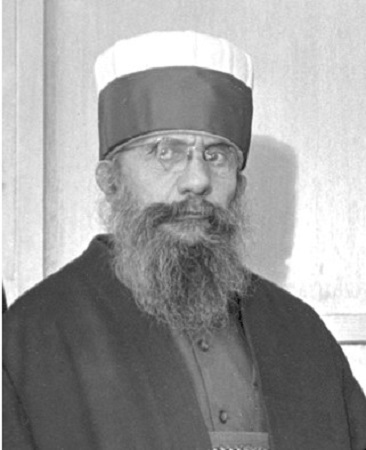
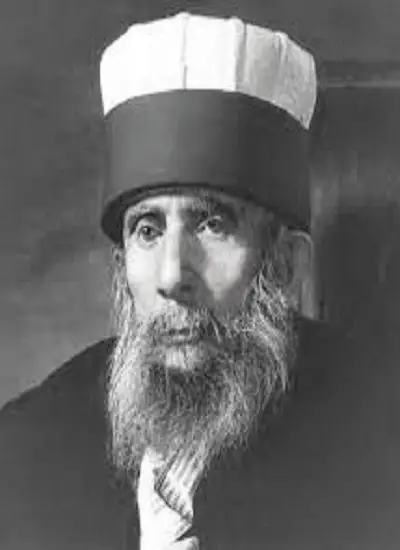
Memorie.al / I consider myself fortunate that as soon as we set foot on this blessed land of America, without delay we became acquainted with, and quickly befriended, one of the most distinguished personalities of our nation, His Grace, Baba Rexheb. We could hardly wait for the weekend to spend it with him, his sister, Aunt Zejnep, as well as all the friends and well-wishers of Baba who came to see him, to confide a trouble, or even to serve him and the Teqe. But the weekends were very far apart from each other, separated by seven days. Only when the phone would ring in the middle of the week, and Baba’s so dear voice would say to us: “Where are you, my sons? Come, for we have missed you.” And we, the next day, as soon as we got off work… straight to the Teqe! I remember those times that will never return, and honestly, my eyes have welled up with tears, and I cannot see the computer screen clearly as I try to write these memories. The only thing that comforts me is the fact that whenever I spent time with Baba, I tried and made use of the time that stubbornly slipped away, and I left no problem undiscussed with him, even if it meant going past Baba’s bedtime, which he respected fanatically.
Continued from the previous issue
Baba Rexheb smiled and replied: “Not at all, my daughter: All monotheistic faiths believe in the same God and pray to the same God, the One, the Magnificent, and the Most Merciful! Even the church where you prayed is His House; you did very well. You had neither a teqe nor a mosque where you could pray. And listen up, all of you,” he addressed us, “God is one and the same for all monotheistic believers, and it is only the so-called religious people who, for certain power-related purposes, sow division and confusion in people’s minds, preaching hatred among them.”
Throughout this context, I think a short pause is in order. The reader’s subconscious should analyze and process the presented facts and, necessarily, their interpretation through a mystical lens. Meanwhile, let us continue with the reader and address a more graspable, more tangible, and more real subject. Baba Rexheb, that living saint who suffered for the troubles of others and only suffered for them, also suffered deeply in his soul for himself: the communists accused him of having his hands stained with blood! And Baba would say: “It is unbelievable how deceptive political propaganda manages to find people it blinds to such a degree” – and he would suffer. And who suffered and for whom? Baba Rexheb suffered to save the soul of Bedri Spahiu, for whom Baba prayed to God to have mercy on him for his crimes!
Now let us leave aside the indoctrinated ones, that ignorant mass (as Baba Rexheb called them), whom we must (according to our great mystic) not only forgive, but also pray for. Let us deal, however briefly, with the other side, with those lovers of Baba Rexheb who, carried away by deep respect for his figure, fall into inaccurate statements. I have noticed in some publication how, while describing Baba Rexheb as an extreme patriot, during that time when the propaganda of the nationalists intertwined with the Slavo-communist one and the civil war instigated, started, and continuously fueled by the communists began, some author, to make the writing artistically appealing, says that Baba Rexheb, under those conditions, also took up arms… No. These claims, although I understand they are always made with a sense of elevation and goodwill towards Baba’s figure as a patriot, do not correspond to the truth, and only open the mouths of the ideological sycophants of Bedri Spahiu and Ramiz Alia and their companions even wider.
Now let us also leave aside the testimony of the protagonist himself, Baba Rexheb, about what he said regarding confrontations with the communists, and since we still have other contemporary witnesses, we allow ourselves the luxury of choosing among many witnesses the one who has even more than what one might say, and we refer to what Mr. Haki Gaba affirms, a devotee of the Teqe of Zall and Baba Rexheb’s companion at that time, with whom I have spoken dozens of times for hours on end. He recounted how, in those extremely dangerous times… we had no way of allowing Dervish Rexheb to go and move about alone and armed, as he was, into the thick of things. The Dervish was brave and his eye didn’t flinch; he would go and converse calmly with the people and elders, dripping honey from his mouth and convincing them to return to the path of patriotism and forget the international of Miladin and Dushan. But how could we trust the devilish communists who were lying in wait for the Dervish? And then, how could we have the face to appear before Baba Selim? So we, like a Ballist band, accompanied and protected our Dervish like the apple of our eye whenever he moved in the Gjirokastra area.
Baba Rexheb’s contemporaries also recount a highly significant fact. It was mid-1943. Dervish Ahmeti from Tërbaçi of Vlorë came to the Teqe of Zall. He had a rifle on his shoulder because he had joined the national-liberation forces and taken to the mountains. He had come to the Teqe to urge Dervish Rexheb to follow his example. Dervish Rexheb looked him in the eye and said: “How can you tell me, Dervish Ahmet, to come with you, when you have a gun on your shoulder? The gun is not for us!” (I will treat the event up to this point, as it sheds light on Dervish Rexheb’s stance; the reader is not interested in us straying from the main topic to later discuss the fate of Baba Ahmeti, who was interned in labor camps by the regime he had taken up arms against, contrary to the rules of his tariqa). The fact is that later, when fratricide, instigated by the communists, reached such proportions that it could no longer be stopped, Dervish Rexheb left at the end of 1943 and went to Tirana, and then to Shkodër, from where, at the end of November 1944, he also left Albania.
After this not uninteresting interlude, we continue to follow Baba Rexheb along the paths of his mysticism, trying to understand him. I can state wholeheartedly that when Baba Rexheb began to address the sharpest problems that have clouded the human mind since the beginnings of this society, such as questions about the existence of God and so forth, with his sweet speech grounded in rigorous logic, he would captivate you without you realizing it and lift you into flight with him to timeless and simultaneously extraterrestrial levels. Billions of people live on earth, Baba Rexheb would say, but how many of these are spiritually alive? And right after this rhetorical question, he would add the assertion… egoism does not allow man to become one with God. The ego, and only the ego, separates man from God. He considered egoism a severe moral and social disease. Baba asserted that… egoism is like a high mountain that rises right before our eyes and prevents us from seeing beyond.
If we manage to climb this mountain to its peak, with effort and daily sacrifices of a self-denying level, only then will we see that God appears before us, in all His majesty! The mystery that surrounds God and makes Him invisible to us is nothing other than human egoism! So whoever looks at himself and falls in love with himself will never be able to see God!
But the other famous mystic, Padre Pio, how did he confront the concept of the impossibility of seeing God? One day his close friend Agide Finardi asked him this question, and Padre Pio replied: “For those who love, earth and heaven unite”! And when he saw that his friend remained somewhat confused, Padre Pio added: “But for these to unite, and thus for you to see God, you must love everyone and always, except yourself”!
Padre Pio tried to deeply instill this concept into the consciences of young couples getting married. When he united two young people in marriage, he would tell them: “Before you bind yourselves inseparably, think carefully: what you want to create today, the family, is sacred. Love one another, and melted into one in this love, love God, the Creator of the Universe, for He then gives you the possibility of renewal. Analyze and cleanse your conscience every day, repenting for the things you should not have done. The devil will try to sow jealousy between you. Fight it with mutual love. Never look at the other’s faults; look at and correct your own, and keep in mind that if you do not know how to forgive others, no one will forgive you! Only in this way will love for one another, love for your neighbor, and love in God conquer evil and, day by day, advance you towards God”!
Baba Rexheb also imparted these same concepts to young people, adding: “Nobility is to confront evil with good, but keep in mind that hoping to be rewarded for the good deeds you have done and the gifts you have given is nothing but trade. And with God, you do not do trade!” Mother Teresa expressed the same concepts but in somewhat different words. She said: “The moment a person understands that he is a sinner and needs his sins to be forgiven, he begins to find it easier to forgive others. But keep in mind that without forgiveness and without love, there can be no life…!” When reading the admonitions of Padre Pio given to young people regarding daily analysis and repentance to draw closer to God, it is understood without any doubt that following this advice leads to the cleansing of the conscience and also to its further preservation from mistakes.
Adding here also the admonitions of Mother Teresa, we cannot help but draw a parallel and recall Baba Rexheb’s saying: “Great people have outwardly visible behaviors that are entirely moral, while their invisible behaviors are examples of morality!” You read this statement and nothing is unclear; on the contrary. You reread it slowly and you see that the first part of the statement has great expressive force, but when you get to the second part, a field as wide and infinite as analysis opens up before you, starting with yourself. Then you understand that the statements, whether of Padre Pio or Mother Teresa, if applied, place a person in a circle within which anyone who enters with conviction and full conscience will undoubtedly, over time, become close to God! And for those who become close to God, Baba Rexheb would say: “God guides them. They become like that pen which truly writes, but is guided by the hand and mind of the Writer”!
With the opening of Albania, newcomers began to come to the teqe more and more frequently, and among them there were necessarily also former communists. One day, a person who had held a leadership position in a central department and was known for being harsh in the development of the class struggle in the sector he directed in Albania, comes and even kisses Baba Rexheb’s hand. After he leaves, one of Baba Rexheb’s old believers and friends, who had fled Albania with him in 1944, says to Baba: “You are strong, Baba. These people who would put you and me in their grip, flay us alive, and, by God, he has come to the teqe, showing humility and kissing your hand – have they made a turn and repented for what they did?”
Baba looked at him with his sweet smile and calmly replied: “We are both right, both you and I. But my philosophy is to have mercy, to forgive, and, if possible, to bring them back to the right path of God. And keep in mind that you have known me for fifty-some years now, during which my Bektashi principle has always been to try to ripen the unripe and to preserve the ripe so that they don’t become unripe. Therefore, I act as befits me, then I leave it to time, I follow them on their path, and I pray for them. Time, then, is the judge of whether they have repented and turned back or not. This is also the reason my teqe is open to everyone.”
After taking a pause, Baba continued: “If we were not to act in this way, what would the communists think? ‘These ones are just like us,’ they would say. Just as we have behaved towards them, so they are behaving towards us. But we must put their minds to work, to compare our behavior with what Enver Hoxha imposed on them, and draw their own conclusions! When they themselves understand, without our pushing, how wrong they were and how badly they acted, then our mission before God will have borne its fruit, because we will have turned a lost conscience back to the path of God with full and free faith!”
As I wrote these lines, I tried to identify with you, dear readers, thinking how, hand in hand, as you progressed with the reading, you first joined with Baba’s friend because you were inevitably disgusted by the hypocritical behavior of the former cadre of the communist party, weren’t you? I emphasize this fact with conviction because there are three possibilities, and no more: if you are impartial, his behavior disgusts you, because it is the attitude of a man without personality. On the other hand, if you are among those who have condemned the violence of the dictatorial power as unjust and inhuman, like all violence, it is absolutely clear how you have judged his behavior. But even if you still hold communist convictions today, undoubtedly such behavior by a former colleague and comrade from the same barricade makes you feel bad, or am I wrong?
However, I think that then the first two categories of readers cannot help but agree with the line of reasoning and, necessarily, with Baba Rexheb’s positioning in the given circumstances. But you, gentlemen of the third category (excluding those who lack human feeling and the minimum of rational logic, and are guided solely by the spirit of prejudiced opposition to everything), do you not also join with the great lesson that the great mystic Baba Rexheb gives us on this occasion? Some of you may not admit it out loud (even though he too feels it deep in his conscience), but most of you will acknowledge that that party current which had filled their minds with the idea that Baba Rexheb was an enemy with blood-stained hands was nothing but low slander that could not in the least tarnish the grand figure of this mystic of gigantic proportions! So the lie told and repeated since the now distant year 1943, concerning Baba Rexheb, continues even today and is still a lie.
There is no doubt about that. But what is of great importance regarding the notion of time as a philosophical notion is the truth, which, as long as it comes to light, must also be affirmed by the one who feels it – that is, by the honest person! Do we have concrete examples? Yes. I will bring you a truth as typical as it is meaningful: they had been classmates, idealistic friends, and comrades-in-arms in the mountains as partisans, Selfixhe (Ciu) Broja and Nexhmije (Xhuglini) Hoxha. The second, to this very day, passionately defends the good old days and the good things the people had and enjoyed during the dictatorship. While Mrs. Broja writes her memoirs and states: “But we?… Ah, we…! We who contributed to bringing about this era, we have nothing left but a can of kerosene in our hand, to go to the city center and, seeking forgiveness from the people, set ourselves on fire.” (Page 344, Selfixhe Broja, “Tallazet e Jetës” [The Waves of Life]; T. Globus R. 1998, Tirana). This statement is tragic. It is true. But it is an honest statement of truth when its time came.
But what feelings would Nexhmije Hoxha’s statement arouse in Baba Rexheb? It would prompt him to pray and pray a lot for her devilish soul, that God might have mercy on her! Despite having expanded somewhat in treating this point, we will not now forget the parallel of the influences that the teachings of the mystics we are covering have. Regarding the figure of Padre Pio, by 1929 several benevolent books had been published, but also a multitude of writings to and from the Vatican, with slander and malice towards him. While the Padre, unshaken in his faith in God, continued to pray to God for people. At this time, Emanuele Brunatto and his friend Francesco Morcaldi prepared a book simply with documents and facsimiles taken from their collaboration with Monsignor Bevilacqua during the investigations carried out against the clergy of Manfredonia, which brought to light all the deceptions, lies, and slanders with which the documentation of the war against Padre Pio had been assembled. This book would bring to light all the rottenness hidden behind the war that certain circles of people in the Vatican were waging against Padre Pio.
On the other hand, these lovers of Padre Pio knew very well and had stated that if Padre Pio found out what they had prepared, he would never allow them to distribute the book. But the unbelievable happened. Suddenly and unexpectedly, another book on Padre Pio was published, titled “Padre Pio of Pietrelcina, Messenger of God.” The commotion caused throughout Italy, and even further, was great. This was because the author of the book was Alberto del Fante, a man well-known as a Mason and an atheist, and at the same time well-known for his writings in the newspaper “Italia laica,” where he had frequently attacked Padre Pio, labeling him a deceiver and a trickster adept at pulling the wool over the eyes of naive people ready to be led by the nose and enthused!
But then something extraordinary had happened in Del Fante’s life. A nephew of his, to whom he was much attached, little Enrico, fell so gravely ill that medicine had lost all hope for him. Then his parents turned to Padre Pio, who promised them that he would pray to God for him, and that they should not worry, for God would help them. And indeed, the unexpected happened, the miracle: the boy’s health returned, and gradually he improved until he was completely healed! To the thanks that the boy’s family gave to Padre Pio, he would reply: “Do not thank me; I only pray to God. Miracles are performed by Him, not by me!”
In this interweaving of facts experienced by contemporaries and also documented, we follow the two parallel lines of our two great mystics: Baba Rexheb, with his attitude towards atheists, was a living reflection of the great example of which direction was to be followed and which path had been wrong! And how did Padre Pio influence Alberto Del Fante? I believe no one needs an explanation; the facts speak for themselves.
And to completely button up the comparison of the two mystics, we continue with the following event:
One day I asked Baba Rexheb and told him that I had happened to speak with many people, and some said that after so many years of marriage, without having children, they had prayed to you, Baba Rexheb, and after you prayed for them, it wasn’t long before God blessed them with a child. Not to mention Asllani and his wife Shazo, when the misfortune happened and their 17-year-old son (the youngest of their children) was killed in a car accident, and they went mad with grief; by God, you consoled them, telling them not to overdo the crying and wailing because it was rebellion against God’s will, and you added, as they themselves affirm: “Don’t carry on like this, for you will sin. You will see that after a year, God will replace your loss with a son, Hysen.” (And indeed, within the year, God blessed them with a son, whose name they didn’t have to choose – Baba Rexheb himself had chosen it!) I also continued telling Baba how there were many people who affirmed that they had been sick, doctors couldn’t find a cure, you had prayed for them, and they were healed. From these two proven facts, I had heard dozens of similar cases. How does it stand, I asked Baba, did he truly have extraordinary powers?
Baba smiled and said to me: “No, son, I am just like each of you; I pray to God. The only difference is that I practically pray all day long, when I am not occupied with some work. Then it is in God’s hands whether He listens to my prayer or not. In these cases, God listened to my prayer and did it for them. So forget about my so-called miracles; I only pray to God, as do you, and I have no other power. Miracles are performed only by God!” The essence of Baba Rexheb’s mysticism was: to fight and overcome egoism. In every teaching of his, in every piece of advice he gave, in every example he brought, as he dissected them with such beauty of expression and comparison, and with persuasive force, they all led you to the same conclusion: narcissism (being in love with oneself) is the basis of all the evils of this world. Egoism. This pronounced phenomenon of narcissists has nourished and given stature throughout the centuries to tyrants and dictators, and then, in their wake, to all those unfortunates who know not how to love anyone but themselves, let alone sacrifice themselves for another!
Baba Rexheb emphasized: “If he does not eliminate egoism, man cannot see the Great God, the Creator, the Most Merciful of the Universe.” He was very keen to bring an example with which he showed that to break down the wall that people have before their eyes, which is egoism, they must become one with God, believe in Him, and love Him unconditionally, with complete and unquestioning faith. With this example, Professor Frances Trix also ends the last paragraph of her work on Baba Rexheb. She has stated: “Twenty years ago, I read Baba Rexheb’s work as a study book; now I read his phrases, although under Baba Rexheb’s guidance I understand them, but I still return to the reading because… something slips away from me of his fine philosophy. For example, when Baba explains to me the famous, inaccessible theory of Ghazali on ‘marifet’ (gnosis), he, as if unintentionally, gives you a deep philosophical lesson on the three degrees of faith, which are ‘the faith of people inclined to believe,’ who believe even just by praying; the faith of those who arrive at the same conclusion as the former but only after it results from ‘their own deduction’; and finally, ‘the faith of the arifs (the distinguished ones), who, on the path to God, see God Himself with their own eyes! These are endowed by God with ‘Ilmi Ledun’ (Divine Science).”
Now we come to the example that Baba Rexheb used regarding becoming one with God by believing unconditionally in the spiritual guide, a story that left a deep mark on Professor Trix. Baba recounted the event between the famous mystic Jalal ad-Din Rumi and his spiritual disciple, Shams-e Tabrizi: One day, the disciple goes to meet his teacher, but he had just left the house. Everywhere the disciple went, he saw his teacher, and as soon as he approached him, the teacher would disappear into the winding alleys. Finally, the disciple sees the master entering a house and follows him. He looks for him inside the house but doesn’t see him; then he goes up the stairs and still doesn’t see him. Finally, he has no choice but to go out onto the flat roof of the building, and since even there his murshid had disappeared, he throws himself off the roof, but he does not fall to the ground to his death because… the teacher catches him in his arms!
And Professor Trix places precisely this event as the epilogue of her work on Baba Rexheb, drawing an analogy with her: whenever she could not follow Baba through the labyrinths of Islamic mystical philosophy, He was always found beside her! Comparing the division that humanistic philosophy makes among people, based on their inclination to believe or not, and comparing this with the categorization made by mystical philosophy, where the initial differences between assertions later lead to fundamental differences in subsequent interpretation, Baba Rexheb pointed out how even in the artistic field this difference was clearly visible. He would take and compare verses written with passion by a lyric poet, and moreover necessarily a believer, confronting them with verses written by a mystical poet, but on the same theme.
And Baba would say: “Look at the fundamental difference in the understanding of the circumstance. Where does this stem from? The mystical poet has lived the given circumstance through the inspiration that comes from his spiritual guide. Whereas the lyric poet, what does he do? He describes an imagined circumstance; that is, he commits sophistry!” After exchanging all this information with the reader, combing through facts and viewpoints of Baba Rexheb, this colossus of Bektashi mystical philosophy, analyzed also through the lens of two major characters of mysticism and the Christian faith, Mother Teresa and Padre Pio, I deem it appropriate to also make their synthesis.
With their earthly behavior of self-denial, unconditional love for others, and total devotion to the Creator of the Universe, they ascended day by day, while alive, along three colossal pillars raised from three corners of the globe (Detroit, Calcutta, and Pietrelcina), with a direction of concentricity, straight towards the heavenly infinity, from where they had surpassed the limits of egoism. From up there, united as monotheists, they contemplate God, give us their personal example, and pray for us. Even today, from eternity, they invite us along the path they traversed, which is an example of virtue, morality, human love, and union with God… and they continue to pray for us! / Memorie.al