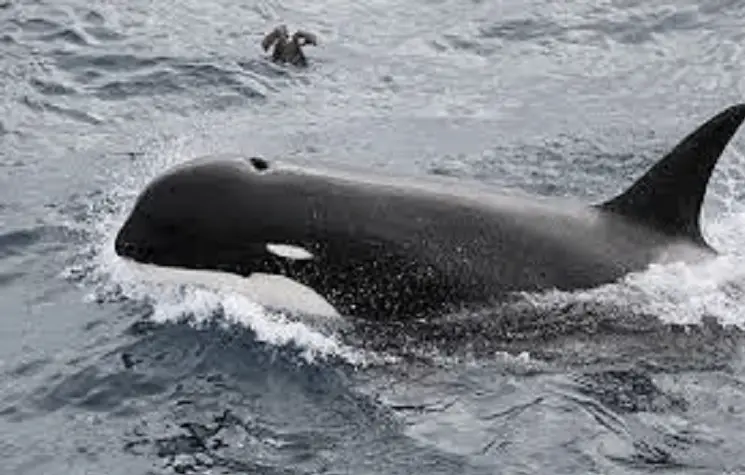
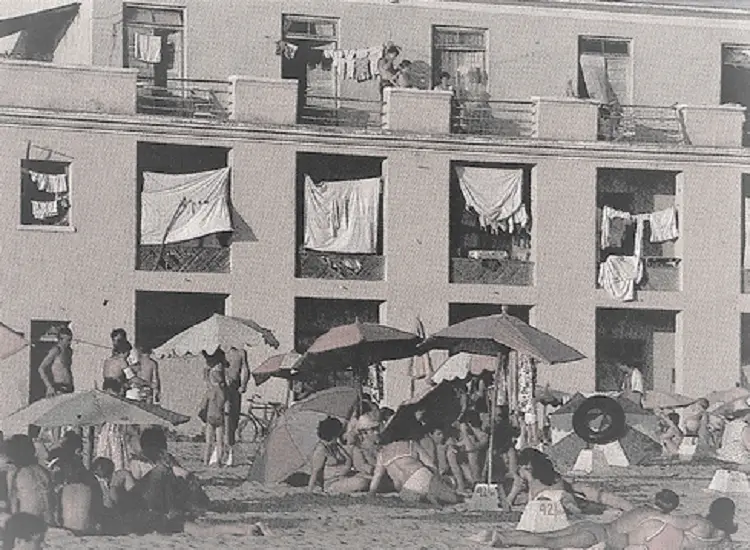
Memorie.al /This year marks 64 years since the time when giant whales visited the coast of Durrës, which got stranded in the shallows and could not return from where they had come. Those days, Durrës turned into a pilgrimage site, as citizens from many parts of Albania flocked to see the sea mammals that had lost their way and ended up under the knives of Albanian butchers, and then in workshops producing candles and oil. The old residents of Durrës remember that time as something extraordinary. They recall how schoolchildren, accompanied by their biology and zoology teachers, went to see the giant whales.
They also remember that to bring the whales ashore, a painstaking and voluminous task was carried out due to their extraordinary size and weight. Everything was done under conditions lacking modern loading and unloading equipment, as it was the year 1958.
The whales were tied with ropes and hawsers and pulled by fishing boats until they were brought ashore. Then a solution was found as to what would be done with them. Butchers from Durrës, Tirana, and Kavaja were mobilized, who for days on end cut up the whales, chopping them into pieces, until only their skeletons remained.
Meanwhile, citizens from Tirana, Elbasan, Berat, Shkodra, and other places came to Durrës every day to see the sea mammals. The elderly remember that in those days in Durrës, nothing else was discussed except the whales. Professors from the University of Tirana were present in Durrës for days on end. They conducted their studies and kept numerous notes. Moreover, they took one of the skeletons and sent it to the capital.
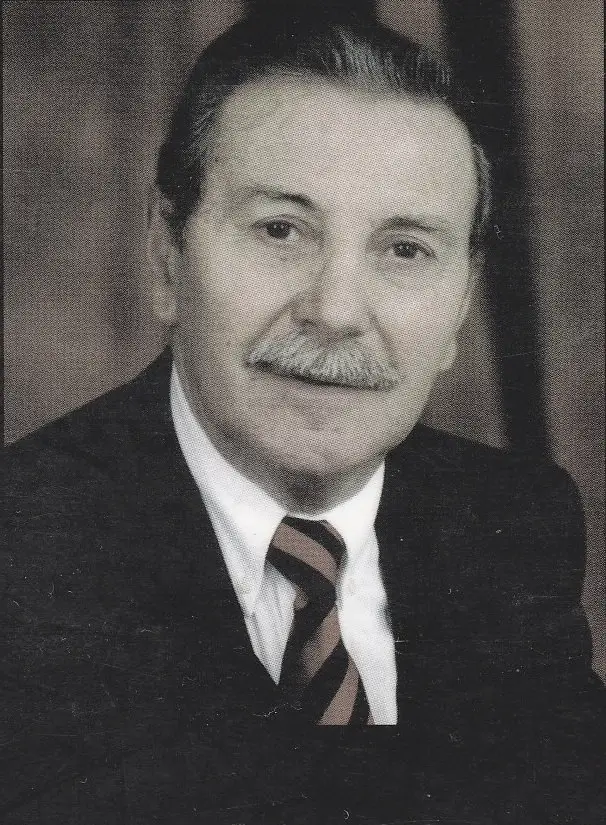
The skeleton was placed in the Museum of Natural Sciences in Tirana. Daut Hoxha, an old teacher in Durrës, remembers that time and says that the appearance of the whales was an unusual event that attracted great attention. He is now 87 years old and recalls that in Durrës there was enthusiasm and wonder not only for the stranding of the whales but also for the influx of visitors coming from many cities of the country.
How does Daut Hoxha remember this event?
“The day when news spread about the whales seen on the Durrës coast, I had just returned from a service I had performed in Tirana. As I remember, it was October 1958. The weather was warm that autumn because I recall I was dressed lightly. A friend of mine told me that a fishing boat, while returning from hunting, had encountered several whales near the coast.
It seemed like something unbelievable. The fishermen were initially frightened when they saw the giant animals, but then they realized they were dealing with whales. They had radioed about their existence near the coast. There was no doubt that the whales had lost their way and mistakenly entered the Mediterranean, then the Ionian and Adriatic Seas.”
How did they come ashore?
“The whales followed the fishing boat as it sailed to enter the port and got stuck in the sea sand, unable to turn back. There were 8 whales that got stranded in the shallows. They move in schools, and this was considered by the professors of the time to be a family of 8 members.”
And then what was done with them?
“The whales got stranded in the sea lane used by small vessels and fishing boats when entering and leaving the port, so it was decided that they had to be removed from there, as they were obstructing the ships, becoming a serious obstacle. Specialists, fishing boat captains, and experienced fishermen went and saw the situation up close.
It was proposed that they be pulled with ropes or sea hawsers. Meanwhile, the whales, having been stranded in the shallows, had died. The location, more or less where a sunken Greek steamship had once been, was reached with pilotage equipment.
Then the whales were pierced with harpoons and hook-shaped devices, tied with fishing ropes, and pulled to the shore, right where the Fishing Port was located at that time. Today, the ferry terminal stands on that spot.
At that time, the quay had not yet been built, and the fishing port ended at the coastline. To bring the giant animals ashore required a great deal of work, as the ships could only go as far as they could navigate. A large volume of work was done by hand, by pulling.”
How do you remember the moment when you saw the whales with your own eyes?
“It was a surprise. We see a dolphin or a turtle coming ashore and we are amazed and curious to look at them – imagine whales. They were giant animals. They were 10-12 meters long, and each of them weighed from 40 to 50 quintals (4,000-5,000 kg).
But the most beautiful thing was when the professors coming from Tirana told us that these belong to the smaller species of whales, because there are other types that are even larger, twice the size of these that had appeared in Durrës. These were the measurements taken by the professors who came from Tirana.
I remember that Professor Tahir Haxhihyseni came to Durrës, as well as another with the surname Demneri. They took this matter seriously. It was said that these whales were called ‘sperm whales’. Together with my friends, we went several times to see them. It was said that there were two reasons why the whales had ended up in the Adriatic.
The first reason was that they had followed schools of fish they fed on, which caused them to lose their way. The second reason was more scientific. Since this species of whale lives in the Atlantic Ocean, the family of 8 members might have mistaken their way by following sea currents and inadvertently passed through the Strait of Gibraltar, entering the Mediterranean, and then the Ionian and Adriatic.”
The whales were brought ashore at the fishing port, and the Directorate of Fisheries was put in charge of this operation. At that time, the director of fisheries was Jani Fullani, the father of the former governor of the Bank of Albania, Ardian Fullani. Fisheries took care not only of bringing them ashore but also of the work that followed.
What happened next?
“At the fisheries of the time, there was an influx of visitors. I remember that a security cordon was set up to prevent people from contacting these giant animals. The schoolchildren of Durrës, under the guidance of their Biology and Zoology teachers, went and saw the whales, considering these visits as part of the learning process. Meanwhile, visitors from Tirana, Elbasan, Berat, Shkodra, etc., flocked to Durrës to see them.”
What was done afterwards with the whales?
“After they were brought ashore, they thought about removing them from there, as the decomposition process had begun and a strong smell started to be noticeable. Butchers were called to the scene. A considerable number of them from Durrës, Tirana, and Kavaja, with knives and cleavers in their hands, worked for several days in a row at the fishing port. They were engaged in cutting and chopping up the whales. Consider about 40 tons of whale meat that had to be chopped by hand. There were no other tools.”
Where did all that mass of whale meat and blubber go?
“I don’t know exactly what use was made of that large mass of meat and fat. It was said that it ended up at the ‘Ernest Telman’ Extract-Tannin Factory in Vlorë, to be turned into oil and paraffin for producing candles. I remember it as one of the unusual events of my life.”/Memorie.al