
By Imam Muhamed Sytari
Part One
Memorie.al / I will begin my study with the prayer of the distinguished scholar from Shkodër, Hafiz Ali Kraja (1900–1973), published in his book *”Should Religion Exist, Does It Hinder National Unity?”* in which he writes: “I pray to the Almighty God to protect the Albanian people from sectarianism, which is a dangerous abyss for the nation and the homeland! Amen.” Reading carefully through the winding paths of our national history, I believe this is one of the most important prayers with which Albanians should have been equipped in their past, and especially in the present, to escape the “dangerous abysses” into which they have often fallen, witnessing moments that are far from pleasant, often even tragic, especially in the last 100 years of that history.
Over the centuries, the contribution of the distinguished imams and hodjas of Shkodër and of all Albania, in the direction of educating generations with faith in one God, with comprehensive knowledge, with dedication in life, with interfaith harmony and tolerance, and with the will to serve for the good of the common homeland, has been vital and of great value.
Browsing through published and unpublished documents, old manuscripts, and archival traces left by them, makes us believe and say with full mouths that the contribution of our learned hodjas lies at the foundations of the formation of an Albanian society that is civilized, knowledgeable, and deeply believing. Allow me to develop this study through concrete examples from the life and work of our gentlemen, the honored Hodjas of Shkodër.
In 1869, the distinguished scholar from Shkodër, Daut Boriçi-zade (1825–1896), in his book “Albanian Primer,” wrote that: “The Albanian, with the method of letters I have indicated in the Albanian alphabet, can within a short time write his own language”! In 1875, he wrote another: “Albanian Primer with Arabic Letters.” Researchers of Albanian primers inform us that: “Daut Boriçi entered the role of a luminary as a didactician, as a textbook writer, and as an organizer of popular education. He took in the North the corner of the trinomial that had previously been completed by Naum in the South and Kristoforidhi in the center of Albania.”
The Albanian alphabet with Arabic letters naturally reflects the natural Islamic religious orientation of this distinguished scholar, which in reality was the orientation of the majority of the Albanian population and the trend of the time.
“If the supporters of the Latin alphabet emphasized a European identity, an Albanian identity, and a distinction from the Turks, what was the position of the partisans of the Arabic alphabet? What is immediately noted is that the first identity they emphasized was the Muslim religious identity. In fact, the Arabic alphabet was inextricably linked with the spirit of the Qur’an…”
In his 1869 primer (to which I have personally contributed to the transcription of some sentences, in service of the work of two researchers, Shefik Osmani and Njazi Kazazi), Daut Boriçi gives some valuable advice in the form of messages, such as: “Do not remain idle, Go to school, Do not wait, Listen to good advice, When you speak, think; Do not lie, etc.” As he also instructs: “in an imperative manner: Start writing in Albanian!”
During my research, I have also found written in the hand of this learned man many wisdoms that hold value in the life of Albanians, such as: “Writing remains in the book, while the author dissolves into the earth,” “Learn, O son, for ignorance is shame. Only a donkey accepts it,” “The Messenger of Allah (peace be upon him) said: He who dies on the path of seeking knowledge dies a martyr,” etc.
This learned man demonstrates his example of modesty even in the personal notes found in the books of his library, in which I have also found this note: “It was registered in the network of my possessions, while I am the poor one to the Only One, the Shkodran, Boriçi-zade Daud, son of Haxhi Mustafa. May He forgive both! Year 260 H.” Seal.
Even today, we do not know of any school or educational institution in Shkodër, or beyond, that bears the honored name of this scholar and esteemed educator, whose traces make even us feel proud.
The path of Daut Boriçi, in writing Albanian with Arabic letters – at a time when these were the letters used to write the language of the most powerful empire in the world – was also followed by other honored hodjas of Shkodër and beyond.
Among them I want to mention Hafiz Jusuf Këlmedi (1876–1943), who left behind a small book of “Albanian Ilahis” (hymns), inside which it is explained that they are: “Arranged by Haxhi Hafiz Jusuf Këlmedi, Imam of the Lower Perash Mosque, in Shkodër.” 32 pages, without year or place of publication. It consists of five ilahis in the Albanian language with Arabic script and contains 343 verses, divided into 171 stanzas and one verse.
In some of his ilahis, he urges purity from sins by promoting pure Islamic morality: “Be pure, O servant – from sins you shall be saved / you must die and enter the grave – there repentance will be of no use.” He prays for our salvation from all enemies, saying: “O Lord, have mercy on us – for the sake of peace be upon him / Grant us safety – all of us, the people of Islam / I, the wretched one, a stranger – my name is Haxhi Jusuf / Make our enemies disgraced – always leave them in regret.”
The contribution of our hodjas to the building of a society full of virtues of faith, knowledge, and deepening in various sciences is numerous. It is enough that when the hodjas of Shkodër are mentioned, the mind immediately goes to the many libraries with countless books, in various sciences and endless knowledge.
When speaking of the Bazaar Madrasa in Shkodër, it is said that it was: “an old center where religion, Islamic culture, and patriotism were taught… This madrasa had a rich library with religious, literary, and scientific works…”!
Theodor Ippen (1861–1935), Consul General of the Austro-Hungarian monarchy in Shkodër during the years 1897–1904, recalls in his studies that: “In the Bazaar there is a theological school, a madrasa, which consists of a main building, several elegant but neglected kiosks, and a separate building for the library.” Researchers write: “It is known that here in Shkodër there are more than 25,000 (twenty-five thousand volumes in the classical oriental languages alone).”
We recall Jusuf Tabaku (1797–1904), whose library is said to have “had around 2,000 books inventoried and stamped with the corresponding label.” Studies and publications testify to the grandeur of this library, appreciating its enrichment with various books from different sciences and fields, in various languages.
“Our libraries some time ago were not like today’s. They did not have the order of these modern ones, and they could not be valued as much as these of today…! We are listing below the Mohammedan libraries found in Shkodër… according to their importance: 1. The ‘Kllëçi’ Library… 2. The ‘Vakf’ Library… 3. The ‘Myftija’ Library… 4. Other private libraries…”
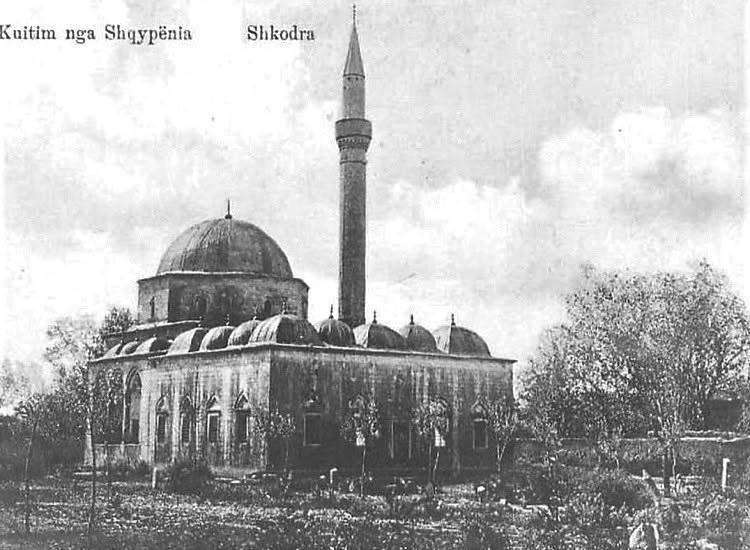
“The private library that today attracts the greatest admiration among the old, among clerics, scholars, and many tourists who deal with the appreciation of oriental objects, is the one built here about 200 years ago, installed for the first time near the castle, and today near the Lead Mosque in Qafë: called the ‘Kllëçi’ Library after the surname of its founder (Hasan eff. Kllëçi)… Hasan eff. Kllëçi was a judge in Shkodër and one of our first hafizes… Today the ‘Kllëçi’ Library exceeds the number of 2,000 (two thousand) volumes, all in good condition…”
A good part of these books are testified to have been written by hand, copied from originals. For this, I have found some notes in his handwriting, where it is noted: “Possessor by means of writing, Jusufi Siddik, Lecturer and Mufti of the city of Shkodër. May (God) forgive him.” This note is accompanied by his personal seal.
In one of these books, copied in the handwriting of His Grace, it is written: “Written by Jusufi Siddik, Lecturer and Mufti of Shkodër. May Allah forgive him and his parents? 26 Shawwal 1286, Saturday night, after evening.”
Unfortunately, the medieval blood in the veins of shadow-people caused that in late 1998, the house where these books rested, after a long agony under the graces of the communist system, burned down entirely, thus burning one of the most precious treasures of culture and ancient knowledge in Shkodër – the library of Jusuf eff. Tabaku…! Because it is in the nature of shadow-people to steal, burn, and destroy books and libraries; they can never coexist with one another!
Here comes to mind the bitter account of the old Hodja Hafiz Musa Hoxha (1926 – living), who, while telling about the painful moment of the confiscation of the books he possessed, says: “They took four quintals of books from me, although I tried to hide some…! When they burned the books of my library, I stood before the village; I managed to save these pieces…! I was telling people: Help me save my books..!”
There is no doubt that anyone who has read even a little about the hodjas of Shkodër has verified their attachment to books and knowledge, so much so that in the notes of Hasan eff. Podgorica, from whom Hafiz Halid Bushati received his authorization (ijazah) – who was the mentor of Hafiz Jusuf Këlmedi – I have found this marginal note, in Arabic: As-Sayyid Ash-Sharif Al-Jurjani said to Imam Taftazani, in verse:
“Do not refuse a book that is requested on loan,
Stinginess for a person is shame!
Have you not heard the hadith that is transmitted?
The reward of stinginess with Allah is fire!?”
Imam Taftazani replied in verse:
“O you seeker of books, leave me,
For lending a beloved is shame!
My beloved in this world is the book,
Have you ever seen a beloved being lent!?”
We recall Hafiz Ibrahim Repishti (1882–1943), about whose library it is written that: “he counted about 2,000 volumes, among which there were unique copies of books…” / Memorie.al
To be continued in the next issue