




From DASHNOR KALOÇI
Part One
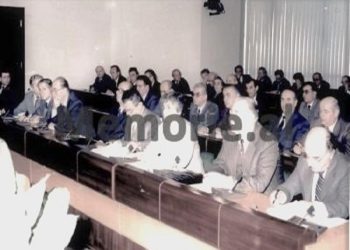
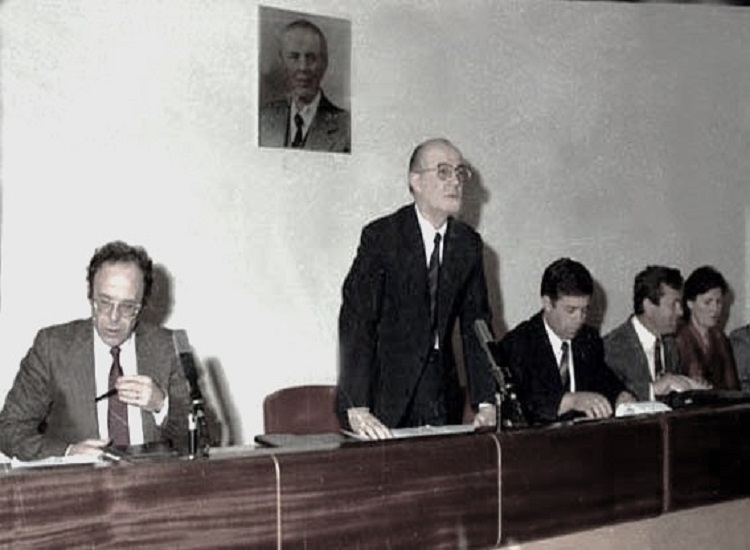
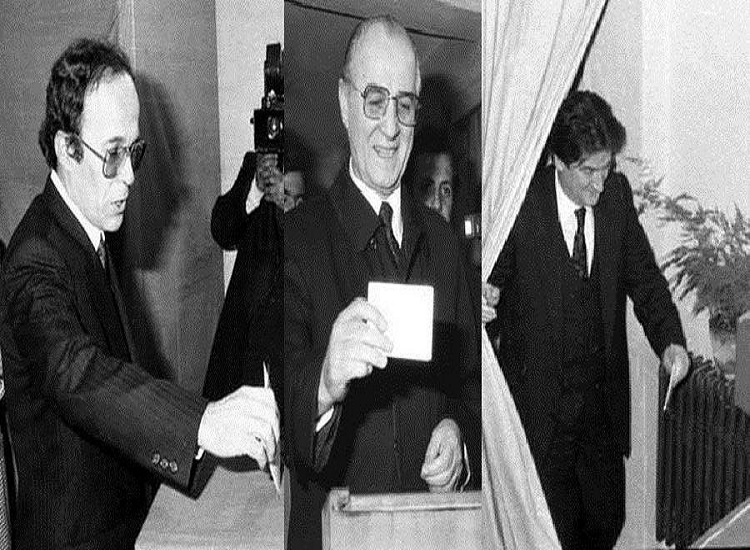
Memorie.al / Just ten days had passed since the first pluralist elections of March 31, and the two main political forces, the Party of Labour and the Democratic Party, along with their allies, which had emerged from those elections, were on the verge of opening the first pluralist People’s Assembly. On April 11, 1991, the Political Bureau of the Central Committee of the Party of Labour of Albania, led by its General Secretary Ramiz Alia (who also held the post of Chairman of the Presidium of the People’s Assembly of the Socialist People’s Republic of Albania), held a lengthy meeting. Besides the events of April 2 in the city of Shkodër, which were the first item on the agenda, the meeting also discussed the problems arising with the opening of the first session of the first pluralist Parliament. This was an extremely unusual event, as it was happening for the first time after 45 years of rule by the communist regime of Enver Hoxha and his successor, Ramiz Alia.
As we shall see from the minutes of this meeting of the Political Bureau of the Central Committee of the PPSH, several of the most radical problems of the political drama that Albania was undergoing in the spring of 1991 were examined and discussed there. These documents clearly reveal the behind-the-scenes machinations of the communist power in force, led by Ramiz Alia, who was in its final throes and facing its inevitable fall, while also dealing with bloody events such as those of April 2 in Shkodër, as well as the unfamiliar challenges of political pluralism.
In light of the above, this archival document sheds light on three key issues that were agitating the country’s leadership circle in those critical days. The most interesting part concerns the political “architecture” that the PPSH was projecting for the new Assembly, which included 54 agronomists and 35 doctors. The discussions on the division of parliamentary commissions, the study of the Bulgarian experience, the proposal of new figures such as Kastriot Islami to head the parliament, and the preparations for confronting the new opposition (the Democratic Party) clearly reveal all the efforts and démarches that the still-ruling PPSH was making, as it tried to maintain control of power through constitutional procedures and parliamentary diplomacy.
The document in question is published in full, preserving all the dynamics of the speeches, the terminology of the time, and the interventions of the members of the Political Bureau, starting with its head, Ramiz Alia, and then Xhelil Gjoni, Adil Çarçani, Hekuran Isai, Spiro Dede, and others. Equally interesting are the discussions of the highest leaders of the PPSH, not only regarding the names of their own political force that they were selecting to head the government, constitutional institutions, or parliamentary groups and commissions – such as Fatos Nano, Haxhi Lleshi, Llambi Gegprifti, Ismail Lleshi, Petro Dode, Fehmi Avdiu, Çun Jonuzi, Ajli Alushani, Kleanthi Koçi, Pëllumb Kapo, Lush Përpali, Tahir Elezi, Lefter Xhuveli, Bilbil Jaupi, Lutfi Dautllari, Fatmir Zaloshnja, etc. – but also regarding the opposition led by the Democratic Party, whom they speak of and discuss by concrete names, such as Aleksandër Meksi, Genc Ruli, Emin Myslu, Dhimitër Anagnosti, Petraq Kolevica, etc.
For more on this, etc., we are informed by the document in question, recently extracted from the Central State Archive of Tirana (the fund of the former Central Committee of the PPSH), published for the first time with the corresponding facsimiles by Memorie.al. In a way, it clearly shows all the behind-the-scenes of the Albanian transition of that period, which undoubtedly constitute some of the most important events in Albania since the creation of the state on November 28, 1912.
MINUTES OF THE MEETING OF THE POLITICAL BUREAU HELD AT THE MEETING OF THE POLITICAL BUREAU OF THE CENTRAL COMMITTEE OF THE PARTY
On April 11, 1991
Agenda:
- On the events of Shkodër on April 2, 1991.
- On the stance towards the demands of the trade unions and the organizations and associations being created.
- The problems arising for the opening of the new pluralist Assembly.
(The agenda had not been distributed beforehand)
Absent comrades: Pali Miska, Vangjel Çërava, Xhemal Dymylja.
PROCEEDINGS OF THE MEETING
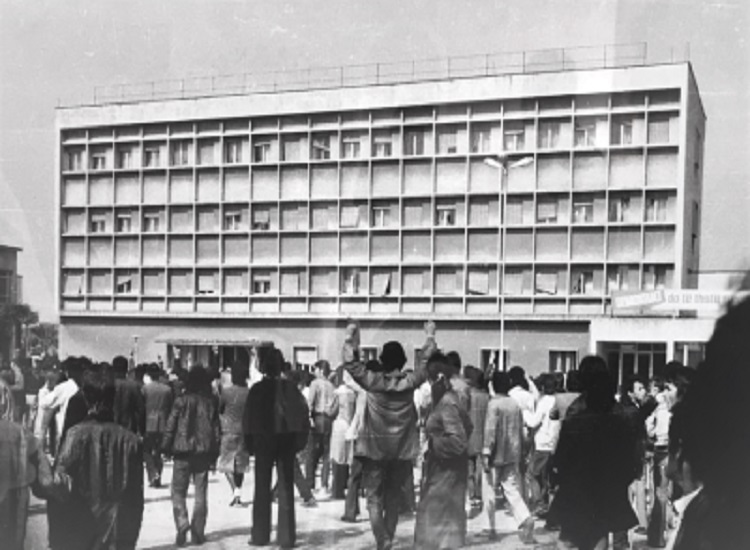
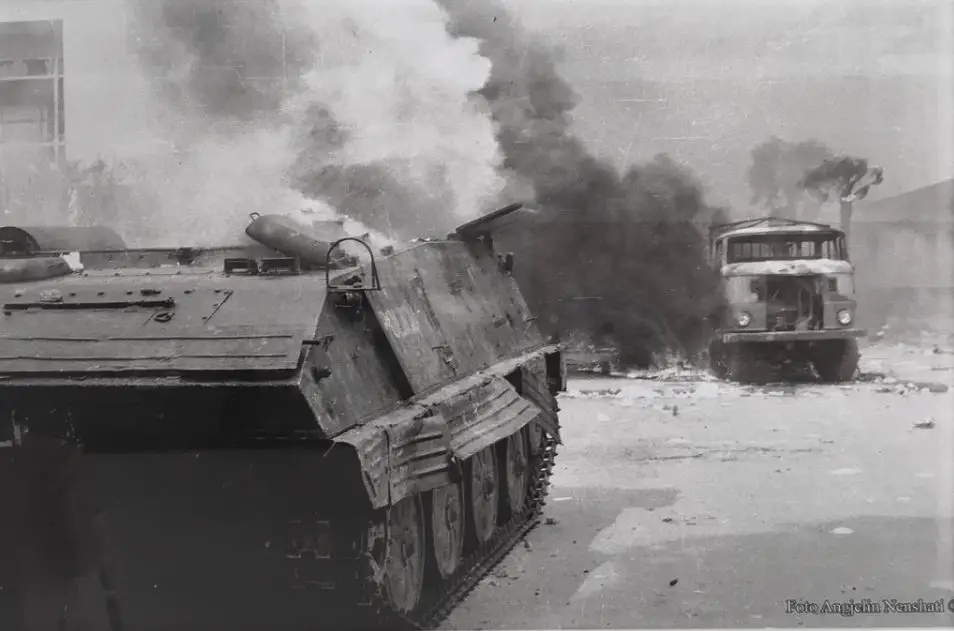
COMRADE RAMIZ ALIA: I thought we should hold this meeting of the Bureau to discuss the situation of these days and what tasks lie ahead of us. During this time, as you are all aware, the events in Shkodër occurred, where three people were killed, and a fourth died from wounds received that day; the Committee of the Party of Labour of Shkodër was burned down, and, in general, a rather difficult situation has been created there.
These are, according to the data we have so far – which are highly contradictory and very incomplete, because the investigation is working, but in a very clumsy manner – apparently, these events were provoked. There, it seems, it was prepared with the aim of provoking an incident that our opponents could use to discredit our party. And secondly, to create a tense situation in Shkodër, aiming to consider Shkodër as a base for their activities.
The events began on April 1, one day after the elections, when a crowd of people took to the streets of the city of Shkodër without police permission, with various slogans, insults against our party, against the elections, alleging fraud in the elections, etc. They demonstrated for about two hours, and then dispersed late at night. The police forces did not intervene.
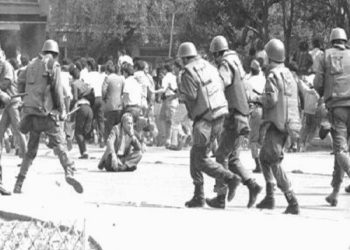
On the second day, April 2, the events unfolded differently. Again, illegal gatherings were held, especially by students from two high schools in the city of Shkodër, joined by other masses of people. They followed the same tactics: slogans, insults, jeers, shouts, etc. On this occasion, the police intervened to disperse them using force, without using weapons. But later, when the crowd began throwing stones at the police, and when they approached the Party Committee, the police used their weapons and fired.
In these actions, some here, some there, three people were killed and a large number of people were wounded. After this action, the crowd stormed towards the Party Committee; the police entered the Party Committee, then on orders withdrew from there, while the crowd entered the committee, set it on fire, went floor by floor, took out whatever they wanted, burned whatever they wanted, destroyed whatever they wanted.
Xhemal Dymylja escaped out the back, slipping along the walls, while everyone else went out the front door. The crowd did not bother them when Bukurie Cungu, Adem Golemi, and other apparatus employees came out. After they had passed a part of the road, they attacked Gjergj Grabova, beat him and thrashed him badly, then someone took him, put him in his own house and from one house to another they saved him.
Naturally, this whole affair created a very tense situation in Shkodër, so much so that at the funeral of those three, it is said that tens of thousands of enraged people participated because of what had happened. You have also seen in the news agencies that this event had a very bad effect in the world. The version of the opposition forces, of course, was according to their appetite, as if this whole ruckus started because one of the leaders of the Democratic Party was shot by someone from inside the Party Committee, that the bullet hit him in the back and the wound is in the front, etc., etc., which, naturally, only the investigation can verify.
The investigation is doing its work, but, as I said, quite slowly, although it must be said that it is quite difficult because one person says one thing, another says something else; an autopsy on the corpse has not been performed because they did not allow it; people do not speak, they only say “I saw a man with hair,” another says “a man without hair.” Naturally, the investigation has its own difficulties.
Nevertheless, this has now become one of the most difficult problems of the time. Representatives of the Independent Trade Unions of Shkodër and of the centre came to me; they raised these issues with me, just as they have come from the Democratic Party as well; they have sent protests demanding that light be shed on this matter, that the perpetrators be found, and so on. Then, within this story, there are as many fantasies as you like, such as that weapons, machine guns, refrigerators with food and food reserves were found in the Party Committee, which, so to speak, embellish this whole story.
This event must be clarified according to the data we will get from the investigation. Until today, it is very difficult to clarify, since one says one thing, another says another, and the investigation has not yet reached final conclusions on this matter, which has now become, so to speak, an apple of discord. It is clear that this was sought by the opposition as well, to create a precedent to aggravate the situation and create problems for the future. In fact, they showed their heads yesterday with two events.
First, the organization of Independent Trade Unions sent some kind of letter to the Prime Minister’s office, which they also send for information to the Presidium of the People’s Assembly, in which they raise 17 demands, one of which is a demand to increase wages by 50 per cent for all categories of people. It goes on to say that by April 14, the conclusion on the Shkodër events must be given, for which radio, television, the press must take a clear stance, an open trial must be held for the perpetrators of this event, etc., otherwise this organization will use all democratic means, including strike. In a word, to impose their own views.
The second event that showed its head was at a meeting that Spiro, Ismail Lleshi, and Fehmi Abdiu had with the Democratic Party regarding preparations for the upcoming session of the People’s Assembly. At this meeting, after we discussed the procedure and measures to be taken, in order to come to the Assembly together to avoid pointless discussions regarding procedures, such as who will chair the meeting, the formula for the oath, etc., they agreed on all points, but said that they might not come to the Assembly if the conclusions on the Shkodër event are not given.
Comrades told them that there are special bodies dealing with the Shkodër event and that this is not related to the Assembly, so they should reconsider this stance. They ended the meeting without giving any definite opinion on their part. According to the view of our comrades, some of them are wavering, but, nevertheless, they said that they have pressure from their base on this matter, hence they are in difficulty. But I think this is a program, a plan of theirs, to create trouble and problems for us.
From all this, considering also international opinion, I believe that it is our duty to clarify the situation, which only the designated legal bodies can clarify for us; there is no other way it can be clarified. The situation in Shkodër is somewhat calmer than it was. We decided to dissolve the Party Committee of Shkodër, because it did not respond to these situations. This dissolution of the Party Committee of Shkodër was done; we sent comrades from the Central Committee apparatus, Muharrem Xhafa and another, to help work there.
Shaqir Vukaj, a relatively young comrade in Shkodër, was appointed at the head of the new Committee, along with other comrades, who have started working with the 12–13 people they have there. They have started to make contact with the party organizations and with individual communists in the city and village.
The next day after this was published in the newspaper, Xhemal Dymylja came to me and in a very, how shall I say, protesting manner, he complained why in the newspaper *”Zëri i Popullit”* it was said that the Party Committee in Shkodër was dissolved for detachment from the masses of the people, that it showed incompetence in these situations, etc., while this was not said to the Party Committee itself. That is to say, Xhemal Dymylja’s entire concern was why it came out in the newspaper in this way, whereas why that situation was created in Shkodër and practically it is not under our control that did not concern Comrade Xhemal at all!
To tell you the truth, this was a complete disillusionment for me, showing how far egoism and personal viewing of issues can go in these very difficult times, when individuals, for me, have no value whatsoever, including myself. Because it is no longer a matter of mine or yours, but it is a great national problem, an issue greater than “mine.”
Unfortunately, we have comrades even in our ranks, at the highest levels, who do not care at all about what is happening in the world; they know how to speak rhetorically about the general interest, but when it comes down to it, they see only their own interest, nothing more. I spoke to Xhemal. Whether he understood or not, I am not clear, but for me it is of no importance to clarify myself on this matter, because there is no doubt that the Party Committee of Shkodër and Xhemal Dymylja have special responsibility for this situation that has been created.
Of course, one cannot blame him for everything; there are also others at fault there, but today this is the reality, and this reality found Xhemal exposed. Today in Shkodër, the situation is such that there is nothing under control; the only person working is Tereza Marubi, no one else. It must be said that she showed herself to be a brave woman; she took the reins in hand, knew how to manoeuvre, to gather representatives of religions and different parties, etc., in order to establish order and calm in her own city, at a time when there was no help whatsoever from the Party Committee.
Nevertheless, this does not mean that power functions in Shkodër; it does not function at all. The Internal Affairs bodies are a disgrace, in the full sense of the word. There is no power there; people are beaten in the market, there are no policemen; people get shot, no policemen; people walk around with holsters on their belts, peasants have their livestock killed, walls are covered with all sorts of slogans, no policemen.
The situation is extremely difficult from this point of view, although Muharrem Xhafa, when we heard him today, was optimistic, but I understand that his optimism is related to that pessimism of the first days, when no one would go to the market in Shkodër; whereas now they have started to go out.
The situation in Shkodër must necessarily improve. First of all, the bodies of power must start working, while the party, in my opinion, should be reorganised from scratch completely, because this party as it is is worthless. There, one must make contact one by one with the communists so that they can respond to these situations. That is as far as the Shkodër issue is concerned.
Second item on the agenda:
“On the stance towards the demands of the trade unions and the organizations and associations being created.”
COMRADE RAMIZ ALIA:Regarding the first issue (the two new developments: the strike if the 17 demands are not met, and the non-participation in Parliament) – for the first one, I told comrade Fatos (Nano, Prime Minister) to call those from the Independent Trade Unions in order to discuss with them, because we must follow the path of discussion and dialogue, with the aim of exchanging views and avoiding excesses.
Our comrades must be careful, because regardless of what these organizations are, generally speaking, I would pose such a problem: now, with pluralism, they are popping up like mushrooms and they will pop up again, sometimes an organization, sometimes a party, and sometimes various associations. However, I have the impression that in all of them we are calling them hostile, adversaries, and leaving them to their fate, even the organization “Chameria,” or the Friendship Association with Israel, with America, etc.
It seems to us that all of these are against us. That is not the case; therefore, we need more correct stances and struggle and effort to draw them to our side, because there is a tendency to create various associations. We are used to there being one party and that party giving orders; if it doesn’t give orders… Why? Now the Party doesn’t give orders; whoever feels like it creates an association. We must try to keep them under control or to influence them, not abandon them, because abandoning them is very easy.
Here I am referring also to the organization of Independent Trade Unions, which, not only do I have the impression, but it is a fact that the existing Professional Unions consider them hostile. Surely they have their own views, they are against the decisions of our party, and surely, because even the demands of the petition itself show that one cannot say they are in our favour; they are playing the opposition’s game. Regardless of this, we must not cease our communist activity, with the aim of winning over these organizations or these individuals, or influencing them. / Memorie.al