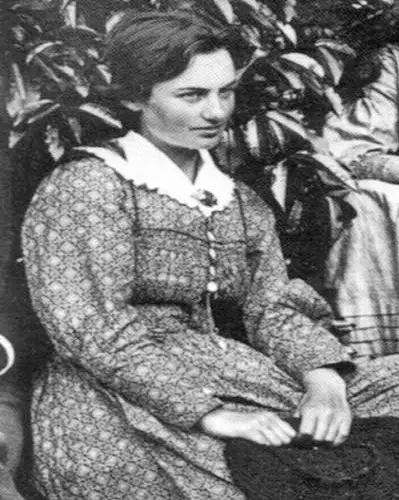
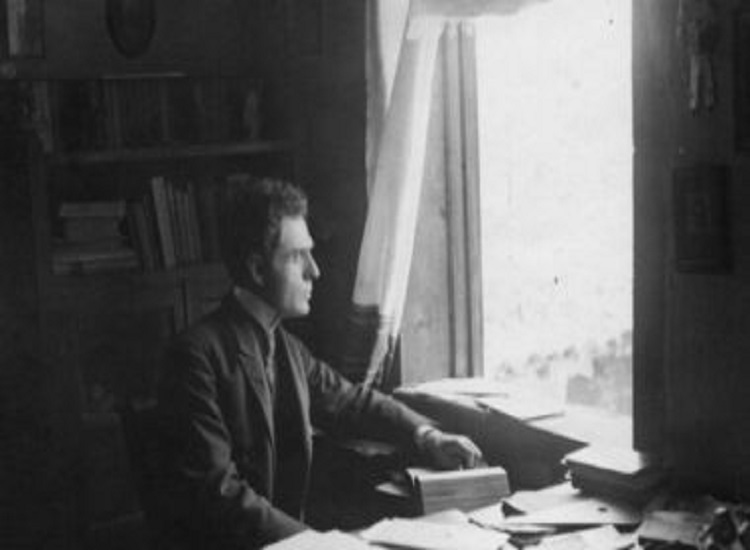
Memorie.al / In this letter, Edith Durham provides autobiographical data, which, apparently, Mit’hati had requested from her for an article about her in one of the newspapers of the time. The letter was discovered recently. The modesty of Durham at the end of the letter is striking, where she asks Mit’hati not to publish her photo, and even in these notes “there is nothing interesting”…
London, February 1, 1921
Miss Edith Durham
To Mit’hat Frashëri
Dear Sir,
I was born in 1863 and am the eldest of the children of Arthur E. Durham, chief-surgeon of Guy’s Hospital in London. At the age of 11, I entered as a day pupil at a small school run by two Germans, Mr. and Mrs. Pretorius. I owe much to Mrs. Pretorius and my mother for their constant care for the children’s progress in their studies, because they also instilled in me a desire to learn. I also owe much to my teachers, especially the Latin and English teachers. At the age of 14, I was sent to Bradford College in London, where I stayed until the age of 19.
I always wanted to become a painter, and so at 19 I went to the St. John’s Wood School of Fine Arts. When I was 21, I received a scholarship to the Royal Academy of Fine Arts in London, where I worked for three years. I started illustrating, exhibited some paintings, and when I hoped to achieve success, the sudden death of my eldest brother and my father shattered all my hopes. My poor mother’s health was shaken. I was forced to give up my studies.
Keeping a studio was impossible, because I could not leave my sick mother alone. Five years of work and care exhausted me so much that my doctor considered me so ill that he said I absolutely needed two months of rest every year to save my health. Staying locked indoors all the time was impossible. My burning desire was to return to my art. Under these circumstances, I took a health trip, a journey to the Adriatic, and went, by chance, to Montenegro.
There I kept many notes and made many sketches. And, since circumstances at home did not allow me to pursue painting, as a means of slightly changing the monotonous service of caring for a sick person, I began to engage in anthropological studies, hoping that every year during my holidays I would penetrate deeper into the Balkans, visit each country, and make comparative studies among the different peoples. After my mother died, I decided to devote myself entirely to these investigations as well as to painting, and thus make up for the 11 lost years.
I was elected a member of the Royal Anthropological Institute of London. And in the highlands of Upper Albania, I began my studies, with great hope and, I may say, with great success. Thus, I was starting life a second time and foresaw no more obstacles. Unfortunately, that same year the Young Turk revolution broke out, followed almost immediately by the uprisings of the highlanders. Since I was in the country and there were no people to help the poor refugees, I began to collect a little money and inform the newspapers of the situation.
And so, for the second time, all my plans and hopes were shattered. From this bitter moment onwards, as you yourself know well, the history of Albania has been nothing but a continuous war. Not only of Albania, but of all the other Balkan countries. With anxiety, I found myself caught between the wheels of politics.
There was no more studying or painting. When the Balkan War ended, I believed that the recognition of Albania’s independence would save me too. In March 1914, I left London with renewed hopes, with watercolors and all other painting supplies, intending to resume life and hoping to conduct excavations to find prehistoric objects. When I arrived in Trieste, I learned that the situation in Albania was already very serious, and by the time we reached Durrës, war might have broken out.
Mr. Harry Lamb sent me to Vlorë to send from there some dispatches about the Greek attack and the condition of the refugees. The Great War had broken out, and my poor plans and aspirations, like those of millions of others, were destroyed. I no longer have the strength to begin for the third time research and investigations that require the energy of youth. But I always hope to escape this slavery of politics and find the free time to at least edit my notes.
When I promised Mrs. Dako in Korçë and Monsignor Preng Doçi in Orosh that I would do whatever I could to help Albania, I had no idea where these promises would lead me. Here, sir is the story of a long disappointment. But perhaps, as the highlanders say, it was written, wasn’t it? Whatever happens happens! I never give permission to publish my photograph, and since I have refused this permission to many newspapers, I cannot grant it to you either.
Now I wish Albania peace.
Would you be able to edit an article from these notes? There really isn’t anything very interesting.
T’u ngjatë jeta (these words are written in Albanian)
Edith Durham
(AQSH, Fondi 35, viti 1921, dos.36/5, fl.101.)
She has done a lot for Albania. When we say a lot! A lot! But even if not, just one case, one special and symbolic act of hers is enough for her to be honored and respected as a heroine, when on the day of the Fascist invasion on April 7, 1939, at the age of 76, with a cardboard placard hung around her neck reading “Hands off Albania!” “Help Albania!” – she protested alone for hours in front of the British Foreign Office, an action she repeated day after day, so much so that she forced the high English authorities to pay attention to her and, perhaps-perhaps, influenced the revision of their stance.
Durham, born in London, had visited the Balkans for the first time in 1900, when she was already in her late thirties, and the journey proved to be a turning point in her life. She published seven books and writings about the region in numerous newspapers, including reports on the First Balkan War. Her observations were often sharp. She was knowledgeable about Serbia and Montenegro, but her love for Albania was predominant. With her progressive views and independent character, Durham was a step ahead of her time in many respects, always standing by others, especially the suffering Albanians, like a blood sister.
Us and Durham
Edith Durham’s activity in Albania and for Albania as a traveler, artist, ethnographer, anthropologist, writer, and humanist is immense and unique. For nearly half a century, she tied the fate of her life to the fate of the Balkans and especially Albania. Besides her other political, social, and scientific activities, she wrote seven books on Balkan issues, among which “High Albania”, written in 1909, is the most famous and accomplished. This book, even today, is a good guide to the culture and traditions of the highlanders of Northern Albania.
It should be emphasized that her articles for the journal “Man” made her a well-known member of the Royal Anthropological Institute. With an enlightened and generous mind, she quickly understood the spirit of Albanians. Without fear or compromise, she showed the world and its laws what she had learned. Albanians have not forgotten and will never forget this Englishwoman. In the mountains of Albania, which she knew very well, the news of her death at that time caused a stir among her many acquaintances, but also among those who had heard of her.
“You who gave me bread, shelter, and trust, did not disappoint me”
From the many notes and appraisals of Edith Durham for Albania and Albanians, we would highlight this paragraph from her book “Albania, the Burden of the Balkans”. “I had believed in Albanians, they deserved the European fate they are building with such vigor today. You who gave me bread and a bed, shelter and trust, did not disappoint me. The gods had blessed that land where the preservation of certain human values is the secret. That place and those people surprise you. Their almost natural exoticism sometimes surpasses superficial modernity. There, the air of the mountains and seas is different. The Albanian language has a different music. The word; ‘mirë se erdhe’ (welcome), comes straight from the soul of those people. Europe without Albania and Albanians would be incomplete in its identity of ancient and modern history. The Balkans without considering and understanding Albanians is without identity and without a future! Even in the universe of the spirit, I feel respected by the Albanians of the earth and the sky, I am among them like them, an Albanian who continues to walk through those epic and humane spaces tirelessly, I am in their trust.”
Gratitude, Durham!
You deserve more from us, for your sublime nobility! The truth is that Albanians have honored and still honor Durham today, because she gave them her heart, and they gave her deep gratitude. Hence, they consider her studies as an authentic and inseparable part of their history. Moreover, she is considered and honored as one of the most prominent foreign figures of the last century, who fought for Albania’s independence and freedom, whether by the Presidency, the authorities, or the high scientific institutions of our country. However, she should be valued more.
Firstly, to be known better, since many of her works have not yet been translated into Albanian. Secondly, although many of her materials and documents are preserved in several academies of the world, but mostly in three museums in London, no scientific institution has bothered to at least look at them for curiosity, let alone study them and present them to the Albanian public. Thirdly, in the framework of future evaluations given to historical figures, she too should be given a more deserving place of honor as a protagonist and direct “Albanian” fighter. Because this way we honor ourselves more than her!…
Where can you “find” Edith Durham?!
Thanks to her journalistic writings and special publications, she gained great fame. During her quarter-century of work, she had gifted English readers these works: “Through the Lands of the Serbs” (1904), “The Burden of the Balkans” (1905), “High Albania” (1909), “The Struggle for Scutari” (1914), “Twenty Years of Balkan Tangle” (1920), and “Some Tribal Origins, Laws, and Customs of the Balkans” (1928), etc. From her published opus, six books deal almost entirely with the Albanian issue.
By reading Durham’s works, Albanians and foreigners learn many truths from history, more data about the nation, its cultural heritage, and the stances and behaviors of neighbors and great powers at the beginning of the 20th century. As such, they are necessary references for researchers of various scientific profiles. Today, her original documents are held by the Museum of Mankind and the Royal Anthropological Institute in London, while her collection of jewelry gathered in the Balkans is located at the Pitt Rivers Museum in Oxford and the Bankfield Museum in Halifax. The Bankfield Museum also has a representative exhibit about her life and work.
A day’s journey with the Albanians
Notes by Edith Durham from a trip of hers to the southern regions of Albania.
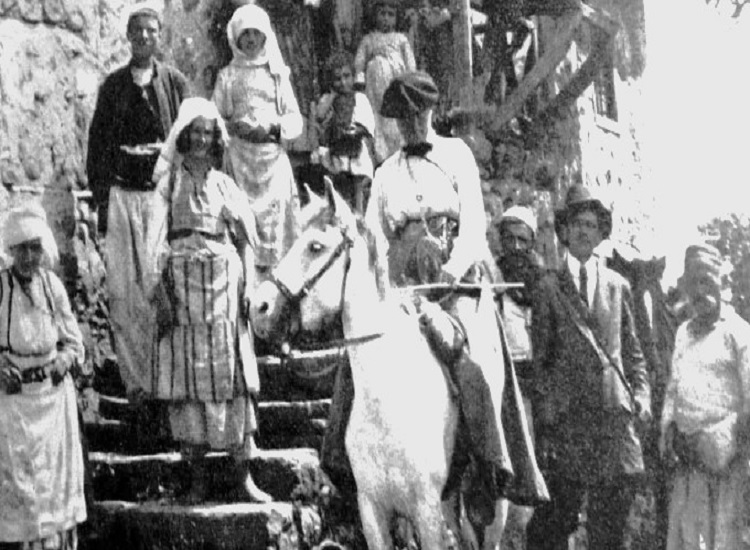
We left Berat for Elbasan at 6 o’clock in the morning, on my horse, the weakest I have ever seen, because it neither galloped nor walked, but moved constantly by jumping. I don’t mind the jumping of a colt for a while, but when it lasts for 12 hours straight, it is truly tiring. I was glad that the road was very bad so that the horse would go slowly, otherwise the journey was pleasant. We soon reached the Devoll River and continued along its bank.
The suvaria (mounted gendarme), a cheerful, agile boy, who called my journey a matter of sport, for fun, something he fully approved of, said that besides a small private obstacle of his own, the road was completely safe. His poor old father, who at that time could not resolve that matter of honor himself, had been forced to leave that area. His son did not consider his situation so bad, as long as he had joined the gendarmerie. This was a protective support for him, because he was well armed. For my sake, he said he hoped they wouldn’t run into any of his enemies that day, and while he spoke like that, he looked in all directions with his ash-gray eagle eyes. Fortunately, he did not live along the road we were taking, but if one saw him, they might ambush him on his return. Surely he wasn’t crazy to come back this way. The number of abandoned graves found along the road was witnesses to that boy’s words.
All the men, who were plowing the land, carried rifles (gjeverdare). The shepherds of the hills had Martini rifles (martina) and bandoliers full of cartridges. Some of them were very young, dark lads, very handsome, lively and proud-looking, as if to say “try me, I’m here”. Life in this region is very hard, so the strongest can survive. Nearly a quarter of the land was cultivated, but within some forests, it was seen that they were opening new lands, which were fertile. We emerged into a large square, in the middle of which stood two large walnut trees. Here the suvaria stopped to enjoy the memory of the bullet marks from target practice that various people had done in this place.
A year earlier, two villagers, father and son, had been shot by the owners of that house on the hill until both were killed. Now nothing remained but their grave, a large pile of stones. Why were they killed? The suvaria didn’t know, but perhaps they had a blood feud. If so, they must have been crazy not to have been armed. To go out unarmed in these circumstances is as stupid as going out without an umbrella in England and then complaining about getting wet. The judges had sent them to hell. This is a pagan place, called Muslim, but there is no mosque, priest, or hodja. They are not found in the many villages scattered on all sides.
…Finally we descended into the valley and came across some piles and an arch which showed that there had been a bridge here. We headed to the riverbank and the suvaria, shouting and chattering with some villagers on the other side, asked where the river was fordable and then cut and entered the river first. The courage he gave me forced me to follow him without any doubt. The water came up so high that we didn’t have to swim, but the others got soaked and struggled. From here we continued towards a good road and saw Elbasan stretching out in a wide plain with white minarets, a glimmer amidst the cypress trees, which seemed as though we would never be able to reach it… ./Memorie.al