From Eugen Shehu*
Memorie.al / Undoubtedly, the history of a nation are the history of the great families of that nation. The great Albanian families have at all times been the first barricades against every storm, unyielding in their stoicism; they have awaited and faced hordes of enemies of all kinds, defending at once their honor and their nation. Undoubtedly, in the ranks of these great families, the house of the Derallas holds its deserved place in the Albanian history of the last century. Among the scions of this house, Mehmet Pasha Deralla would leave behind ranks and honors offered by the Sublime Porte, placing himself fully in the service of Albania, in the front ranks of the knights who sought the independence of the Arbëresh ethnic lands. This refined Albanianism, the Minister of War of the first Albanian state (1912), would pass on, among others, to his sons, Halim, Gajur, Hysen, etc.
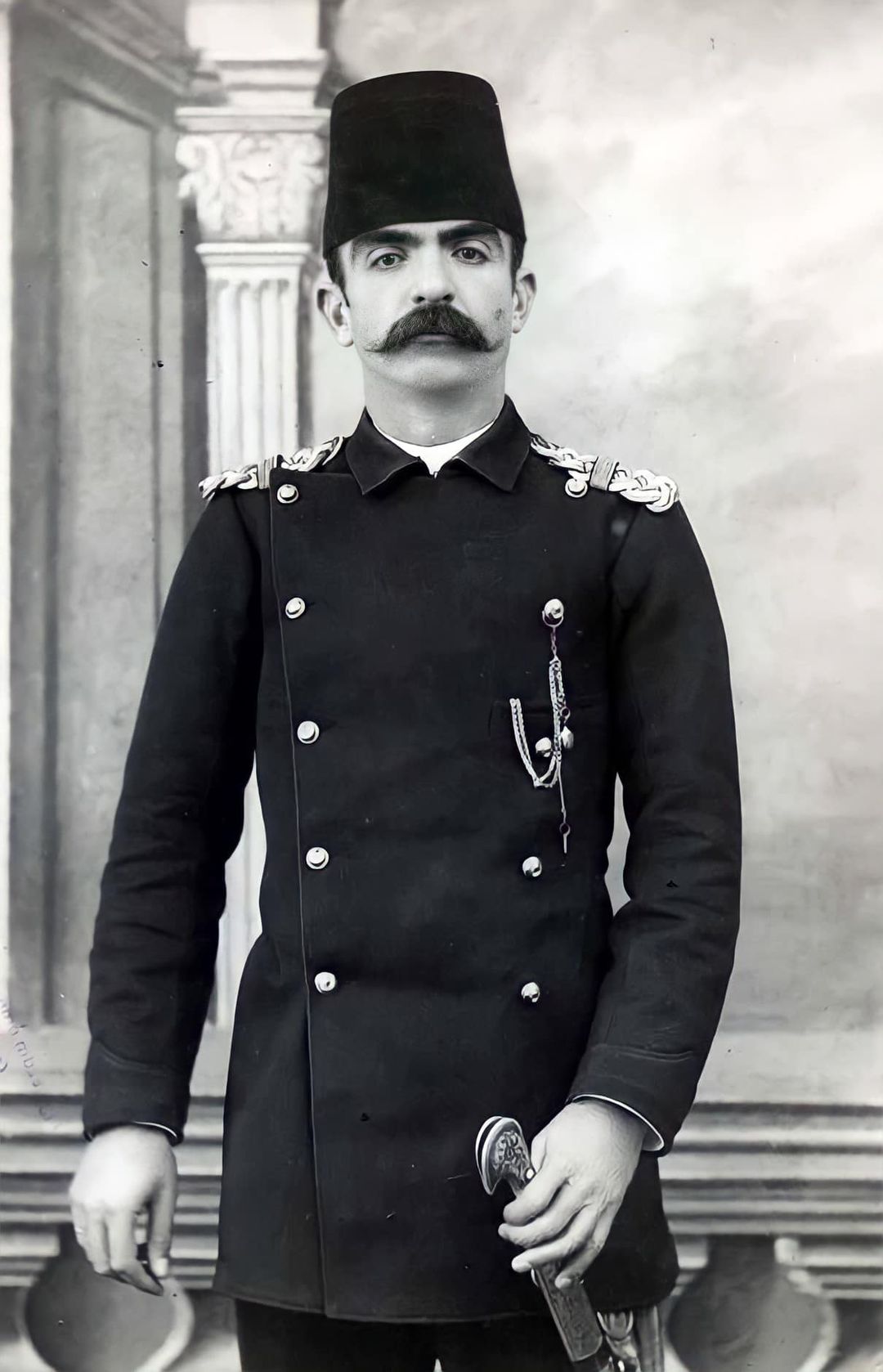
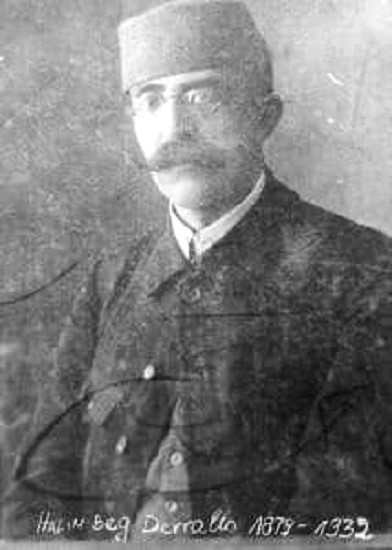
Halim Deralla was born in the village of Gradec, near Tetovo, in the year 1879. He spent his childhood there, and later, he began his first lessons at the civic school of Tetovo. After finishing his studies there, he set off for Istanbul, the capital of the Ottoman Empire, coveted especially by the sons of great houses, such as Halim was. In truth, he learned a great deal, spending most of his time over books, and after finishing secondary school, he continued his studies, in 1898, at the Faculty of Law.
Thanks to the reputation that Mehmet Pasha Deralla enjoyed at that time in Albanian patriotic circles, Halim would come into contact with the first ideas of the Albanian national renaissance figures, regarding the autonomy of the Arbëresh lands. The student from Tetovo was regarded with respect in Istanbul, not only for his persistence in acquiring knowledge but also for his somewhat quiet, taciturn, and proud nature.
Thus, upon finishing the Faculty of Law, he was appointed as a high-ranking sub-official of the Ottoman administration in Serbia. He would distinguish himself for his correctness in state functions, which was something unusual among the ranks of the corrupt officials of the empire of that time. Moreover, the steps of his career in the field of jurisprudence could have been extremely easy if, at the dawn of the last century, the Albanian issue had not come to the fore.
At the beginning of 1908, Halim’s father, Mehmet Pasha Deralla, in close cooperation with Ismail Qemali, Hasan Prishtina, Dervish Hima, Ibrahim Temo, Mid’hat Frashëri, etc., conceived the autonomist movement in the Albanian Vilayets. Now he had to travel to various regions, to awaken national consciousness among his compatriots. But he also had to manage the large properties he owned in Tetovo and its surroundings, and under these circumstances, he called his son, Halim, to help him in the great task he had to face.
Halim, now almost 30 years old, with his tall stature and that deep, thoughtful gaze, would rush to place himself fully in the service of his nation, understanding that the path to the independence of the ethnic lands was walked with rifle and knowledge. Halim would make a great contribution in 1908, especially in supporting Albanian schools in Albanian Macedonia.
On his initiative, supported also by Dervish Hima, the son of the Derallas would buy primers and Albanian books to distribute for free to students in Tetovo and its surroundings. Sources from Austro-Hungarian diplomacy, speaking about these lands, inform us that; “although officially the schools have not been opened, two hours of lessons in the Albanian language are held regularly every day in them.” (Archive of the Institute of History – Tirana. Vienna Documents Fund. Report of Consul Pollanc, sent to Vienna, doc. 26).
The Young Turks, despite having promised many freedoms and rights to Albanians, when they saw that the autonomist movement was growing, tried to stop it by every means. Thus, they managed to somewhat limit the broad participation of Kosovar fighters in Ferizaj, who nevertheless managed to pledge their *besa* (oath of honor) in that assembly of men.
The Ottoman military authorities tried by all means to stop this manifestation, pretending that Istanbul would very soon fulfill their demands, but the Albanian patriots understood that this was a maneuver just to get by. Sali Gjuka, Halim Deralla, Dervish Hima, Nijazi Resnja, etc., did their utmost to ensure that the Albanian march towards Skopje would not stop.
Because the Second Army Corps headquartered in Monastir (Bitola) consisted mostly of Albanians, and because local Albanian commands had begun to operate in Tetovo, Debar, Ohrid, Kumanovo, and Monastir, etc., on the evening of July 24, 1908, the Sublime Porte decided to halt the march, listening to the Albanians’ demands and immediately granting them some of their denied rights. Sources from our historiography inform us that among the representatives of the fighters in the negotiations were, among others, Halim Deralla, who with the authority he enjoyed, defended the rights of Albanians with logic and determination.
After three or four days in an almost state of war, Skopje was emptied of Albanian fighters, who managed to win some elementary rights. Among these rights was also the removal of corrupt Turkish officials, whom the people could no longer tolerate. “The Albanian Committee,” reported Pllanc, “is ordering the local Turkish authorities to dismiss officials whom the people do not like.” (Archive of the Institute of History – Tirana. Vienna Documents Fund, dated July 29, 1908).
In the years 1908-1912, the Deralla house in Tetovo would be transformed into a cradle of Albanianism. Mehmet Pasha and his son Halim would always be seen at the head of great patriotic movements, contributing not only with bravery, daring, and logic but also with their wealth. Together, they would welcome and see off in their large house in Tetovo, the brave patriots like Sali Gjuka, Bedri Pejani, Bajram Curri, Isa Boletini, Mid’hat Frashëri, Hamdi Ohri, Hoxhë Voka, and dozens of other patriots from all Albanian ethnic lands.
They would participate in the Assembly of Junik and then at the beginning of 1912, they would command the first band of fighters from Tetovo, which took up arms to resist Turkish attacks and those of the Serbo-Bulgarians. In August 1912, Hasan Prishtina, in his capacity as the Albanian representative of the northern territories, held several talks with the high Ottoman authorities in Pristina and Ferizaj. Then, in Ferizaj, he presented a memorandum of 14 points to the Ottoman government commission.
This memorandum was handed over to the Ottoman commission on August 9, 1912, declaring that if they were not accepted within two days, the Albanian insurgent forces would march towards Skopje. After this, the Albanian forces commanded by Idriz Seferi, Isa Boletini, Hasan Prishtina, etc., were reorganized and set off by train towards Skopje. Since the Ottoman government delayed its response to the memorandum, the general headquarters of the Albanian insurrection decided to take Skopje, and within 48 hours, the city was surrounded by about 30,000 Albanian fighters, while inside the city, other patriots were secretly organizing.
The Vali (Governor) of Kosovo, Masar Bey, finding himself in these difficult circumstances, resigned. Meanwhile, the commander of the Skopje military garrison, unable to resist the insurgents, secretly left, informing the Sublime Porte of the great Albanian revolt. Under these circumstances, on August 12, 1912, the path was almost open. Skopje, the ancient city of the Arbëresh lands, was very close to the freedom dreamed of for years.
After taking all measures, after informing Albanian patriots inside and outside Albania of what had been achieved, the patriotic men did not fail to enter Skopje. “The prominent leaders and commanders; Hasan Prishtina, Idriz Seferi, Isa Boletini, Bajram Curri, Halim Tetova, Shaban Prizreni, Ramadan Zaskoci, lead towards Skopje with unfurled flags, with the insurgent military band, with enthusiastic cheers.” (Shaban Braha “Idriz Seferi” – Tirana 1982, pp. 177 – 178).
In November 1912, when Mehmet Pasha Deralla was traveling to Vlora as a representative of the people of Kosovo, his son Halim, at the head of a band of 200 fighters from Tetovo, would throw himself into the defense of Albanian lands. It is now known that after the fall of Turkey, our neighbors, supported by the Great Powers, sought the annexation of our lands.
The chauvinist oracles foresaw the complete dismemberment of Albania, so the Greeks, Bulgarians, Serbs, and Montenegrins had pounced on the borderlands with the voracity of a pack of wolves. Although the formation of the first independent Albanian state had its own historical dimensions, this act could not, in any case, save Albania from its dismemberment. And while the representatives of the Great Powers were dozing like sleepyheads while Albanian land was being divided, it was her sons like Halim Deralla who, disregarding danger fought for the freedom of their homeland’s lands.
After the resignation of Ismail Qemali of Vlora and his cabinet, Mehmet Pasha Deralla returned to Tetovo. But the Serbs could not forget him or his son Halim, who organized a series of battles against the submission of Tetovo, Skopje, Kumanovo, and Struga, to the Slavic boot. Moreover, in the wars fought in these regions in 1913-1914, the distinguished house of the Derallas was targeted by the pro-Bulgarian government of that time.
This is the reason why he and his son were arrested in the autumn of 1914 and sent bound to Karlovo, Bulgaria. Father and son would be heavily accused by the Bulgarian military court, but it was the unstinting help of some Albanian patriots from Skopje that assisted in their escape from the Karlovo prison, and from 1914 until the end of 1915, Mehmet Pasha Deralla and his son lived in the mountains and forests of Shar, pursued by Serbo-Slavic and Bulgarian henchmen.
In 1921, when the first Albanian parliament opened its doors, Halim Deralla would be a deputy for the regions of Albanian Macedonia. He would bring to this parliament, with a loud voice, all the Serbo-Slavo-Bulgarian barbarisms that were being played out at the expense of his compatriots, under the hated Serbian regime. Deralla, like his father, would defend the Albanian cause without fear, although threats came from all sides, even with attempts to eliminate him physically.
In the event of the large-scale population transfers that Belgrade had planned with Istanbul, for the extradition of Muslim Albanians to Asia, Halim Deralla, not only in parliament but especially in Tetovo, Gostivar, and Kumanovo, even up to the villages of Prilep, would go personally to talk with his compatriots, emphasizing the idea that Albanian lands should never be abandoned.
Even on several occasions when the Slavo-Bulgarian authorities forcibly seized the houses and lands of Albanian villagers, Halim Deralla helped them with gold, buying them new houses. Highly visionary, on the level of Albanian and Balkan politics, Halim Deralla would take a firm stance, especially during the events of June 1924. Like few other politicians of that time, he would consider Fan Noli’s and his supporters’ action a Bolshevik revolution, and as a sign of revolt, he would leave Tirana, where offers for important positions were not lacking.
In the large house of the Derallas in Tetovo, together with his brothers Gajur and Hysen, he would take care of the family’s inherited properties, not forgetting the gatherings with the leaders of the *kaçak* (outlaw) bands of Albanian Macedonia. Halim Bey Deralla would support the *kaçak* movement in these lands not only with orders and instructions, but especially with unstinting material help.
His very house in Tetovo would often be a safe haven for the *kaçak* leaders. When the Albanian Prime Minister Ahmet Zogu, with the help of European states, took the road to Albania, he lodged for one night together with 200 men, in Halim’s house in Tetovo. Halim Bey received him as the honor of an Albanian dictated, and according to family data, he accompanied him the next day, attaching to his formations several brave men from Tetovo, Gostivar, and Kumanovo, who would accompany him all the way to Tirana. Thus, December 24, 1924, otherwise called the Triumph of Legality, carries within it the generosity and loyalty of Halim Bey Deralla.
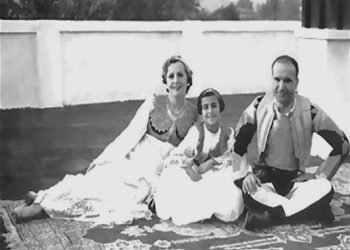
In the years 1925-1928, the son of Tetovo was again elected to the Albanian parliament, as a representative of the regions of Albanian Macedonia. Even in these years, he would distinguish himself both for his spirit and determination for a legal state in the mother country, and for the defense of the national rights of his compatriots in Kosovo, Macedonia, Chameria, etc. His words that “we are responsible before history for the lives of the 2 million Albanians who were unjustly divided by the Conference of Ambassadors in London in 1913,” would be heard powerfully in the hall of the Albanian parliament and would also be echoed by other prominent men such as; Ali Bey Këlcyra, Rauf Fico, Father Gjergj Fishta, Mustafa Kruja, etc. At the beginning of the 1930s, Halim Deralla returned to Tetovo, to live near his wife, daughters, brothers, and his many comrades-in-arms.
Meanwhile, his personality could not reconcile with the Serbo-Slavo-Bulgarian colonization reforms, as well as the physical and psychological violence exercised against the inhabitants of Albanian Macedonia, so he raised his voice in defense of the fate of his compatriots. Being a proven jurist, Belgrade could not arrest him because a trial could expose the Serbo-Slavic regime even more. For this reason, the Serbs, as they had done hundreds of other times, paid people to kill Halim Deralla.
Two consecutive assassination attempts in the years 1930-1931, caused a great stir not only in Tetovo but also in Belgrade and Tirana. While the dark forces of Belgrade were terrified by the idea that even after these assassinations Halim Tetova was still alive, it was the King of the Albanians, Ahmet Zogu, who generously invited the prominent man to leave Tetovo and go to Tirana. A year later, in the spring of 1932, Halim Deralla fell ill in his home. The man of Tetovo would close his eyes forever, in a somewhat mysterious manner. The people of Tirana and of all Albanian ethnic lands respectfully accompanied their son, the prominent personality of the Albanian national movement. / Memorie.al
*Bern-Switzerland