

Part Five
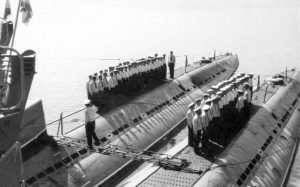
Memorie.al / The CIA has revealed the great role that the Soviet Union played in communist Albania. In several “Top Secret” documents, but declassified for years now, it is shown that the USSR built several important military bases, especially in the south of the country. There, details are given about the submarines that Moscow had on Sazan Island and in the Bay of Vlorë, as well as air bases, such as those at Rinas, Kuçova, etc. Then, an overview of political developments is provided, mentioning the dismissal of Defense Minister Beqir Balluku in the summer of 1974 from all his functions in the army and the party. Likewise, a special place in the declassified CIA documents is given to those dealing with Albanian political emigrants in Yugoslavia, who were incorporated into the Prizren Committee, initially led by Apostol Tanefi, and under pressure from the UDB (Yugoslav secret police), which recruited them through coercive measures, such as returning to Albania, etc.
Continued from the previous issue
Enver Hoxha and Mehmet Shehu had been in constant conflict with each other for years. The CIA has declassified documentary files on the situation in Albania during the years 1949–1955, and besides various political developments, the conflict between Mehmet Shehu and Enver Hoxha is also mentioned. According to the document, Moscow was in between them, and within its government, ministers had lined up either pro-Hoxha or pro-Shehu. Complaints made to Russia are described there, while in the end, Moscow took Hoxha’s side.
March 1949
Repatriation of 97 Albanians by ship
The ship “Dolores,” flying a Panamanian flag, set sail from Genoa, Italy, toward Vlorë on October 9, 1948, with 97 Albanian passengers who were being repatriated from Australia. The Albanians had arrived in Italy from Australia on September 23, aboard the British ship “Strahnaver.”
Initially, the “Dolores” had a Greek crew of 27 men, and Captain Gladouris refused to sail toward Albania with the young men, who, according to him, were all of military age and could be used for attacks by communist guerrillas against Greece.
The ship began its voyage only after the crew was replaced with Italians. The documents of the “Dolores” state that of the 97 passengers, 72 were Albanians and 25 were naturalized Australians. The list also includes the names of the passengers.
November 1950
Activities of Albanian emigrants
The Committee of “Free Albania”
Siad Kryeziu, Zef Pali, and Gaqo Gogo held meetings with officials of the Greek Ministry of Foreign Affairs and Secretary Panayotis Pipinelis. These members of the Committee of “Free Albania” requested Greek approval to establish a camp in northern Greece, where Albanian agents from the emigration could be brought.
The delegates stated that the camp would serve as a base for intelligence and operational missions in Albania. After discussion of the matter with high-ranking Greek officials, approval was given by the ministry on November 4, 1950. On November 3, Kryeziu, Gogo, and Pali hosted a dinner for 25 members of the refugee camp in Lavrion. There, Muharrem Bajraktari, leader of the “Independent National Bloc,” delivered a speech.
July 1952
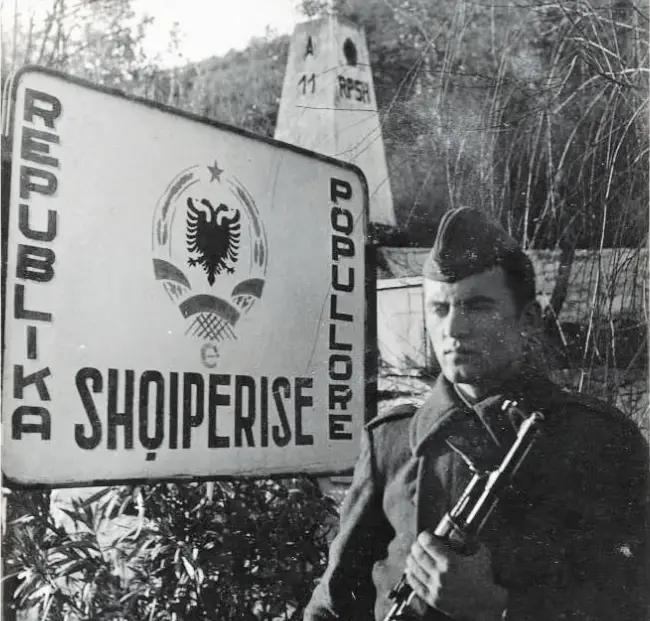
The border with Yugoslavia
Albania has taken measures to strengthen its northern border with Yugoslavia. Until November 1951, there were only nine border military battalions, five of which were deployed along the Yugoslav border at Koplik, Tropojë, Kukës, Peshkopi, and Pogradec.
Another battalion has been added to the border units for the protection of unspecified installations. Each battalion has about 450 men, and in total it is estimated that the Albania-Yugoslavia border is guarded by about 2,250 men. The border is secured through outposts, patrols, and special units at bridges, communication points, and border towns.
Reconnaissance units usually remain hidden at border points known to be used by Albanians to escape toward Yugoslavia. During the summer months, patrols are stationed at extreme border points, at outposts, and observation points. Whereas during the winter months, units are pulled back further inland.
Border defense tactics are based on ambushes and reconnaissance at strategic points, as well as mobile patrols. The border troops were reorganized at the end of 1951. Company commands were abolished, and guard squads were placed under battalion command.
Resistance activities
March 22–29, 1953
Two Albanian officers who recently escaped to Greece reported that since Stalin’s death, resistance to Enver Hoxha’s regime has increased. Throughout Albania, they said, there are guerrilla groups that attack the communist army every day.
When asked whether these guerrilla groups were capable of overthrowing the regime, the officers answered positively. They also added that an increasing number of officers were being arrested due to the army’s numerous defeats at the hands of these guerrilla groups.
The officers stated that new intelligence centers had been established in Peskovica, Pogradec, Tropojë, and Shkodër. Sources also report serious acts of sabotage in the construction work of the Mat hydroelectric plant. The latter have led to the arrest of about 100 people, while the peasant population of the area is prohibited from moving freely in the region.
May 1955
Soviet aircraft
Three “MIG-15” aircraft and three Soviet pilots flew over the capital from Tirana air base. At the airfield, 15 single-seat, single-engine fighter aircraft and 5 two-seat aircraft were also observed.
About 10 other Soviet aircraft arrived in Albania along with Soviet pilots on a six-month mission to train Albanian pilots. At the end of April, the Anti-Air Directorate was established in Tirana, led by General Gjin Marku, who had previously been army commander in Elbasan.
The units include anti-aircraft artillery and aerial reconnaissance units, including radar. Since March 1955, an unidentified anti-aircraft regiment in Tirana has been equipped with ten radar units, six of which are located at Tirana airfield. The radars are of three types, each with a specific detection range.
One has a range of 500 km, a second about 30 km, while the third type is unspecified. Each of the radars is mounted on a “Zis” truck. In March 1955, four Soviet officers and eight other military personnel were assigned for five months to the Tirana regiment to train the new radar operators.
Comment: General Gjin Marku is the commander of the “Enver Hoxha” Officers’ School in Tirana. In 1945, Marku studied at the “Voroshilov” Military School in the USSR. He completed his studies in 1948 and last year was appointed director of artillery at the Ministry of Defense. In 1949, he became a major general and was appointed head of the Combat Troops at the Ministry of Defense.
December 1955
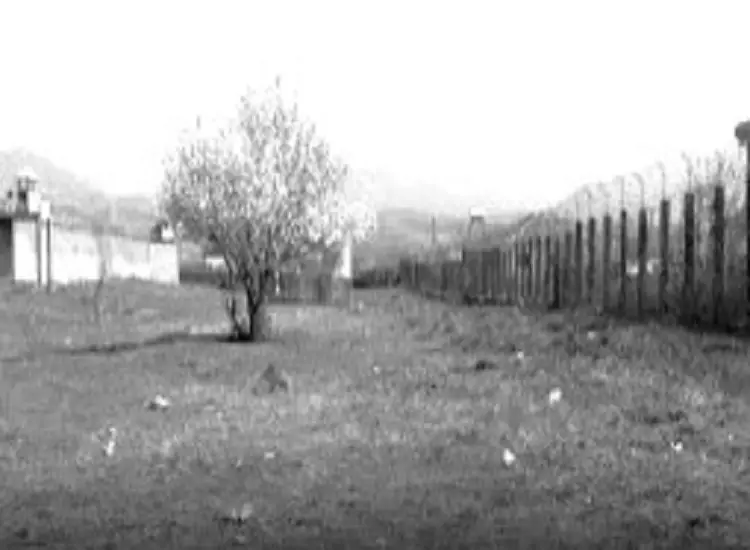
Burrel Prison
Burrel Prison holds about 400 prisoners. Its director is a certain Metani, while the main supervisor behind him is a Sigurimi agent named Jorgo Jaçe, from Gjirokastra. The prison is guarded by about 50 men. Most of the prisoners are political prisoners.
Among them, about 100 are Zogists, about 150 are supporters of Balli Kombëtar, and about 150 are nationalists, including supporters of Gjon Markagjoni, Mustafa Kruja, and Ismail Vërlaci.
Members of these political groups help each other as much as they can, sharing the scant food and keeping their political interests alive through secret discussions. The main Zogists are Enver Hasa, Et’hem Cara, and Dul Hoxha.
The main Ballists among the prisoners are Kudret Kokoshi, Abdullah Rami, and Koço Tasi. Despite differences of opinion between the Zogists and Ballists, they all support the Committee of “Free Albania,” even after discouraging news that occasionally comes in about disagreements among the Committee’s factions.
The prisoners favor a coalition government if the current regime is overthrown, while not all of them accept the return of King Zog. If a referendum were held, Zog is believed to receive about 70 percent support.
Since 1949, prison officers have mistreated prisoners less, marking some improvement in their conditions. There is no breakfast meal, while the daily food for prisoners is soup for lunch and dinner, with 600 grams of bread for each.
Family members of prisoners are allowed to bring food for their people. The prison building consists of two large rooms measuring 7×7 meters, eight rooms measuring 5×3 meters, and 28 cells for three persons each, measuring 2×2½ meters. The prison also has 3 isolation cells. / Memorie.al