
From VEPROR HASANI
Part Two
Memorie.al / On the morning of December 5, 1912, according to the Western calendar, or December 18 according to the Eastern (Ottoman) calendar, terrifying news spread: the Greek armies had entered Devoll and were advancing toward Korçë. They were burning, killing, and destroying everything in their path. The Greek divisions were led by a colonel named Dhamiano. The Muslims of the Devoll villages were seized by panic. All the horror would fall upon them. They decided to leave their homes and set out for Korçë; perhaps there they would be safer. Nothing was certain, but they had no other choice. They waited for darkness to fall. The accounts of that night, as dawn broke on December 6/19 are among the most harrowing. Those who took to the road were many. They could take nothing with them.
Continued from the previous issue
Why was Kondulis behaving this way? Here is the explanation given by the newspaper “Koha”: “Korçë, as you already know, is still under Greek military administration. Just as Vardha did with his andartes (his murderers) of the eleven hundred, and as he stripped and ruined Korçë and its surroundings, a bomb, a kind of curtain, was needed to cover it up. For this reason, Greece used its diplomat and sent Kondulis back with its army to maintain security (order) and tranquility in Korçë and all its surroundings.” (Newspaper “Koha”, April 1, 1914) The Greek government even began paying salaries to the hodjas so that they would speak well of Greece. (They took the salaries; otherwise they would get the bullet!)
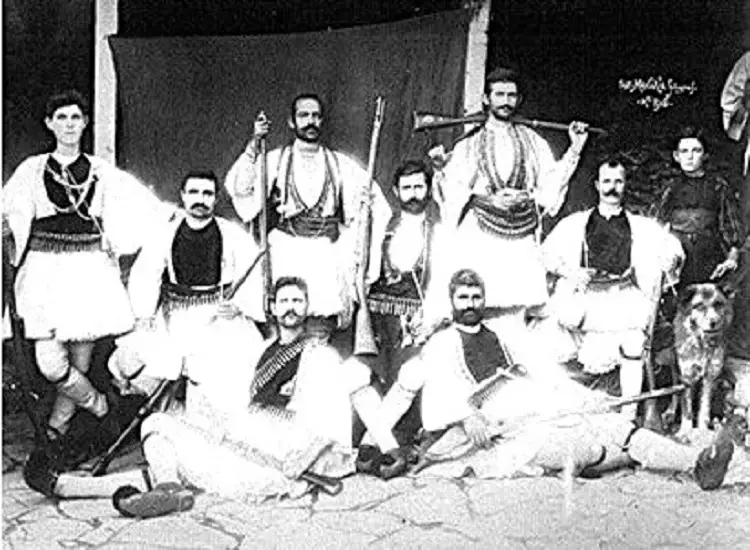
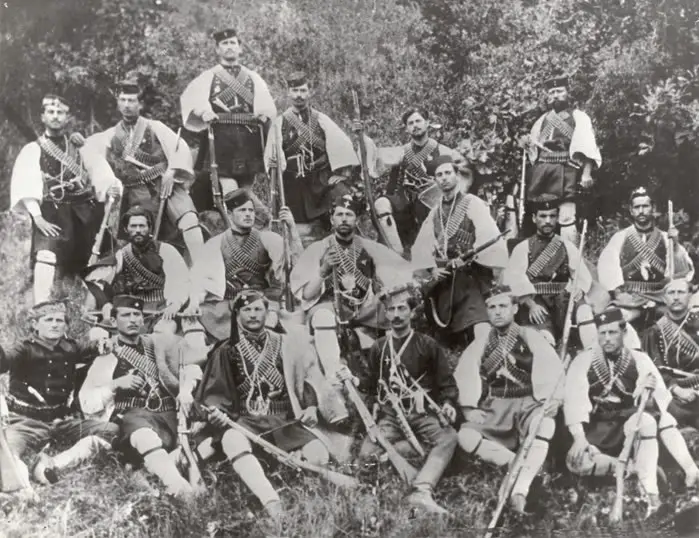
Prince George had left, but he had left his ideas behind. Colonel Kondulis and Bishop Germanos decided to create so-called “sacred battalions” (“Ieros Lochos”). The Greek officer Mavrazas was charged with organizing them. About 1,000 Orthodox were gathered. Only 30 of them enlisted willingly; the rest volunteered out of fear. Those who refused were beaten in plain sight, wherever they were caught: on the street, in cafes, in shops, at home, or at work. Males from age 20 to 55-60 were forced to answer the call.
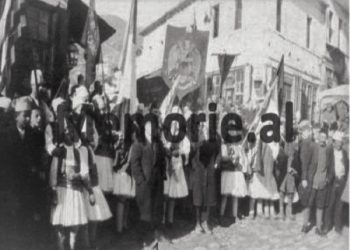
Also, two to three times a week they had to close their shops, leave whatever work they were doing, and take rifles on their shoulders to train along the riverbanks and streams, in the fields and rivers, so as not to allow Korçë to fall into the hands of the Albanians. The decisions made in London would turn in Greece’s favor. That was their conviction. They continued to hold meetings, to go out to rallies, to send telegrams to the commissions they had created in Athens and in London.
Members of the commission in Athens were: Bishop Germanos, Dr. K. Noçka, Mihal Lako, Jani Dardha, and Efrim Gjini; and in London: Josif Adhamidhi with Jani Dardha. In the military parades in Varosh and in the city of Korçë (until that time, Varosh was not identified with the city of Korçë), they even brought out the elderly. They did not leave women out of the ranks either: Mina of Duja, Pancica of Pando Katili, and about twenty other women who grazed sheep and washed other people’s laundry. All of them screeched and tried to shout as loud as they could: “Enosis, i thanatu, aman de” – “Union with Greece or death.”
The Greeks’ goal was to spread panic among the Muslims. If they dared to come out in defense of Korçë, then the entire Greek army, andartes and “sacred battalions,” men and women, with Mina of Duja and Pancica of Pando Katili, would all throw themselves upon them and no one would remain alive. Only the scent of ashes would be felt. Let them try if they wanted! So far, they had been burned and killed, their properties and estates had been leased out, and they themselves had fled. This terror is best described by the newspaper “Koha”:
“I must write a long but true pen-stroke,” says its Korçë correspondent, “to show all the evils we are suffering from the Greek brothers, the great murderers of the world, unparalleled in universal history! To carry out all their vileness, they have as helpers a vile and filthy traitorous clique, who together skins the poor, wretched people! These wretches have leased the estates of the beys and, with the help of the government, have become worse than Ismail Durdushi; they kill and butcher on all four sides, they have three pairs of horses each, and they do not know how to torment the farmers (peasants) more to get more yield. The Muslim farmers, but even more the Christian ones, are so desperate and enraged against these infidel beys that it would be no surprise if they strike and kill them, for they have come to know the villains who until yesterday shouted and roared at them, saying: ‘Oh men, attack the Turks and take the estates,’ and today you see them, by Allah, walking the streets of Korçë with some foul little beys…!” The Bishop and the Greek officers went mad whenever Europe demanded that Korçë be handed over to the Albanian army. And so it seemed it would happen, but they did not want this solution.
Again, the demand was made that Korçë be handed over to the Albanian army, and again the Greeks made other moves against it. Bishop Germanos urgently set up a commission of Grecomans. On December 1, 1913, he gathered them at the Metropolis. They swore on the Bible. They would defend Korçë with their lives. For the creation of the Grecoman commission, Bishop Germanos notified the Greek military and civilian authorities of Korçë, the so-called “Northern Epirote” commissions of Ersekë, Leskovik, Përmet, Gjirokastër, Delvinë, Konitsa, and Himarë. He asked Colonel Kondulis to give him several officers as soon as possible, so that training could begin with the soldiers of the “sacred battalions.”
He welcomed with pleasure the appointment of the Greek officer Mavrazas at the head of the battalions and called on the inhabitants of Korçë and the villages to join the Greek army. The Grecoman commission celebrated December 7/20, 1913, the first anniversary of the entry of the Greek army into Korçë. At the end of the celebrations, three telegrams were sent: one to the King of Morea, one to Venizelos, and one to General Dhamianos.
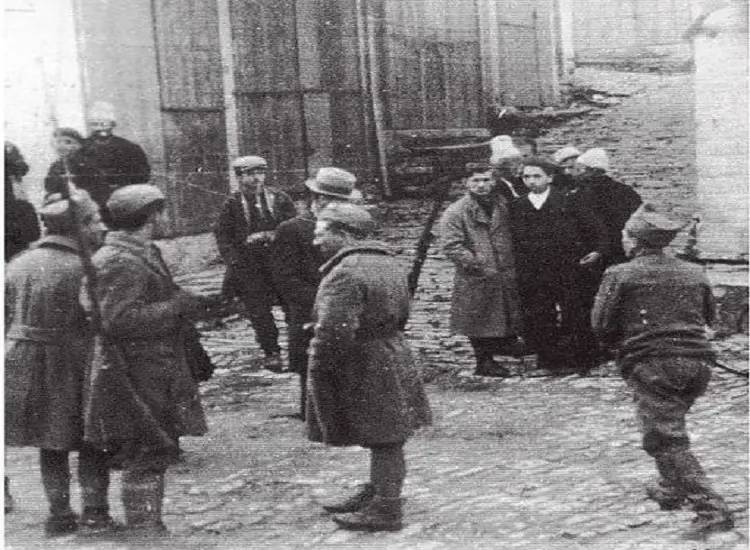
The terror against the Muslims of Korçë and its surroundings continued. The newspaper “Koha” in its articles in the form of memoirs wrote: “Some time ago, they killed two beys of Pojan near the village; now most recently, they killed three Muslims from the plain, and no investigation was made, nor was it learned who committed these murders. Here in Korçë, it is rumored that a Greek committee has been set up, whose duty is to intimidate and kill anyone who opposes Greek propaganda. This Greek committee in Korçë was formed by 8 people, and Kondulis received an order to recognize and support the Greek committee with every brutality, so that the committee has its hands free to do as it pleases. They have also brought in the murderers from the Gulf to kill those people they don’t like. Since this committee also includes some Korçë natives who care nothing at all for Korçë, there is a fear that they may involve us in a fratricidal slaughter. In a word: we have no security whatsoever here in Korçë, and we do not know how our end will be, but things do not look good at all; and the fear is even greater for the nationalists, who are a thorn in the eyes of the Greeks and traitors!” (Newspaper “Koha”, April 1, 1915)
It had been a year since the Greek army had entered Korçë. It was January 7/20, 1913. Bishop Germanos was very moved by this date. He was touched. He greatly wished to die in this city, perhaps even to have his grave there at St. Mary’s at the end of Korçë, under the shade of the fig trees, so that when spring came he would not be scorched by the heat. Perhaps even Anastasia would come every day to weep there at his grave. About this woman, sometimes he said she was his wife, sometimes he said she was his niece, sometimes he said she was his sister, but that matters little; it suffices that the bishop would feel her tears falling drop by drop upon his grave. Her voice would make him shiver even in death. Eh, the famous bishop of Korçë was ready to leave this world at any moment, without any worry in his soul, only to see this city without a single Muslim. He wanted them all dead, in a huge cemetery without end, covered by grass and long oblivion. If, by mistake, any Muslim remained alive, his soul would remain wounded and would not find rest. Not even Anastasia’s fox furs would heal him. But the Muslims of Korçë could not help him fulfill his wish. Nor could they give him Korçë, for it was not worth as much as one of Anastasia’s kisses. Nevertheless, that morning the bishop of Korçë rose healthy and happy. It was the first anniversary of the day they had occupied Korçë, and here he was, still there. They would celebrate that day. Anastasia also liked celebrations. It was said that she betrayed him with Greek colonels and officers, but the bishop acted as if he knew nothing. What could he do? He had a defect: he had one leg and one crutch. Often Anastasia was frightened by the wooden leg; she felt as if she had been placed in a coffin and was sleeping with a dead man.
Yet the bishop could not let the day pass without celebration. They would all gather at a place called “Teboja” somewhere above what is today Rinia Park. The place was surrounded by a small forest. “You will not come,” he told Anastasia, “wait for me here at the Metropolis.” The celebration of the anniversary would also be attended by Commander Kondulis, the trusted man of the Greek King Constantine. Kondulis was all-powerful and could do whatever he wanted, and no one could stop him. Captain Vardha would also come; he was known as one of the maddest Greek captains, he did not fear death. It was said that bullets could not hit him, but the prophecy did not come true. The men of Devoll took his life with a burst of bullets on April 24, 1914 (never mind, that’s another story).
Also coming to the great feast was a special commission created by members of the National Defense (“Ethniki Amyna”), chaired by the bishop himself. On the beautiful hill, like a real paradise, the soldiers of the sacred battalions would swear on the Bible. “We will all die, and we will not leave Korçë in the hands of the Albanians!” “I will come too,” insisted Anastasia again, but the bishop, leaning on his crutch, begged her to stay at the Metropolis, because it was wartime and one never knew what might happen…! The celebration was conducted magnificently.
The satisfaction of the anniversary of the occupation of Korçë did not last long. Events unfolded quickly. On February 24 / March 6, 1914, at the “Ethniki Amyna” (National Defense) of Korçë, chaired by the bishop, a telegram arrived from Gjirokastër stating that a general meeting would be organized in that city, and therefore Korçë should be represented. It was decided that K. Polena (the doctor), Spiro Bimbli, and Papa Petroja would go to Gjirokastër. The journey that Venizelos had undertaken to Europe over the matter of Korçë had failed. Colonel Kondulis and the division chief (Merarchis) Mattheopoulos were summoned to Athens. Venizelos asked Kondulis and General Papoulas, who was in Ioannina, to return to Korçë and hand it over to the Albanians. The Greek army had to withdraw, and Ethniki Amyna had to surrender its weapons and disband. General Papoulas came urgently and left the same day at dawn on February 15/28. Colonel Kondulis would take care of the withdrawal of the Greek army. The artillery was sent to Kolonjë, while all other materials were transported toward Florina. The Metropolis began weaving another dark plan for Korçë.
On March 2/15, 1914, the Albanian army, composed of 250 men led by Mustafa Bey Aranitasi and the Dutch officer Leopold de Ghilard, entered Korçë. The Greek colonel Kondulis, with eyes he did not raise for a single moment, with despair that would not leave his eyes, and with a hand trembling as if he were an epileptic, signed the surrender of Korçë. (He had not imagined it would happen to him like this.) A moment later, Colonel Kondulis was seen accompanied by another Greek colonel, Nikolaos, setting off toward Kolonjë in an automobile that most resembled a death car. They were leaving like two shadows, to arrive afterwards, perhaps, in Ioannina. Above the government building of Korçë, the Albanian flag was raised. Mustafa Bey formed the first Albanian government in Korçë. That same night, Mustafa Bey and Captain Ghilardi visited Bishop Germanos. He returned the visit the next day. He brought the hierodeacons with him. Kind words were exchanged about the new Albanian government. The bishop also did not spare kind words, but his soul was black, just like the clothes he wore. He had sworn: very soon he would strike from behind, with the andartes and Grecomans. Mustafa Bey had no time to wait.
Aided by the most well-known patriots of the region, they formed the Government Council. Two more Dutch officers came from Vlorë: Major Johan E. Snellen van Vollenhoven and Captain Jetze Doorman. They would organize the Albanian gendarmerie. Major Snellen was appointed Commander of the Defense of Korçë, who put into use the official seal with a double-headed eagle in the center, bearing the signature “Commission de Contrôle Provisoire Korça” (Provisional Control Commission, Korçë). Pandeli Vangjeli was appointed Prefect, Abdyl Ypi Deputy Prefect, Themistokli Gërmenji Chief of Police, and Hysen Nikolica Police Commissioner.
Mustafa Bey set off for Kolonjë; he would also establish the Albanian government there. In those days, Major Snellen van Vollenhoven asked the bishop to disband the so-called “sacred battalions” or as they were otherwise called “Ieros Lochos” and to enlist as gendarmes and policemen for the new government of Korçë, but could the bishop accept this request? He had been preparing for months the great fratricide of April 2nd.
The Albanian government of Korçë organized the first gendarmerie corps. People volunteered to serve Korçë. For this reason, they were called “volunteers.” The newspaper “Koha” describes their first military parade: “Never will that Sunday be forgotten when, for the first time in the history of Albania’s rebirth, the nationalists were able to see one of the living dreams they had longed for; never will it be forgotten, we say, that all those who took on this duty were wholeheartedly volunteers, and not forced as in past times when they came for fear of the whip and the bayonet. The longed-for volunteer reassures us completely by the sight of cheerful faces, revives and raises our life, when each one does not delay in fulfilling his duty, proving to us that in Korçë no foreign propaganda can find a place or support…!
On Sunday, when the parade took place before His Excellency Major Snellen van Vollenhoven, the number of the gendarmerie reached 120 men. There, in front of the Courthouse, His Excellency saluted them and then showed his joy by delivering a warm patriotic speech about the need for the gendarmerie.” (Newspaper “Koha”, March 5/18, 1914). From this corps of volunteers (gendarmes), the best marksmen, or as they are called today, snipers, would emerge. We do not know all their names, but the press of the time (in the same order) mentions these gentlemen: Kristo Pema, Qerim Butka, Koli Kaluci, and Zenel Plasa. (Newspaper “Koha”, April 4/17, 1914). / Memorie.al