
By VEPROR HASANI
Part One
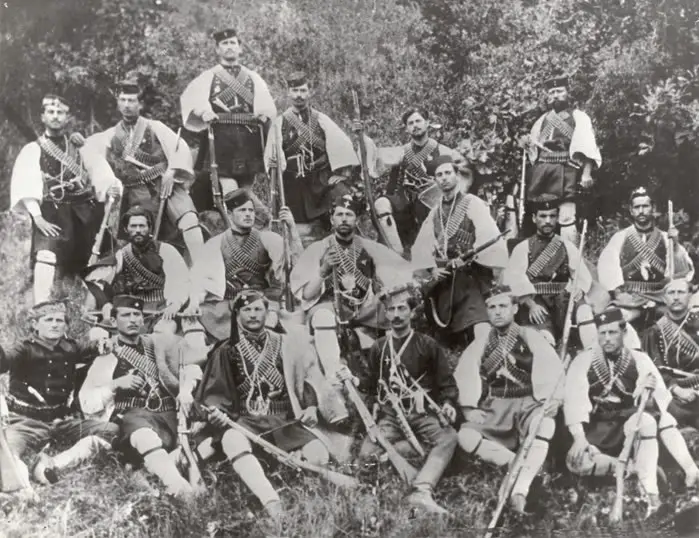
Memorie.al / On the morning of December 5, 1912, according to the European calendar, or December 18 according to the Ottoman calendar, a terrifying piece of news spread: the Greek armies had entered Devoll and were advancing towards Korçë. They were burning, killing, and destroying everything in their path. The Greek divisions were led by a colonel named Dhamiano. The Muslims of the Devoll villages were seized by panic. All the horror was about to fall upon them. They decided to leave their homes and set off towards Korçë, perhaps there they would be safer. Nothing was certain, but they had no other solution. They waited for darkness to fall. The accounts of that night, as December 6/19 dawned, are among the most harrowing. Those who took to the road were many. They could not take anything with them.
It was impossible for them. They had to flee as soon as possible, even a minute sooner. What mattered was staying alive; they asked for nothing more. With infants in their arms, with sick elderly, with children running on foot, they hurried through that black night to reach Korçë as quickly as possible. They were sure: wherever they knocked, Muslims would open the door for them. Even at the Orthodox, they would not find the door closed. The little children cried their mothers soothed them: “Hush, son, just a little further and we’re there,” but the road seemed endless. Until then, they had never experienced a more terrifying night.
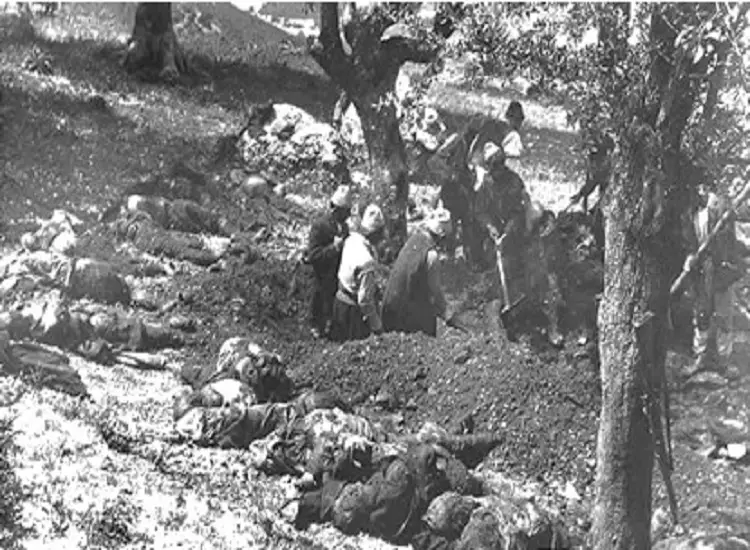
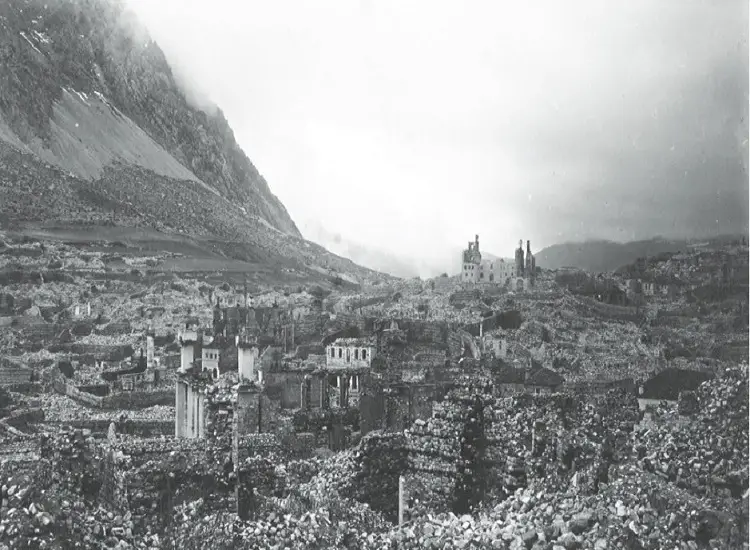
Fortunately, they managed to leave in time. A moment later, the Greek armies arrived in their villages – a pack of savages, thirsty for blood and plunder. All the destitute wretches of Greece had gathered. They stormed the Muslims’ houses. Each one scrambled to grab as much as possible. Colonel Dhamiano watched every move. He was waiting for his own share. After searching even the last house, they set the village on fire. The Muslim villages were turning into ruins. Then, with the same brutality, with torches in their hands, they rushed towards other villages. They stopped in Plasa, Kuç, Dishnicë, Mborje, Kamenicë and elsewhere, leaving nothing unplundered.
After the Greeks left, the Muslim villages were attacked by the destitute Orthodox, Roma, and Egyptians, so that they too could take whatever little might have remained. “The road of Plasa and further up,” writes Petro Harizi in his book “The Chronographic History of Korçë,” “as well as the road from Dishnicë to Korçë, was teeming, we might say, with the people mentioned above, who, loaded themselves or having loaded their animals, were carrying all sorts of loot and household furniture that had been plundered: cauldrons, pots, mirrors, tables, chairs, as well as oxen, cows, sheep, goats, chickens, wheat, barley, honey, cheeses, butters in jugs and gallanoskas [large clay pots], brought from the ruined villages into Korçë.”
A day later, on the morning of December 7/20, 1912, the chief of the Greek divisions, Dhamiano, entered Korçë with the Greek army, advancing as far as the outskirts of the village of Helmës. The third division stayed in the city of Korçë, while the other divisions returned to Florina. The residents of Korçë, young and old, who happened to be outside the city, greeted the Greek vanguard (5 horsemen led by an officer) in a friendly manner, even showing them the roads they should take to reach the city of Korçë or other villages they desired. They believed that the Greeks were coming to celebrate with their Albanian brothers who had just emerged from Turkish occupation.
They were a civilized people and could not stay away without coming to rejoice with their neighbours. The Albanians had helped greatly for Greece’s independence. The friendship between the two peoples was supposed to be great and eternal. This is what the newspaper “Koha” also wrote, but not without irony: “That morning, one of the neighbours managed to visit and congratulate that people, whom she had as her helper. The poor Albanians, as is in their nature, came out with the great respect that an honest friend deserves.” (Newspaper “Koha”, May 13, 1915). But they had been mistaken. The Greeks were coming to seize Korçë and Southern Albania. (They didn’t even want it beautiful as it was, but burned and reduced to ashes).
For the people who had come out to meet them (since they happened to be there by chance), they showed no respect whatsoever. They pushed right through them, on horseback, risking trampling them with the horses’ hooves. The people were stunned, left astonished and disappointed by what they had expected. Someone followed hastily behind the horses, trying to show that he was their man. He kept telling them, in a loud voice: “ime elinas… ime elinas…” (“I am Greek… I am Greek…”), but they didn’t turn their heads. When he tried again to step in front of the horses, things got even worse. The Greek officer’s whip wrapped around his neck, and the poor man nearly died right there in the middle of the road. With great difficulty, he got back on his feet. He looked at them with rage and cursed them in Albanian. He had been one of those who pretended to be Grecomans, but now he saw himself as deceived.
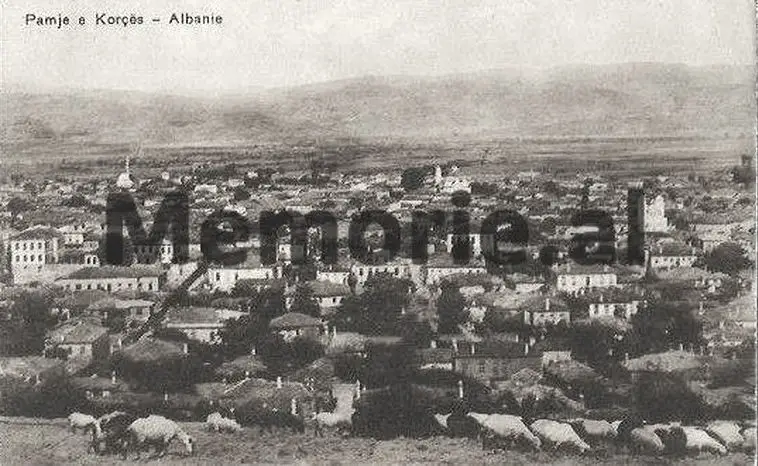
Finally, the Greek vanguard entered the city of Korçë. They looked at the city and were amazed. Korçë was a white city, entirely white, it shone. All the houses were white, painted white, with gardens in front and flowers, enclosed by walls or railings. The bazaar was another wonder, white as well. The streets were straight and clean, with cobblestones that were washed daily with abundant water from the river that flowed down from the Morava Mountains. There was no single-story house. The people were kind and hospitable.
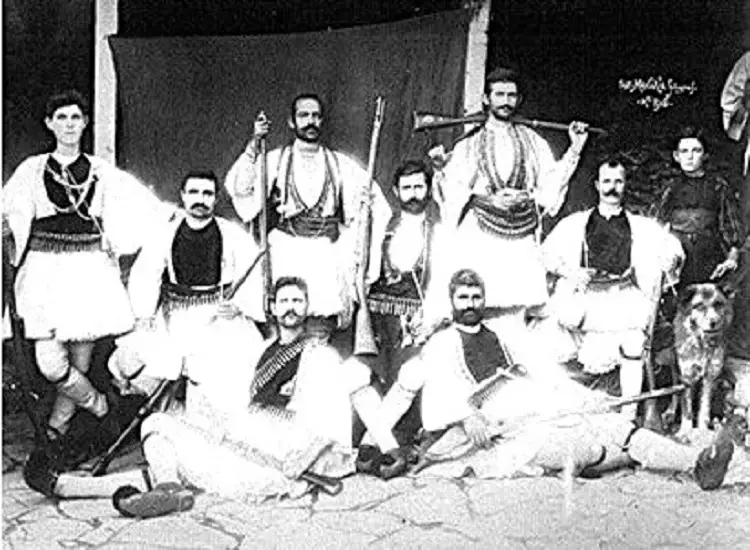
The newspaper “Koha”, in a compilation of memories from its correspondent in Korçë, describes the entry of the Greeks into the city as follows: “Those five horsemen, like wolves entering a sheepfold, left no street of the city unpatrolled, left no pockets unsearched, taking the most valuable things and the memories inherited from grandfathers…! Besides the horsemen and the officer, no other visitors had entered, when we saw a crowd of people; strutting with clubs in their hands as if they had taken the king’s head, singing in Greek, they spread through the city like madmen. These were the andarts [irregulars], deniers of their own homes.
After them came a battalion of regular soldiers (the regular Greek army), who were distributed into the Muslim neighbourhoods to protect their honour (the Muslims’ honour), supposedly! The handsome visitors (the Greek soldiers), when they saw the bright light of the city, dug in their heels and began to strut; for a week they left nothing undone: they dishonoured, cut, stole, destroyed mosques and tekkes, and then used the minarets for rifle practice, may their line be extinguished! … Look how beautifully and how much the Greek government loves the Muslims! Like holding a coal in one’s bosom…!” (Newspaper “Koha”, October 14, 1915). For the Muslims of Korçë, bad days had come.
The Greeks completely lost their minds when, in one house, they found thousands of books printed in the Albanian language. They couldn’t believe their eyes! How was it possible! Korçë with books written in the Albanian language! Thousands of books! Why would they need so many books! They burned them all. But how would the Greeks know that this city, built only 400 years earlier, had initially thought of books and knowledge. When the city’s foundations were laid (1486), the walls of a school for boys and girls were also raised. Korçë, since the 19th century, had had doctors, and since 1892, a pharmacy.
The traveler August Dozon, in 1874, wrote to his government: “For the future, the creation of a hospital is being considered. Above all, this city had for its gods, the School and the Book.” According to the aforementioned traveler, Dozon, in 1874 Korçë was preparing to establish a printing press, and do you know why? To translate the works of the world’s greatest classical authors. The Greek hated books in Albanian, but also in other languages. Then they went to Plasa and burned all the books of the Aromanians written in the Romanian language.
There was no day that could pass without some horror. It was a time when you could hear the most unbelievable news, and all of it was true. A month later, they sent a man named Kapçambelis as prefect of Korçë, then they also brought a judge, and a secretary named Klosaqis. They were all alike: barbarians. For the Greeks and the andarts, Korçë and Southern Albania were and would remain part of Greece. The entire stretch to the south had to be cleansed of Muslims. In this part of the country, the Muslims were surplus.
The Greek army and the andarts became masters of the house in Korçë. The city’s streets stood empty and looked terrifying. No one dared to leave their home. It happened that people had their heads cut off and were left there, in their blood, on the cobblestones. They didn’t care whether you were an adult or a child. They were only interested in spreading panic and causing the Muslims to flee, their departure from Korçë forever. A captain named Angjelidhis was installed as police chief. The most fanatical Grecomans were dressed as policemen.
They spied on, followed, and arrested every person known as a patriot, whether Muslim or Orthodox; on this point they made no distinction, but to be Muslim was a true terror. They beat them, massacred them, and sent them bound to the prisons of Thessaloniki and Halkidiki, from where they would never return. For the Muslims, there was no mercy whatsoever. They even devastated the bazaar. The shops, hotels, cafes, warehouses (properties of Muslims) were looted. The same continued as long as the Greeks stayed in Korçë.
The continuity of the looting is also recounted by the newspaper “Koha”: “Trade in Korçë is very meager, the bazaar is completely idle, all the merchants, even on Saturdays, sit with their arms crossed and are spending their old money, since the Muslims are completely ruined, and since the money from America comes very scantily, Korçë’s trade today is weeping and the Bazaar is in great trouble. But even those handsome Korçars who grabbed [plunder] until they burst, they sit and their money is running out and they are thinking they have nowhere to get more and they can’t find anything else to grab, because they have become accustomed to idleness…! A great scarcity, indescribable, only meat is sold cheaply because the butchers have cows and sheep that have been plundered…” (Newspaper “Koha”, April 8, 1915).
The Greeks had no intention of giving up the killings, burnings, tortures, just as they had no intention of giving up the fires and destruction. With this kind of horror, March 1913 arrived. They continued to show the strength of their army and of the Grecomans they had recruited. But during this time, another piece of news began to spread, which made the Albanians breathe deeply. It was said that Korçë and Southern Albania would be united with Albania. The Greeks had to leave Korçë and go back to where they came from. The decision had been made by the London Conference. For the first time, after so many months, Korçë dawned differently.
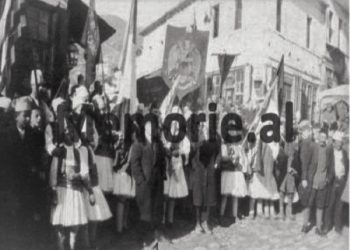
Only that morning did the city realize how tired it had been during that time. They could not believe that the Greek would leave. “When we had the Turks, we lit one candle for them to go away, but now we light ten for the Greek to break his neck, but the Lord doesn’t hear us!” (Newspaper “Koha”, October 14, 1915). This was the constant expression of the residents of Korçë. Now the tiring days were to begin for the Greeks, but as always, they absolutely did not want to give up. They gathered the Grecomans and went out to rallies. “Either union or death!” were their cries. They wandered through the streets of Korçë as if it were carnival day, and then returned home, without any fear or shame.
The army again took to the streets and demonstrated its strength. Volleys of bullets were sent from time to time over the Muslim neighbourhoods. They hoped that the voice of their rallies would reach London and from there spread throughout the world. The decisions of London had greatly alarmed Athens. King Constantine had lost sleep. He had to send his son Jorgos [George] to Korçë to check the pulse of the Albanians and to think about what they could do for Korçë. So the king’s son set out on his journey.
On May 16, 1912 [Note: likely 1913? The text says 1912, but context suggests 1913], Constantine’s son, Jorgos [George], came from Bitola specifically to Korçë, accompanied by the prefect of Florina, Colonel Kondulis, and several Greek officers. He was received at the Metropolis by the Bishop, by the Greek civil and military authorities of Korçë. Journalists had come from Greece and European states. Everyone waited to see what would happen. News spread quickly. A royal dinner was laid out for the king’s son, which remained unforgettable. The eating and drinking of that night continued until morning without end. The bill was paid by Llasoja [the communal fund], the public treasury of the Orthodox residents of Korçë. (The Greeks never knew how to put their hand in their own pocket).
Before leaving, Jorgos [George] came out onto the balcony of the Metropolis to tell the people gathered in the courtyard that Korçë would be Greece’s forever and ever. He stayed in Korçë for three consecutive days, visited churches and mosques as if to tell the Muslims that under the Greek state they would be just as favoured as the Orthodox, but there was no Muslim who could believe this. (The dead, the burned houses, and the looting had not yet been forgotten). Meanwhile, the king’s son set off towards Ersekë, Leskovik, and Përmet, later stopping in Gjirokastër. The prefect Kapçambelis was replaced by Colonel Kondulis. He would be all-powerful; he was the trusted man of the king’s son.
After so much time occupying Korçë, the Greeks had managed to understand one thing: with the Muslims against them, Korçë would never become part of Greece. Either they had to be eliminated, or a different policy had to be followed with them. Here is how the newspaper “Koha” describes the behaviour of Colonel Kondulis after the visit of Prince George: “Colonel Kondulis, already known as the governor of Korçë during the Greek time, is using all the cunning and slyness of diplomacy, by which he thinks he will entice Muslims and Christians to want Greece and to curse and deny Albania.
To the Muslim leaders, he professes himself a brother and a friend with all his heart. Every Friday, Kondulis goes to the mosque and prays to Allah together with the Muslims. By this, he wants to show that Greece is not against Islam and does not destroy their faith, or their religion, or their conscience, but on the contrary, will honour and strengthen it. He has started going from village to village and consoles the Muslims, telling them that both he and Greece are sorry that so much damage has been done to Muslims… and their king (Constantine) will pay the Muslims for the damages done to them by the andarts. And he tells the Muslims that from now on they should not be afraid, because no one dares to disturb or kill them…” / Memorie.al