
By Mentor Nazarko
Part Four
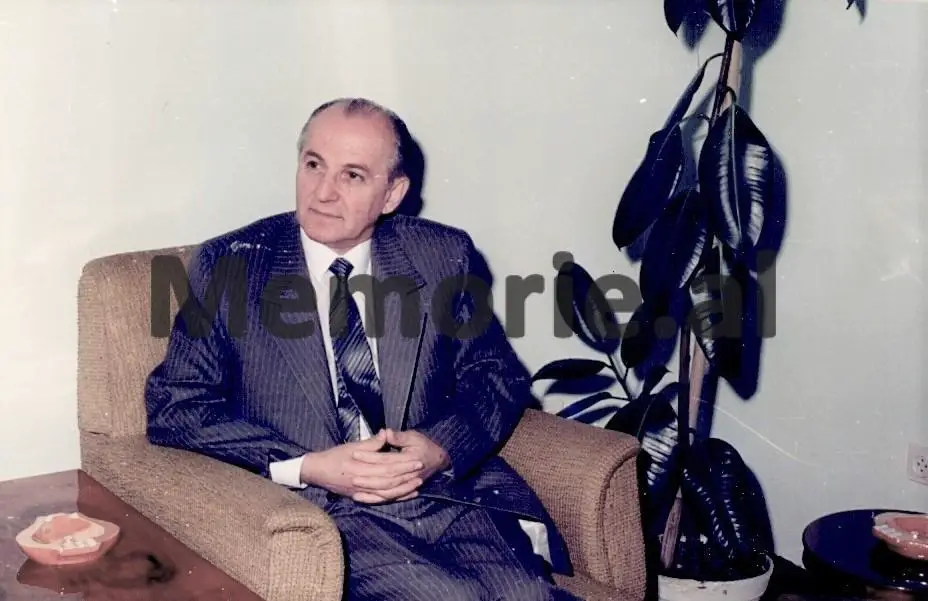
Memorie.al / This interview with Ramiz Alia, part of a series published in the newspaper Abc in the autumn of 2005, is without a doubt the longest, most complete, and freest exclusive interview given by the former communist president at the end of his life. We have chosen to offer the lens through which he views Mehmet Shehu, and it is clear that Ramizi has broken away from Enver Hoxha’s official line, according to which Mehmet was a poly-agent (spy agent).
Continued from the previous issue
Mr. Alia, you were an architect of the efforts to open up toward the USA and other countries. While with Germany you failed, there is a hypothesis. Is there something left unsaid in these efforts? Did you become unacceptable to the West for the continuation of the Albanian transition?
Alia: Not only for me, but also for other comrades in the leadership, it was clear that the path had to be opened for relations with the outside world, including countries such as the USA, England, the FRG (Federal Republic of Germany), and the USSR, with which our country had no diplomatic relations. The truth is that for relations with the Federal Republic of Germany, as well as with the USA and Great Britain, negotiations had begun, also having the positive opinion of Enver Hoxha.
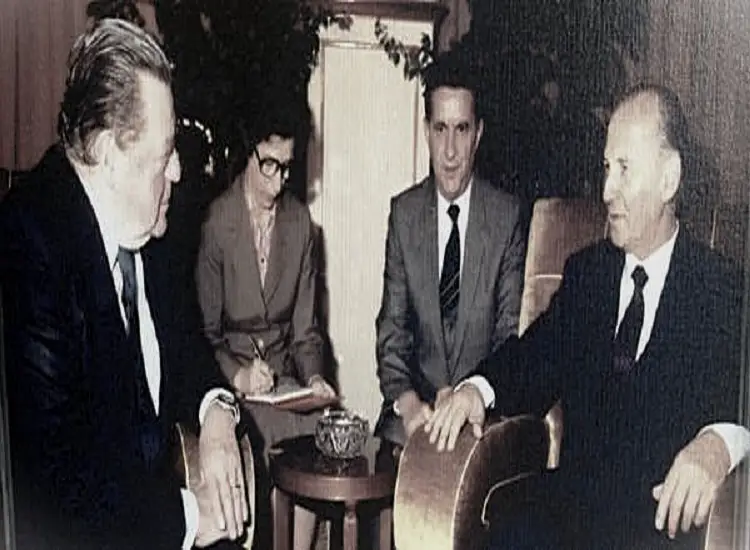
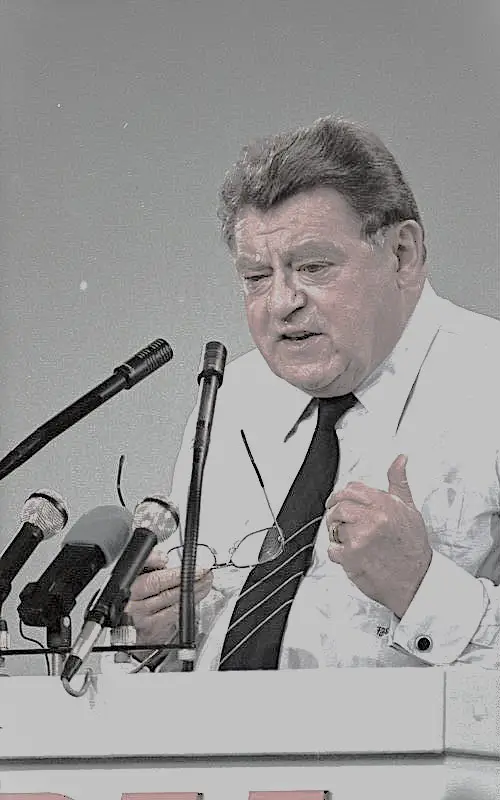
It is known that the Bavarian Chancellor, Strauss, came to Albania in the summer of 1984, that is, when Enver Hoxha was still alive. He authorized Strauss to be received by officials of the Ministry of Foreign Affairs, and also gave instructions regarding our requests for reparations, as a precondition for establishing diplomatic relations.
Enver Hoxha had also agreed to the negotiations with England and the USA. In 1984, both the British and the Americans, through the French Embassy in Tirana, requested that the issue of Albanian gold, held in British banks since the end of World War II, be resolved. Enver also agreed to this and gave the necessary orders.
There has been much speculation in our press regarding relations with the FRG. Doubts have been cast, presenting the matter as if the FRG proposed a one-billion-dollar loan to Albania, but the PPSH (Party of Labour of Albania) supposedly did not accept it in order to remain faithful to the principle that they do not take loans from capitalist countries!
I am sorry that, sometimes, confusion on this matter has also been caused by some diplomat who supposedly learned from some German person or another nationality at that time, that Albania had supposedly refused the German loan. No, categorically, no! The Germans never proposed any loan of those dimensions.
Our side asked the Germans for war reparations (yes, millions, even a billion dollars). But the Germans officially replied to us that they could not give such, because it had been prohibited by the London Conference of 1953, between the USA, England, and France, who were the tutors of West Germany at that time.
Finally, to conclude the negotiations and to show that later our relations could be improved, the Germans decided to give Albania a loan of 20 million Deutschmarks, at 1 to 10% interest and with a 40-year repayment period, along with 20 million Deutschmarks in free aid for German technology and know-how. And the Albanian government, despite the fact that the Constitution prohibited it, accepted this loan.
At that time, we were not so “fanatical” about the constitutional article that prohibited taking loans! If it had been a loan of 1 billion marks, we would have accepted it even more enthusiastically. The “sin” is the same, whether you accept 20 million or you accept 1 billion! There, that is the truth.
To conclude the answer to this question, I remind you that diplomatic relations with the FRG were established as early as 1987. One day after the announcement of the establishment of these relations, I received and held friendly talks with Mr. Genscher. Meanwhile, relations with the USA and Great Britain were established in 1990, although negotiations to resolve the issue of Albanian gold, which was a precondition for diplomatic ties, had begun as early as 1985. As for the question of whether I became unacceptable to the West regarding the Albanian transition, I am not aware of such a thing.
I resigned from the post of President of the Republic in April 1992, not because I had any outside pressure, but because I deemed it reasonable not to remain in that post, since the March 1992 elections were deeply won by the PD (Democratic Party) and, consequently, they would have both the absolute majority in Parliament and the government. In the climate of that time, there was a risk that the president would be reserved the role of a “puppet.” That is why I resigned.
Do you have any suggestions regarding relations with Greece? Anything that comes from that time?…
Alia: I have thought before, and I still think today, that the relations of our country with Greece, but also with the other neighbors, should be as good as possible. Man cannot do without neighbors. This is a well-known law. Besides the previous factors, for the relations of our country with Greece, a very important factor has been added, both for Albania and for Greece.
I am referring to the emigrants, who are said to number around 800,000 people. Through their work and sweat, these emigrants bring great income to our country, which helps raise the economic level of Albania. But at the same time, they also help the development of the Greek economy, because they are involved in the entire economic system of the neighboring country. Politically, the emigrants serve as a link between our two peoples, just as the Greek minorities living in Albania also serve this purpose.
Between Albania and Greece, there are no unresolved problems that would hinder the further development of our relations. The Greek minority in Albania lives freely, with full rights like any Albanian citizen. The stance of state bodies toward minorities is correct and respects international norms regarding minorities. In our press, from time to time, there is talk about the rights of the Chams in Greece. The issue concerns the properties they have across the state border.
It seems to me that within the framework of friendly relations, with patience and understanding, everything can be resolved. The right of ownership is also recognized by the norms of international organizations. But the implementation of these norms requires efforts from both sides, requires patience and not nervousness, which unfortunately is sometimes observed, turning this matter into a political problem that poisons relations between the two countries.
My opinion is that the state bodies of our country, both here at the center and at our embassy in Athens, has numerous obligations toward the Albanian emigrants in Greece.
It is incomprehensible that about 800,000 Albanians do not have organized associations, recognized both by our embassy and by Greek authorities, local and central. The emigrants have many problems, sometimes even conflicts with authorities and locals. Who protects their interests? Who helps them get back on track when they make mistakes, when they violate norms of behavior or the rules of the country where they work and live?
What is done about the emigrants’ children? About their education, about learning their native language? Greece is quite widespread; consequently, the emigrants are found in every part of it, on all the islands. The existence of emigrant associations would be a great help for them to feel closer to their homeland and their families.
You remain a misunderstood figure in your political efforts. The democrats do not like you, but neither does a part of the communists. What is your life’s message that could answer these misunderstandings, or…?
Mr. Alia: I do not claim that every politician, from whichever current, agrees with me or approves of my stances and actions. Throughout all my activity, I have followed what my conscience has told me. Precisely with this conviction, I participated in the Anti-Fascist War for the liberation of the country, I militated in the ranks of the PPSH, and with this conviction, I worked with all my might to preserve the freedom and independence of the country, just as I devoted myself to building the new Albania, a society of justice and social equality, as we desired, based on Marxist theory.
When, as a consequence of the upheaval that occurred throughout Eastern Europe, socialism would give way to pluralist democracy and the market economy, I conscientiously tried to make this change happen without major social traumas and, especially, without bloodshed and fratricidal war.
I am happy that, in cooperation with all the comrades and political protagonists of the time, the change was made peacefully. Undoubtedly, like any person, throughout my life I have also made mistakes. But never to gain anything personally, never with the conscious intention of harming my people or any particular person. / Memorie.al