Memorie.al /The two testimonies, that of D.B. and that of A.A., are cases that reveal other dark sides of the dictatorship, regarding the violence and torture that the former State Security (Sigurimi) inflicted upon women. It is mainly about those women who were in internment, who suffered hardships and torture after their husbands were sentenced to successive imprisonments. But there are also cases where, due to a heavily burdened biography, with the near disappearance of all relatives, women suffered the consequence of being discredited, in some cases before the people, with the obligation to reveal everything. But what was a phenomenon related to the threats, blackmail, and arrests of these women in order to recruit them and turn them into spies.
For these testimonies, the Center for Trauma and Rehabilitation has a database with over 42,000 names of former political persecutees, divided into categories: those executed, those who died in prisons, those who lost their mental faculties while imprisoned, those interned, those expelled. This database constitutes the basic statistical wealth of the center.
These materials represent the status of the former political persecutee. In this center, about 20,000 political persecutees have been visited, who have testified to the names of communist crime, the tortures of communist prisons, and their post-trauma over 16 years of democracy.
The former persecutees recount the tortures, the staging of political accusations, and their lives after regaining freedom, which now constitute the living file recorded with cameras and dictaphones. Everything has been recorded on dictaphone tape and with cameras. Still feeling the fear of persecution, the names of the former persecutees giving testimony are coded, especially when they denounce the crime and the names. The names of their persecutors are spoken openly, without fear, but remembering everything as if it were the day it happened. Nothing from their memory has been erased.
These are truths that have never been told before, and they affirm that entire books would be needed to write down the most horrifying details from the interrogations and prisons. Based on these testimonies, the Institute of Former Political Persecutees has compiled a full 200 dossiers, which contain chilling truths, names of people who fabricated endless killings and internments for various reasons.
Within the framework of collecting these testimonies to document the torture, to shed some light on the consequences of persecution during the years of dictatorship, and also to not leave an important part of our society in oblivion, a number of questionnaires (500) were formulated by the Center for Trauma and Rehabilitation and distributed. These questionnaires were distributed with the help of the Institute of Former Political Persecutees, throughout the entire territory of the country.
The distributed questionnaires aimed to document the socio-economic situation of former political persecutees, to highlight the psychological consequences on the victims of political persecution. But how will this living documentation be administered? As long as the process of shedding light on the crimes continues, these will serve as evidence and testimony of the crimes of the dictatorship.
For the person who has personally suffered the consequences of the dictatorship on their own back, these testimonies are also a counterposition to the falsified dossiers of communist history, which still hold people hostage today. The former political persecutees today are more concerned about their economic situation and family relationships than about the sufferings they experienced in the past.
Long-term political persecution, on the one hand, has left consequences on levels of isolation and self-esteem; while on the other hand, it has also affected their level of trustworthiness. This is closely linked to how they experience the present and how they see the future. Does a kind of prejudicial stereotype exist among political persecutees, as a neglected and forgotten group?
Testimony of D.B.: When they arrested women, they tortured them to obtain information
She is physically very weak, so much so that she can hardly manage to remember what happened to her life during the dictatorship. Her life was a hell in the place where she was interned. She came from a “Balli Kombëtar” family, the reason why she found herself immediately after the liberation in the muds of Lushnja, in the internment camps.
What is your date of birth, and could you tell us a little, why were you sentenced during the dictatorship?
D.B.: I was born in 1924. I come from a Balli family, I married S.B. Before we were interned, I worked in Tirana as a nurse. They took me to Lushnja, then to Ndërmenas in Fier, despising us and taking away our profession.
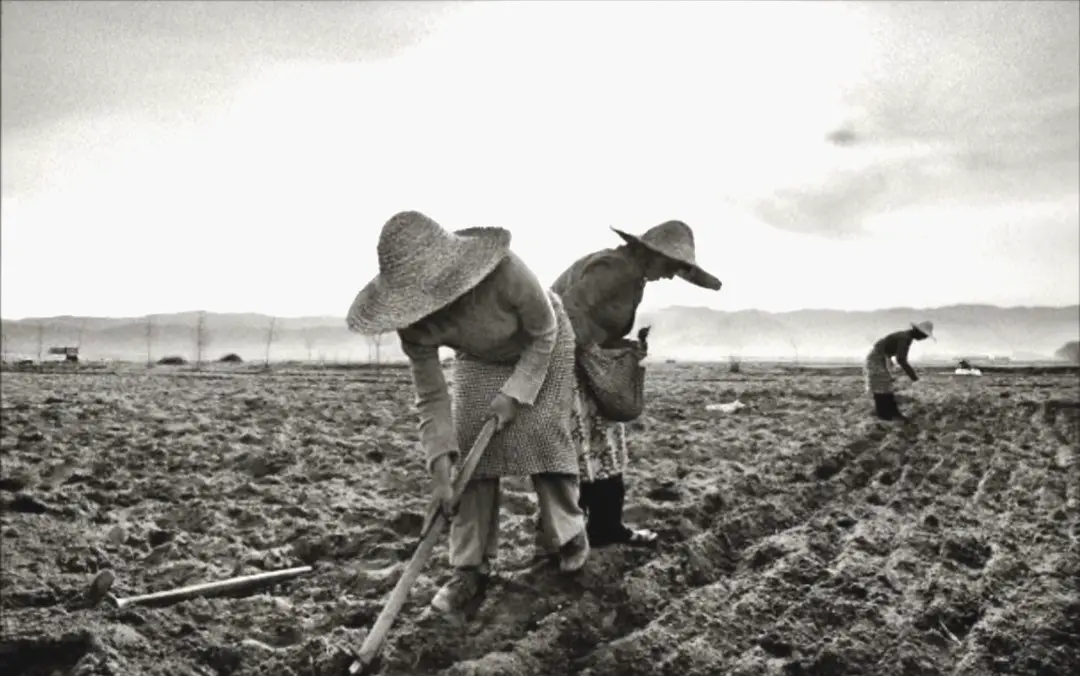
We worked in the field, in the mud; we lived in abnormal conditions in some houses that were not even fit for livestock. No one entered our house; they separated us alive, from my sister, brother, and other relatives. The children would say to us from time to time; “What did you do, Dad that you spoke against the government?”
The poor children didn’t know what suffering their parents had. They had no fault at all, but the only fault was that they were against the communist dictatorship. Enver Hoxha’s regime did what no one in the world has done; it separated children from parents, brother from brother, leaving children unmarried. Parents died without experiencing joys.
How did you experience the dictatorship system?
D.B.: We were always sad, dissatisfied, because we also saw our work and didn’t want to know, because we didn’t even imagine that one day democracy would come with what we had seen, but the time came when…
Did you consider communism eternal?
D.B.: Yes, we considered communism eternal, that’s how we were. We thought we would die there. Having all these problems, and also my husband who was constantly persecuted, you couldn’t say a single sincere thing…!
What about your children, were they in difficult jobs?
D.B.: Yes, yes. As soon as they finished eighth grade, or even before finishing eighth grade, there was a rule that children worked during the three summer months, 6 hours or for a year. This 6-hour work seemed like light work for the children, but then all the adults worked in canals, weeding, harvesting, etc.
What about your health, how have you been?
D.B.: As you see, health…! What can I tell you?!
And now, has anything improved for you, or have you suffered?
D.B.: Eh, as you see…!
What consequences did all that hard work have?
D.B.: Consequences for my husband…, yes, my husband, here he is. But God throws you with one hand, and catches you with the other.
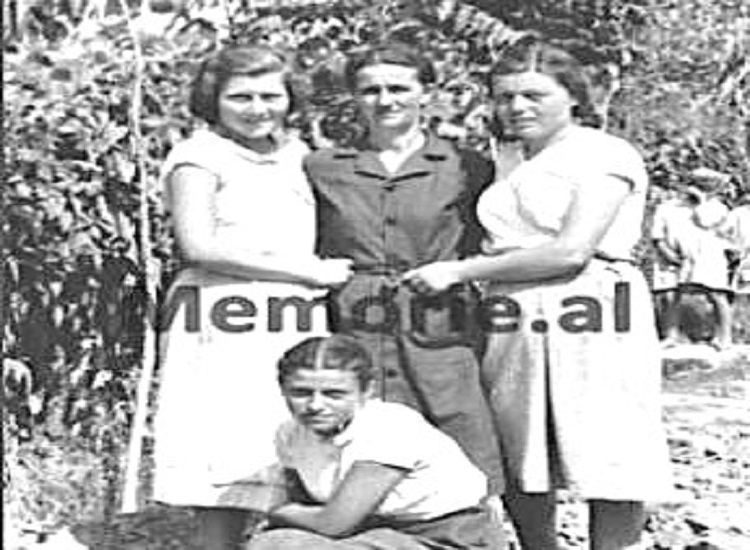
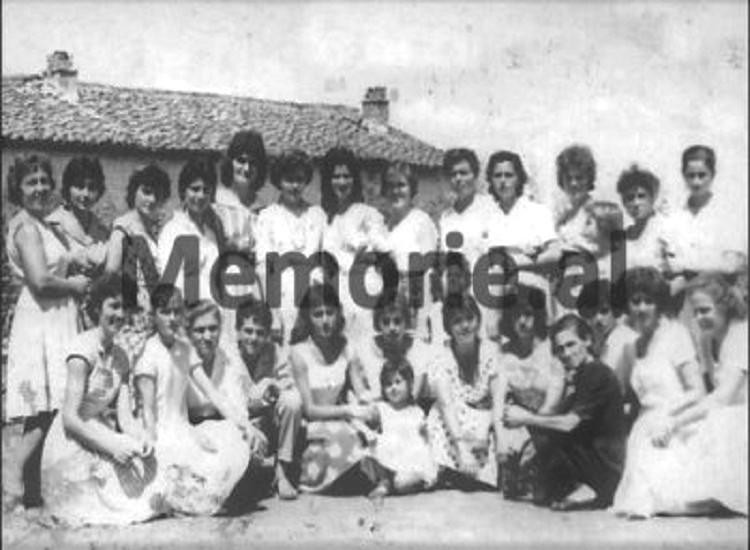
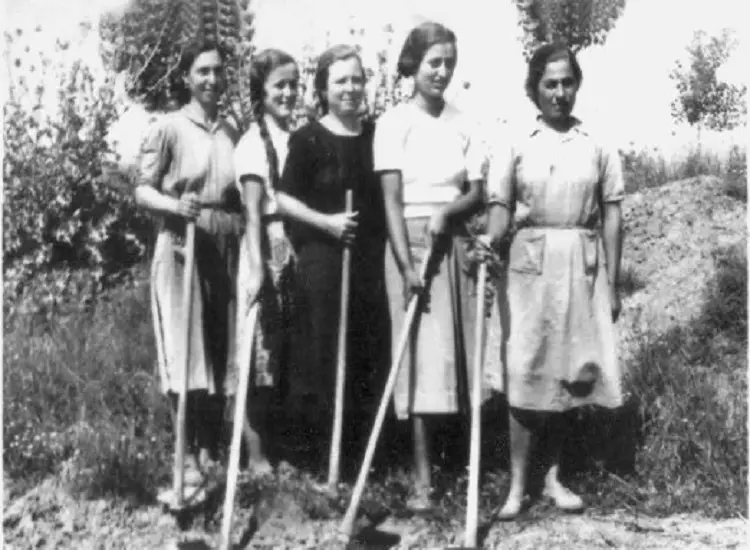
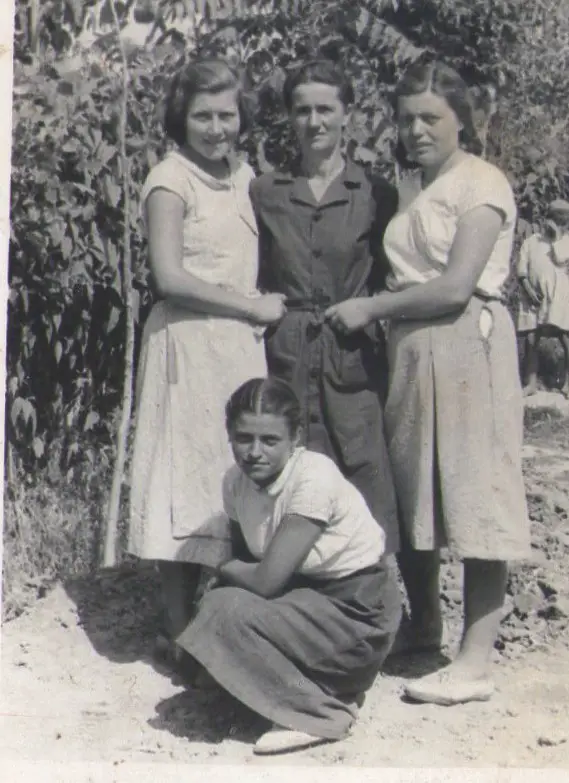
Is this a photo you took during the internment period?
D.B.: All these photographs, I took them all during the internment period. All of them there.
And today, do you talk with your children about that period, for example, what do you remember…?
D.B.: To this day, the children don’t want to know the name of where we were. They are against everything; it’s erased from their memory. They seek another life, they think of another life. That’s how it is.
Meaning you was not given the right to education?
D.B.: No, no, no. The right to education, no.
During the time you were there, was there any intervention from the Sigurimi operative to make you a spy?
D.B.: Yes, yes, yes.
With trickery or by force? Could you tell us something about that then? Who were they after for punishment, you or your husband?
D.B.: My husband, more my husband.
Could you tell us something more about this? What methods did they use to spy?
D.B.: Eh, mostly men were used there to spy. When they arrested them, of course they tortured the women to get some information, to tell how they lived, everything they knew…!
The story of A.A.: In internment, every month they brought us before the people, you had to give an account of what you were doing…?
Mrs. A.A. speaks about her story after her husband was arrested; a case to see how the dictatorship acted with these women, on whom the entire responsibility of the family fell; for them, the suffering was endless.
Mrs. A.A., could you first tell us briefly about yourself?
A.A.: I was born in 1941, and I have suffered both at my father’s doorstep and at my husband’s. I married K.B., after he came out of prison, when there was an even more difficult period for him.
Why?
A.A: My husband came out of prison sick. He had many problems with his lungs, which were shattered, while he also needed a psychologist. He exercised violence against me, which, as he endured it there, I endured it on my back. Life with a man who had suffered the tortures of the dictatorship was very hard, very shocking…! But my father was also in prison. He was tortured; he was put in prison three times.
The last time, he could no longer live, dying at home. My uncle was also executed without trial. At that time, they would take you and kill you without any trial. Two of my aunt’s sons, one they hanged, and the other they executed. This constituted my entire biography at that time.
We know it’s difficult for you, but could you tell us in more detail, how did you experience this series of persecutions?
A.A: You live, because you can’t die! When you can’t die, then you live as best you can.
Do you talk with your husband about the period of persecution?
A.A: We talk, but it’s something that doesn’t fix our life.
Could you list some of the sufferings you had at that time, starting from personal suffering, family disputes, or also society, how did they view you?
A.A.: We suffered the punishment on a farm in Lushnja. We worked there, and we were always under surveillance, we had people over our heads. One small mistake and they would get you fired from work, and then other measures would follow.
At that time, the class struggle was very fierce. Every month you were put before the people and you had to give an account of what you did. They spied on you at every step you took. While the children read at night, they learned a lot, but you couldn’t dream of school.
From all that suffering you experienced, did you stand by your husband?
A.A.: Yes, absolutely.
What were that greatest hope and your strongest point that kept you alive, amidst all those sufferings?
A.A: That the child would be born, that they would grow up, one day we would come out into the light. That’s all.
Could you tell us some of the types of torture he suffered in prisons, so that we might perhaps have a complement to the story he himself told?
A.A: His tortures were very severe. He was tortured once with bread with nails, as he himself said. In the dungeons with water, he caught the cold in his lungs, an old cold that never goes away. When they were transferred from one place to another, they would fill them up like bundles; they would load them with kicks. The tortures were of various kinds, as he told me at that time.
Let’s move on to your life today. What are the problems that concern you the most? What is your health, economic, and social situation?
A.A.: In all of these, a person, and age has also passed, I am spiritually broken. Morally, a person needs to find understanding at some point. My marriage has been very difficult.
Why, how did he behave?
A.A.: When he came out of prison, he was alienated, he had become nervous. / Memorie.al