




By DASHNOR KALOÇI
Part Three
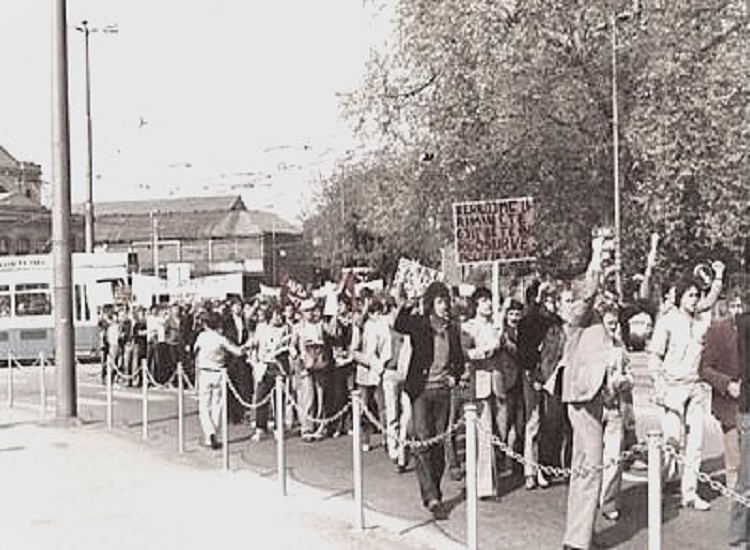
Memorie.al/ The events of the spring of 1981 in Kosovo, which began at the start of March with the protests and demonstrations of the student youth and subsequently of the people of Kosovo, who rose up to demand their lawful freedoms and rights, as well as the status of a republic, just as all other peoples and ethnicities then within the Socialist Federal Republic of Yugoslavia had and enjoyed – led by the Bosnian Cvijetin Mijatović (President of the Presidency, May 1980 – May 1981) – as is already known, provoked a harsh reaction from official Belgrade. The high leadership of Serbia at the time, led by Prime Minister Ivan Stambolić (President of the Executive Council of the Socialist Republic of Serbia), upon which the Socialist Autonomous Province of Kosovo then depended, sent armored forces there and violently suppressed those protests, not only with police forces, but by also bringing the army and tanks out onto the streets and squares of Prishtina and other cities where those peaceful protests took place, during all of which days (March 11 – April 11, 1981), there were a total of 12 victims.
These events, which became the lead story in all world media, as well as the public reaction of official Tirana, are now very well-known from dozens of writings or archival documents published mostly after the 1990s, but what has remained a great enigma and has not been made known to this day is this: how did the leader of communist Albania, Enver Hoxha, initially react to those events; what was his first impact regarding what was happening in Kosovo; and what steps did official Tirana subsequently undertake to come to the aid of its compatriots in the Socialist Autonomous Province of Kosovo? Did Enver Hoxha stand by what he had said in 1970, that Fadil Hoxha and the high leadership of Kosovo were doing very well to oppose Kosovo being given the status of a Republic within the framework of the Yugoslav Federation, or had he changed his mind and his stance?!
Regarding these and other matters, we are familiar with several archival documents located in the Central State Archive (the personal archive of Enver Halil Hoxha), which have been unknown until today and will be published for the first time and in several installments by Memorie.al. From these documents, it is noticeable that from March 4, 1981, (when the spontaneous student youth protests first began in Prishtina), until April 3, when Enver Hoxha held a working meeting with Prime Minister Mehmet Shehu and Ramiz Alia regarding the events in Kosovo – thus for a full month – there was complete silence and no meeting of the Political Bureau or the Secretariat of the Central Committee of the Party of Labour of Albania was held, thus no reaction from the high leadership of the PLA or official Tirana.
Likewise, what is noticeable in these documents is the panic that seized the main leader of communist Albania, Enver Hoxha, who was hesitant and undecided about the stance official Tirana should maintain regarding the events in Kosovo, so much so that in another conversation at the House of the Party on April 5, 1981, with the “comrades of the leadership” (Mehmet Shehu, Adil Çarçani, Hekuran Isai, Kadri Hazbiu, Pali Miska, Spiro Koleka, Rita Marko, Pilo Peristeri, Simon Stefani and Qiriako Mihali, Nedin Hoxha and Behar Shtylla), where they would go for coffee, or to play cards, billiards, etc., Enver asked them: “What do you think about the recent events in Kosovo and what should we do? Should we take a stance and be concerned, or not?” Likewise, during another brief conversation that Enver Hoxha had in his office with Ramiz Alia about a month later (on May 13, 1981), he told him: “Regarding the events in Kosovo, it seems to me that our subordinates should also think, and it should not be expected that I am the only one to think about them”!
Regarding these and other matters, these archival documents, which belong to the period April–June 1981, where Enver Hoxha held several conversations and meetings, both with his two closest collaborators (Prime Minister Mehmet Shehu and Secretary of the Central Committee, Ramiz Alia), as well as with the Political Bureau and the Secretariat of the Central Committee, are being published for the first time with their respective facsimiles by Memorie.al.
Continued from the previous issue
MINUTES OF THE CONVERSATION BETWEEN ENVER HOXHA AND RAMIZ ALIA, HELD IN HIS OFFICE ON MAY 13, 1981, REGARDING THE EVENTS IN THE SOCIALIST AUTONOMOUS PROVINCE OF KOSOVO
BRIEF MEETING IN THE OFFICE OF COMRADE ENVER ON WEDNESDAY, MAY 13, 1981, WITH COMRADE RAMIZ ALIA
COMRADE ENVER HOXHA: As I have written in this material, it seems to me that our subordinates should also think about the events, and it should not be expected that I am the only one to think about them.
COMRADE RAMIZ ALIA: Yes, that’s right, comrade Enver.
COMRADE ENVER HOXHA: My concern is regarding the statement made by Dušan Ristić last night. Now in the Provincial Assembly of Kosovo, they might say that they will cut off cultural, scientific, and educational relations with Albania.
Then, under the created conditions, even we must be prepared to broadcast all the programs signed with official protocols with Kosovo through Radio-Television. But has anything been done in this direction by the government side?
COMRADE RAMIZ ALIA: No, nothing has been done yet.
COMRADE ENVER HOXHA: It is known that the government hasn’t done anything yet, but my worry is about the preparation of lectures and other materials with which we were engaged to help in the development of education and culture in Kosovo. In this direction, work must begin without delay, because preparation cannot be done within a day.
Then there is the other matter as regards what others say about us, especially in relation to the articles we publish, and regarding the acts that the Titoists are carrying out in Kosovo. They are now dismissing professors and teachers, especially those who do not speak out against patriots and workers who rose up in demonstrations, and about other things they think to do regarding education, culture, students, etc.
All these stances should be clearly pointed out by our press, because in this way we prepare international opinion for the anti-Albanian actions of the Titoists. The facts that we will point out will come as a supplement to those we raise in our articles.
We note that in the world, many people, many diplomats tell us that on these issues we are addressing in our press and propaganda, they are hearing about them for the first time. Besides these, we, relying on the data of Tanjug, help the revisionists of Belgrade to expose themselves.
Therefore, let us better mobilize our press and propaganda workers to work with their heads, and not only when we suggest to them, to draw their attention to reflect more deeply on the events, to make them suggest to us as well what we should do.
Even without waiting at all for the publication of our article, they should have suggested that in our press, Radio and Television, we should highlight all that the Yugoslavs say about us, how and why they accuse us. These we should reflect in the press as they are, without comment, because the comment will be made later.
This path is also being followed by our enemies, the Yugoslav revisionists; they inform their people about events they think are in their favor, so we too should inform our people about those actions they are taking against the Albanians in Kosovo, etc.
Likewise, ‘Tanjug’ earlier made a summary of our article, and then gave these others. We should do the same. Naturally, the articles we publish have their effect, but the point is that before we give answers, we must prepare the ground in time, so that our domestic and international opinion is well and correctly informed about every action of the Titoists.
COMRADE RAMIZ ALIA: Yes, correct, that’s right, we must also prepare and we will act accordingly, comrade Enver.
MINUTES OF THE MEETING BETWEEN ENVER HOXHA AND RAMIZ ALIA IN HIS OFFICE ON JUNE 4, 1981, REGARDING AN ARTICLE TO BE PUBLISHED IN “ZËRI I POPULLIT,” AGAINST THE ACCUSATIONS OF BELGRADE
CONVERSATION OF COMRADE ENVER HELD IN HIS OFFICE WITH COMRADE RAMIZ ALIA ON JUNE 4, 1981, REGARDING THE PREPARATION OF A THEORETICAL-HISTORICAL ARTICLE IN A STRICT POLEMICAL FORM AGAINST THE UNFOUNDED ATTACKS MADE ON US BY THE RABID CHAUVINISTS OF BELGRADE
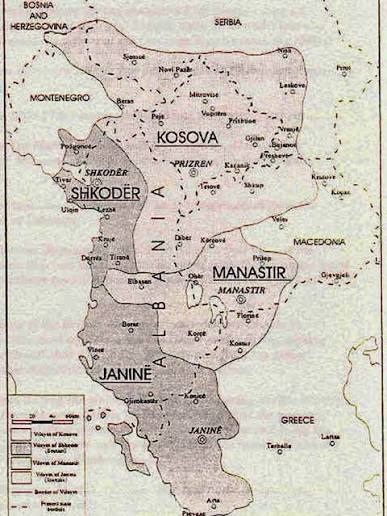
COMRADE ENVER HOXHA: I gave Haxhiu some other theses, with which I think to prepare an article also against the Bulgarian revisionists. As I say in the theses, the main purpose, without addressing the Yugoslavs directly, is to tell them that in Macedonia, Albanian lands are included, where a large Albanian population lives. This is the idea, which will be launched by attacking the Bulgarians for the map they published on the anniversary of the Treaty of San Stefano. According to this map, the Bulgarians extend their borders to the Adriatic.
In the article, we will attack this publication and point out that, from the point of view of ethnicity, in Macedonia, whether it can be called Aegean, or Vardar, or simply Macedonia, there exist Albanian lands and populations, and to clearly define the borders within which territory this population lives. I put the title in the theses: “Dangerous Games with Maps.”
It is not the first time; I say there, that the Bulgarians have made such publications. They also another time, in 1960, printed a map where they put all of Albania within the borders of Yugoslavia. This was a gift given to Tito at that time. On this map, Albania appeared as the seventh republic of Yugoslavia.
In the theses you will receive, it is written in which documents our interventions for these actions are recorded, such as my speech before the representatives of 81 parties in 1960 in Moscow, then also a special note addressed to the Bulgarian Government. Yes, as I saw these days, the speech I gave before the representatives of 81 parties in 1960 in Moscow is stronger.
COMRADE RAMIZ ALIA: That is a very good document.
COMRADE ENVER HOXHA: There it also speaks about the event in Sremska Mitrovica.
COMRADE RAMIZ ALIA: It’s about the speech that was held in this place, where the Soviet ambassador was also present?
COMRADE ENVER HOXHA: Yes. And on this occasion we made a strict protest. I think this event should be used in the article we will publish against the Great Serbian-Soviet conspiracy, to use the strongest phrases used there against the Soviet ambassador and the military attaché.
COMRADE RAMIZ ALIA: In which one, in that of Sremska Mitrovica?
COMRADE ENVER HOXHA: Yes, in that of Sremska Mitrovica. There it was said that: “Albania is surrounded with barbed wire, where the boot of the border guard dominates…” and the Soviet ambassador with the military attaché who participated in this event, listened with the greatest seriousness, in other words, they approved, thus publicly supported the theses of the executioner Ranković. This is one thing.
As regards the articles that you told me will be prepared by Aleks Buda, they are good and can be published, but, as I see, it appears that the outside world is not paying proper attention to the events unfolding. A few days ago, I read the article prepared by a group of professors, which seemed good to me. I also read Ismail Kadare’s article, which was even better, however I note that these have not been echoed by the international press; there is a “fatigue” on their part, and it even seems as if they want to leave the impression that they have spoken much about the tragic events that occurred in Kosovo. Although, as I see from our latest materials, there might still be comments.
COMRADE RAMIZ ALIA: Last night, Reuters gave a news item about our latest article, comrade Enver, but a very small thing.
COMRADE ENVER HOXHA: Yes, yes, Reuters gave a very small thing; it did not touch the essence of the matter. But why does the world press maintain this stance? In general, there is a tendency of decline by the world press in the treatment of Kosovo events, because the West aims to protect Yugoslavia; however it sees clearly that in the policy the Yugoslavs are following, they have no basis. Diplomatic circles approve our stances, they do not give echo in the press to the Kosovo events, and we notice that, as time passes, the world press is talking less and less about them.
It is different on the Yugoslav side; they speak and will speak more. Their tendency is to attack us from all four sides, whether the world presses writes or does not write about these events. The attacks they make against Kosovo and the People’s Socialist Republic of Albania are made mainly for their domestic opinion, but as much as possible also for abroad, because the more their word is spread, let it be heard, they think, it’s good; whoever believes, let them believe, but even he who does not believe, something will still remain in his mind from the great propaganda they are making.
Now it seems to me that the time has come that we should use historical facts for polemic. Therefore, after preparing all these articles we have in hand, I think we should also write another long article, not to be printed immediately after these, but in time. In this article, let us begin to explain theoretically what “irredentism” means, what “nationalism” means, and what “chauvinism” means.
First, let us explain these as they are understood in Yugoslavia and as they are understood in Albania, in “little” Albania or in “Greater” Albania, what are the reasons for their birth, where they have their bases, to make on this occasion a balance sheet of where the most pronounced “chauvinism” or “nationalism” has existed, among the Serbian people, in the Serbo-Croat-Slovene Kingdom and in the Titoist regime, or among the Albanians living in Yugoslavia and then in the People’s Socialist Republic of Albania? / Memorie.al