



By UVIL ZAJMI
Part Two
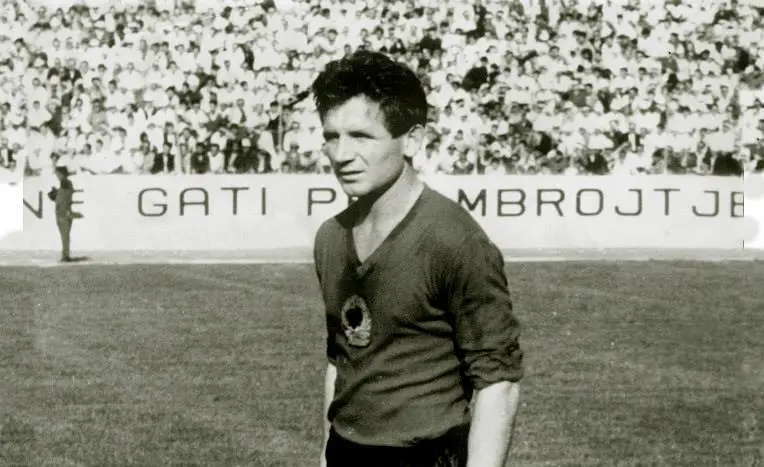
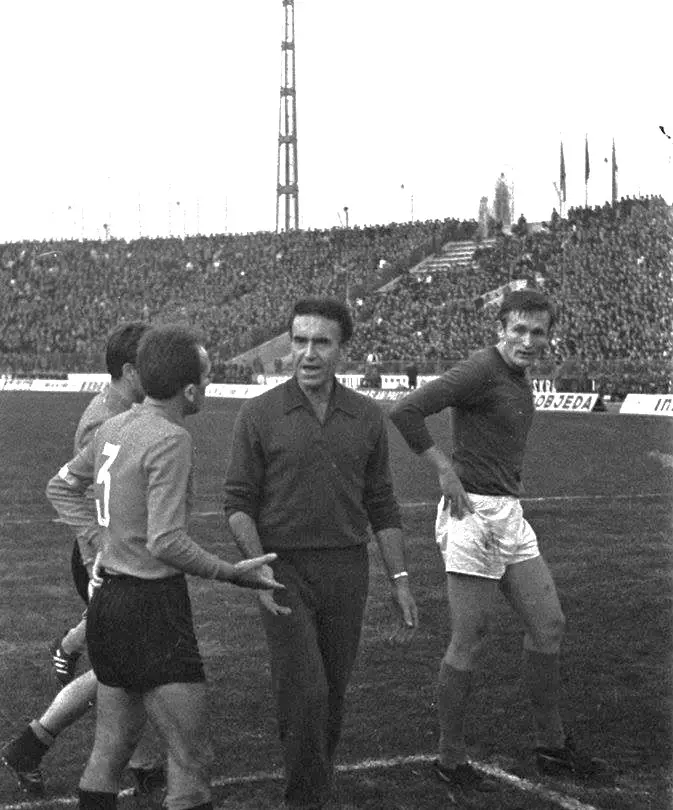
Memorie.al / This were the third match for our national team in 1967. Following the encounters in Dortmund (West Germany vs. Albania, 6-0) and Tirana (Albania vs. Yugoslavia, 0-2), two final matches remained: Yugoslavia vs. Albania on November 12, and Albania vs. West Germany, scheduled for December 17. Qualification was still at stake; nothing had been decided for the two contenders, West Germany and Yugoslavia, as Albania sat in last place with zero points. The matches still held great interest, and the one in Tirana would ultimately determine which team would go to the finals in Rome in June 1968. But what was the political and sporting atmosphere on the eve of the Belgrade match? How did the lineups change, and why did the Serbs place ten footballs in the Albanian goal?
Continued from the previous issue
How do Zan Rragami, Mikel Janku, and Iljaz Çeço remember it, and what was the critical commentary coach Loro Boriçi made regarding his own team? These are the unforgettable 90 minutes from half a century ago – specifically Sunday, November 12, 1967 – in a stadium filled with Albanians, where chants of “Eho! Eho! Eho!” echoed through the stands.
The Aftermath of “17 Nëntori” – “Partizani”
The consequences of the “17 Nëntori” vs. “Partizani” match (2-1) in June 1967 led to the expulsion of both teams from the championship. That period was characterized by public criticism and self-criticism, both individual and collective, within sports clubs. Nevertheless, the championship concluded with Dinamo as champions (38 points), followed by 17 Nëntori (33), Besa (26), Skënderbeu (26), and Partizani (25). Flamurtari survived after two play-off matches against Tekstilisti, while Luftëtari was relegated to the Second Division. Meanwhile, the draw for the first round of the European Cup took place, and Sporti Popullor informed readers of the matchup: Dinamo vs. Eintracht Braunschweig.
In a sudden move, the Albanian Football Federation (FSHF) decided not to hold the national championship. Instead, in September, a nationwide activity called the “FSHF Cup” was organized with teams split into two groups. Despite Dinamo’s preparations for the European Cup, an order arrived just weeks before the match prohibiting their participation.
Sporting Highlights: Marjeta Pronjari’s New Record
Athlete Marjeta Pronjari set a new high jump record of 1.64 m. “Traktorul,” a Romanian volleyball team, continued a friendly tour in Albania. Activities were held in honor of the 25th anniversary of the People’s Press and the newspaper Zëri i Popullit, won by 17 Nëntori. Vllaznia returned from Romania after a 1-1 draw with Jiul and a 5-3 loss to Minerul. For the Balkan Cup, Partizani defeated Fenerbahçe 2-0 in Tirana. In Turkey, Partizani played the return leg, losing 3-2.
The Political Atmosphere in Albania and the World
In September, Enver Hoxha visited Shkodra, while a government delegation led by Mehmet Shehu traveled to Pakistan. Two major congresses were held in Tirana: the Democratic Front and the 6th Women’s Union Congress. On October 8, the world was shocked by the news of Che Guevara’s capture; he was executed on October 9, 1967, on the orders of Bolivian President René Barrientos.
Albanian-Serbian Relations
With Tito’s Yugoslavia, sporting relations were at least “normal” on the surface, as reflected during the match in Tirana. However, the Belgrade match was anticipated with more intensity. There was sporting tension because the hosts were expected not only to win but to score as many goals as possible. Additionally, there was political pressure, as many Albanians living in the territories of the former Yugoslavia flocked to attend the match.
The Squad against Yugoslavia
The national team played no friendlies before this match. Coach Loro Boriçi gathered the following players:
- Goalkeepers: Rama, Janku, Jozja
- Defenders: Jorgaqi, Vaso, Dembo, G. Xhafa, Stringa
- Midfielders: Mema, Rragami, Shllaku, Kazanxhi
- Forwards: Andoni, Pano, Çeço, Zhega, Bizi, Hyka
A Night in Macedonia
The team gathered in Tirana, stayed one night in Pogradec, and then traveled by bus to Serbia. They spent a night in Skopje, where the city’s large clock remained frozen at five minutes to six – the exact moment of the severe earthquake. They observed tents housing displaced families along the road. The delegation arrived in Belgrade on Friday, November 10, staying at Hotel “Pallas,” where hundreds of Albanians were waiting for them.
Group Standings before the Match
West Germany had 4 points (3 matches, goal difference 6-1), and Yugoslavia had 4 points (2 matches, goal difference 4-3). Notably, the West Germany vs. Yugoslavia match (3-1) on October 7, 1967, in Hamburg was the first football match ever broadcast in color – though the second half reverted to black and white due to heavy rain.
Boriçi Changes the Lineup
Boriçi made several changes. In goal, he started Jani Rama of Dinamo, a tall and elegant goalkeeper who excelled in the air. This was Rama’s debut as a starter, while Mikel Janku remained on the bench (Tirana would be his final match for the national team). Defenders Frashëri and Kazanxhi did not play, nor did Xhaçka and Vorfi, who left the national team permanently. Gani Xhafa and Jorgaqi made their debuts, and Sabah Bizi returned to the squad.
The “Threat” of Ten Goals
On the eve of the match, the Yugoslav media and public created an aggressive atmosphere, claiming they would score over ten goals. Upon arrival at the training session a day before the match, the Albanian staff found ten footballs placed inside one of the goals as a psychological tactic to signal the impending scoreline. “It was Zhega who went to the goal and kicked the balls out,” recalls Iljaz Çeço.
The Anthem: Another Delicate Moment
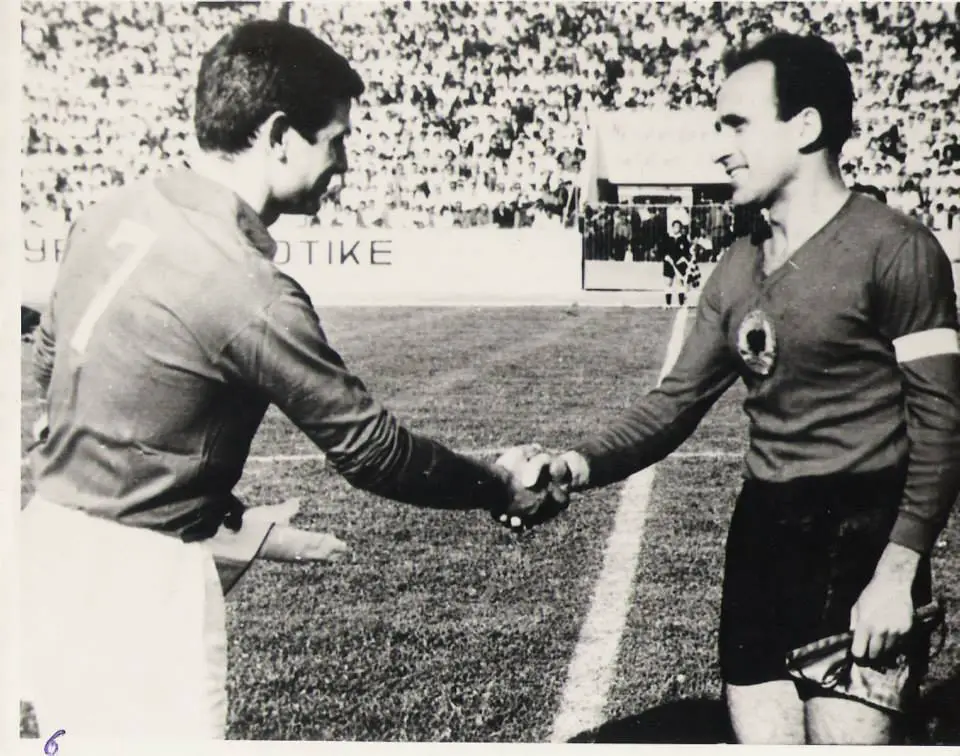
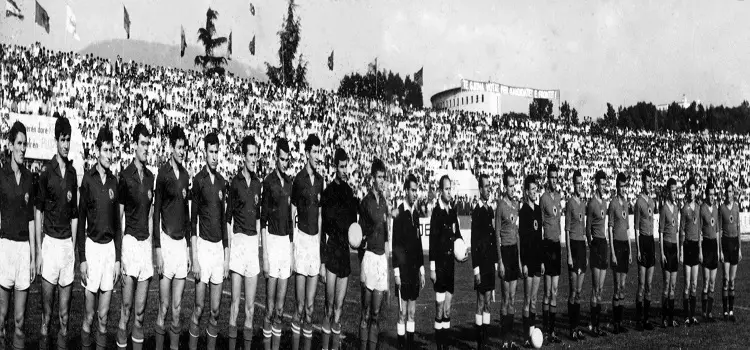
The execution of the national anthem was a powerful moment. For the first time in nearly 20 years, the Albanian anthem was played in a Yugoslav stadium. It was accompanied by the voices of ten thousand Kosovars present, who sang it loudly.
November 12, 1967, Belgrade
Stadium: JNA (Armata), 4:00 PM
YUGOSLAVIA 4 – 0 ALBANIA
- Yugoslavia: Vukčević, Fazlagić, Pavlović, Damjanović, Holcer, Đorđević, Sprečo, Rora, Lazarević, Osim, Džajić. Coach: Rajko Mitić.
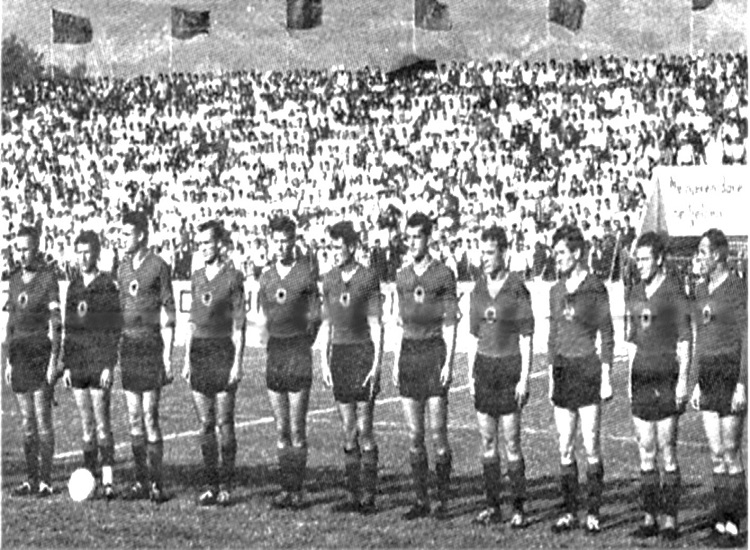
- Albania: Rama, Xhafa, Jorgaqi, Vaso, A. Mema, Rragami, Bizi, Shllaku (C), Andoni, Pano, Zhega. Coach: Loro Boriçi.
- Goals: Sprečo 40′, Osim 48′, 71′, Lazarević 56′.
- Referee: Radulescu (Romania)
- Attendance: 40,000
Match Chronicle: Goals from the Air
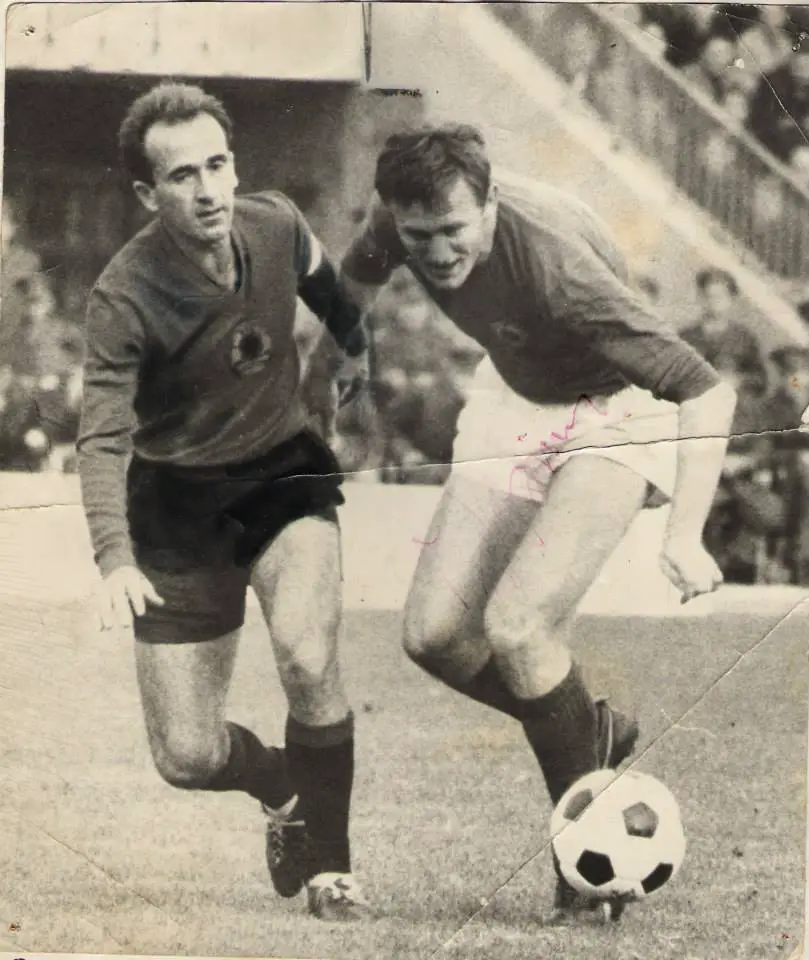
The first goal came in the 40th minute from Sprečo; a cross from the left hit the post and bounced down. Despite protests, it was ruled a goal. Shortly after the second half began, Ivica Osim scored with a powerful shot. The third was a header by Lazarević from a left-wing cross. The final goal was another header by Osim, where the goalkeeper Rama reacted late. Albania’s best chance fell to Sabah Bizi after a pass from Pano, but the shot was saved.
The Enigma of the Broadcast
The match was broadcast on Yugoslav television. In Albania, it was only seen in the north (mainly Shkodra) by the few families who owned televisions and could pick up the signal from Montenegro. In the rest of Albania, it was followed via radio.
Boriçi’s Critique
Since no sports journalists accompanied the team, coach Loro Boriçi himself wrote a critical commentary in Sporti Popullor upon his return. He stated: “Our team was not comprehensively prepared… It lacked the proper physical preparation, which stems from the weak and unserious work done in regional teams and clubs.” It was a unique time when a coach acted as his own team’s public critic.
The Belgrade Days of the Albanians
The reception from Albanians living in Yugoslavia was extraordinary. They surrounded the team at every moment. Loro Boriçi wrote: “The most touching moments cannot be forgotten. There were elderly people, adults, and youths. They wanted a souvenir from Albania. We gave them Albanian cigarettes… even children took them to bring to their fathers. They even asked for the empty boxes once they were finished. One person was given a copy of Zëri i Popullit. They even took photos in front of the bus, making sure the license plate with the ‘TR’ (Tirana) initials was visible.”Memorie.al
![“The ensemble, led by saxophonist M. Murthi, violinist M. Tare, [with] S. Reka on accordion and piano, [and] saxophonist S. Selmani, were…”/ The unknown history of the “Dajti” orchestra during the communist regime.](https://memorie.al/wp-content/uploads/2026/02/admin-ajax-3-75x75.jpg)
