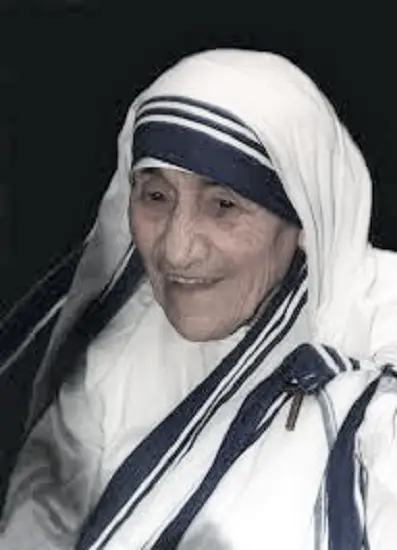

By Visar ZHITI
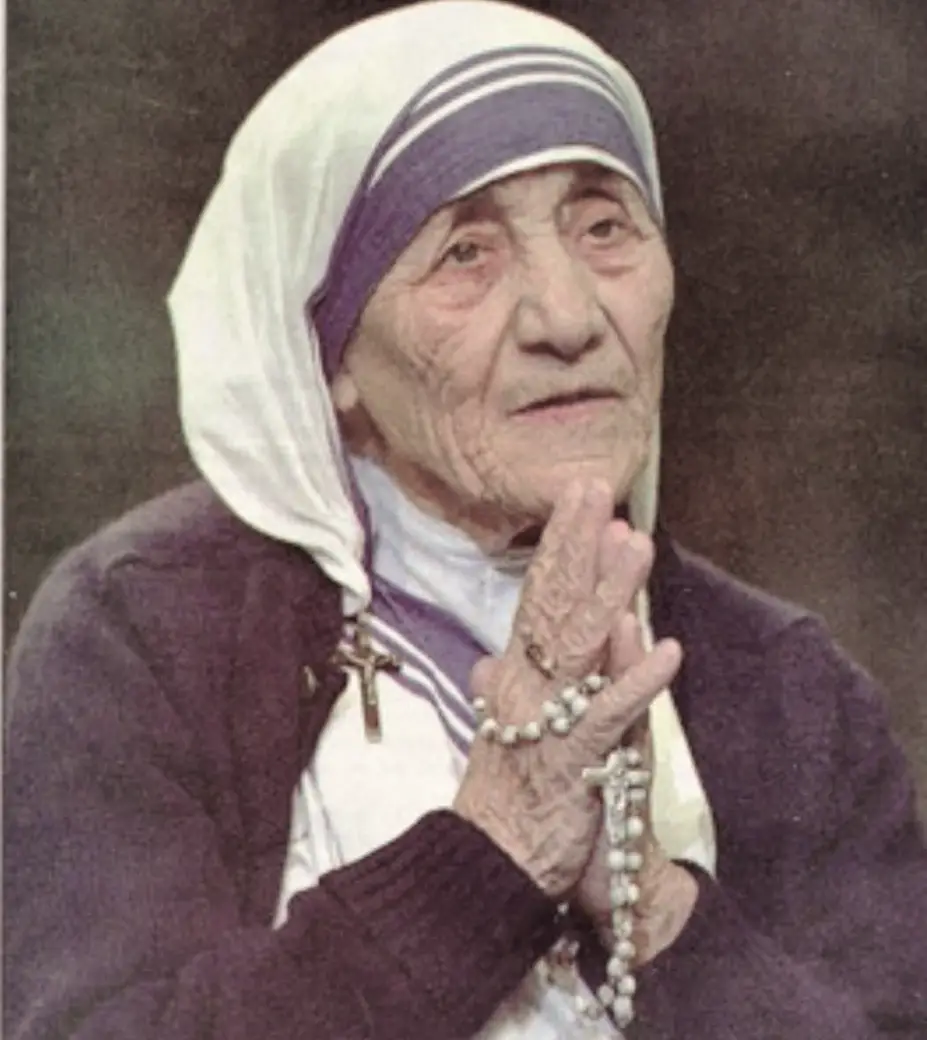
Memorie.al / The day of the canonization of Mother Teresa is now a holiday for everyone, officially proclaimed, and indeed on that day she is commemorated; there should be activities dedicated to her, homages, conferences, publications, concerts, etc., etc.
Her humanitarian work, her deeds, and her words have crossed all borders. She is not simply a great Catholic missionary, nor merely the winner of the Nobel Peace Prize. In today’s language, she is considered the “investor of love,” the “industrialist of smiles,” etc., being called the most famous woman on the planet, the Mother of the World, etc.
Why? Because, after all, despite astonishing developments, when life and the scientific worldview, science itself, the arts, have become incredibly modernized – the 20th and 21st centuries have brought unimaginable wonders to daily life – man explores the atom and the cell, as well as the celestial spaces and galaxies, and all of himself, while searching for God everywhere. It seems to him he cannot find Him, but it is simple. Even according to the old Aristotelian thought that there is no effect without a cause, so this entire universal creation also has a Creator, etc., etc. But one thing has remained the same: people, more than anything, need love and a smile – that is, humanity. Saint Mother Teresa took this as her mission. Perhaps here, for us, begins the spiritual mystery of the Supreme Creator: in love and a smile.
I too have written about our Saint Mother Teresa: extremely modest, extremely poor (materially speaking, I mean), dignified always to the point of inner greatness. Mother Teresa, the modern saint, without any kind of business, without inventing anything, without leading any country, and (if there are personalities who enter history by force, causing great slaughter and then emerge from it dragging their statues), so without discovering laws of physics, although she re-discovers the fire of the soul with the science of the miracle of faith, without writing epics – she just prayed with murmurs, investing in pain – she became universal, she became the world itself.
To enter the timeless love of the world with the only thing you have: love, which you have turned into a profession, and at the same time keep it at divine heights, making it believable that it is just as human, every day, on our Earth.
To remain in humanity’s memory, even in the essence of its conscience, with your weakness transformed into your strength, set in motion by the spirit, like hands that caressed painfully while offering hope, joy, and faith. Love and light reclaim the meaning they had at the beginning and will have forever. May there be more and more of Saint Mother Teresa’s holiness in our cities, in our homes, in our souls!
SAINT MOTHER TERESA IS ALBANIAN,
BUT HOW MANY ALBANIANS BELONG TO MOTHER TERESA?
This is the issue. It is a secular issue. The question I have asked before and ask again. For a human truth, it is our relationship among us. Let us start from oneself, from the other, to the state. After all, Mother Teresa also advised: “You want to fix the world, start from your home, fix it, love it, and smile.” As a great American military man repeated to his mission members: “You want to fix the world, first make your bed.” From the small we go to the large; they are inextricably linked with each other.
Saint Mother Teresa is Albanian, daughter of the Albanian people, with parents from Prizren and Gjakova in Kosovo. She was born in Skopje, in today’s North Macedonia – which we call South Macedonia. Her father was poisoned when returning from Belgrade as an activist for the Albanian cause. Her mother died in Tirana, Albania, mistreated by the dictatorship that ruled at the time. Mother Teresa felt the Calling and became a Catholic nun. She served her whole life in India for the poorest of the poor. She opened houses of love, as she called the houses of mercy and charity, in many countries of the world.
She became universal as an emblematic, saintly figure. The countries most connected to her are, of course, first the Vatican, the Holy See, to which she belonged; great India as her place of work, where veneration for her is extraordinary – and because of her, also for Albanians; North Macedonia (or South Macedonia, I repeat), for Skopje where she was born – they try to change her nationality, being unjust to Albanians, often even aggressive; Kosovo, the land of Mother Teresa’s parents, and together with it, Albania, since she is Albanian. Being one nation with two states now, the Republic of Albania and the Republic of Kosovo have the privilege of her belonging. Heroes, just as we share history – Gjergj Kastrioti Skanderbeg and the five-century Ottoman occupation, Buzuku, Bogdani, the great Frashëri brothers, Ismail Qemali and Isa Boletini, World War II, occupation again, union and division – but we share the language and customs, literature and arts, the common Euro-Atlantic future, and Saint Mother Teresa. Therefore, we also have the advantage of doing more for her than others. Just as we receive from her sainthood, we must also share it and know how to show it to the world: that we, who gave you Saint Mother Teresa, deserve her…
In Kosovo, the activities are well known, not only those of the “Mother Teresa” Cathedral in Pristina, but also the state ones, presidential ones, and joint ones: honors and gatherings, scientific conferences, publications, concerts, meetings in schools, etc., etc.
But in Tirana? This is the 25th anniversary of the passing of Saint Mother Teresa and the sixth of September 5th since her canonization as a saint.
Let’s start with the “Mother Teresa” airport. Is there any sign there that would remind us of her – a plaque or a light, or even fresh flowers at her statue, which is so sad? Last year, I remember, nothing.
“Teach me to love!” – Mother Teresa prayed. Let us learn to love. But what about the President of the Republic? Even though he has a festive Muslim name, he should know that Mother Teresa, even when she prayed, said “my Muslim brothers.” She cooperated with them; moreover, she was the initiator of the re-establishment of the Bektashi World Headquarters in Tirana.
Preliminarily, there is no news of any activity or word. I am inclined to think that on the eve of this date, he removed from the presidency offices an excellent employee, Edvin Shvarc, who held an American degree, knew foreign languages, was a translator, and had worked with four other presidents before Bajram. He is the son and successor of the brilliant translator who gave splendor to the Albanian language, Robert Shvarc – a Jew, just as Christ was. This connection came to me spontaneously. Albania is the proverbial country that protected and gave shelter to Jews when they were persecuted by the Nazi-fascists. Are you saying that this is how the presidential celebration in Tirana for Saint Mother Teresa would begin?
And I cannot help but remember – it is impossible not to – the Albanian leadership, the government officials and top politicians on the day of Mother Teresa’s canonization, 6 years ago in the Vatican. They are the same ones now, unchanged.
I was there, the head of the Albanian embassy to the Holy See, in the Vatican. Naturally, my journey from a political prisoner of the dictatorship to that high office is also a symbol of the significant post-dictatorship changes.
Here are some of my notes; I bring them back:
HOLINESS FROM HER SEPTEMBER 5th
She came. How much light there was that day! On one of the windows of the representation, on the second floor of an old building on Via Ottaviano 43, we had placed a large portrait of Mother Teresa. Her smile seemed to sweeten the air. Pilgrims and numerous tourists would stop, photograph it, and then continue in crowds towards the most beautiful square in all of Catholicism, in front of St. Peter’s Basilica.
I was alone in the embassy, working with my wife. We worked until after midnight, sending frequent reports to our Ministry of Foreign Affairs in Tirana and to the Vatican Secretariat of State.
The whole world would gather on that holy day. The countries most directly connected with Mother Teresa – Albania first, with Kosovo, North Macedonia (for us, South Macedonia), and India – would have the largest state delegations, over 20 people each. Other countries would not. Heads of state, presidents, kings, Nobel laureates would come…
The ambassador of North Macedonia told me one day after one of the masses in the Basilica that he didn’t know what to do; his government people all wanted to come to the ceremony. “But you,” he asked me, “how are things with you?”
“I don’t know what to do either,” I said. “None will come…”
Let me confess. From the Presidency, there was no answer as to whether they would come. Nor from the Parliament. The Prime Minister would come, but not a state delegation – just like that, alone, with his group. And with the Foreign Minister, maybe. The Vatican Secretariat of State wanted to know how many people would come from Albania, who would be the head of the state delegation? If the president didn’t come? His cabinet absurdly cooperated with the nunciature, not with their own embassy. In due time, a list arrived from the Prime Minister’s office: the Prime Minister, his spouse, the Foreign Minister, and a couple of directors from that ministry. Then I received a long list: the President of the Republic, as head of delegation, would be at the head of about 25-30 people – his spouse, his staff, advisors, guards, vehicles, etc. So there was no room for others, according to them. One or two days before the ceremony, the parliament sent its list: the Speaker without his spouse, with one advisor and a couple of deputies. From the opposition, no news of participation. In any case, the coordinating and direct cooperating institution should be – and is – only the Ministry of Foreign Affairs.
The Vatican Secretariat of State understood me and calmly awaited every suggestion of mine, every request or document that annulled each other, as they came to me from the homeland.
And then the Albanian delegation arrived, three-headed: the president with his own – so many of them that they didn’t want to have anything to do with anyone, except Rome’s pizzerias; the parliamentary speaker – not so much part of the group; the prime minister – correct with the members of his own delegation. They were placed in different hotels, without peace among themselves.
Meanwhile, the Diocese of Prizren-Pristina had organized a large concert in Rome. I also helped with addresses and connections, in a famous church, with Albanian artists from all over the world who were truly excellent. Mother Teresa gathered and inspired us, we said. Among the endless spectators were all the fragments of our delegation, even from the opposition – but never together.
And then, the morning of the canonization, with great emotion and even greater worries. The Italian police and protocol requested that the cars of the Albanian delegation, like any state delegation, be lined up together. Those from the presidency, the president himself, got alarmed. A man in a black suit and tie came running; it was not the president, but one of his envoys. Their car – the president’s car – had to be first. He was almost shouting, drenched in sweat from running. We explained that in front of them were not the Prime Minister’s or the Parliament Speaker’s cars, certainly not the Foreign Minister’s, but those of the Italian police. According to protocol, after them came the car of the Albanian embassy to the Holy See. Officially, you are first. He barely calmed down and left.
“How far apart we act from each other,” I said to myself this verse of Mother Teresa. “Far apart” – she called the devil in Albanian.
We entered the Vatican, a chain of black cars through the back gates, and they would emerge into the square passing through the interior of the amazing St. Peter’s Basilica. The square was full, a sea of people and flags from all over the world. The beautiful red flags of Albania stood out. There, also those of Kosovo. The motionless Swiss Guards with spears in hand, in their colorful uniforms designed by Michelangelo.
The state delegations took their designated places near the great altar, facing the cardinals.
Without speaking to each other, the Albanian president and his spouse sat in the front row, and next to her, the Prime Minister’s spouse and the Prime Minister. In the second row – the Speaker of Parliament. In the Foreign Minister’s place sat the ambassador to Rome. “I took it first,” she said. Our places as diplomats had been taken by those from the president’s clan’s entourage, and they were talking loudly, so much so that other delegations thought they were arguing.
Anyway. What matters is the sun. It shone amazingly. On the terraces above, among the many statues, the cameras of journalists from all over the world, also from Albania and Kosovo. The great church choir, Gregorian music, rose through the biblical air. The white procession arrived with Pope Francis. A divine emotion filled our souls.
The holy mass began. The canonization of our Mother Teresa. It was said that she is Albanian. When the time came that, according to the ritual of the mass, they had to give each other a hand as a sign of peace, in that entire square with over 100,000 people, only the Albanian president did not give his hand to his prime minister, and vice versa.
Meanwhile, a kind of incident – let’s call it that – happened with Macedonia. In the brochure of the holy mass, distributed among those present, in Mother Teresa’s biography it was written in English that she was born in Skopje, and in parentheses it was added: (Albania). The embassy of North Macedonia (South Macedonia for us) protested. Skopje is not in Albania, but when Mother Teresa was born, in 1910, Skopje was an Albanian Sanjak, and the Republic of Macedonia had not yet been invented. Vatican officials apologized; there was no time to reprint the brochure. After the word Skopje, the name Albania in parentheses was blackened out, but that drew even more attention. I don’t know how this mistake happened – which wasn’t such a mistake. I don’t believe it was done intentionally, but it revealed a historical truth.
I won’t go on any longer. I simply confessed. A memory, an experience not only mines. It is said that every people gets the government it deserves, but also every government gets the people it deserves. What happens above is renewed below, sometimes as comedy, sometimes as drama, often swapping places similarly.
Let us remember on Saint Mother Teresa’s day – as a reproach and as an opportunity for improvement. For the state and for its people. Yes, yes, they can learn – and should – even from a single person, when that person is “Mother Teresa.” Meanwhile, let us not forget the most important thing – why not with pride, even though Mother Teresa preaches humility, but this also makes you proud – that Albanians gave the world yet another saint, now a modern one of the 20th century, who was canonized 6 years ago in the century we live in. Let us take from her every day: the high faith, the unwavering will to work, persistence and achievement – from wounds to the stars – holiness, but also simplicity, and those things that cannot be bought, no matter how rich a capitalist you may be, they cost nothing and are everything: love and a smile. For a more beautiful life and a more precious and beloved Homeland. Amen. /Memorie.al