

From ROMEO GURAKUQI
Part Two
Memorie.al /Since the Albanian National Liberation Front was organized and led by the Serbs, nothing could be expected from this organization regarding the Serbian reaction. The Albanian government of the Regency in power, in order to counteract, organized voluntary combat formations, sanctioned the deployment of these regular formations such as the SS Division “Skanderbeg”, and sought German support against the Albanian National Liberation Front in every way. At the same time, friendly relations were established with Croatia and a political-military understanding was attempted with Turkey and Greece. Why was nothing expected from the reaction of the Albanian National Liberation Front? What are the events that mark the relations between Marshal Tito and the Albanian National Liberation Front?
Continued from the previous issue
In this document it is written: “The Brigades of our Divisions continue to be stationed in the previous locations of Kosmet. The Brigades are successfully pursuing and surrounding the bands. The fugitive elements, especially those who are less guilty, are surrendering” (AQSH, F. 14/APL, Year 1945, File of Albanian military formations in Yugoslavia, p. 56, Radiogram 01.04.1945). Very important for understanding how much knowledge the units of the Albanian National Liberation Army had and how involved they were in the process of surrendering Kosovar partisans and the forced mobilization on the ground, is shown by a coded radiogram, sent by Enver Hoxha, from Tirana, on May 30, 1945, to the V Division of the Albanian National Liberation Army.
In that radiogram, it is requested: “Inform us how many fugitives have surrendered to your division and how many Kosovars you have mobilized on the ground.” (AQSH F. 206/APL year 1945 D. 11 sheet 5, Radiogram dated May 20, 1945, signed: Enver). The responses regarding the above request came on behalf of the Headquarters of the V Division from the Political Commissar, Gafur Çuçi, who clearly explains the operations of this division from May 21, 1945 to June 1, 1945.
Based on these data reported by the aforementioned, it is understood that the mission of the V Division of the Albanian National Liberation Army was the gathering of Kosovars who were massively deserting from the partisan units of KOSMET, preventing them from passing through Macedonia to Greece, mobilizing other Kosovars, and handing them over to the 52nd Division of the Yugoslav National Liberation Army.
In this documentation reported by the aforementioned, the number of Kosovars handed over by the V Division of the Albanian National Liberation Army, up to June 1, 1945, is 1,389. (AQSH F. 206/APL year 1945 D. 11 sheets 6-12). On June 5, 1945, Enver Hoxha, from Tirana, orders the V Division of the A.N.L.A. to “send the fugitives surrendered to your division, to the 52nd Division of the Yugoslav National Liberation Army”. (AQSH F. 206/APL year 1945 D. 11 sheet 13. Coded Radiogram, A1.38/III).
Subsequently, from the documentation, it is understood that during August and September 1945, the V Division of the A.N.L.A. continued this practice also in the area of Tetovo and Gostivar. (AQSH F. 206/APL year 1945 D. 11 sheets 17, 33.) So, this concerns open cooperation and interaction between the Albanian National Liberation Army and the Yugoslav National Liberation Army, in the process of stripping Kosovo of any kind of resistance against reintegration into Serbia within federal Yugoslavia, and especially in the so-called “mobilization” of Kosovars, which appears to us to have been a forced, arduous, and ultimately bloody internment.
Events in Kosovo
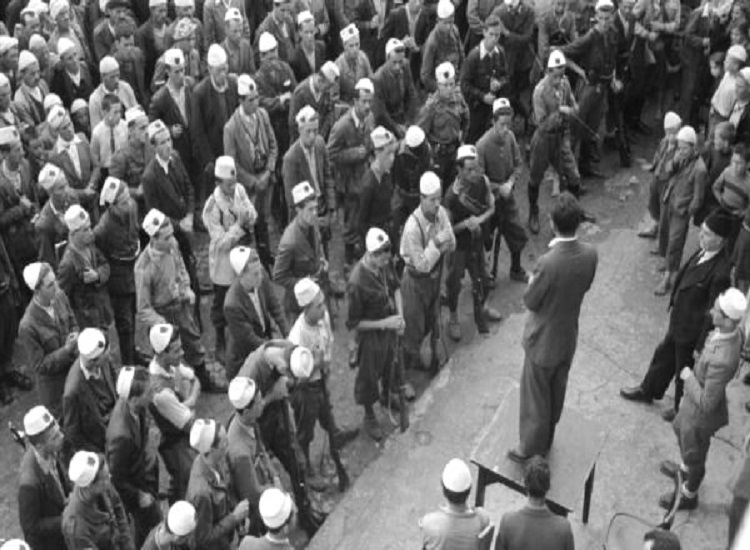
For a short time after the occupation of Kosovo by Albanian, Yugoslav, and Bulgarian partisans, there are no reports of unrest. Serbian, Montenegrin, and Macedonian garrisons were in many Kosovar cities, and the troops of the N.L.F. of Albania passed through Kosovo on their way to Montenegro to help pursue and expel the Germans from there. After this, there seemed to be a sort of reduction of the garrisons in the area, but in February 1945, unrest began.
So, February 1945 can be considered precisely the time of a reawakening of the Albanian population of Kosovo and northwestern Macedonia, to understand what was happening under the carpet, under the final fog of World War II: Under the guise of the war against Nazism and their “collaborators”, under the guise of partisan internationalism, the process of reintegration, re-annexation of the aforementioned territories into Serbia and Yugoslavia was gradually being carried out.
And in these circumstances, unrest began, followed by the brutal reaction of the Yugoslav partisan and communist authorities with the cooperation (whether conscious or unconscious, let the reader judge) of the partisan brigades of Albania. In February 1945, in response, the Yugoslav partisan authorities imposed martial law in Kosovo and began to administer the province through the army.
During the process of suppressing the resistance, a large number of people also lost their lives in Kosovo, where the determination of Albanians not to return under Yugoslav rule was intertwined with the fear that this would mean the recruitment of men from the Kosovo region to fight the Germans in northern Yugoslavia and beyond. The Yugoslav communists had no illusions about the problem they faced in Kosovo.
In December 1944, General Svetozar Vukmanovic Tempo told the British colonel Deakin (the Senior British Liaison Officer with the Yugoslav partisans) that the Albanians are an ethnic group which, in all likelihood, could not be placed under Yugoslav rule except by force, and that the Bulgarians could be used to do this, so that the blame would be shifted from the Yugoslav partisans. Although the political aims of the Albanian insurgents were not clearly articulated, the fighting in Kosovo continued with unprecedented ferocity for six consecutive months. The Yugoslav communist and partisan authorities were very clear and determined in achieving their political objectives and were not stopped or restrained by anything.
First, the harshest means of military response were used against the armed forces of the Kosovar anti-communist civil resistance, and this activity did not lack the support of Kosovar and Albanian partisan units. Second, when it became clear that the anti-Yugoslav sentiment was not an integral part of the forces collaborating with the Germans, but of an entire population, it moved to a second phase, which consisted of: a) the forced mobilization of males into the Y.N.L.A., and b) physical elimination against any individual or group of individuals who tried to react, even peacefully, to such dictatorial policies of the communists now in power in Yugoslavia and Albania.
Even a detailed American report shows that in February 1945, an organized uprising inspired by Balli Kombëtar took place in Kosovo, involving 7,000 people. The uprising was suppressed only through the use of the VI Division of the Y.N.L.A. Aside from this report; there is little direct evidence of the revolt or other major movements of the Yugoslav National Liberation Army. In mid-March 1945, Dalmatian troops, along with tanks, are reported by some sources to have passed through Albania on their way to Macedonia. Otherwise, from the northwestern part of Macedonia, there are a number of reports of unrest.
In early February 1945, the 49th Division of the Y.N.L.A. had been engaged in fighting near Kičevo and on February 28, 1945, an irredentist unit of Balli Kombëtar attacked two battalions of E.L.A.S. under the command of Gotsi (a Slavic-Macedonian who previously operated in Greece), who had recently sought shelter from Greek Macedonia in the Gostivar-Kičevo region, killing 50 Greeks. Macedonian troops, along with Gotsi, are reported to have subsequently launched a counter-offensive and defeated the Albanian forces of Balli Kombëtar. On March 2, 1945, 200 Albanian prisoners were brought from Gostivar to Skopje.
Subsequently, all Albanian men aged 17 to 30 in the Struga-Gostivar region were mobilized, and a later report indicated that orders had been given to mobilize all men aged 35-45. From a single village in the Radusa area, consisting of 125 houses, it is reported that only 8 men were left unmobilized, all the rest reportedly forcibly mobilized (i.e., taken by force for internment). The morale of these troops was naturally low and a number of them are reported to have deserted in the hope of joining the Albanian nationalist forces in the uprising.
On March 29, 1945, groups of Albanian insurgents led by commanders named Xhema and Mifail, operating in the Tetovo-Gostivar region, are reported to have moved towards Kosovo and the Dukagjin Plain to join the Chetniks and Albanian nationalist forces, led by Xhafer Deva, in actions against the Yugoslav National Liberation Army.
Before leaving, they attacked three villages in the Gostivar area and killed all the partisans of the National Liberation Committee. In reprisal for this, Macedonian units burned all the Albanian villages and forcibly took all the men and sent them to Skopje prison. In Kosovo, Miladin Popović, Tito’s former envoy to the Albanian communists, was killed in Pristina on March 12, 1945.
Starting from April 1, 1945, it is reported that the activity of the Kosovar resistance forces and Chetniks in Kosovo was increasing again and for this, the 12th Macedonian brigade was sent from Skopje for support, while 4 other Macedonian brigades and a number of Serbian brigades were already operating in Kosovo. The unrest in early April seems to have continued on the northwestern edge of Macedonia and to deal with the situation, on April 7, 2 battalions of OZNA were sent to Skopje, in response to a request from the Macedonian federal government for reinforcements.
The area between the Albanian border, the Shar Mountains, Skopje, the Karabzica Mountains, Brod and Kičevo and inclusive of the area of Tetovo and Gostivar up to Debar is reported on April 16, 1945 to have been a war zone, due to alarming rumors about the scale of the Albanian uprising. Numerous Yugoslav forces were engaged in the fighting against the Albanian nationalist forces, including the first infantry brigade of Skopje, the 8th, 9th, 16th Macedonian brigades and other unidentified troops from the Bitola area.
In addition, the E.L.A.S. troops under the direction of Gotsi in the Gostivar area were engaged in defensive fighting. According to reports, 7,000 Albanians were imprisoned in Tetovo and a large number of Albanians from Skopje were taken and sent to the forests, 140 others had deserted from the municipal power station in one day. In Skopje itself, there were constant rumors of Albanian unrest and 12,000 Albanians were reported to have been forcibly infiltrated from Kumanovo, Gjilan, and Vranje towards Banat.
There was little confirmation of these reports, but by the end of March 1945 there were talks in Belgrade about Albanians marching north along a guarded town and American reported cases of typhus among Albanians in Banat. From Split, there are also reports that between April 5 and 8, 1945, three parties of Kosovars had arrived, totaling around 2,000 men, some of them guarded, who were said to have been mobilized in Kosovo, to clear the Pristina area after the unrest in this area. / Memorie.al