From Mentor Nazarko
Memorie.al / Did Enver Hoxha weaken Albania’s position in the clash with Greece at the Paris Peace Conference in 1946? Kristo Frashëri, the great Albanian historian, shortly before he died wrote a work dedicated to this conference, which had a decisive role in confirming Albania’s existing borders. He says that Enver Hoxha did not have any decisive role in its decisions for Albania to receive war reparations from Italy, without, however, enabling our country to be considered an Associated Power that had fought the occupiers. This stance, together with the differentiation of the USA as a country that was in favor of the country’s territorial integrity, unlike pro-Greek England, is an advancement compared to the stances, his books, but also of the entire communist historiography. But there are many arguments to say that Enver Hoxha weakened Albania’s position.
- Enver Hoxha did not consider as an essential argument the resistance led by Ahmet Zogu, on April 7, 1939. Enver Hoxha did not want to praise his predecessor as a hero of the resistance because, otherwise, he would have had to share power with his supporters, or even with him, regardless of the referendum on the form of the regime on January 11. In other words, calculating his own narrow personal interest, Enver Hoxha did not mention his predecessor, Ahmet Zogu, at all in the opposition to the Italian occupation.
- Enver Hoxha did not call the resistance of April 7 as something organized in a state manner, led by King Zog, but called it something spontaneous, popular, of 15,000 volunteers (!!!), as he says in the speech we are partially presenting in the dossier dedicated to the Paris Peace Conference.
- Enver Hoxha had included Abaz Kupi, a senior military officer of the kingdom, in the General Staff of the War, on July 10, 1943, he had called him to the Peza Conference, etc., etc., precisely for his role in the resistance against the Italians, but this was not enough for him. Abazi, publicly known for this resistance, had made the war himself as a volunteer, according to Enver Hoxha.
- Mujo Ulqinaku, a non-commissioned officer of the kingdom, was a hero of the resistance. But he too had fought alone as a volunteer according to the propaganda of the communist regime. It is understandable that for internal propaganda purposes, Ahmeti had to be painted as someone who fled, who did not keep his opinga (traditional shoes) and did not fight with a weapon in hand, although he knew how to fight (in the War for Independence, in the First World War, in defense of the Congress of Lushnja, in the overthrow of Noli’s government, etc.). But to defend Albania in the debate that would determine the fate of Southern Albania, Enver Hoxha did not even mention Zog as a deserter.
THE GREEK POSITION THEN AND NOW!
Why did this chivalrous gesture of the political successor towards the political predecessor have international value? Because Greece internationally defended and defends a well-structured thesis, a thesis that, paradoxically, Albanian communist historiography, in short, the dominant historiography, still defends today.
According to it, Ahmet Zogu and the Albanian state smuggled their independence, sold it to Italy, and donated it to Italy through the surrender of the crown. Don’t communist historians say this? For Greece, the organized resistance led by the King on April 7, 8, 9, 1939, does not exist. For Greece, the King, his decisions, those of his government, the organized and unequal war of the Albanian army with all the Italian sabotage, did not exist and still does not exist today. There existed only the treacherous action of a good part, bought with Count Ciano’s money, deceived, of the leaders, ministers, parliamentarians of the Kingdom. This cunning Greek approach practically gave credibility to the incredible forged precisely by Count Ciano: that the occupation resembled something legal, based on the 1926 Treaty, done on a voluntary basis, etc., etc.
And according to this Greek thesis, Albania after April 7 was a state that voluntarily and willingly gave Italy the crown of the Kingdom, gave it parts of its sovereignty, but remained a legitimate state. Consequently, Albania’s declaration of war against Greece in October 1940 was an act of an existing state, the sovereign state. Therefore, Greece defended and defends the position according to which Albania was an enemy country, cooperating with the Axis Powers, which had to be punished with territorial reduction, as happened with Italy, Germany, Bulgaria, Hungary, etc., etc. So, Enver Hoxha appears to have sacrificed with a kind of awareness the position, the strength of Albania in the international arena at a crucial moment, such as the preservation of its southern borders. 5. Enver Hoxha did not do what Ahmet Zogu did with Fan Noli, nor what Fan Noli did with Ahmet Zogu, although he had the duty to do so.
Enver Hoxha did well to align Albania alongside the Anti-Fascist Alliance, creating the partisan army, etc. Enver Hoxha defended his creation with fire in Paris as well, referring to international media that reported on the heroic partisan war. He referred to the international press, the BBC, which reported on the war. But he made a serious mistake in not considering his communist state as a successor to a state that militarily fought against Italy, led by Zogu. There were also international reports on this war: look at the newspapers “Le Temps,” “Daily Mail,” “New York Times,” etc. The example of the good cow that fills the bucket with milk but kicks it over at the end is known not just from fables with animals.
ENVER HOXHA’S OTHER MISTAKES
It is well known that the fates of the borders of the countries involved in the Second World War, the fates of the world order in general, were determined by the Concert of the three Great Powers, the Soviet Union, the USA, and Great Britain. But if Enver Hoxha had good relations, although not directly, with the Soviet Union, he worsened them with the other two countries. Therefore, the non-use of the argument of organized state resistance, led by King Zog, was not Enver Hoxha’s only shortcoming at the Paris Conference and after it.
- Enver Hoxha further weakened Albania with his harsh and severe stances towards these two Great Powers. This behavior likely does not relate to the impositions that came to him from belonging to a communist camp led by the Soviet Union.
- Enver Hoxha, as Professor Kristo Frashëri admits, in the final judgment of his scientific conscience, weakened Albania by becoming enemies, especially with the USA, but also with Great Britain.
- Enver Hoxha did not automatically accept the recognition of King Zog’s previous agreements with the USA, a normal action for any state that emerged from World War II.
- Enver Hoxha did not give either the American mission or the British one the status of a diplomatic mission, despite the fact that both these states had not yet recognized Albania as an independent state within its pre-war borders. A benevolent action towards these missions could have been taken, although someone might say that he used this card as pressure to urge them to recognize him. And what was the result? Neither the USA nor Great Britain recognized us as a state; they withdrew their missions, but, however, at the Conference of Ambassadors in December 1946, Albania received the status of an Associated Power. In a word, it was recognized by the Great Powers, the sacrifice and Great War of the Albanian people.
- Enver Hoxha tolerated or collaborated in the destructive incidents in the Corfu Channel. Before the Paris Conference, Albania was involved in an exchange of fire with British warships on May 15, 1946. After the Conference, Albania tolerated or collaborated in the laying of naval mines that caused the death of 45 British sailors on two destroyers of Great Britain.
- Enver Hoxha, at the instigation and encouragement of the Soviet Union, became heavily involved in the Greek civil war. This involvement in the form of military support, with logistics, etc., also weakened Albania, giving arguments to Greece for maintaining the Law of War. But if for this behavior, Albania certainly had Soviet impositions, it is quite clear that the other behaviors were self-destructive and weakening of Albania’s international position, which was accepted as a member of the UN only in 1954.
HOXHA’S BEHAVIOR AT THE PARIS CONFERENCE, A PREMISE FOR A CURRENT PROBLEM
If we look at the history or current state of relations between Albanians and all the countries of the region, those with Greece still contain this great injustice. If with Serbia, the injustice was resolved to the greatest extent; if with Macedonia, it is progressing on the path to a solution in an irreversible form; with Greece, the problem remains as large as a rock.
Unresolved. With an injustice that has a high cost. Greece says that Albania attacked alongside Italy. Therefore, Albania is an enemy state. For this reason, Greece justified itself with the ethnic cleansing to the detriment of the Cham Albanians and other Albanians. With this pretext, Greece blocked the assets of Albanians that reach considerable values, which include not only the assets of individuals, but also the assets of religious communities, or even of benefactors of Albanian origin, dedicated to schools, churches in Albania.
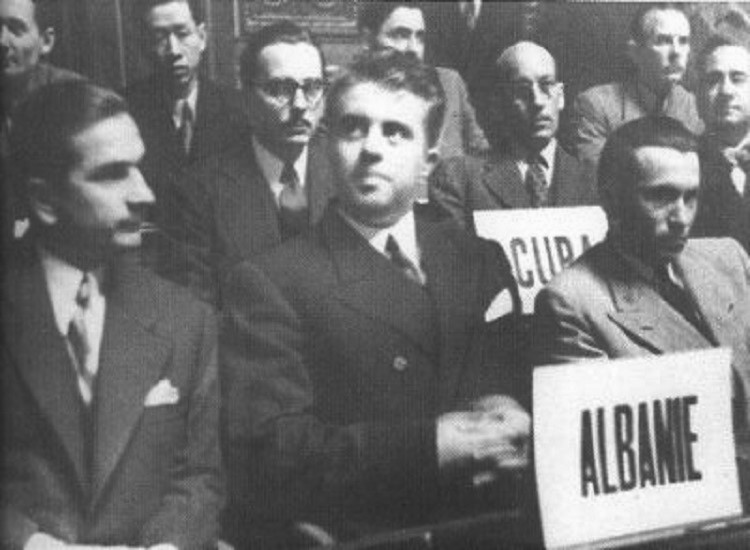
Precisely on this erroneous but devilish premise, Greece activated its claims for Southern Albania, claims that are still waved today by certain Greek circles in various forms. It declared them forcefully precisely at the Paris Peace Conference, which was the greatest post-war event, decisive for our international borders and for our status as a state. Precisely during this conference, Albania could have lost significant territories. The Conference would decide by majority vote whether Albania was or was not an allied country, or an occupier: it would have to cede the territories of Southern Albania, or not. The risk was very great. The decision that was taken was half in favor of Albania because the vote produced a result of 10 to 10.
The Conference paradoxically had member countries unrelated to Italy, but also to the status of a UN member state, being republics of the Soviet Union. If outside of us (Enver Hoxha’s participation) there had not been the participation of the Soviet republics like Ukraine and Belarus, Yugoslav activism, and Russian imposition, Albania could really have been in trouble. It could have lost the South.
OTHER AUTHORS REGARDING THE PARIS CONFERENCE
Regarding this conference decisive for the fate of our current borders, relatively little and quite late has been written. In my research in 2002-2005 for my master’s thesis dedicated to the issue of Albanian properties in Greece and the Law of War between the two countries, I came across archival materials on this conference. I contacted two authorities of historiography, now deceased, such as Professor Kristo Frashëri and Professor Arben Puto, expressing my profane surprise at the lack of books and works regarding this decisive moment for the territorial integrity of Albania. I also presented to them the results of my research, for which they showed interest. Since 2007, when I published the book “The Last War,” in which the Paris Conference was partially touched upon, fortunately we have two contributions from these two authorities: The Italo-Greek War, Dictators and Quislings, by Professor Puto, and a monograph by Professor Kristo Frashëri focused precisely on the Paris Peace Conference of the summer of 1946. Even Kristo Frashëri himself acknowledged the gap in scientific works regarding this vital moment for Albania’s existence within the borders we have today. Besides the imaginary role of Greece, Professor Frashëri emphasizes the negative role of Great Britain, to Albania’s detriment. But the novelty that Professor Kristo Frashëri presents in relation to the dominant thinking of communist historiography is that Enver Hoxha appears to have been mistaken regarding the USA. / Memorie.al