From ERALD KAPRI
Part Two
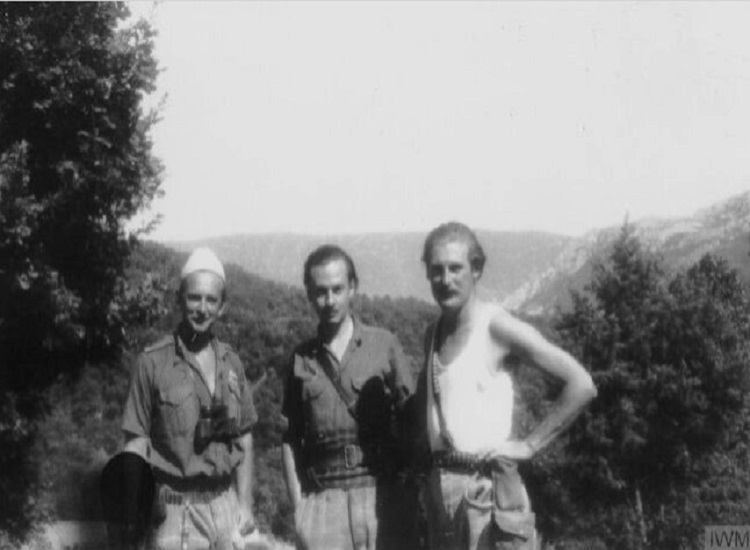
Memorie.al / Among the British officers who fought and led war operations in Albania during 1943–1944, three of them were among the most active and remained the longest. Billy McLean, David Smiley, and Julian Amery. Initially, the first two arrived earlier in Albania, in April 1943, and formed the First Brigade. Later they returned in the spring of 1944, staying for several months near Abaz Kupi’s headquarters and his thousands of troops. At the end of the war, all three officers drafted a memorandum of over 40 pages and submitted it to the British Foreign Office, in which they reported in detail on their missions.
Continued from the previous issue
The Memorandum of the Three British Military Officers in Albania, 1944
THE FINAL BATTLE OF THE NATIONALISTS
The position of the nationalists gradually deteriorated around the month of August. Kupi had not secured supplies from the British, and his influence was now limited to Krujë and Shijak, while Fiqiri Dine failed to secure either cash or supplies from the Germans, who, being distrustful of the Albanians, also turned against the Balli Kombëtar, executing Skënder Muço on suspicion that he was in contact with the British, and deporting several Ballists from Vlorë to the Zemun concentration camp.
Nevertheless, the nature of Smith’s proposals, despite their apparent failure, the fact that a British mission continued to have confidence in Kupi, and the examples of the Romanian and Bulgarian revolutions, where bourgeois figures and active participants such as Maniu and Georgiev were included in the new governments, encouraged them to believe that the British did not intend to allow the National Liberation Front to secure a monopoly on post-war power.
On 18 August, Fiqiri Dine and General Prenk Previzi, chief of staff of the Albanian army, met with Kupi in Luzë to seek his advice on the policy they should follow. Kupi proposed that, together with Gjon Markagjoni and the Ballists, they should withdraw from Tirana with all the forces at their disposal and join him in the mountains to fight against the Germans.
Fiqiri Dine and Prenk Previzi seem to have been enticed by this proposal, but decided first to seek support from the British. Accordingly, Kupi informed us of these negotiations, to which we referred as Force 399, being uncertain whether such a plan would align with the policy toward Albania, which we knew was under discussion.
On 24 August, another meeting took place in Tirana with the participation of Fiqiri Dine, Shefqet Vërlaci, Qemal Vrioni, Nuredin Vlorë, Mid’hat Frashëri, and Ali Këlcyra, where it was decided to accept Kupi’s proposals regarding Fiqiri Dine, provided that aid would come from the British.
On 29 August, in accordance with Force 399’s instructions, we informed Kupi to relay to the Tirana nationalists that we would be prepared to consider our stance toward them if they were to present their proposals. Also on 29 August, Kupi informed us that he had decided to resume operations against the Germans and to attack them in Durrës. (A plan from which we dissuaded him, as Major Smiley knew well the defensive capacity of that city.)
On 31 August, Fiqiri Dine and his government resigned. On 2 September, at our request, Kupi moved to the Prezë area to assist in the destruction of the Turkmenistan troops situated between Durrës and the Ishëm River. On 5 September, instructions were received from Force 399: “to do everything possible to get Kupi into action.”
On 6 September, a Zogist band under the command of Kupi’s eldest son, Petrit, together with a squad of Turkmenistan troops, attacked and took control of the headquarters of a German battery, killing 10 Germans and seizing military materials. Further operations by Zogist forces were carried out on 9, 10, 11, 12, 14, 20, 21, and 24 September.
On 6 September, as a result of the guarantees given to us, the Balli leaders – Mid’hat Frashëri, Ali Këlcyra, Hasan Dosti, Koço Muka, and Vasil Andoni – left Tirana to join Kupi, bringing with them about 600 forces under the command of Abaz Ermenji, which were placed under Kupi’s command. That same day, Fiqiri Dine, Prenk Previzi, and Hysni Dema also left Tirana to join Kupi.
On 9 September (4 days after we had been instructed to do everything possible to get Kupi into action) and three days after the start of operations, instructions were received from Force 399 ordering Lieutenant-Colonel McLean, Major Smiley, and Sergeants Jones and Jenkins to return to Italy for debriefing.
The instructions further stated that no supplies would be sent to the nationalists, and that Captain Amery, who was the temporary head of the mission, should act as an impartial observer and not encourage Kupi to fight.
These instructions were confirmed twice in the telegrams that followed, particularly at the start of the civil war and later when the failure of Smith’s mission became evident, precisely at the moment when we could have abandoned the nationalists with some semblance of consistency. Nevertheless, to do so at the most opportune moment, when we were dependent on the instructions and guarantees given to us by the authority of Force 399 – and while they had again gained ground against the Germans – we found ourselves exposed to serious accusations of lack of support and a breach of faith that will never be erased from memory.
THE FINAL PHASE
The decision not to provide the nationalists with material or propaganda support was the deathblow to their cause. Driven out of most of the territory they had previously controlled, engaged in war both against the National Liberation Front (NLF) and against the Germans, without the right to enter Mirditë – barred by Gjon Markagjoni unless they paid – and unable to secure further help from Tirana merchants, the nationalists found themselves in a crisis from which they would not survive.
Perhaps it would be entirely true to say that from this point on, nothing was of any further value, despite the small influence they still wielded, except for the landing of British troops prepared to protect the nationalists at least from the forces of the National Liberation Front. But this last hope was extinguished when we were forced to reject a request from Abaz Kupi at the time of the Sarandë landing, for direct assistance in operations at Durrës and on the Tirana–Shkodër road.
Later, after he realized that our departure was already certain, he began to disperse his troops – a decision we had advised him to support, as he was unable to maintain them independently, while at the same time refusing to seek support from the remaining collaborationists.
On 12 October, Kupi repelled a German attack against our base in Velesh (Mount Velë) and a few days later, together, we marched toward the coastal lowlands near the mouth of the Mat River, awaiting evacuation. Meanwhile, news arrived of an attack by National Liberation forces against the forces of Muharrem Bajraktari and Gani Kryeziu, of the arrest of Seit and Major Simcox, and of the killing of Fundo.
The nationalist movement had now ceased to exist as an organized entity. Kupi continued with the dispersal of his forces, and when this process had reached a certain point, he asked us to arrange his departure. The authorization required for this was not arriving, so we advised him to secure a boat and leave on his own – something he managed successfully by himself. On 28 October, the entire mission departed successfully by sea. / Memorie.al