
By ERALD KAPRI
Part Three
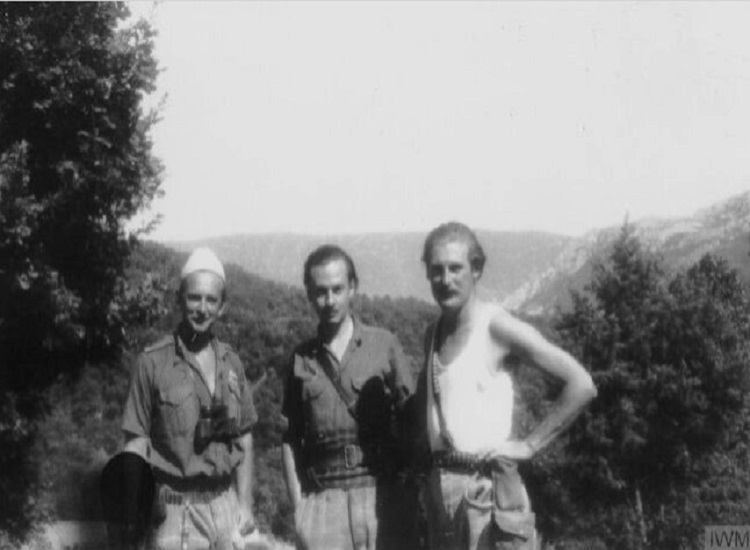
Memorie.al– Among the British officers who fought and directed war operations in Albania during the years 1943–1944, three of them were among the most active and who stayed the longest: Billy McLean, David Smiley, and Julian Amery. Initially, the first two had come earlier to Albania, in April 1943, and formed the First Brigade. Later, they returned in the spring of 1944, staying for several months near the headquarters of Abaz Kupi and his thousands of troops. At the end of the war, the three officers drafted a memorandum of over 40 pages and submitted it to the British Foreign Office, in which they reported in detail on their missions.
Continued from the previous issue
The Memorandum of the Three British Military Men in Albania, 1944
THE FINAL BATTLE OF THE NATIONALISTS
The second part of the memorandum of the three British officers – Billy McLean, Julian Amery, and David Smiley – contain interesting data about the war in Albania, mainly in the north of the country. They describe the military operations carried out by Abaz Kupi’s nationalist forces after June 1944. This report also discusses the reasons why the Zogist forces were not supplied with weapons and ammunition by the British. The delayed entry into operations, as well as the fear of a large-scale civil war, irritated them and led them to withhold aid for Abaz Kupi’s nationalists.
The details speak of civil war between the partisans and the Zogists in at least several instances. Before leaving Albania, Abaz Kupi appears to have taken the defeat sportingly, saying that in Albania, power had been held by the Ghegs for 1,000 years. Another interesting piece of information provided by the officers concerns the mercenary forces that fought in Albania during the war, brought in by the Germans. It may seem unbelievable, but every nation beyond the Caucasus had fighters in Albania—such as Turkmens, Kazakhs, Armenians, Uzbeks, Tajiks, and Kyrgyz.
Hundreds of troops recruited by the Germans after the war in Russia, as a promise to grant their countries freedom from communist Russia. It remains unclear what became of these hundreds of forces after the war, some of whom deserted and joined the Albanian partisans. The British provide no data on their fate or whether they were able to return to their homelands. It is worth noting that in some important battles, these forces fought alongside the Albanian partisans and also suffered casualties.
THE FULL REPORT
The civil war in Albania has now ended, and everything was now in doubt as to whether the National Liberation Front would be hindered from coming to power. The political and military forces of the old nationalism have been overthrown, and their leaders are either in exile, prisoners of the NLF, or on the run. The legend of men such as Kupi will live on in the mountains, and new men may emerge even from within the ranks of the National Liberation Front to exploit discontent.
Anger toward the new regime could grow among the Ghegs, and there might be an eruption of revolts, but the entire history of Albania shows that as long as the government relies only on foreign aid, and the National Liberation Front appears to have many friends in Belgrade, even if perhaps not openly, an opposition movement cannot grow unless it is supported from abroad.
The fundamental fact is that a revolution is taking place, and Albania has secured a new caste of leaders and a new orientation in foreign policy. The mind has a natural tendency to dictate a certain motive regarding events, and it is not easy to align all the viewpoints of the British officers—who inevitably link the Albanian problem with the war against Germany—with the views of the Albanians, who naturally and equally link all developments of the war against Germany with the revolution taking place in their country.
By expressing our views to a certain extent, this perhaps gave the Albanians the opportunity to speak for themselves, and we reached a conclusion with three statements drawn from personal conversations with nationalist leaders:
“You should know that there are only three political parties in Albania: Germany’s agents, England’s agents, and Russia’s agents. But what none of us understands is why Russia’s agents are paid by the English.” – Ramadan Kaloshi from Dibra.
“You must remember, Colonel, that we Albanians are everything that is wicked; we are poor, we are ignorant, we are small.” – Islam Elezi from Dibra.
“Perhaps it is only right that they (the National Liberation Front) should take power. We Ghegs have exploited the Tosks for 1,000 years; now it is their turn to exploit us.” – Abaz Kupi.
APPENDIX A
DETAILS OF COOPERATION WITH THE ZOGIST MOVEMENT
Operations
Experience with the National Liberation Front in 1943 led us to the conclusion that Albanian communiqués are often entirely unfounded, and in fact, it is questionable whether reports of operations carried out by Albanians should be given any weight as long as no eyewitnesses are available. Consequently, it was the policy of this mission to make every effort to ensure that BLOs and BNCOs were present whenever needed during operations.
There also came reports of actions carried out by Zogist forces, such as in the cases of Musa Picari, Nik Sokoli, and others, during which no British observers were present. These reports may have been accurate, but since they could not be verified, they were not included in the list of operations given below, each of which had BLOs and BNCOs as eyewitnesses.
23 June. Destruction of the bridge at Gjoles along the Shkodër–Tirana road by a Zogist band. This bridge was the third largest in Albania and was located in an area defended by the Germans. This occurred more than a month before the Germans erected a temporary bridge guarded by 60 soldiers, and during this period, the main Shkodër–Tirana–Durrës road was closed, and German traffic (about 200–300 vehicles per night) was forced to take a considerable detour. Major Smiley and Sergeant Jenkins were present.
6 September. A Zogist band attacked and captured a German position, killing 10 Germans, including their captain, seizing war materiel, and capturing 12 Italian prisoners. The wooden bridge was set on fire. This position was identified as the headquarters of the 3rd Battery of the 297th Artillery Regiment. Lieutenant-Colonel McLean, Major Smiley, and Captain Amery were present.
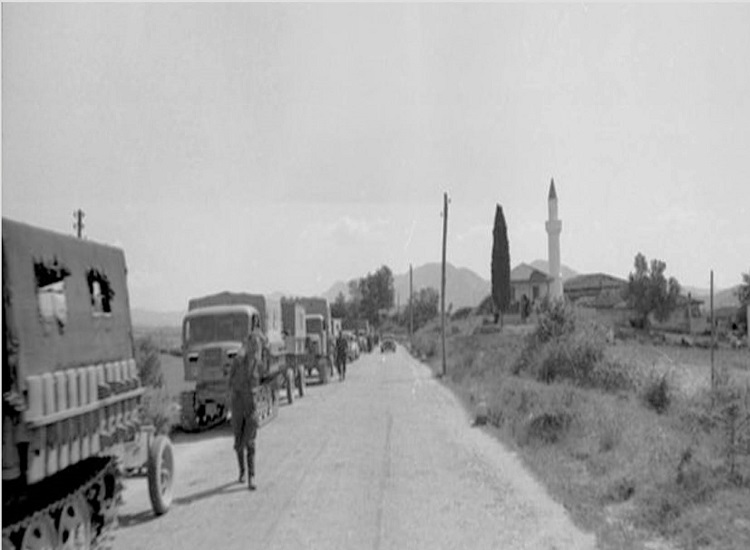
9/10 September (evening). A mixed Zogist and Ballist band attacked a convoy traveling on the Shkodër road near Preza. Result: 1 ammunition truck was blown up, 2 trucks were burned, about 15 trucks were looted and damaged, 8 motorcycles were destroyed, 35 German soldiers were killed, 2 light machine guns, 30 rifles, and other military materiel were captured. Lieutenant Merrett, Sergeant Jones, and Corsentino were present.
10/11 September (evening). A Zogist band and Sergeant Jenkins mined the main Shkodër road. 3 trucks were blown up.
11/12 September (evening). A Zogist band, with Major Smiley and Sergeant Jenkins, blew up the concrete bridge on the main Shkodër road at G.2558, blocking the road for three consecutive nights.
12/13 September (evening). A Zogist band attacked a German convoy at Kulakumit G.21. A convoy of 9 vehicles was completely destroyed by fire, and all German soldiers were killed or dispersed, including two field gendarmerie officers. Light machine guns, rifles, and other military materiel were seized. A bag of the 181st Division of the 21st Alpine Troops was found among the seized documents. Lieutenant-Colonel McLean, Captain Amery, and Sergeant Jenkins were present.
14/15 September (evening). Ambush by a Zogist band on the Tirana–Durrës road, two miles north of Tirana. Mines were laid. 1 truck carrying German soldiers was completely destroyed, 1 truck was damaged, and 3 German soldiers were killed. The action was broken off when the National Liberation Front began attacking the Zogist band from the rear. Major Smiley was present.
15 September (evening). Zogist and Turkmenistani forces attacked and repelled a German armored car heading toward Shkodër. Lieutenant-Colonel McLean, Captain Amery, and Sergeant Jenkins were present.
20 September. A joint Zogist and Ballist band attacked a convoy and at the same time blew up the bridge on the road leading to Shkodër near Laç. 1 truck was destroyed. Sergeant Jenkins was present.
21 September. The same band attacked a German column on the Shkodër road, forcing it to retreat. Sergeant Jenkins and Sergeant Schoemaker were present.
24 September. The bridge at Hani i Teqes on the main Shkodër road was blown up, and a German column was attacked and forced to retreat by the Zogist band. Major Smiley was present.
12 October. The Zogists repelled a German attack against the headquarters of the British mission in Velsh. 3 casualties among the Germans, and possibly more. Lieutenant-Colonel McLean and Captain Amery were present.
In addition to these actions, more than 200 tire-puncturing spikes were laid by the Zogists, BLOs, and BNCOs, and they proved successful.
It should be noted that all these operations were carried out by small forces, at a time when the NLF’s offensive against the Zogists was at its peak, and when the correspondence we received did not in any way encourage providing aid in terms of supplies and propaganda from the British. The results achieved, consequently, can be considered only as a partial expression of the military potential of Abaz Kupi’s forces. / Memorie.al