By András Tóth
Part Two
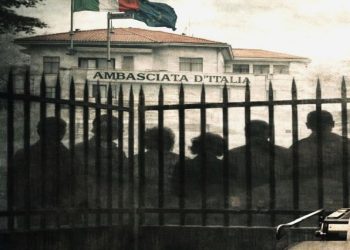
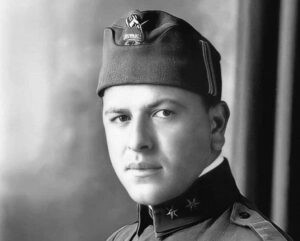
Memorie.al / There is a sentence, penned in black ink in June 1962 by a senior Albanian official, in the margins of a plea letter from an 86-year-old, nearly blind widow in Belgrade: “Dr. Kalmar is an Albanian citizen. Therefore, he cannot be allowed to become a Yugoslav.” Behind this sentence stands the youngest son of a Jewish merchant family from Budapest, who fled the “numerus clausus” to Prague, from there to the true Davos of the “Magic Mountain,” and eventually ended up in the poorest country in the Balkans – a country that first lured him with gold francs, then hid him in its mountains from the Germans, and finally, simply refused to let him leave for decades on end.
The story of Kalmár Lajos is a compendium of the 20th century: it encompasses the generation of émigré Hungarian doctors, the great European war against tuberculosis, and the miracle of the Albanian besa (pledge of honor), and the suffocating embrace of the Hoxhaist dictatorship.
Continued from the previous issue
Whenever a German patrol came, the couple would be dressed in peasant clothes and hidden in a barn. During this time, Kalmár worked for five months as a village doctor. In the winter of 1943–’44, the Germans launched an anti-partisan operation in that area, and Kalmár was captured. He ended up in the military prison hospital in Tirana – “they could execute me at any moment,” he wrote in a letter smuggled out to Sadiku.
His friend began to move heaven and earth: his cousin, Bajazit Boletini – the son of the legendary Isa Boletini, a high-ranking commander – intervened, and upon the official request of the Deputy Minister of Foreign Affairs, Vehbi Frashëri, the German command released the doctor. The archive preserves this document. A few hours later, Kalmár showed up covered in mud, cap in hand, at Sadiku’s workshop, and the two men fell into each other’s arms.
When it turned out that his house in Tirana had been looted in the meantime, the doctor merely said: “In war, saving a life is more important than wealth.” He only regretted the loss of his X-ray machine – but then Sadiku confessed: he had dismantled the important parts and taken them home long before. “We survive you, me, and the X-ray machine – I can easily replace the rest.”
The country that would not let him leave
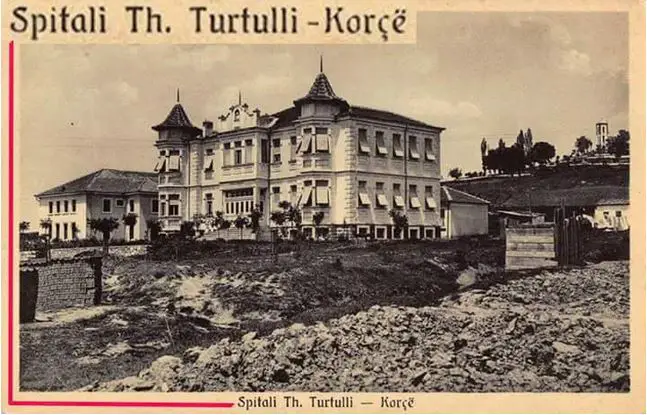
They survived. And after 1944, Kalmár stayed – first because he wanted to, later because he had no other choice. The new communist Albania did not touch him (it only confiscated his gold), and it even needed him: a national campaign against tuberculosis was launched. Kalmár worked at the Tirana Sanatorium, and in 1948, he was transferred to Korçë – precisely the year when Hoxha broke ties with Tito, and a doctor with a Yugoslav wife suddenly became unsuitable for the capital.
In Korçë, four of his colleagues noted in an official medical report what everyone could see: Kalmár’s hand had been destroyed by X-ray radiation. Hyperkeratosis, wounds, atrophied skin, cracked nails – the typical martyrdom of radiologists from the heroic era, which even lead-lined rubber gloves could not prevent. He was the first in Albania to try to have his condition recognized as an occupational injury.
In the 1950s, he lived on staircase no. 16 of the “Shallvare” buildings in Tirana, went on house calls accompanied by his dog, and at his home clinic, he often gave free consultations. According to the city’s urban legends, he never accepted more than thirty-five consultations a day – but anyone who came with a friendly recommendation never paid him a cent. Meanwhile, a decades-long drama unfolded behind the scenes.
Jovanka’s mother, the widow Olga Ristić, was growing old and going blind in Belgrade – and she wrote a series of letters to Enver Hoxha, and later to Mehmet Shehu, asking them to let her daughter and son-in-law return. One evening in 1947, the exit permit came by telegram – and was revoked the very next day. 1956, 1957, 1959, 1962: request after request, refusal after refusal. Hoxha’s Albania would not let anyone leave whom it needed – and the ultimate argument was pure cynicism: Kalmár is an Albanian citizen, therefore he cannot go. The citizenship that had been offered to him as a contractual privilege in 1931 had turned into prison bars.
In 1961, the body of the elderly, radiation-sick doctor collapsed: he lost eighteen pounds, suffered from fainting spells, and retired. But even as a pensioner, he had his moment of triumph. In 1966, his former student, Kol Dodaj from Mirdita, traveled to Tirana with the mysterious X-ray of a miner’s lungs. Kalmár looked at the image: silicosis.
The heads of the scientific council – led by the regime’s honored professor of pulmonology – waved their hands dismissively: there is no silicosis in Albania. Then the old Hungarian doctor stood up and, with “strong scientific arguments,” proved that yes, there was. The patient was immediately granted a disability pension; Dodaj ultimately identified 380 miners with silicosis. The history of Albanian mining medicine begins with this debate in Tirana.
The final farewell
That same year, 1966, the authorities – it is still unknown why precisely then – finally allowed him to leave. The furniture was shipped by boat from Durrës to Dubrovnik under customs seals, sewn into sacks; the sacks were sewn by the tailor Enver Bali, a former patient of Kalmár’s. He left behind two and a half million old lek in the bank – he had calculated that he would spend them during the summer in Durrës. He was never allowed to enter the country again. The night before the departure, Sadik Salimusaj and his son stayed at their place until late dinner.
At the gate, Sadik asked: “Doctor, what time are we leaving for Rinas tomorrow?” The reply: “The question is not when we are leaving, but when you are leaving. Sadik, you are not coming to Rinas.” In a country under surveillance, a tearful goodbye at the airport could have harmed them both. This was their last meeting – but not their last word: Kalmár wrote letters to the Salimusaj family in Albanian from Belgrade for decades. In rubber boots, near the Hungarian border, the 65-year-old Kalmár was forced to retake the exams for his own diploma in Yugoslavia.
He passed them and started working again – because it was necessary: Yugoslavia did not recognize his years of service in Albania, so he had no pension. Thus it happened that the former doctor of Davos, now in his seventies, worked five days a week as a pulmonologist and radiologist at the small hospital in Novi Kneževac (Törökkanizsa) near the Hungarian border, while spending weekends on the train back to Belgrade.
A Hungarian colleague, Beszedics Erzsébet, remembered him thus: “He went to work in some strange rubber boots, he had let himself go a bit, but as a professional he couldn’t be bad, and he was not a bad man.” The most unexpected twist came in 1977: that Hoxhaist Albania, which had held him hostage for a decade and a half, issued a government decision signed by Mehmet Shehu, to pay Kalmár his old-age pension in foreign currency – they transferred 85 dollars and 35 cents per month to the hospital address in Novi Kneževac.
From a hermetically sealed and foreign-currency-starved Albania, this was a gesture that resembled a decoration. He wrote his last letters on a typewriter, because his hands no longer obeyed him. “I cannot walk on the street… or in the house, except by holding onto the furniture” – he wrote to his old friends in Tirana in 1984. He died on July 25, 1988, in Belgrade, at the age of 86.
In the death notice published in the newspaper “Politika,” he was already referred to as Ljudevit Kalmar-Ristić – he had taken his wife’s surname as well, as a kind of final return home to that woman he had met sixty years earlier on the snow-covered fields of Davos. He rests in the New Cemetery of Belgrade, alongside her.
In the web of legends – what do we know for sure?
The life of Kalmár Lajos was thickly covered by legends, and the researcher must first peel them away. According to people’s memories, he had graduated in Vienna (or Zurich) – in reality, in Prague, as confirmed by the registry of Charles University. According to a popular Albanian article, he fled to Albania in 1938 from the Anschluss together with his beloved “Dušanka” – in reality, he arrived in 1930 upon the official invitation of the government, and his wife’s name was Jovanka.
There is a story that in Durrës, the Germans placed him in a line of dozens of others to be shot, and he was saved by an even number; and another that he was released from captivity after he cured the fever of an SS commander’s wife. They are beautiful stories – but they are wandering motifs that the archives do not confirm.
What is certain: in December 1943, the Germans arrested him, and he was released thanks to the intervention of his Albanian friends – a master shoemaker, the son of a legendary hero, and a deputy minister? Here, for once, the truth is no less interesting than the legend: an entire village fell silent for him, and that in itself is a miracle.
The tangible traces of that friendship, moreover, exist to this day: the letters and New Year’s cards in Albanian that Kalmár wrote for four decades – the last ones in a trembling hand, or on the typewriter – are preserved by the Salimusaj family in America. And there is also an unfinished chapter to the story: the name of the Trimi family that hid him is on the list of recognized Albanians who saved Jews, but that of Sadik Salimusaj, who got his friend out of prison, is not there to this day! Perhaps this will be the next step of the research.
The Albanian Davos that was never built
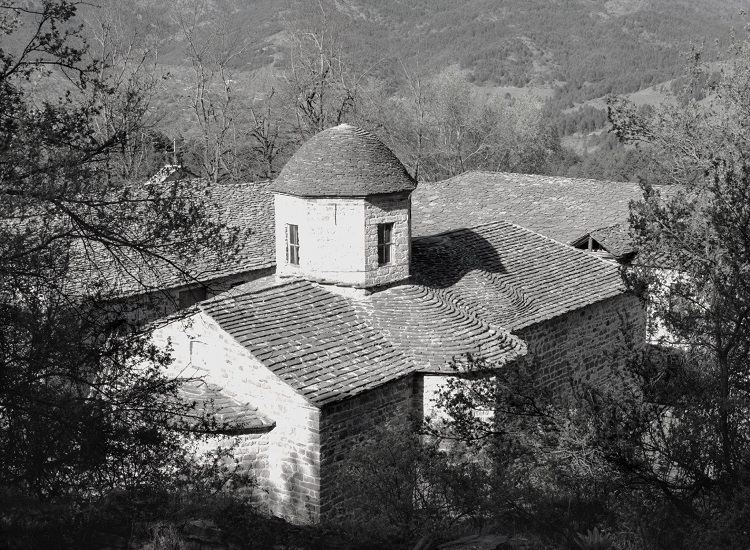
Kalmár compared nine mountainous areas in 1930 before choosing Voskopoja – the monastery valley above the Aromanian city that in the 18th century was famous throughout the Balkans, boasted a printing press and an academy, smelled of pine trees and nightingales, and had so much spring water that it could even produce electricity. The government made a decision; the archbishop gave up the monastery, an Italian merchant made a price offer for the furnishings.
Then it turned out that there was no budget line from which to cover the sanatorium – or even Kalmár’s salary. The plan for the Albanian Davos remained on paper; the country’s first tuberculosis ward was finally opened in 1935, in a military barracks in Tirana. But from there, everything grew: in the official history of today’s University Hospital of Pulmonology in Tirana, the name of the “doctor of Hungarian origin, Dr. Kalmári Lajos,” still stands among its founders.
The doctor who turned into a spy character?
And finally, a twist that would fit even on the last page of a spy novel. In 1969 – three years after Kalmár finally left Albania – the Tirana film studio shot the feature film “Guerrilla Unit.” According to the plot, an agent of the Italian military secret service, SIM, tries to infiltrate the city’s resistance ranks to discover and destroy the guerrilla leaders – but he is exposed, and the fascist plan fails. The name of the traitor agent in the film is: Ludovik. There is no proof that the choice of name referred to Doctor Ludovik who had just left for the “West” – it might be a coincidence.
But in Hoxhaist Albania, where film production was an extension of propaganda and where those who had left were usually later resurrected as traitors, the researcher cannot help but raise the question: did the regime that had not let the Hungarian doctor leave for sixteen years, bid him farewell on screen – by turning him into a spy, that man who for a lifetime had treated his poor for free?! For now, it is just a suspicion. But one of the kind for which it is worth sitting down in the archive once more! / Memorie.al