

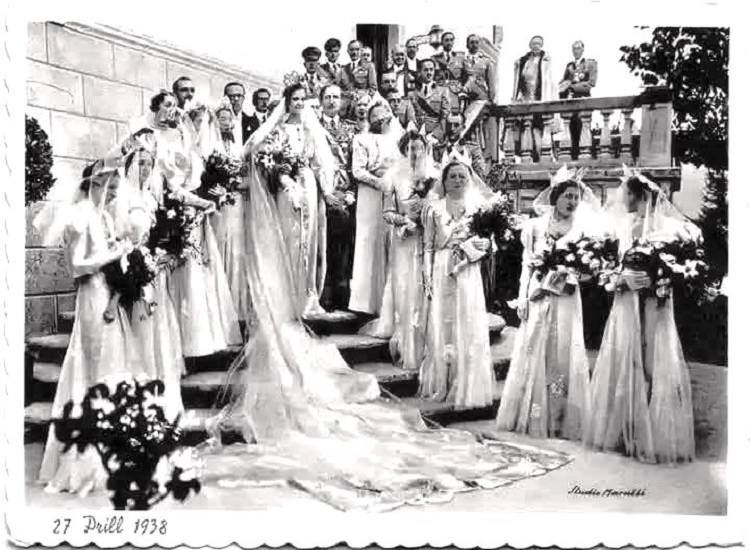
Memorie.al / At the end of the 1930s in Albania, a new dress code would be sanctioned by law. In “King Zog and the Effort for Stability in Albania,” Bernd J. Fischer gives details on how the veil was removed and how Albanian men were forbidden…! At the end of the 1930s in Albania, a new dress code would be sanctioned by law. In “King Zog and the Effort for Stability in Albania,” Bernd J. Fischer gives details on how the veil was removed and how Albanian men were forbidden from wearing folk costumes in everyday life.
While highlighting the previous efforts that had been made in this direction, Fischer pauses at New Year’s Eve 1936, when on the occasion of the reception organized at the Royal Palace, the guests were asked to come in Western-style clothing. And at this end-of-year reception, King Zog would declare: “We must take rapid and great steps toward Western culture and civilization. Such a thing is imposed on us by history, by geography, our political position and by the character of our nation.”
Fischer writes that within a few weeks the King had prepared a concrete social and economic project with the aim of bringing such a plan to life. In the social field, Zog proposed the removal of the veil that covered the faces of Muslim women and the elimination of mixed Albanian and European clothing among males.
“The King began with the implementation of the social reform which could be carried out without any great impact on the budget. In March, a law was presented to Parliament, which was voted immediately, according to which it was considered a violation punishable by a fine of up to 500 gold francs, for any woman who covered her face entirely or partially. The law provided for an even heavier penalty for all those who forbade or tried to persuade women not to implement this law,” writes Fischer.
In this framework, preparatory work would be carried out before moving to the concrete implementation of this innovation. “First, the King sent three of his unmarried and Muslim sisters, the princesses Myzejen, Ruhije and Mexhide, for a surprise visit to the city of Shkodra, areas which were supposed to be the centers of the remnants of fanaticism.
The purpose of this visit was mainly to give a convincing and tangible proof of the possibility and practicality of the unveiling of Albanian women, showing before everyone the pleasant faces of Zog’s sisters.
The three princesses, dressed in the latest European fashion clothes, with short and tight skirts and with made-up faces, stayed in Shkodra for a week, accompanied by Juka, Aranitasi and other state officials.
The sisters made visits to schools, churches, mosques, hospitals, markets, archaeological centers and spent a good time in meetings with various people. The economic activity of Shkodra was completely suspended.
The princesses, who until that time had been practically closed like hostages in the royal palace and who until then appeared in public only for some horseback ride, accompanied by armed guards along the secluded roads near Tirana, in Shkodra appeared everywhere openly, giving lunches and dinners, always in the presence of photographers. The tour was extremely successful,” writes Fischer.
In parallel with this tour, Zog would take care to also have the support of religious communities, however for this initiative there would be no lack of opposition. Alongside other elements, one of the oppositions was related to the inability of Albanians to cope with the high prices for buying clothes of the time.
“Rumors began to circulate about the possibility of an opposition to this action in Shkodra, as well as the organization of a silent passive opposition in the form of a women’s strike at home. But finally, throughout the entire country no real opposition was noticed and in fact almost all elements of Albanian society welcomed this change with joy.
The small group of Roma of Albania, which until then had scandalized the citizens of Shkodra and other regions by staying unveiled, rejoiced immeasurably when it saw that it had always been right.
The merit of the acceptance of this measure by the Albanian people at this time belongs to Zog, since he had previously been able to prepare the foundations that made possible the taking of such a decision, although he did not go further.
He sought the removal of the veil while leaving women the right to continue preserving the previous clothing, including here the headscarf of the time. The authorities were satisfied even with the small uncovering of a part of the face,” continues Fischer in “King Zog and the Effort for Stability in Albania.”
Men’s clothing
Although with a different sensitivity, the same path would be followed for the application of a new dress code for men. In the summer of 1937, the new dress code for males would be adopted according to which national costumes would be allowed only on the occasion of national holidays./ Memorie.al