







From DASHNOR KALOÇI
Part Twelve
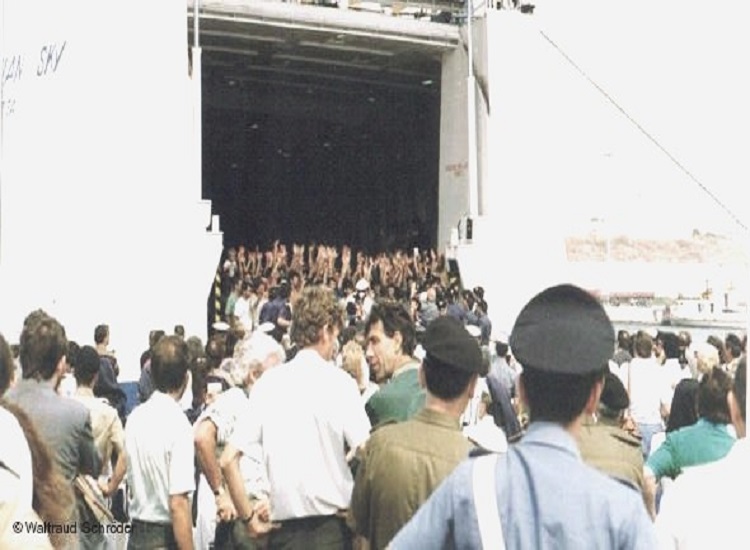
Memorie.al / When not even a week had passed since July 2, 1990, when thousands of Albanian citizens climbed over the railings and walls of foreign embassies in Tirana and entered their premises with the aim of leaving Albania, the high leadership of the PPSh (Party of Labour of Albania), headed by General Secretary Ramiz Alia, held the 11th Plenum of the Central Committee, which held its proceedings on July 6 and 7. Although the agenda was predetermined with three main points, dominated by that on the development of education in Albania, almost throughout the proceedings of that plenum (especially in point 4, “Miscellaneous”), the event of those days, otherwise known as “July 2 of the Embassies,” was discussed and debated. In that plenum, in which all members and candidates of the Central Committee of the PPSh participated, the first secretaries of the party committees of the districts, ministers, leading cadres of the education, culture, science, and economy sectors, leaders of the organization of the Union of Working Youth of Albania, from the apparatus of the Central Committee of the PPSh, Radio-Television, ATA, etc., there were absent Nimet Cani, Ali Vukatana, Reiz Malile, Shpëtim Çaushi, Zylyftar Ramizi, Qemal Lame, Zef Loka, Pirro Kondi, and Hekuran Isai, who for several days had been “in the field,” “managing” the embassy event.
After the opening of the meeting by Ramiz Alia, the floor was given to the Minister of Education, Skënder Gjinushi, who also held the relevant report (“On the perfection of the educational system and the further qualitative strengthening of the school”); the key topic of that plenum was the “embassy event,” discussing and analyzing in detail how and why it happened (“the role of foreign agencies”), up to the tasks that emerged for managing that situation in those hot July days, when over five thousand Albanian citizens from all districts of the country were inside some of the main embassies in Tirana, waiting to leave Albania.
In addition, throughout that meeting, but mainly in point no. 4 of the agenda (which was discussed in the last session), some of the main events that had occurred in various districts of the country during that year were also taken into analysis, such as: the protests in Shkodra in January for the removal of Stalin’s bust; the events in the city of Kavaja where the people of that city clashed with police forces; mass escapes from the state borders with Yugoslavia and Greece; mass gatherings in holy religious sites, such as the Church of Saint Ndou in Laç of Kurbin; the legal permission of religious beliefs and the opening of places of worship; or other problems that were raised for solution, such as: the talks of the international factor for the re-establishment of diplomatic relations with the USA, the Soviet Union (the talks held with the Soviet Deputy Foreign Minister in Sofia by Sofokli Lazri); the Kosovo problem; international pressure for Albania’s opening to the world and its accession to several international conventions; the privileges of the high leadership of the PPSh and their families who lived mainly in the “Block”; the words circulating among the people about Enver Hoxha’s family and Ramiz’s relations withNexhmija; the change of legislation and the penal code; the release of political prisoners; the issuing of passports to citizens who sought to go out as visitors to their relatives abroad; the new economic mechanism; the housing and employment of many additions in all districts of the country; the giving of land and livestock to the cooperative peasantry; up to the supply of the urban population with basic food products and various industrial goods.
As we will also see from archival documents belonging to the 11th Plenum of the Central Committee of the PPSh, which we emphasize are published for the first time, in addition to the leadership and some of the high officials of that time, several other high figures who continued their political careers even after the 1990s also discussed or were mentioned in that meeting, such as: Skënder Gjinushi, Fatos Nano, Sali Berisha, Rexhep Mejdani, Gramoz Pashko, Spiro Dede, Dritëro Agolli, Ismail Kadare, Moikom Zeqo, Mehmet Elezi, Lisen Bashkurti, Koço Kokëdhima, Ylli Popa, Aleks Luarasi, etc.
Likewise, in the voluminous file of this plenum, of great interest are also those documents belonging to the secretaries of the Party Committees of the districts or the “Information Group” who went to all districts of the country and documented all the main issues that emerged in the meetings of the basic party organizations, where “On the letter of the Central Committee” was discussed, documents that constitute the largest and also the most important part of the file in question. Indeed, it can be said to be among the most important of the entire period of the communist regime of Enver Hoxha and his successor Ramiz Alia, since that period of time with the events that took place marked the prologue of the fall of that regime.
Also of great interest are the documents belonging to the last session of that meeting with point no. 4 of the agenda “Miscellaneous,” which constitutes the hottest point of the entire plenum, where the release from duties and retirement of three members of the Politburo (Rita Marko, Manush Myftiu, and Prokop Murra) was discussed, even with harsh debates, as well as the release from ministerial duties or other high functions that several other “leaders” had held for years, such as Simon Stefani, Pali Miska, Muho Asllani, Lenka Çuko, Vito Kapo, Pirro Kondi, Jovan Bardhi, etc., and the appointment of “young comrades” in the leadership of the high forums of the Party and State, such as: Xhelil Gjoni, Abdyl Backa, Niko Gjyzari, Kiço Mustaqi, etc. Regarding these etc., the documents in question extracted from the Central State Archive (Fund of the former Central Committee of the PPSh) inform us, which are published for the first time and with the relevant facsimiles by Memorie.al
Continues from the previous issue
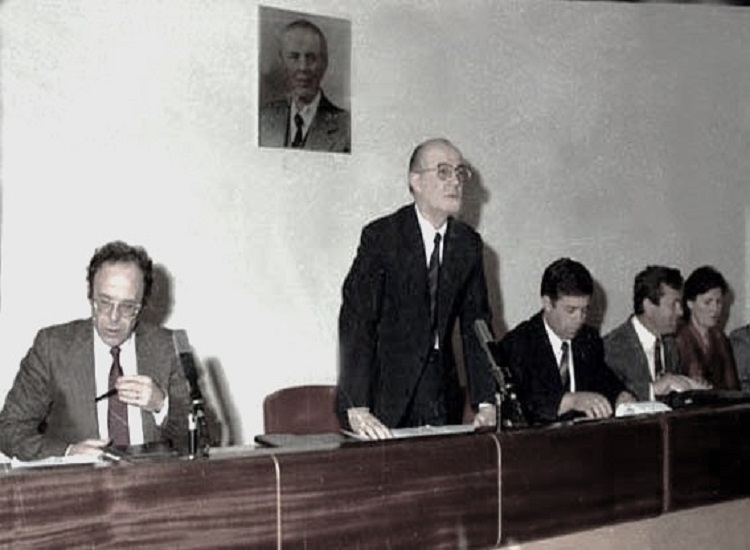
MINUTES OF THE MEETING OF THE 11TH PLENUM OF THE CENTRAL COMMITTEE OF THE PPSh, HELD ON JULY 6 AND 7, 1990
MISCELLANEOUS
Several issues of today’s situations and the political problems arising from them.
COMRADE ARANIT ÇELA: Excuse me, Comrade Ramiz. I had a thought regarding the decree that has been issued. The first point is completely clear, while the second, it seems to me, gets confused by saying that they will be equipped with a passport based on the rules, etc. It could be said briefly that these citizens will be given passports for abroad.
COMRADE RAMIZ ALIA:It is formulated in such a way as not to make a distinction only for this category. They can be equipped with passports for abroad, like any Albanian citizen based on the provisions foreseen in the relevant decree. I do not believe there is any concern about this issue. The decree foresees the granting of the passport within one month. But, by setting this limit, the possibility of taking the passport even within one or two days, etc., is not excluded. But it seems clear that the embassies intend to keep these people here, in their courtyards, and use them against us in case of need.
COMRADE ARANIT ÇELA: I think we should expose the stance of the embassies to the people. We must tell the people that the embassies are stopping the departure with passports of these citizens.
COMRADE RAMIZ ALIA: Precisely this issue must be made public. ATA transmitted the news about the decree, now we must publish it in the press as well. So, this news must be made known, both inside the country and in the outside world. At the same time, in the Presidium of the People’s Assembly, we discussed that the Minister of Foreign Affairs, Reis Malile, or the Deputy Minister, Muhamet Kapllani, should appear on television and clarify this issue. Also, to clarify these aspects mentioned here, the newspaper can give some note when it publishes the news about the decree.
COMRADE ARANIT ÇELA: From various agencies, news is being given that airplanes with clothes and food are being sent to Albania for the refugees. Why shouldn’t we also give the news that we do not accept these planes and do not allow them to land on our soil? I think there is no reason to keep this issue secret.
COMRADE RAMIZ ALIA: So we decided on these issues? (The comrades approve). Good, Aranit.
COMRADE KOSTANDIN HOXHA: I had another issue. After the Plenum of the Party Committee of Tirana, many comrades have gone and met with workers in various enterprises. I have also been to some enterprises and the reaction of the people there was quite positive. I just think that we need to work with more nerve and tension, people should be encouraged to send telegrams, to go out to meetings, perhaps not in “Skënderbej” Square, but there in the enterprises, they must show their patriotic sense, the defense of the Party line.
COMRADE RAMIZ ALIA: For this, more nerve is needed, more impulse…!
COMRADE KOSTANDIN HOXHA: I have the impression that these problems are passing a bit softly, Comrade Ramiz. Attention is shifting to some other issues, such as wages, the workplace, etc.
COMRADE ARANIT ÇELA:Today, leaving the house, I met with people. Dozens of women were crying and screaming for their sons who have entered the embassies. Fathers and other relatives were also crying and asking for some way out to get their people out of the embassies.
COMRADE RAMIZ ALIA: The comrades of Television have filmed such scenes, which can also be shown on television.
COMRADE ARANIT ÇELA: That’s what I wanted to say, we in our propaganda can exploit this moment.
COMRADE RAMIZ ALIA: Clear. Is there any other comrade who wants to speak?
COMRADE XHELIL GJONI: I also had a couple of issues, Comrade Ramiz. It seems to me that the situation, especially in Tirana, is serious.
COMRADE RAMIZ ALIA: That’s how it is.
COMRADE XHELIL GJONI: From the information I have seen these two-three days, I have the impression that the Party Committee has the situation in hand, but is not operating to solve the problems. Especially now, the supply of the market should not remain outside our attention. Many things are missing in the market, including vegetables. These shortages should not be allowed to influence the situation even worse. Likewise, there are quite a few problems in the services. It is clear that all these harmful actions are being instigated by the enemy, but why are they allowed? Great damage is being done to us in the economy as well. At the flour factory, no work is being done to produce flour. For these, two or three comrade ministers could be better activated. In this direction, in the district of Tirana, some measures must be taken.
We have taken that entire action for the housing and for the system of people at work. We must concretely address these problems that have become acute. Especially in Tirana, work must be done with precedence so that some such problems enter the path of solution; otherwise we remain only in observations. It is no longer time to wait; some operative measures must be taken and these works must be stimulated. Another issue I wanted to emphasize is that the Party Committee of Tirana seems to me to have “lost from its hand” the intelligentsia. Comrade Dritëro also spoke here. I see it as reasonable and I think that not only the comrades of the Politburo, as we judged together, should begin to hold meetings and talk with the masses in defense of the Party line, but also well-known intellectuals, such as Dritëro Agolli, Ismail Kadare, Nasi Lera, Spiro Dedja, Mehmet Elezi, etc.
This work must begin as soon as possible, because there is much talk of completely liberal influences and phenomena, and our press is becoming a tribune for some deranged and malicious people. In some articles, only words from an anti-socialist, even anti-national, standpoint are being pulled. I do not have any concrete opinion on whether or not we should remove Marashi from the position of editor-in-chief, but I agree with Sofo’s opinion. Marashi is wise enough to restrain the publication in the newspaper of these kinds of deranged writings. He must control the newspaper “Zëri i popullit” with more responsibility. Likewise, Dritëroi and Nasi Lera should also look more carefully at some publications of the newspaper “Drita.” Liseni, together with his comrades in the Central Committee of the BRPSH, should look at the newspaper “Zëri i Rinisë” and propagate the Party line with culture, conviction, and sound arguments. For this, we have all the possibilities for the press to speak about democracy, but in the press, the opinions of the masses must come and not only of some individuals who speak about democracy.
COMRADE DRITËRO AGOLLI: I think Television acted well for the current events by interviewing people from the working class. But among the interviewees, there should definitely have been intellectuals as well, because it seems as if intellectuals are indifferent or in opposition. We, in the League of Writers, have held meetings and expressed our opinion about the events in the embassies, but no one from radio-television came to these meetings. It is not right that even the press should reflect only the opinion of the workers. In propaganda, the voices of workers, peasants, and intellectuals must be united and not given separately and in phases, in the first phase the workers, then the peasants, then the intellectuals. This is a primitivism. Today, at 5 o’clock, we again have a meeting at the League of Writers. The comrades of the press and propaganda, if they wish, let them come there.
COMRADE RAMIZ ALIA: The remark is correct.
COMRADE DRITËRO AGOLLI: Indeed, in the press, there has been some writing that leaves something to be discussed, but I think that in general the press has not been in opposition to the Party line. In the course of the democratization process, such writings will also be needed. Sometimes errors have also passed in other writings that are not of this nature.
COMRADE RAMIZ ALIA: In the press, there will also be such writings; they do not do any harm.
COMRADE DRITËRO AGOLLI: I think we have another concern. Often, when we issue decisions, laws, etc., we must think well about all the positive and negative sides and the consequences they will have. Laws like this one on the granting of passports for abroad must be seen in continuity, like a stream whose weakest bank you must study where it might burst. If it is not studied well from when a law is issued, it may happen later that society is unprepared for the surprises that come from this cause.
COMRADE RAMIZ ALIA: But it is not the law on the granting of passports for abroad that caused people to enter the embassies. We must understand the situation well. In principle, I agree with what you say, Dritëro, that for every law that is issued, the consequences that may come must also be carefully considered. But it must be well understood by everyone that it was not the law or its non-implementation that caused this situation. Precisely this opinion is circulating in Tirana, it is used as a justification even in the reports of the Party committee, where it is said that people entered the embassies because the passports for abroad were delayed. The cause of these events that happened to us must be sought deeper.
COMRADE DRITËRO AGOLLI:The measures of the Sigurimi (State Security) were also weak.
COMRADE RAMIZ ALIA: I emphasize once again that your remark for a careful study of the laws we issue stands. For example, we just talked about the issue of services. If for this issue the relevant laws and regulations do not come out as soon as possible, that too can take a wrong path. The determination of these regulations helps in solving the problem. If a large tax is placed on services, this issue, unwillingly, you have sabotaged.
COMRADE SOFOKLI LAZRI: Currently, we must fight carefully on two fronts, on the external front and on the internal one. I think that in this situation, conferences play a great role, but especially the press. Discussions will continue in the press. But it seems to me that there is a bad understanding of this issue, even among some comrades of the apparatus of the Central Committee of the Party and among those who direct the press. In our press, criticisms must definitely also be written. But, if you look at the press of recent times, it is filled with criticisms and the worst is that things that are not to be criticized are criticized in the newspaper “Zëri i popullit.” Nikollë Spathari, in his writing titled “Incompetence under the ‘veil’ of sectarianism,” says that he had gone to collect folklore in Puka, while when he returned to Tirana, a letter had come to him from the Party secretary of the village, who told him not to mention the name of an old rapsod, because a great-grandson of his had something in his biography.
Who would be interested in these unaddressed facts and for which village or for which person are they about? If the facts in the writing are put like this, then they are generalized and from this article the idea emerges as if we persecute those who fought against Turkey, that is, Ded Gjoluli. This is not at all real. Neither the Party nor our people hold such extreme positions. So many years have passed since the time of the war and our people do not hold such positions even towards the children of the ballists, whom we may now have even made sons-in-law. And, above all, there is no reason for this problem to be raised in “Zëri i popullit.” While these events are happening to us in the embassies, should the press deal with such issues? Is the author of this writing not seeking to arouse hatred of the grandchildren of the ballists, by reminding them that they are still persecuted and that the newspaper “Zëri i popullit” or Nikolla Spathari must protect them!?
This problem does not stand at all. However, through writings, messages are transmitted and these messages come precisely in order, one after the other in some writings of “Zëri i popullit.” We in our press have not opened a discussion for anyone to write whatever they want and whatever they can. However, if you read our newspapers of recent times, it seems as if we have opened a discussion on how to determine the political line. These are newspapers of the Party and the press has the purpose of defending the Party line. The communist also has this purpose; he must explain to the masses the issues where they have ambiguities. I think we must be careful with this issue. I also had another issue. In the meetings and conferences held with the masses, people who have authority must go. I agree with the opinions expressed here on this issue. I think the problem does not arise that the director, the chief engineer, or a head of a department must necessarily go, but a person who has authority should go, whether an intellectual, party secretary, veteran, etc.; it is enough that he has authority as a person.
COMRADE RAMIZ ALIA:The one who is listened to by the masses must go. / Memorie.al
Continues in the next issue