
From Besim Dervishi
Part Two
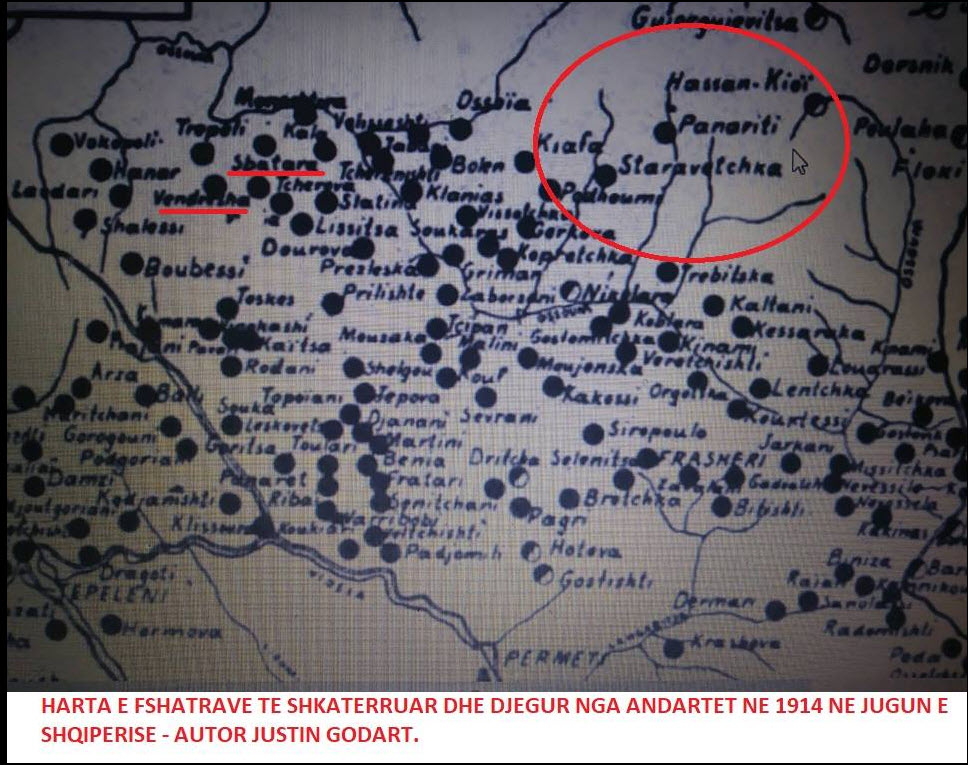
Memorie.al / One hundred and seventeen years ago, on July 25, 1913, at “Qafa e Martës” (Wednesday Pass) in the village of Backë, Skrapar, one of the most legendary battles took place between the çeta (guerrilla bands) of Skrapar, Kolonjë, and Korçë against the Greek andarte (irregular) hordes. The men of Skrapar, Kolonjë, and Korçë fought side by side like men against the andarte criminals. But how did the events unfold leading up to this fierce battle? The history of the “Megali Idea” theory has marked one of its most shameful and detested pages, especially with the massacres carried out in southern Albania in 1913–1914. The Greek government of that time was not satisfied with taking “Lower Albania” (as the British historian John Foster Fraser calls the Southern Epirus in his work of the same name, as do all Western travelers in the 1800s), but also laid claim to the kazas (districts) of Gjirokastër and Korçë (see the book “L’Albanie en 1921. Préface de M. d’Estournelles de Constant” by author Justin Godart, p. 259).
Continued from the previous issue
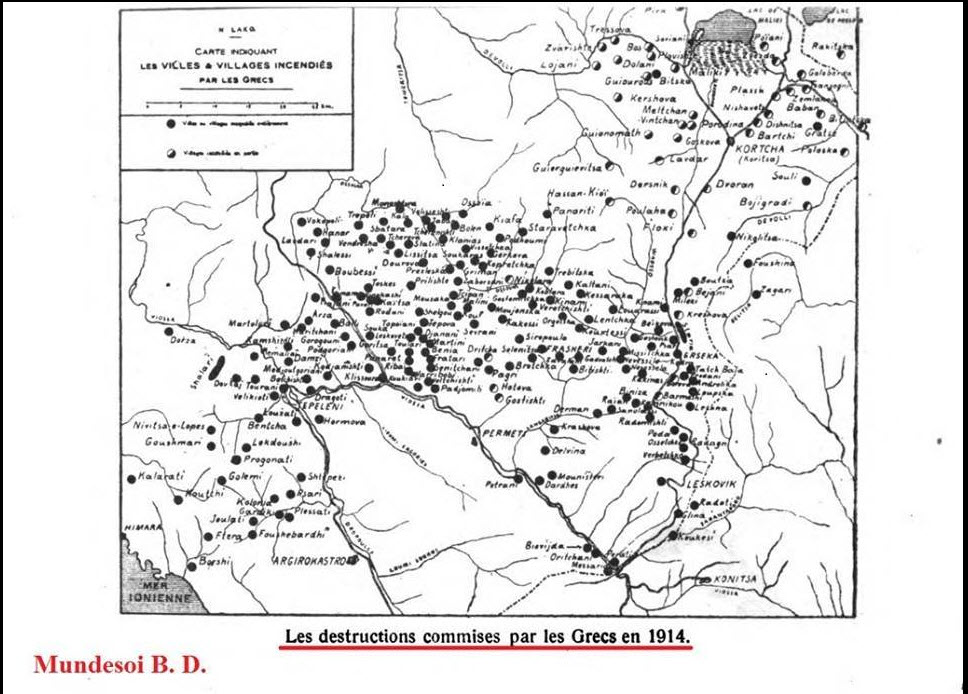
Furthermore, it is impossible to believe, but the roads of Vlorë were filled with the bodies of naked women showing signs of violence on their bodies, such as strangulation marks on their necks, and small children with marks on their bodies as if cut with knives (see the book “Albania’s Greatest Friend: Aubrey Herbert and the Making of Modern Albania” by author Aubrey Herbert, p. 186). According to British MP Aubrey Herbert, the andartes killed 250 unarmed civilians in the village of Kodër, and burned 90 bodies. In the village of Hormovë, Tepelenë, they killed 159 children and 151 women. In Gjirokastër, about 8,000 residents refused to leave.
On May 1, 1914, the andartes burned 55 houses in the village of Qinam, Kolonjë; 120 houses in Starie; 2,200 houses in Leskovik; and 150 houses in Frashër (see the book “Albania’s Greatest Friend: Aubrey Herbert and the Making of Modern Albania” by author Aubrey Herbert, p. 182). Interesting is the letter sent from Vlorë by Edith Durham and published in the prestigious newspaper The Times on Wednesday, July 15, 1914. This letter describes the massacre of the innocent residents of the village of Backë in Skrapar by Cretan forces, as well as the attack and slaughter carried out against the refugees of Skrapar (see the book “Albania’s Greatest Friend: Aubrey Herbert and the Making of Modern Albania” by author Aubrey Herbert, p. 184).
MP Aubrey Herbert mentions in his book the arrest of two andarteofficers and their detention in the prison of Vlorë by the International Control Commission and the Dutch officers. They, along with the confiscated weapons, were suspected of involvement in the massacres carried out in Hormovë and Backë (ibid., p. 185).
The Legendary Battle of “Qafa e Martës”
Backa has been a cradle of Albanian patriotism. This is also mentioned by the French historian Nathalie Clayer, who in her book emphasizes that especially the teqe (Dervish lodge) of Backë, with Baba Fetahu, was the hearth of this patriotism (see “Aux origines du nationalisme albanais: la naissance d’une nation” by Nathalie Clayer, p. 547). The çeta of Lace Backë stood out particularly in engagements against the Turks in 1900 in the village of Panarit (see the book “Riza Kodheli” by Haxhi Çemerica and Ilir Buzali, p. 6).
Turkish pursuit units had become regular “visitors” to Backë, because that village constantly caused them trouble, especially regarding the boys who had to go for conscription (nizam). At this time, other bands were formed in Skrapar besides the band of Lace and Zoto Backë, consisting of young men who refused to go to the army, such as the band of Servet Zaloshnja, Ali Farmaqi, etc. In 1906, the band of Lace Backë, together with the band of the legendary Mihal Grameno, routed the Turkish forces in the village of Staraveckë.
That same year, thirty delegates, led by Lace Backa, Zoto Backa, Ali Farmaqi, Servet Zaloshnja, Riza Kodheli, Kaso Borocka, Qamil Krushova, Hysen Radëshi, and others, participated in the assembly of Frashër. At this assembly, instructions from the Committee of Manastir were given to create armed çeta fighters who would strike the occupier, as well as to open Albanian schools in every village (see the book “Riza Kodheli” by Haxhi Çemerica and Ilir Buzali, p. 5, as well as the book “Riza Cerova” by author Mane Nishova, p. 12).
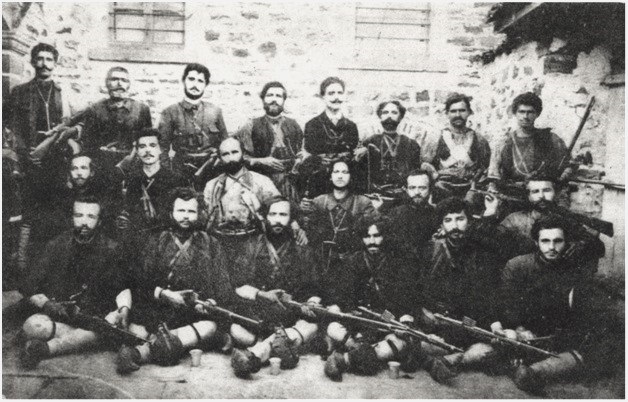
But let us talk about the Battle of Qafa e Martës. It is considered the greatest and most historic. It took place starting July 25, 1913. Prof. Skënder Luarasi rightly called it the “Battle of Thermopylae.” Just as the 300 Spartans fought heroically against the Persian army under King Leonidas, so too did 150 men from Skrapar, Korçë, and Kolonjë, under the command of legendary leaders Lace and Zoto Backa, Sali Butka, Qamil and Xake Panariti, Riza Kodheli, after bloody fighting lasting several days, nail down over 500 criminal andarte forces, inflicting heavy losses upon them.
This battle was also a strategic victory, because the Greek andartes, who had entered via Marjan of Korçë, had as their target the capture of Skrapar and the city of Berat. Had they succeeded, their nearly century-old dream of the “Megali Idea” could have been almost realized. Upon learning and understanding the intention of the andartes, Lace Backa issued a call to arms throughout the entire area. Coming to the aid of Lace Backa was Sali Butka, who first met and consulted with the “Beu of Mëlova” and they decided to gather at Turbohovë—at what was called the “Assembly of Men”—for the whole region.
At this assembly, residents of Tomorricë, Gjerbes, Grevë, Melovë, Grëmsh, Kuç, and others took part. The assembly was held at the house of Fetah Ymer Koxhabelliu. About 58 freedom fighters were registered in Sali Butka’s çeta. Immediately, without wasting time, this band, under the command of Sali Butka, set off toward “Qafa e Martës.” Also participating in this battle were the band of Servet Zaloshnja, the band of Ali Kuçi, and the band of Muço Kapinova. Lace Backa, upon spotting the andartes, who were coming in swarms from Marjan, gathered his band along with Zoto Backa and Riza Kodheli. As a born strategist and a good connoisseur of the terrain, he decided that the dominant point of the “White Rock” must be seized.
This task was assigned to Zoto Backa, who, with a few brave men, set off immediately and occupied that commanding position (see the book “Riza Kodheli” by Haxhi Çemerica and Ilir Buzali, p. 11). The fighting was fierce; the enemy had numerical superiority in a ratio of 1 to 5, but also military superiority. This became evident when the positions of the freedom fighters were bombarded with heavy weapons, such as cannons, etc., from the Church of Marjan.
After many hours of fighting, Lace Backa was wounded, but the freedom fighters continued the battle. The ground was strewn with andarte corpses. Soon, some raised the white flag. The battle was won, but without its commander. In this battle, Qamil Panariti and several other fighters also fell. The echo of this battle crossed the borders of Skrapar and Albania. Its victory had several effects. First, the momentum of the hordes was halted. Second, Skrapar and Berat were saved. And third, this victory conveyed a message to all Albanians that without unity, there is no freedom.
Recently, there are some so-called “new” historians who shamelessly propagate that the war against the andartes was of a religious or ethnic character. No, you are mistaken, esteemed historians; read history carefully—the band of Lace Backa fought with its brothers of every faith, against every kind of enemy. This band cooperated with the bands of Sali Butka, Qamil and Xake Panariti, Servet Zaloshnja, but also with the bands of Mihal Grameno and Themistokli Gërmenji. Were these not the same bands that fought alike in Panarit (1900), Staraveckë (1906), and Përmet (1909) against the Turks, just as they cooperated alike in 1913 and 1914 against the Cretan-Greek andartes? The same applies to the bands of Sali Butka, which cooperated with the bands of Mihal Grameno, Spiro Ballkameni, and Themistokli Gërmenji. Therefore, your theory is old, divisive, and its time has passed. / Memorie.al
BIBLIOGRAPHY
1 – “L’Albanie en 1921. Préface de M. d’Estournelles de Constant”, Justin Godart.
2 – “Shqiperia e Poshteme” (Lower Albania), John Foster Fraser, Publishing House “Zeni”, Year of publication 2009.
3 – “Epirus, Low Albania”, Sherif Delvina, Publishing House “Eurorilindja”, year of publication 2003.
4 – “Albania’s Greatest Friend: Aubrey Herbert and the Making of Modern Albania”, edited by J. Tomes and B. Destani, year of publication 2011, New York.
5 – “Albania past and present”, Constantin Chekrezi, USA, 1919.
6 – “Aux origines du nationalisme albanais: la naissance d’une nation” (On the Origins of Albanian Nationalism: The Birth of a Nation), Nathalie Clayer, Paris 2007.
7 – “Riza Kodheli”, Haxhi Çemerica, Ilir Buzali, Tirana 1984.
8 – “Riza Cerova”, Mane Nishova, Tirana 1975.
9 – “Barbarite Greke në Shqipëri” (Greek Barbarities in Albania), Kosta Papa Tomorri, USA 1917.
10 – Contributed with data: Nj. Dervishi, A. Guri, B. Hysi, Z. Gode.