



Part Twelve
Memorie.al / The CIA have released new details on several operations to drop secret agents by parachute into Enver Hoxha’s communist Albania. In one case, however, the operation failed completely, as the agents did not land according to the plan prepared in advance. On the other hand, it is shown how the State Security had inserted spies as far as the UN.
Continued from the previous issue
23 November 1951
Detailed report of the infiltration operation
Due to the high nervousness displayed by agent T5 before the drop, it is possible that he did not receive the tap on the shoulder (the drop signal) before leaving the aircraft, even though T5 insists that he was struck by the dispatcher. The change of assembly plans during the journey to the drop site is something difficult to understand, and this made T5 think that he was being deliberately abandoned by the group. After the drop, the agents were so dispersed that even their training in assembly by sound signals was of no use to them.
Regrouping tactics have worked with other groups when they have landed within hearing distance. T1 and the rest of the group had orders to establish radio communications as quickly as possible, and it is not possible that they thought of abandoning T5, especially when they depended on him for support. T1, 2 and 3 knew the area well and believed they would soon find T5, but this error of judgment occurs often, and a pre-arranged plan is much better than trying to find one another by chance.
The clash with the Yugoslavs
Three rifle shots heard by T5 may have been the pistol used by the group for assembly in case of emergency. T5 had several clashes with Yugoslav patrols and has killed several Yugoslav soldiers, and in one case a civilian informant. The Yugoslav authorities have no doubt that T5 is a reliable Albanian agent on a CIA mission. But T5’s actions in Yugoslavia show a great hatred of his for Tito, and this may influence the information passed to us about Yugoslavia.
On 16 August 1951, T5 set off by plane toward the drop zone, but reported several details that may shed light on the lack of organization of the operation. T5 reports that he felt dazed as soon as the door of the aircraft opened, and this was not caused only by his looking outside, but because he distinguished some visible signs of fire being directed toward the aircraft. Agent T1 made two changes to the instructions along the way, regarding the place and time of the drop. T5 reports that the change of the meeting place was disclosed only to agents T1, 2 and 3. T1 instructed T2 and T3 that, if they did not meet at the drop, they should find one another through friends they knew in the area, whereas T5 was not included in this plan, at a time when he did not know the area.
When the preparation signal was given, T5 positioned himself near the door of the aircraft and was to be dropped when he received the tap on the shoulder. As soon as he felt it, T5 exited the aircraft and opened his parachute. He says he was surprised to find the ground sloping at about 20–30 degrees, as the parachute enveloped him and made him roll down the slope. T5 did not know the area but tried to stay a few kilometers near the drop zone, in the hope of finding the group of other agents again.
The meeting with the inhabitants
About seven days after being dropped into Albania, T5 spoke to an old woman in a village to ask her for food. She warned him that there were patrols near the village and that it was dangerous to go home with her. She later gave him some bread with cheese. A day later T5 took the direction toward Yugoslavia. On the way he came across some peasants who asked him if he was Liman Peposhi. T5 first answered that he was Peposhi, but when it was becoming apparent that he was not Peposhi, he said he was Peposhi’s man. The old man told him that they had not heard of him for a long time and were wondering what had become of him.
The clash with the Greeks
Two days before T5 reached the border with Yugoslavia, he came across three patrols heading toward him, which, after taking up positions, opened fire on him. Their uniforms resembled those of Greek soldiers. After about an hour of effort he managed to break through the encirclement. On 30 August T5 crossed into Yugoslavia and met an old man in the restricted border zone. The old man told him that Gostivar was six hours away to the southeast. T5 walked for several days, but instead of continuing toward Greece, he went to his village, Gjilan in Kosovo, where he was sure he would get food and shelter. He further visited the village of Kabash, where he visited the house of Xhemal Hazizi. They were at first afraid to shelter T5, but they accepted on condition that their children should not know of his presence.
Five days after he had come to Kabash, T5 told Selman to bring his brother-in-law Rexhep Tërpeza, who is the head of the municipality of Tërpeza. When he came, he said that the Albanians of Kosovo were anti-Titoist and strongly desired union with Albania, even under Hoxha’s regime. According to him, the Kosovars thought that if they united with Albania, they would have the opportunity to act more against Hoxha’s regime. Terpeza also informed T5 that the Kosovars are confused by the current rapprochement in Yugoslavia–US relations.
They do not understand why the US helps Tito, who claims to be a communist. The Kosovars have seen many American products, even though they are sold through cooperatives. Terpeza said that only a small part is sold on the free market, and this happens in the large cities where there are Americans. Terpeza said that the Albanians who left for Yugoslavia were put to work in road construction, and in some cases they were sent clandestinely to Albania on behalf of the UDB secret services. He said that a British group had also come to Yugoslavia from Albania. They had been told to leave for Yugoslavia in case of need, since the Yugoslavs would ensure their release.
But after they were put to work repairing roads, some of them left again for Albania, in the hope of reaching Greece. T5 learned from him that the Yugoslavs had a camp for Albanian refugees in Vuçiterna. There the Albanians were divided into two categories: those who were put to work and those who received food and shelter without working. He did not know the reasons for this division. Terpeza said that there were resistance activities in the areas of Gjakova and Rugova, but he did not know more. He said that Hasan Alia from Remniku has been wanted by the government forces since 1944. He may have gone into the mountains and may be active with the above-mentioned resistance groups. When he reached Greece, T5 was questioned by a Greek officer for about three to four hours, during which T5 gave details of his activity in Albania and Yugoslavia.
Comments
Since T5 could not find his fellow drop agents, he believes he was abandoned by three members of the group, who changed the meeting place and did not include him in the new plan. According to a memorandum of 17 April 1951, Liman Peposhi and Tahir Vata were recruited by the CIA in April 1951. Their recommender was Muharrem Bajraktari. The Ministry of the Interior has reported that agent T6 was killed by them. According to the June 1951 edition of the newspaper “Atdheu,” Hasan Kabashi was killed during clashes with the Yugoslav communists on 15 October 1951. “Atdheu” is the organ of the Legaliteti party. It appears that the person with whom T2 and T3 met in Kastoria is Tahir Ademi.
Department of Justice
29 December 1969
On 13 August 1967 a source that has given reliable information in the past signaled that Kozma Moja, the second secretary of the Albanian delegation to the United Nations, had secretly admitted that he was a member of the Sigurimi [State Security]. On 14 December 1969, the same source reported that recently Kozma Moja had expressed interest and had commented as follows: “Kozma Moja’s seven-year-old son returned to Albania on 5 December 1969 to continue school in Tirana, where he will stay with relatives.
He had sent his son to Albania because he did not approve of his being educated in the United States or in the UN schools in New York. Moja is very close to his son and feels lonely now that he has left. Moja’s son returned to Albania together with the delegation that participated in the UN General Assembly. The group flew by plane from New York to Rome, where they waited two days for the Alitalia plane to go to Albania. This line has only one flight a week to Albania.
The clashes over “Vatra”
Vincent Marko from Connecticut, USA, was supposed to have been at Tirana airport on the day Moja’s son arrived there. Marko has already returned from Albania, but Moja did not meet him. Moja commented that he knew what had happened during the two dinners given by the “Vatra” organization on 28–29 November 1969 at the New York hotel, but was more interested in what had developed during the “Vatra” seminars that weekend. Moja said he had heard during the seminars that there was opposition, criticism, and protest against the fact that political elements were given the right to speak.
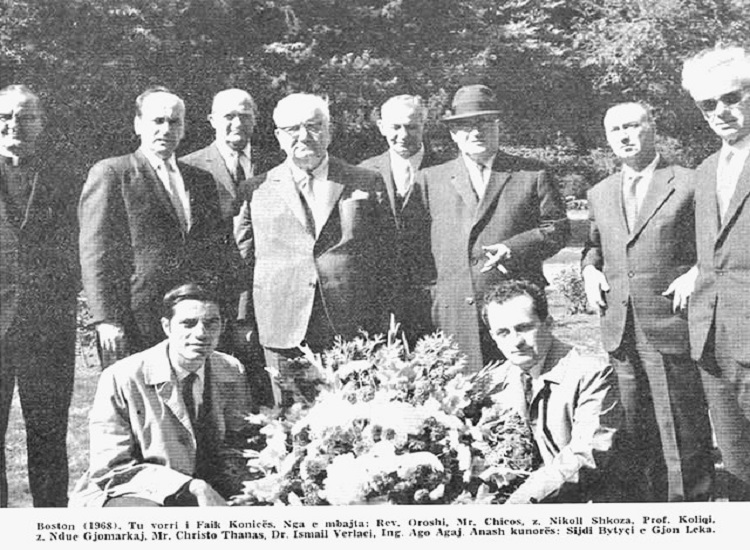
He continued by saying that some people were accusing others of turning “Vatra” into a political organization, and that both … Unicos and Antony Athanas, the presidents of “Vatra” in the years 196… and 1963, opposed such a movement and were criticized for allowing elements such as … Koliqi, the head of the Independent Bloc, and Hasan Dosti, the head of the National Front, to speak at its seminars. Moja said he had read the newspaper “Dielli,” but nothing was said in it about the seminars.
The division of emigrants
The source reported that the Pan-Albanian Federation of America recognizes “Vatra” as an organization of old Albanian-Americans and an anti-communist group, with the weekly newspaper “Dielli.” The source identified the Independent Bloc as an organization of Albanian emigrants, mainly Catholic ones. The source reported that the National Front is also an organization of Albanian emigrants. Moja was interested in knowing about the groups that participate in the “Free Albania” Committee, and also wanted to know whether the State Department sent annual greetings to the Committee.
Moja commented that he had heard that the main speaker of the event had criticized the Albanian government and communism, so Moja was investigating why such a speaker had been chosen. He said that Buzi did not know what he was talking about, and that Albania had abolished all taxes and was the first country in the world to do so. He further said that Albania had lowered the prices of food and clothing. Moja had said that he wanted to know more about the group of Arbëreshë who came to New York to participate in the celebrations organized by “Vatra” on 28–29 November 1969, including the number of people in the delegation and who paid the costs of travel, food, etc. He said that “Vatra” itself did not have much money, so he wanted to know who had sponsored the celebrations.
Therefore he wanted to know what had happened during the trip to Washington of the president of “Vatra,” Vasil Gërmenji, since the trip was made only a few days before the arrival of the Arbëreshë in the USA. Moja expressed his surprise and pleasure at learning that the US government, at state or local level, had no hand in the “Vatra” celebrations. He thought that “Vatra” is a political organization, since its members follow the political line of the Nixon administration. Our source reports that the Arbëreshë are descendants of Albanians who left for Italy since the death of Skanderbeg in the 15th century and who have preserved their traditions and their colony since then.
The role of Ernest Koliqi
Moja said that Ernest Koliqi, the head of the Independent Bloc, came from Italy to participate in the “Vatra” celebrations, and was still in the United States to meet with representatives of the Independent Bloc in the USA. He believed that Maliqi’s visit had political significance. Moja said he suspected that the US government had given the Vatican a free hand to direct the activities of Albanian groups in Italy, and that the “Vatra” dinner was only the beginning of them. He further said that Albania will grant a visa to all those who wish to visit it.
He advised that several visas have already been granted to Americans and that others will be granted soon. Moja was interested in knowing the whereabouts of Fehime Pipa and her brother, as well as the manner of her departure from Albania to Yugoslavia and those who had helped her to escape. The source informs that Arshi Pipa is one of the well-known intellectuals in Albania and who was held in a concentration camp for many years, for reasons of opposition to communism. He came to the USA about 10–12 years ago and works as a professor at a school or university.
1 April 1953
Below we have the text of the propaganda pamphlets approved by the main headquarters. Delays in completing them may be explained by the silence of some elements within the branch, who did not view them favorably. Different sectors of the mission have had different opinions on the style of action or on merging all operations into one.
Text
The Turkish-Greek-Yugoslav Pact, good news for Albania
In order to stay in power, Enver Hoxha and his puppies know that the people must be kept in a state of fear and insecurity. Therefore they try to convince the people that their fall would also bring about the dismemberment of our beloved homeland. They do everything to convince the whole world that Albania’s neighbors seek to violate our borders, to annex our lands, and to extinguish our culture. They want to make the people believe that their fall would be the death of Albania. But this is a lie with a tail. Their being in power has brought nothing but misery to our people and is the real obstacle for our people to benefit from peace.
Recently, O fellow countrymen, their lies have increased even more. They try to discredit the significance of the Turkish-Greek-Yugoslav pact, criticizing it harshly. They want you to believe that this pact is the loss of Albania and that their stance is the only salvation for our Homeland. Sister and Albanian brothers! There is no greater lie than this. The Balkan pact signed by Turkey, Greece, and Yugoslavia in Ankara on 28 February 1953 is in reality one more guarantee on the part of Albania’s neighbors to respect Albania’s independence and the integrity of our national borders. Let us examine this matter wisely and with attention.
The neighbors
Our three neighbors, with all their disagreements, understood at last that they must be united in order to be able to defend themselves against Russian aggression. The solidarity of these three states adds hope to those neighboring nations that find themselves under the red yoke. By maintaining and defending their own identity, they open a path for their oppressed friends to break the shackles of slavery that keep them bound, and to create a shield of strong nations that can draw them along. Trade agreements between countries bring material benefits to all, better living conditions, more food, and more work. Fellow countrymen, the pact between Greece, Turkey, and Yugoslavia has had very good effects for the leaders of the Free West.
They accept that this pact is positive proof that the Balkan countries are united and will unite in friendship, to defend their national identity and to keep ambitious enslavers far away. Sister and Albanian brothers! Do not be deceived by the servants whose only purpose is to serve the masters of Moscow, and to prolong the life of their power. The pact of friendship signed by Greece, Yugoslavia, and Turkey is good for freedom-loving Albanians. It is the first step in creating an atmosphere in which Albania’s freedom can be established. Death to communism! Freedom for Albania! National Committee “Free Albania.” For freedom! For Albania! For the red and black flag!/ Memorie.al
Continued in the next issue