From Fred Brandt
Part One
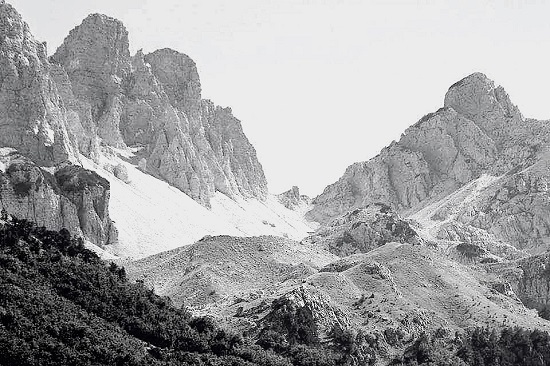
Memorie.al / My chief in Pec (Peja), the commander of the German troops, told me that he had received an order from the supreme command in Belgrade that, in the Albanian Alps, west of Gjakova, we were to build a stronghold. One of the main purposes of the stronghold was, among other means of war, [to counter] the British officers of the Intelligence Service. The commander entrusted to me the raising and maintaining of this stronghold of the German army in the Albanian Alps, along with several soldiers from Tajikistan. From Peja to the mountain range behind which the stronghold was to be raised was a distance of 75 km, but the stronghold itself would be raised even deeper, beyond a pass at an altitude of 1,800 m. The road to the pass passed about 30 km from Valbona and was heavily forested. We had to cross through that dense forest where, at best, only pack animals had passed.
The stronghold had to be two days’ march from Peja. This was for reasons of communication with the central command in Peja. I begged my chief to create for me the possibility of gathering information about the area before I answered “Yes.” He accepted my request. On the first day of March 1944, I, accompanied by six Tajik soldiers and one Albanian from Gucia (Montenegro), set off for the northernmost part of Albania to carry out the raising of the stronghold.
Our armament consisted of: 7 MP (automatic rifles), 7 pistols, and six hand grenades each. We had sufficient ammunition. The Albanian was armed with an Italian carbine. First we crossed a pass at 2,000 m altitude, on the border between Montenegro and Albania, where the ground was buried under the great snow which reached a height of seven meters. Over the frozen snow blew a stormy wind, so cold that it froze one’s breath. After a march of 15 hours, we entered the valley of Theth (Thethi), where an Albanian received me.
From there, for the purpose of reconnaissance and familiarization with the country, for three weeks I crisscrossed the area on foot, under the great snow, often without road or path. From this search, I learned that the leader of the fighters in northern Albania, who commanded about 3,000 men, was called Nikë Sokoli.
In his headquarters there was supposed to be a British officer. The command post was supposed to be in the rocky village of Curraj, in Nikaj-Mertur. On the rocks above that village, Nikë Sokoli had the “Eagle’s Nest.” It was clear to me where I had to direct my next steps: toward Nikaj-Mertur. Only there, with Nikë Sokoli, could I learn whether I would dare to raise the command post in the Albanian Alps, according to the order I had received, or not. After a two-day march, difficult and very dangerous, I arrived in Nikaj.
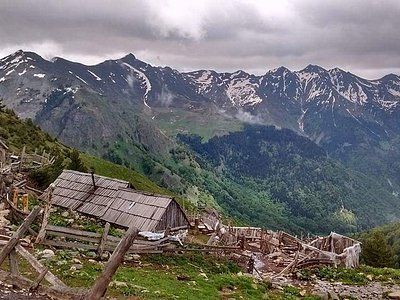
Up there, on the mountainside, below the grey rocks of Maja e Hekurave, almost at the boundary where the trees ended, stood the house of Nikë Sokoli. For two days I looked for a guide who could accompany me to him, but no Albanian of the region took the courage to accompany a German and, moreover, to take him to Nikë Sokoli. Finally I decided to go alone. An order is an order.
In a demonstrative manner, in the eyes of all the people present, I threw my weapons into the courtyard of the church of Nikaj and set off toward Nikë Sokoli. It was almost dusk when I crossed the bridge of Curraj and, when I came upon the first house on the mountainside, night had fallen. There I managed to persuade an Albanian to accompany me. Around midnight, we found ourselves before the house of Nikë Sokoli. They received us into the house. When I sat down on the carpet near the hearth, the wife of Nikë Sokoli came and told us that Nika was not at home. She asked me what I wished.
I told her that I had come as a friend and that I must meet her husband, without fail. I have something important to discuss with him. After midnight, late, two fighters came. They would notify Nika and I could stay in his house until they returned with news from Nika. In the morning, the two partisans came and told me to follow them. The descent into the valley lasted about an hour, and we went to a center which was seething with fighters, all armed to the teeth.
They accompanied me to the guest room, where Nikë Sokoli was seated by the hearth. In the corridor were a dozen fighters who looked after their leader. According to Albanian custom, at first, by Nika’s order, they brought me two cups of Turkish coffee, one after the other. Then he asked me why I had come there. I begged him that we speak head to head. I had a very important message for him, which I needed to discuss only with him, and then he could decide for himself whether to discuss it with his subordinates or not.
With a movement of his hand, the room emptied. When we were alone, I told him that, by order of the supreme command in Belgrade, I had come here to Nikaj for the purpose of raising a stronghold. I had not come as an enemy but as your friend, to help you as much as is in my power. I had to regard the British as his friends and I dared neither to fight them nor to mix with them.
It was not the occasion to express two words, but we had to discuss at length, to take things one by one, until we understood each other on every detail. In the end, Nikë Sokoli gave me his hand as proof of peace between us. Then he took my military cap from my head and put on my head his white hood, which he pushed slightly back on my head. He told me that I had to keep the hood on my head, in the area of Nikaj, so that all the inhabitants would immediately understand that I was his friend.
Before he called his subordinates, I advised Nikë Sokoli that his troops should not fight against the German troops, and that the British should do the same. In order not to compromise him as a leader of the movement, I told him that, from time to time, we could organize light exchanges of fire against each other, but without shedding blood.
He could give false information about the number of German soldiers killed by his troops, about prisoners taken, about vehicles burned, etc. While I was saying these things, he looked at me sternly in silence. I noticed that my words fell on fertile ground.
When his subordinates entered the room, he explained to them that I could stay in Nikaj as his friend and that I was permitted to raise a stronghold with six soldiers, which both sides could use. All immediately approved, and I had to exchange “brotherly” kisses with all of them. About the advice I gave him, he did not inform them; it remained between us.
A ram was quickly slaughtered and the celebration began. Later, late in the evening, I returned to my people, to the church of Nikaj. Two fighters came with me, the ones who had accompanied me to Nikë Sokoli, who, by Nika’s order, would remain at my disposal. The next day, together with the two accompanying fighters, we took the road to Peja, where we arrived late in the evening at the house of the bajraktar, a subordinate of Nikë Sokoli, who received us very friendly.
Again a great celebration, with food and drink, until late at night. The next day we set off toward Valbona, where we arrived late in the evening. At the bridge was a single house within which was a grocer. When we approached, they received us with rifles. Fortunately, it was dark and no bullet touched us.
After the conversation that the two fighters had with the people who shot at us, the fire immediately stopped and they received us in a friendly manner. The escorts explained to them that we were friends and under the protection of Nikë Sokoli. We spent the night there. The next day, early in the morning, we crossed the swaying bridge of Valbona and continued the road toward Bytyçi, as far as Degë.
In February, a British stronghold had been built there. It was attacked by a German military unit coming from Kukësi, but the British officers of the Intelligence Service managed to escape. Now it would be I who, from the command post in Nikaj, would control the area. In Degë there were only ruined houses, not a bite of bread, not a possible shelter to put one’s head.
We had to march at night, toward the east, without road or path and in the great snow that continued to thaw. At one point, late in the evening, we reached an inhabited area, where we found shelter and a warm reception from the people of Nikë Sokoli. My search as a scout lasted three weeks, until the completion of the task.
I informed my chief about what I had seen, experienced, and done. He agreed with everything. From him, I received the order to raise the stronghold in Nikaj and that I had a free hand, for every eventuality. With the six soldiers from Tajikistan, in April 1944, I settled in the stronghold in Nikaj, where Nikë Sokoli had freed a house for us.
One machine gun, one light mortar, seven automatic rifles, seven pistols, one per person, ten hand grenades — this was all our ammunition. On Easter Sunday, accompanied by my Muslim soldiers, I went to the holy mass in the church of Nikaj. Then we went to the house of Nikë Sokoli to congratulate him for the holiday.
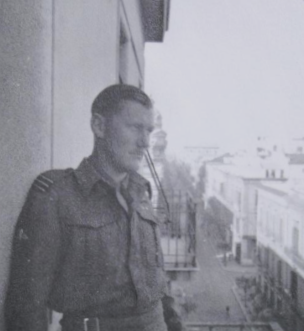
There I met Major Neel, the chief of the Intelligence Service in the area. Nikë Sokoli with some of his trusted men, the British major and the interpreter, an Italian by the name of Sergeante, who spoke English fluently, were seated at the table (no higher than 20 cm).
We leaned our weapons against the wall and sat down at the table; I sat near the British Major Neel. We both enjoyed Nikë Sokoli’s hospitality so much that we forgot any enmity between us. After a handshake, Major Neel filled our glasses of raki with whisky and we drank them to the bottom. We forgot who we were to each other.
After a few days I met again with Nikë Sokoli. He came to talk with me about the advice I had given him, not to fight against the German troops, but with light exchanges of fire to deceive the British. He would accept this on condition that I would come to an agreement with Major Neel, not to oppose the British aid which would be dropped by parachute for Nikë Sokoli. I accepted immediately.
One night later, my two “fighters” came to me and accompanied me to Major Neel. I assured him that I had no objection if he brought materials from Bari and dropped them by parachute for Nikë Sokoli. I even promised that I would help him with my soldiers.
As Nikë Sokoli had told me, supply by parachute was a difficult problem, since half of them, often even more, fell into the hands of other fighters, his opponents. In the first case of the dropping of materials by parachute, everything went well. Almost nothing was lost; even the parachutes with special markings, with gold and the mail for the British officers, fell into safe hands.
This was the beginning. Later, I too was present at the distribution of the goods dropped by parachute. I had also become friendly with other Albanians, outside the ranks of Nikë Sokoli, whom I had advised not to harm us, for the sake of the British. With the Albanians incorporated into the German army in Peja, who were in a blood feud with the Russian legions, I had no contact. What was the cause of this blood feud between the Albanians and the Russian legions, I will clarify below.
In the middle of May 1944, Major Neel proposed that I meet with the British officers of the Intelligence Service who were operating in Northern Albania. I had to decide quickly, since at night we had to begin the march. From Tajikistan I chose the two most loyal and my two “fighters,” whom Nikë Sokoli had left at my disposal. Nikë Sokoli, himself the fifth, among whom was also Major Neel with the interpreter, came with us.
We were so heavily armed a unit that it seemed as if we would abandon Nikaj forever. After several days of marching, mostly at night, we reached the valley of Lura, where guides received us to continue the journey over the Black Drin, toward the east. Somewhere, in a single Albanian house, we found the British stronghold. The house was full of weapons and other materials.
There were also two radio transmitters installed. The next day, several other participants of the meeting arrived. They had been stopped on the road after the Albanians had recognized them as British and had handed them over to a German military unit. A German SS military unit entered the village and swept the entire area. We had been warned in time and hid in the forest, from where we followed all their actions with binoculars. It was getting dark. The SS men, frustrated at finding nothing, left the village.
We immediately returned to the house, soaked to the bone and with feet and hands frozen stiff. The next day, eight more British officers arrived. Major Neel introduced me to them and we greeted each other with handshakes. The house was filled with a mixture of nationalities — Germans, British, Albanians, Tajiks, Italians — whom, for a short time, the same fate bound together. We quickly found a common language.
I promised the protection of Major Neel and his soldiers from every possible danger, especially from Albanian robbing bands. For this I needed the reinforcement of the stronghold in Nikaj, a thing which depended on my chief in Peja but also on Nikë Sokoli. The possible military actions of the German troops against the British were part of the discussions. I assured the British major that there would be no such actions./ Memorie.al
Translated by Lek Ymeraj
Continued in the next issue