
Dashnor Kaloçi
Part Four
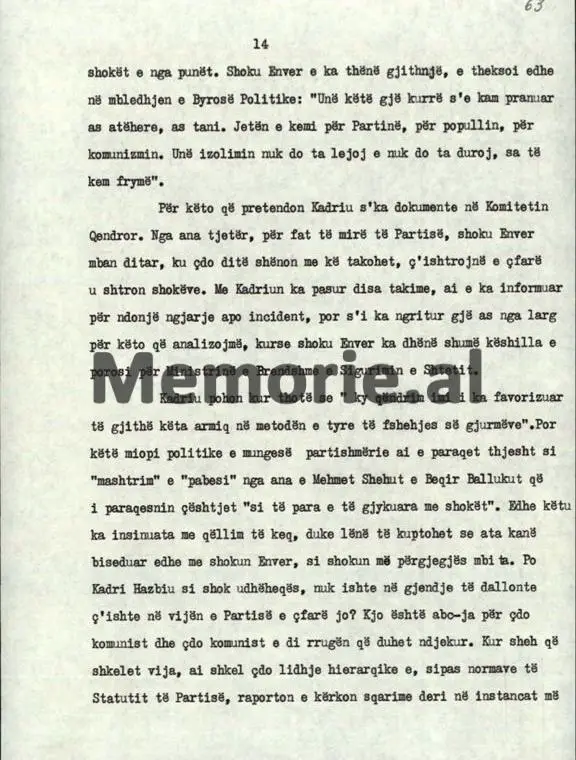
Memorie.al /publishes several archival documents extracted from the Central State Archive in Tirana (from the former Central Committee of the PPSH), which have been unknown for 40 years. Among them is a dossier containing secret materials and documents dating from October 1982, which includes the material of the Political Bureau of the Central Committee of the PPSH entitled “On the Marked Lack of Vigilance and Serious Mistakes of Comrade Kadri Hazbiu, During the Time He Was Minister of Internal Affairs,” Kadri Hazbiu’s written self-criticism, “The Decision of the 5th Plenum of the Central Committee of the PPSH on the Expulsion from the Central Committee and from the Party, as well as the Dismissal from All State and Social Functions of Kadri Hazbiu,” as well as the minutes of the Plenum of the Central Committee held on October 13-14, 1982, in the main hall of the Central Committee building, where the work and activity of the Minister of People’s Defense, Kadri Hazbiu, who is accused of “hostile activity” over a period of nearly 30 years while serving as Minister of Internal Affairs, was discussed and analyzed. The dossier with documents published for the first time by Memorie.al, which includes, in addition to the “Top Secret” material of the Political Bureau with accusations against the former Minister of Internal Affairs, Kadri Hazbiu, also publishes the minutes of the Plenum, where Enver Hoxha and most members of the Political Bureau, such as: Ramiz Alia, Adil Çarçani, Foto Çami, Hekuran Isai, Manush Myftiu, Simon Stefani, Haki Toska, Pali Miska, Prokop Murra, Spiro Koleka, Rita Marko, Lenka Çuko, etc., not only accused former Minister Hazbiu as the closest collaborator of former Prime Minister Mehmet Shehu, but also debated harshly with him during the two-day plenary session, demanding that he provide explanations for his work and activity, from the day he sat in the minister’s office, starting from relations and reports with the Russian advisors, the Tirana Conference in 1956, to his “cooperation with hostile groups” led by Teme Sejko, Beqir Balluku, Abdyl Këllezi, and the “police-agent” Mehmet Shehu, as well as the decisions to dismiss from duties and expel from the Central Committee of Rexhep Kolli, Nazar Berberi, Veli Llakaj, Ndreçi Plasari, etc.
Continued from the previous issue
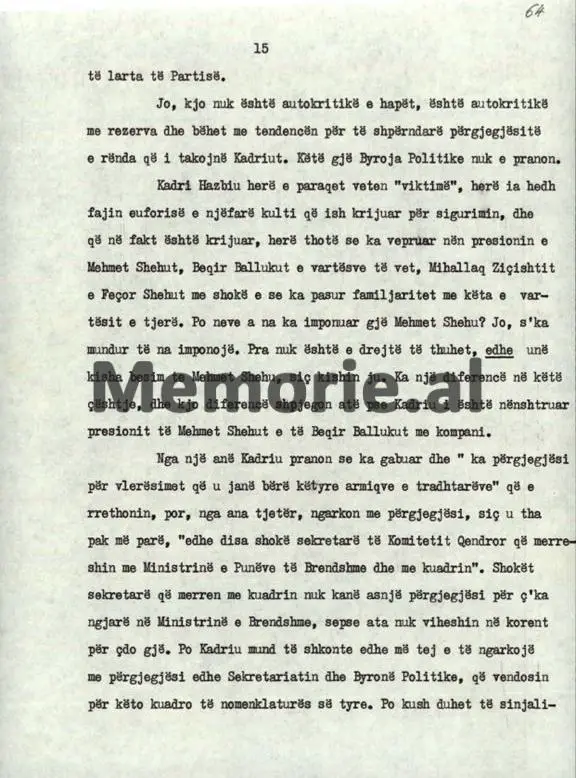
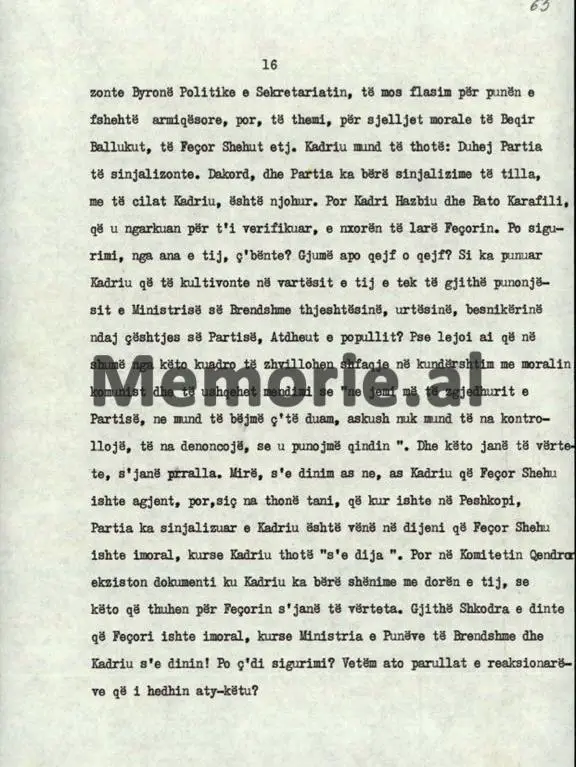
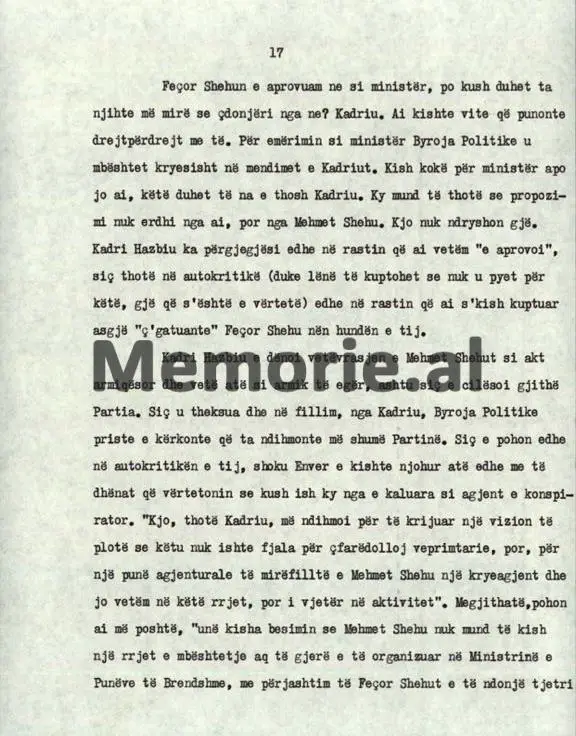
The document containing the “Top Secret” material of the Political Bureau and the Central Committee of the PPSH, with accusations against Kadri Hazbiu, for the time he had served as Minister of Internal Affairs
Top Secret
ON THE MARKED LACK OF VIGILANCE AND SERIOUS MISTAKES OF COMRADE KADRI HAZBIU DURING THE TIME HE WAS MINISTER OF INTERNAL AFFAIRS
(Material of the Political Bureau of the Central Committee of the PPSH)
The Plenum of the Party’s Central Committee, on October 13, 1982, reviewed the above-mentioned material of the Political Bureau and also familiarized itself with the self-criticism that Kadri Hazbiu presented to the Plenum of the Central Committee. The conclusion of the Plenum of the Central Committee was that Kadri Hazbiu not only had not drawn lessons from the conclusions of the Political Bureau, not only had he not taken into account the help given to him by comrades, but he had taken steps backward. In the Plenum, his attitude was arrogant and provocative. In fact, his self-criticism constituted an attack against the Party and its leadership. The questions posed to him by the comrades of the Plenum he treated very superficially and with arrogance.
The Plenum of the Central Committee became fully convinced that Kadri Hazbiu deliberately hides the truth from the Party, that he is aware of the hostile actions of Mehmet Shehu’s group, and that Kadri Hazbiu himself is a member of this conspiratorial group. For this reason, the Plenum of the Central Committee not only approved the measures proposed by the Political Bureau for the expulsion of Kadri Hazbiu from the Central Committee and the Political Bureau, but also decided on his expulsion from the Party. As for criminal responsibilities, the competent bodies shall act according to the facts and documents they have or that will emerge.
Furthermore, the Plenum of the Central Committee, for lack of vigilance, expelled from its ranks Rexhep Kolli and Ndreçi Plasari (the latter’s membership in the Party will be reviewed by the Central Commission for Party Control and Revision), while it expelled Veli Llakaj and Nazar Berberi from the Central Committee and from the Party.
14.10.1982
The secret document containing the self-criticism of the former Minister of Internal Affairs, Kadri Hazbiu, at the 5th Plenum of the Central Committee of the PPSH, on October 13, 1982
The Political Bureau rejected as unacceptable the self-criticism I made before it, severely criticized me, and took the appropriate decision. At the same time, it advised and counseled me that in the Plenum I should be deeper, more sincere, and more self-critical in analyzing my mistakes and faults and their causes. The judgment of the Political Bureau, both regarding the assessment of mistakes and faults, as well as the self-criticism, is completely correct; likewise, the decision on the measures taken against me is also completely correct.
In this self-criticism that I am making before the Plenum of the Central Committee, I am trying to reflect as deeply as possible, inspired by these conclusions and the decision of the Political Bureau. And I consider them as the greatest and freshest help given to me by the Party. I say freshest, because even before, and continuously, Comrade Enver, and recently together with the secretaries of the Central Committee, have helped me to conceive as correctly as possible the dangerousness of the agent activity of the enemy Mehmet Shehu, the causes of its spread, especially in the Ministry of Internal Affairs, and the mistakes and responsibility that fall on me, particularly as the former Minister of Internal Affairs for a very long time. The fact showed that despite this help and my desire, I did not achieve the degree of reflection that was necessary. This weighs even more heavily on me before the Party.
Why couldn’t I do this, and how do I realize everything now? This is exactly what I will try to explain sincerely before the Plenum. At the core of the self-critical analysis I am making, I consider it right to provide answers to several legitimate questions, such as: Why was Mehmet Shehu and his agent activity not uncovered by the State Security, as the Party’s special weapon, but by the Party and Comrade Enver, and why does it happen that such hostile undertakings of great danger have always been uncovered by the Party? Why and how did the Ministry of Internal Affairs become a hotbed of spies? And my role and responsibility as the head of this ministry for over 25 years? It is a fact that enemies, at all times, have targeted the Ministry of Internal Affairs, and within it, State Security, as a neuralgic point of the Party’s work. Precisely for this reason, the Party and Comrade Enver have directed special care to keep them pure and increase their compactness. And at the foundation of this Party work has been and is education with Marxist-Leninist ideology, as well as the understanding and implementation of the Party’s line in an uninterrupted process.
As I judge, the lack and main weakness of my work, and along with it, the serious responsibility I bear, consists precisely here, that I could not, from the position I held, ensure this education and this understanding and implementation of the Party’s line in these bodies. As unavoidable consequences are the implementation of the line with fluctuations, both opportunistic and sectarian, vigilance not at its peak, and the weak compactness that have been observed in the work and struggle of these bodies. It is clear that the damages are great, both for the non-exposure of spies and enemies directed by Mehmet Shehu, for the concealment of many of them within the Ministry of Internal Affairs itself, and for the sabotage they carried out, especially in violating legality.
But why did I not do my duty as the Party requires? There are several reasons for this that I will explain in this self-criticism, but the main one is that, apparently, as a leader in these bodies, I did not always treat ideological education as the most fundamental duty, concretely linked to the norms and rules established by the Party for these bodies. The hidden enemies exploited this gap to influence as much as they could in their favor. And they were able to sterilize the work of the Security apparatus in many directions, divert its attention away from themselves, and tactfully plant self-satisfaction with little, as if it were a breeding ground for unfounded euphoria. My responsibility for this lack is complete and direct.
I now conceive more clearly that, directly stemming from me, little work was done – not to say completely poorly – to ensure the continuous control of the Party, especially over the entire activity of the Security organs. Apparently, I failed to give this task of essential importance the priority it deserved, from which issues would be addressed with the necessary force in the basic organizations and, according to norms, also in the Party committees and bureaus. As I judge now, the thought was created in me that these issues had found their course, experience had been gathered, and unintentionally, I left this as a task only for the proper political apparatuses. This was a serious mistake, which led me not to know the situation and people as they were in the dynamics of life. Consequently, I often fell into subjectivism and superficiality during judgments and when raising issues before the Party at all instances.
From this analysis being made, I clearly see that, despite my good predisposition, I have not been able to raise the most important problems in time and with the necessary force to the Central Committee and to Comrade Enver. Thus, I have left the path open for the weakening of their control and assistance. But why did I allow this control of the Party, directly from the Central Committee and from Comrade Enver, to weaken? It never crossed my mind that this control might have been weak, as it appears now, because nothing was intentionally set aside. This control was realized through operational connections and reports to the respective secretary of the Central Committee, the prime minister and the deputy prime minister responsible for the Ministry of Internal Affairs, and also directly with Comrade Enver (apart from the work of the respective apparatus in the Central Committee).
These multiple chains of subordination occasionally created in me the thought that things are known, that Comrade Enver knows them, and consequently, I went to him relatively less often, both for periodic briefings and for specific issues requiring his direct approval. I note that Comrade Enver received me whenever I asked, in addition to when he called me himself. I should have ensured this direct briefing to Comrade Enver more often and in greater depth. But apparently, I was influenced here both by the multiple subordination links and by the refined attitude of the enemies Mehmet Shehu and Beqir Balluku, who always had on the tip of their tongues to say, “Let’s not disturb Comrade Enver for everything,” or “We discussed it with him,” etc., etc.
I understand this fault for trusting these enemies, and I also understand the responsibility I bear for not establishing a clearer rule for providing more frequent written and official information to the Central Committee as well. By not doing this rule properly, notifications and operational and coherent matters could be left at the mercy of memory. I say sincerely that it is for this reason that in the Political Bureau I said that the absence of Comrade Hysni as the responsible secretary makes it difficult to clarify the information provided in various forms, and in no way did I want to express distrust towards the Political Bureau or to smear Comrade Hysni Kapo for my mistakes. It is quite clear that the weakening of Party control over the security organs at all levels has brought many ills and damages. Because I could not ensure this control, a heavy and special responsibility falls on me as the former Minister of Internal Affairs.
The work of the Security, due to its characteristics, is closed; therefore many evils can be cultivated there relatively easily. But this is successfully fought if one works well on education, on understanding and implementing the Party’s line and directives. I could not ensure this, neither in the necessary depth nor in continuity. Consequently, the cult of the weapon and its people, as infallible, or even when you make mistakes, responsibility is minimized, etc., gradually took hold and flourished without me realizing it. Thus, shortcomings and mistakes found a warm place, as did many cadres with character defects, with repeated mistakes at work, and some even unsuitable to work in these bodies. It now becomes clear that, besides the weaknesses of the Party’s work and my personal ones, this cult was systematically nourished by the enemies, with Mehmet Shehu and Beqir Balluku at their head, with the aim of having their people there, as well as others they could manipulate and use when and for whatever they needed.
Despite the fight I have tried to wage against this cult and euphoria, its effect was weak. As I analyze it now, this cult and euphoria also took hold of me. Apparently, the positive evaluations of the Ministry of Internal Affairs’ work pleased me, and I could not see them with a critical eye, linked to the lacks and shortcomings, as well as the exigencies of the time. Thus, the erroneous thought was created in me that the situation in the Ministry of Internal Affairs is sound, that there are tried and capable cadres there, that mistakes in its various bodies can now be easily avoided, etc., etc.
Here lies the basis for the poor assessment I also made of the danger of the spread of the putsch and conspiracy within the Ministry of Internal Affairs, as well as my narrow judgment now on the extent of the agent activity of the enemy Mehmet Shehu, which I conceived as limited within the Ministry of Internal Affairs. Furthermore, I believe that here also lie the source of the subjective thoughts in the assessment of the cadre of this sector, as well as the insufficiently deep and comprehensive help I gave to Comrade Hekuran, from the time he was appointed Minister of Internal Affairs.
As I judge it now, here also lies the origin of my arrogance, which has been expressed in various forms, in relationships with people, in excessive concern for the slogans opened in my address, as well as in the hot-headedness and lack of tact and correctness in the meeting of the Political Bureau. I understand that this cult, in its full appearance, has severely damaged because it has hindered the infusion of the Party’s healthy spirit into the people of the Ministry of Internal Affairs, has opened the way to subjectivism in evaluating work and cadres, has allowed liberalism, especially in establishing discipline everywhere, as well as in rigorously respecting legality. And finally, it has narrowed my field of vision regarding the dangerousness of the spread within the Ministry of Internal Affairs of the activity of the enemy Mehmet Shehu and his collaborators. For all this, I bear full responsibility before the Party.
The hostile activity (of conspirators and old spies), led by Mehmet Shehu, as well as its development within the Ministry of Internal Affairs, was also favored by the unhealthy familiarity that existed in this ministry, and I myself fell into this familiarity. This familiarity weakened criticism, accountability, as well as the vigilance and compactness of the Security personnel, especially in evaluating things, judging them rightly or wrongly as slander, brought with malicious intent, etc. This familiarity weakened the power of analytical perception to see issues as interconnected and, consequently, also dimmed their timely and proper raising according to all the norms and rules prescribed by the Party. It also narrowed my field of vision and observation of many problems. This is the reason, as I judge, that prevented me from building work and subordination relationships always from a Party-minded and combative position, even with the enemies I had around me.
This favored them because it gave luster to their diabolical tactics. As was their habit, they would try to insert their idea on certain issues, and when opposed, they would retreat, giving the problem the character of changing an opinion for the good of the work, etc. While I did what I could against them, I have an unforgivable fault in that I considered matters exhausted, did not connect them, analyze them more deeply, and raise them before the Party and Comrade Enver for judgment. I understand that against this familiarity, which the Party and Comrade Enver advised us to see as a threat at all times, especially in State Security, I did not know how to fight with determination and consequence, neither in the work and life of the people of this sector, nor in my own personal life. Consequently, the Party’s work in the Ministry of Internal Affairs was severely damaged, while these spies who nourished it benefited. They not only masked themselves for a long time and damaged as much as they could, but they also succeeded in not being targeted for exposure and elimination by State Security and by me, who had this as our duty.
I bear special responsibility that these fierce enemies acted under my nose. I know that the Party will need to do a lot of work to eradicate this evil (familiarity) from the Ministry of Internal Affairs and the Security apparatus. Even the weight of this burden will weigh on my conscience for the rest of my life. Alongside my mistakes as a leader in the Ministry of Internal Affairs, which have weakened its work in every direction, it is now clear that in the leadership of this ministry, and especially of the Security, treason had also taken hold. Recruited and very cunning agents acted there continuously. So it happened when those enemies, Koçi Xoxe and Nesti Karanxhi, with their network, directed it. But even later, they came under the direction of an even more dangerous spy and conspirator, Mehmet Shehu. This function gave this enemy the opportunity to create and infiltrate into this ministry a network of spies and unformed individuals, whom he used as needed, even when he became prime minister.
With such enemies, known so far, such as: Mihallaq Ziçishti, Feçor Shehu, Llambi Peçini, and certainly also with Maqo Çomo, Halim Xhelo, Panajot Plaku (for as long as he was there), and perhaps others, he, together with Beqir Balluku who directly directed the affairs of the Ministry of Internal Affairs, both from the positions they themselves held and through other channels, learned everything that the Security knew.
Through this mechanism, these enemies together had the opportunity to influence negatively, as indeed happened in the affairs of the Ministry of Internal Affairs and especially of the Security. Seeing this activity in the light of the exposure now made by the Party, it is clearly evident that even during the time I was minister, this network of spies was structured and placed in such a way that Mehmet Shehu and Beqir Balluku had key points of the Ministry of Internal Affairs in their hands. Thus, until 1966, the First Deputy Minister, who directed the Security, was Mihallaq Ziçishti, in the Tirana Directorate, Feçor Shehu and Halim Xheloja (the latter later went to Army Security), while Llambi Peçini was in various functions and positions within the Security apparatus. Memorie.al
To be continued in the next issue