
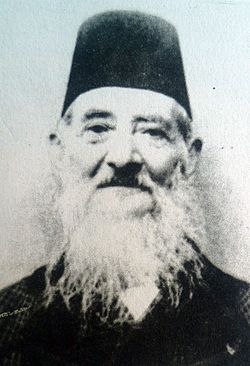
By Hil Lushaku
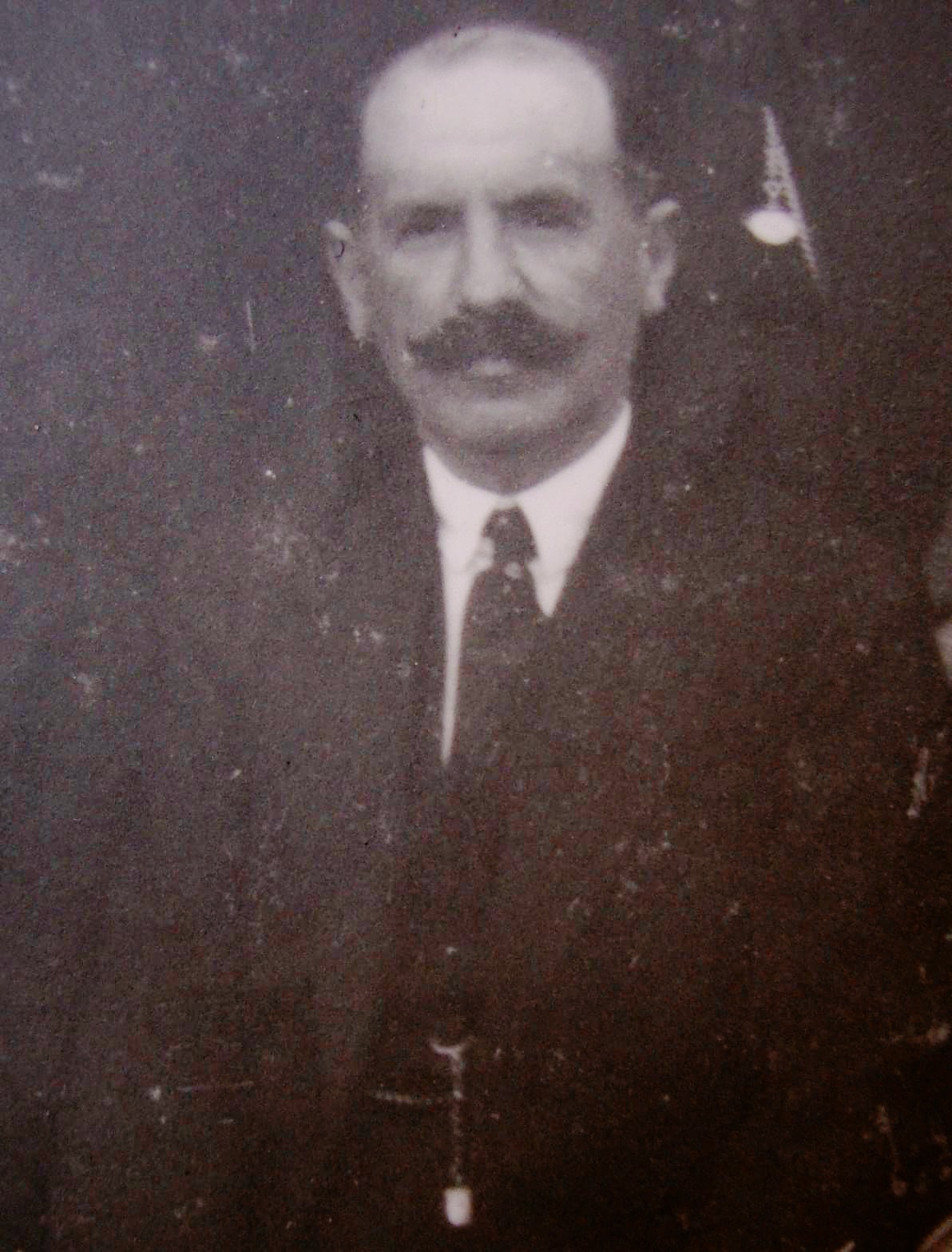
Memorie.al / Qemal Karaosmani was born in 1875 in the city of Elbasan, from which the early origin of the Karaosmani family also derives, one of the most renowned households of that city. His father, Shazivar Karaosmani, provided his son Qemal with the opportunity to go and be educated in Turkey. Qemal Karaosmani completed his secondary and university studies in Turkey, graduating in the final years of the 18th century (note: this is likely a typo in the original for 19th century, as 1875 birth and studies would be late 19th/early 20th), earning a degree in Istanbul in Civil Administration and Economics. During the period he studied in Turkey, he came into contact with and became acquainted with several Albanian patriots and the most prominent figures of the National Renaissance, such as Murat Toptani, with whom he forged a close friendship.
Together with Murat, Qemal went and visited the house where the Frashëri brothers’ family lived, in Kara Toporak, having previously also become acquainted with Naim’s daughter, Asije, who married Murat Toptani. After graduating in Istanbul, he was appointed to the Prefecture of Ioannina, but did not stay there long, as he was transferred to the city of Berat, where he was appointed director of the Cadastre. In Berat, Qemal cooperated closely with Aziz Pashë Vrioni and Iljaz Vrioni, with whom he strove and fought extensively for the spread of national sentiments and the Albanian language.
Based on that contribution he gave to the spread of Albanian education, in 1908, Qemal was invited as a delegate to the Congress of Monastir, where he supported the luminaries of Albanian writing with the Latin alphabet, Gjergj Fishta and Mit’hat Frashëri, and defended the Latin alphabet that was adopted by that congress. During that time, he also went to the city of Skopje, where he met and cooperated with other patriots of the Albanian alphabet, Fehim Zavalani, Gjergj Qirjazi, and Bedri Pejani. A great influence on Qemal at that time was also his cousin, the distinguished patriot and unyielding fighter of the national cause, Aqif Pashë Elbasani, with whom he collaborated in organizing the Congress of Elbasan and in opening the Normal School of that city.
Likewise, in the years 1909-1910, while in Berat, he greatly expanded his activity for the benefit of the Albanian cause, closely connecting with other patriots such as Babë Dudë Karbunara, Sulo Resuli, and Aleksandër Xhuvani, with whom he made great efforts to spread the Albanian language. During that period, through Kristo Karbunara, Qemal became closely linked with Albanian societies in Bucharest and Egypt, from which he received books and newspapers in the Albanian language and distributed them for free in the districts of Berat, Skrapar, and Lushnja.
Qemal Karaosmani wrote memoirs. In them, he expressed: “As much as I wished the publication of this little history to remain for a time after my death, due to the persistent insistence of Mr. Reuf Fico, my dear colleague from Vlorë, I was obliged to give it to publication this year, on the occasion of the twenty-fourth anniversary of Albanian Independence.”
According to his memoirs, it is evident that: “On the 20th of the third autumn of 1912, Bektash Cakrani telegraphed Mr. Aziz Pasha Vrioni, to send horses to Durrës and men to receive Ismail Qemal Bey. The notables of Berat discussed and decided that this sacred duty should be undertaken by Mr. Qemal Karaosmani…”. He traveled together with four of his friends and with three reserve horses, on Thursday, November 21, 1912, spending one night in Lushnja and from there to Durrës, where he met Ismail Bey, at the hotel of Aziz Pasha Vrioni.
He accompanied Ismail Qemal’s group (14 people who had set out from Bucharest, along with delegates from Durrës and Tirana), from Durrës; to the meeting with Mytesim Efendi Këlliçi (deputy prefect of Kavajë); to the meeting with Nebi Sefa of Lushnja at the Darçi Bridge; in Çermë (at Dervish Bey Biçaku and Behxhet Bey Hydi); along the Karapatok road; in Sulzotaj; in Libofshë at the mansion of Nedim Bey Leskoviku; in Petovë (where they were joined by Lef Nosi, Shefqet Daiu, Mit’hat Frashëri, Sali Gjukë Dukagjini, Bedri Pejani, and Rexhep Mitrovica); in Fier (at the mansion of Ymer Pasha Vrioni, where they had lunch); at the crossing of the Vjosa (where they were awaited by Arshi Halili, Major Bilal Nivica, and Hamza Isai, and many others), subsequently arriving in Vlorë at nine o’clock in the evening (Western time).
Qemal Karaosmani, although he was sent from Berat to accompany Ismail Qemal from Durrës to Vlorë, had been appointed a delegate to the National Assembly by the notables of Elbasan. Ismail Qemali chose him as a loyal man and appointed him to the post of Chief Secretary and later also his advisor. Karaosmani has stated sincerely: “After two or three days, when matters were settled, I asked Ismail Bey for permission, telling him: – Now our wish has been fulfilled for the duty you asked of me; I do not have the proper qualities to perform it as it should be; so here, since there are many cultured people who deserve such a duty, please give me leave to go. The old man answered me thus: The duty I have entrusted to you does not require scholars and intellectuals, but needs loyal people of character; therefore you will remain with me. If you insist, you will offend me. Like it or not, I bowed to his command and remained with the title of advisor and chief secretary of the Presidency of the State.”
In his writing “In the Government of Vlorë”, Karaosmani brings up a conversation with Ismail Qemal, daring to tell him that he was appointing people without university degrees to high positions, “like Hysni Toska, who had been a soldier or sergeant in the Turkish army; and also Alem Tragjasi, without having any career, you raised him with so many stripes that you made him a major and higher.” The departure from the governmental cabinet of Hasan Prishtina and earlier of Esad Toptani created vacant places in the government cabinet.
Meanwhile, the announcement of the governmental cabinet by Esad Toptani convinced Ismail Bey that he needed loyal people around him, so he envisioned Aqif Pasha as Minister of the Interior, if he refuses, then Shefqet Vërlaci, but neither accepted the post at that delicate moment for Ismail Qemal and the government of Vlorë. I clarify that, according to the writings of Qemal himself in his memoirs, the wise old man, Ismail Qemali, communicated to Qemal Karaosmani: “Since Aqif Pasha and Shefqet Bey did not accept the vacant ministerial positions, I decided to give you the position of Minister of Agriculture.
As I thanked him for the sympathy he harbored towards me, I begged him to forgive me from this duty, telling him that I am not capable and do not have those qualities to manage a ministry. He insisted, saying: ‘I will be angry if you refuse my proposal.’ I had a special respect for him and looked upon him as if he were my father, so I lowered my eyes and fell silent.”
The press pro-Esad Toptani aimed to smear the Elbasan patriot, a signatory of the great act of proclaiming national independence. “Ushtima e Krujës” wrote that: “Pandeli Cale and Qemal Bey of Elbasan (Karaosmani – H.L.) left before Ismail Qemali for Europe, for personal reasons.” This notice distorts the truth, since they went to Italy, with the approval of the Provisional Government of Vlorë, Cale for health reasons, while Karaosmani for work reasons, a notice also given by “Shqypnia e Re”, writing that Pandeli Cale, Minister of Public Works, and Mr. Qemal Bey Elbasani (Karaosmani – H.L.) Minister of Agriculture, departed from Vlorë towards Italy. The purpose of Mr. Pandeli Cale’s trip is health.
Qemal Elbasani (Karaosmani) wrote a letter to the director of the newspaper “Shqypnia e re” (Hilë Mosi – H.L.), requesting that he publish a rebuttal regarding the article “Around the conspiracy”, published by this newspaper in its issue no. 59, which accused the honest patriot as if Beqir Grebeneja had given him 5000 Turkish lira to support him in implementing his plan. Qemal declared in the letter he sent to director Hilë Mosi, that he had never been in Shkodër, stating that the author may have erred by confusing him with Qamil Efendi Fejzo of Elbasan, and he therefore insistently requests the correction of the published error. The letter was sent from Berat on February 23, 1914, signed by Qemal Elbasani himself, with the clarification “ex-Minister of Agriculture of the Provisional Government of Albania”.
After the departure of the Austrian prince, Qemal maintained close ties with his cousin Aqif Pasha of Elbasan, who continued to hold the post of Minister of the Interior, even though all the ministers of Turhan Pasha Përmeti’s cabinet had left. When the Austrians expelled the Serbs from Albanian territories, Qemal Karaosmani, like many others, judged that the moment had come to reorganize the Albanian administration and for the Albanians themselves to take the fate of Albania into their own hands, so he supported the initiative of Aqif Pasha and the group behind him, led by the young Matjan Ahmet Matja (Zogu), to convene a congress in Elbasan in 1916, which was not approved by the Austrians.
On the eve of the congress, Czapek Mjn, the Austrian commander of Elbasan, telegraphed the municipality of Elbasan, informing them that: “…assemblies that have a political purpose are prohibited in the areas occupied by the Imperial and Royal armies, and those in wartime are also prohibited in Austria-Hungary.” In 1920, again in connection with and support of Aqif Pashë Elbasani and the National Committee for the Defense of Kosovo, he became one of the organizers of the Congress of Lushnja, which definitively laid the foundations of the Albanian state.
Referring to contemporary press comments, it is known that he favored the Italian protectorate over Albania. Qemal Karaosmani was elected twice as a deputy in the National Council. Initially, he was elected deputy of Berat, in the elections of December 27, 1923, being recorded as a deputy of Berat on the list of 102 deputies, registered on January 21, 1924. When he ran in the parliamentary elections of 1923, Qemal Elbasani was included in the group that also included the Vrionis (Sami, Qemal, Iljaz, and Seid) as well as Milto Tutulani, Vangjel Goxhomani, etc.
Also, in the constitutional assembly 1924-1925, the former minister of the provisional government of Vlorë, Qemal Karaosmani, representative of Berat, was elected deputy on December 7, 1925. It should be noted here that after the Legalitet came into force for the legislature 1925-1928, although he ran in the elections, he did not manage to win initially, in May 1925, but later replaced the resigned deputy, Qemal Vrioni, and was sworn in as deputy as a representative of the prefecture of Berat. In this period, he had the strong support of his brother-in-law, the loyal Zogist Ahmet Bey Resuli.
On April 27, 1938, Qemal Karaosmani-Elbasani was among the group of representatives from Elbasan at the wedding of King Zog and Queen Geraldine. After the fascist occupation of Albania and King Zog’s departure from Albania, Qemal Karaosmani did not emigrate, like many others, but moved together with his wife and six children to Kavajë, where he lived until the end of his life. The coming to power of the communist regime found Qemal in Elbasan, in his properties, but it labeled him as a wealthy, reactionary bey family, and confiscated and nationalized all his assets, including the large house in the “Spalikore” neighborhood of Elbasan, where he resided.
This dismissive behavior towards this patriot caused Qemal a disappointment that deeply shook his soul, so much so that he attempted suicide twice. After the confiscation of his property, he was forced to go to Kavajë, where he lived “imprisoned” in his eldest son Masari’s house. In his final years, he engaged in studies, as he possessed a very rich library and had a quite large archive of official documents.
On the occasion of the 50th anniversary of the Declaration of Independence, according to the testimonies of Qemal’s children and grandchildren, the family archive, along with the pen used to sign the Act of the Declaration of Independence on November 28, 1912, was taken from Masari’s house in Kavajë by Ferit Vokopola, and it remains today in the National Historical Museum of Albania.
While he was alive, Qemal, although he had been a statesman and deputy, his name was forgotten in the history of the Albanian state and was never mentioned in the history books of Albania; indeed, he was never commemorated on the anniversaries of Flag Day.
Qemal Karaosmani passed away in the city of Kavajë, in 1948, where he was laid to rest in the old cemetery of Kavajë, which was leveled when the railway and the city’s nursery offices were built, destroying the remains of the deceased, like all others buried there. Today, this patriot lacks a grave for deserved remembrance in history and for human repose. After the fall of the communist regime, Qemal Karaosmani’s merits, values, and contribution were recognized as one of the patriots, signatories, and contributors to the first Albanian state.
He has been proclaimed an “Honorary Citizen” of Elbasan and received a decoration from the President of the Republic, Bamir Topi. In 1900, Qemal Karaosmani married Aishe Resuli from the famous bey family of Berat. Her brother, Ahmet Bey Resuli, was among the most influential of that household. From that marriage they had six children: Masari, Hadija, Qamurani, Shehriaja, Behija, and Aliu. His eldest son, Masari, was educated in Paris in “agronomy” and after the liberation from the Nazi-fascist occupier, worked as an agronomist in Kavajë. / Memorie.al