


Part Two
Memorie.al / “The War for Shkodra” according to Edith Durham’s memoirs from over a century ago, translated into Albanian by Xhevat Lloshi, is undoubtedly one of the most valuable books at the Book Fair in Tirana. These memoirs of the famous English lady come for the first time in full in Albanian from the publishing house “Argeta LMG”/
Edith Durham’s Memoirs
He asked me to recommend a translator who spoke Serbian and Albanian. Such translators were very few, in contrast to the “26,000 Slavs” that Popović mentioned. We chose two. He started with the judges. According to Petar, in Montenegro there was only one good one. We appointed him, on paper.
“You understand,” said Petar, “that we will treat with the greatest justice all those who are with us. For the others we will have no mercy.”
“Exactly as you have already done in Gjakova,” I cut him off.
“Do you have any proposal to make?” he asked.
“It would be good, I think, until more order is established, that the capitulations and a certain European control remain in force.”
“We will not allow any interference…” Petar began.
“It is not worth discussing,” I told him, “since, first of all, everything is in the hands of the Great Powers.” Petar made another attempt.
“Do you have any complaint about the way justice is being administered now?”
“Of course, the soldiers are plundering old Marko exactly like wolves.” He gave me a written order that this should be stopped. But would I also be allowed to cross the Drin and go to help the villages that had been burned and plundered by the Serbs? He suddenly flared up.
“There are no villages that have been burned and plundered by the Serbs,” he declared. “The Albanians have told you this lie.”
“Jovan Jovičević told me, until recently consul here. He told me it was a scandal.” Petar was shaken. “I also wish to know whether it is permitted to feed the sick and those dying of hunger in the city, or in case they accept help, will you threaten them with hanging or imprisonment, as you did in Podgorica?”
He knew this was true and, visibly disturbed, he told me: parole d’honneur, I was free to help whomever I wished. He became, as the case might be, trustworthy, pleading, provocative and humble. I almost laughed out loud when he closed with these words:
“However difficult the task is, you must at least admit, miss, that in all of Montenegro, I am the only man truly capable of taking this thing upon him.”
I almost gave in to laughter. The point was that this was calculated as a blow to Luis Vojnović. I undertook to help him on condition that exact justice would be applied, in case he would stay, and I said: “Goodbye.” As fate brought it, I never had another occasion to speak with him. The most important thing to note from this conversation was, perhaps, that he did not dare to deny even one of my accusations.
Time passed like a nightmare and seemed endless. No news was allowed to come into the city. No letter could be sent or received, except through some correspondent or some other foreigner who came or left. Montenegro meanwhile worked furiously, with threats or promises, to make the population sign letters declaring that they wished to belong to Montenegro.
The terrified people did not know what to do. They did not want to be Montenegrin, but the ships of the Great Powers stood inactive and every hope of help was disappearing. Perhaps the Great Powers had, in the end, accepted the fait accompli. The Archbishop (Imzot Jak Serreqi) took a firm stance. He was offered a great reward as a Montenegrin citizen if he would make the Catholics sign, but he refused, saying that such a thing should not be mentioned in his palace.
Many well-known patriots were forced to flee at night and hide, escaping just in time, because the next day the soldiers came to arrest them since they had told people: “Do not sign and the Great Powers will save you.” Montenegro also tried to raise the Muslims against the Catholics. The country swarmed with spies. No one dared to speak.
I was entirely occupied with relief work. Two quite capable assistants arrived, Miss Buxton and Miss Robertson, the latter a qualified nurse. Alone I would not have been able to cope with the work. The Austrians and Italians had a relief ship waiting, but they were not allowed to act until the political situation was clarified. From the peasants who came down from the highlands I took dried beans from those untouched by the war.
We made house-to-house visits all morning, with meat extract and condensed milk we fed the people who were dying, and these I had brought with me, while in the afternoons I worked at the ambulance for those less ill, and to those dying of hunger I distributed rations of beans and rice. The weather became very hot and the work in the suffocating and dirty huts, as well as among the crowd of people, was exhausting.
Crowds of soldiers swarmed in the city. The taverns were full. It was a time of unrest. Merchants began to complain that the soldiers were stealing from them. No newspaper came. At the bridge of Buna I met Vojvoda Vukotić, the brother of the queen. “How long have you been here?” he asked me. “I am waiting to see the official entry of the King,” I told him. He did not like this. “Has it been set?” I asked. “No,” he answered me.
I felt happier. Nevertheless, the Great Powers were doing something. On May 3, General Martinović, the military commander, departed in haste for Cetinje. We were struggling with our mass of sick people, most of who recovered with careful feeding and a few simple medicines. News came that on the 14th, the British admiral and the representatives of all the other powers would take over the city.
It was too good a thing to be true. I had hoped and I had feared for Shkodra during the gloomy months of the long winter. And now in the heat of the early summer the hopeless year was dragging on slowly. I feared that even at the last moment the Great Powers, in order to achieve their particular aims, would allow this population to be martyred like the people of Gjakova and like the population of Gucia. Then a great massacre could occur, such as that reported from Prizren and near Manastir.
At the last moment the Montenegrins saw that they had to leave and they took revenge in a vile manner. The city was filled with Montenegrin men and women, and it was believed that they were the ones who set fire to the bazaar. The bazaar always remained closed at night and almost all the merchants returned to their homes in the city. It was patrolled entirely by Montenegrin soldiers.
Shortly after midnight a fire broke out in three places at once, and moreover it started in the richest parts of the bazaar. Some merchants who detected the fire were stopped by the soldiers from giving the alarm until it had taken hold well. Then it became impossible to stop the flames, until half the bazaar was completely destroyed. I went to see what was happening. The crowd of Montenegrins, officers and others, were laughing loudly.
The shopkeepers near the fire tried in vain to save the goods, most of which had been looted by the Montenegrins. Since they shamelessly denied that they were guilty and, among other things, loaded the blame on the Austrians, I made investigations in Plavnica and in Podgorica and discovered that a quantity of looted goods was there and people were boasting about them.
The guilt of Montenegro could not be doubted. Such a fire had not fallen in thirty years; this was the final blow that crushed many of the poor people of Shkodra, who hoped that with the trade that would be renewed, they would recover from the losses of the war.
Word spread in the city that the Montenegrins intended to burn it the next night as well. But I did not believe they would dare to do this. On May 14, early, they began to cross the bridge and leave the city.
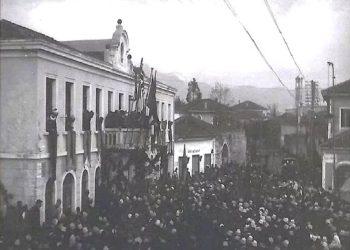
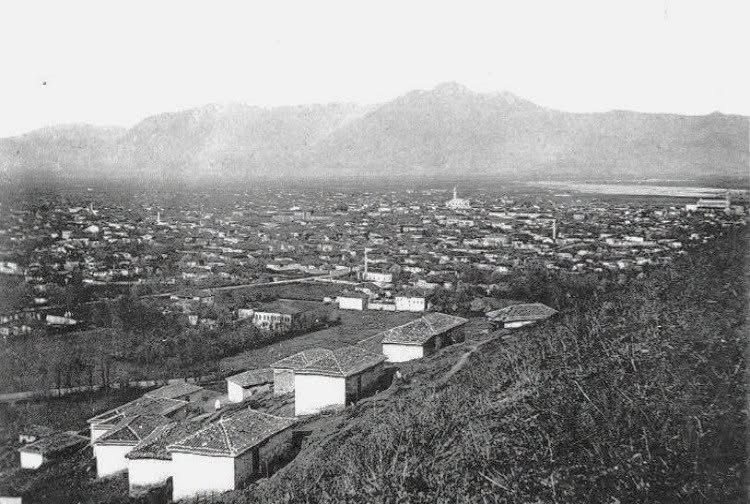
It was a beautiful summer day. The river shone in the sun. In the distance a launch appeared. It was coming closer and closer. The population had prepared Albanian flags and wished to throw roses at the feet of Rear Admiral Burney, but to their great regret, they were forbidden to express their joy.
The launch passed under the bridge over which the Montenegrins were retreating. “Look at those big, fat Englishmen,” said someone, pointing to the sailors. “If only we too had a government that would feed us like that.”
The launch passed by the old customs house. The admirals disembarked along a plank, were received by some Montenegrin authorities and went into the city. The sorrow and tension of the six long months was over. Shkodra had been saved. / Memorie.al