By Lura Limani
Part One
– My Grandmother, Yugonostalgia, and an Unfinished Fairy Tale –
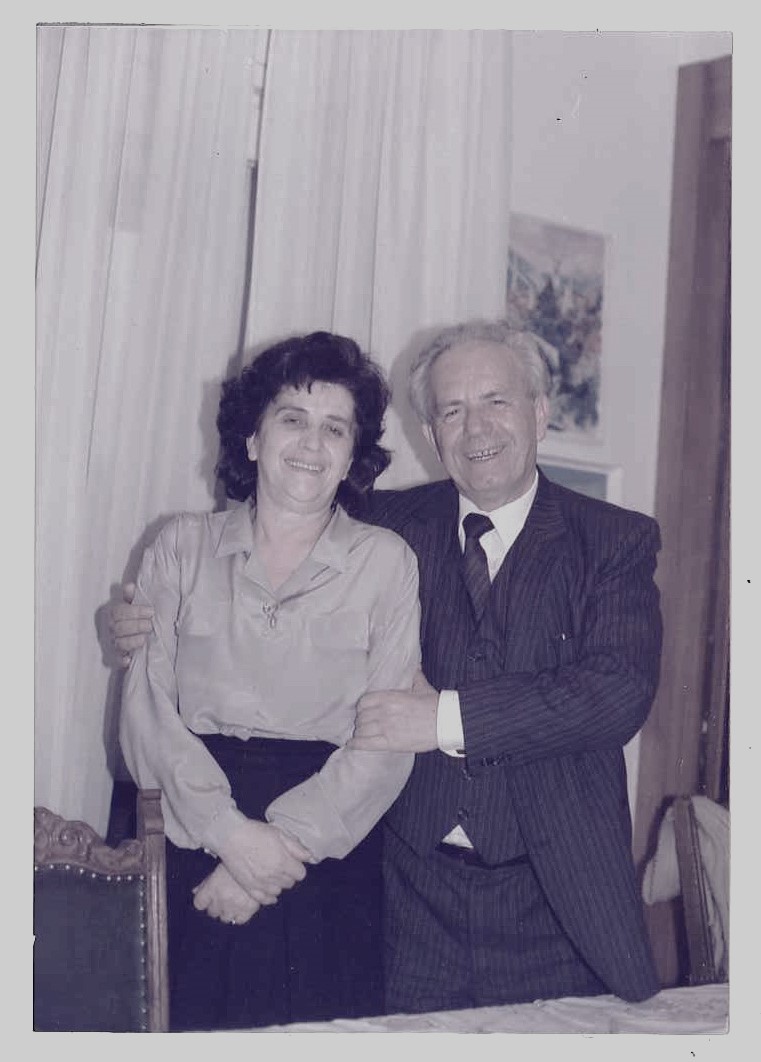
Memorie.al – Raised in post-war Yugoslavia, my grandmother saw herself as an inseparable part of the socialist social structure. How are we to understand her world today? By the time I came to know her, my grandmother had become a difficult woman. She seemed stern: she had a serious look about her; she was not a woman you wanted to mess with. In Albanian, we have the expression zonjë e rëndë – a “heavy lady.” That was my grandmother: difficult, dignified, proud; elegant and well-groomed even when she was shut in at home. In my eyes, she was larger than life. There seems to have been some truth to her robust youthful build, since today her old clothes hang loose on my slender frame, three sizes too big. She had a presence that demanded attention and respect every time she entered a room.
Around the house, she was always ordering us to do something. Every now and then, she would come down from the bedroom early in the morning, open all the windows and doors, and call us to a “work action” – spring cleaning, communist-style. Later in life, when her body had succumbed to old age and folded in on itself, she still carried out her morning ritual, carefully combing her silver hair, which fell gently over her rounded shoulders, before placing a clip above her left ear to hold it in place.
Every few months, she would get a perm at the same place – a small salon near “Zahir Pajaziti” square, at the hairdresser’s called “Ardhmëria” [The Future], a remnant of Yugoslav times. Whenever I walk down from the square and come across the open wires full of bleached towels that the hairdressers leave outside to dry, I think of my grandmother returning home fresh from the salon, the smell of ammonia following her light steps. I live right next to the “Ardhmëria” salon, so my grandmother often comes to mind.
The World of Yesterday
The world that my grandmother’s generation had built and inhabited is now merely a ghost in today’s Kosovo. Unlike Sarajevo, where you can have coffee at the “Tito” café, or Skopje, where you can buy a brooch with the Marshal’s image at the bazaar, Pristina is a desert for the Yugonostalgic tourist.
In Kosovo, the prolonged segregation of the 1990s and the brutal war of 1998–99 with Serbia cut off once and for all real and imaginary ties with Yugoslavia. The war also served as an epistemic rupture. Our entire lives were split in two from that point on: before and after the war; the rupture, an open wound still inflamed two decades later.
Despite this rupture and the homogenization of public discourse through the “master narrative” surrounding the cult of Adem Jashari after the war, collective memory continues to be a site of constant friction. This submerged struggle largely revolves around what and who is remembered and commemorated; whose lives are mourned, which sacrifices are distinguished.
Since the war in Kosovo, as Stephanie Schwandner-Sievers writes, public memory of Yugoslavia has been invisible and imperceptible. In the rare exceptions when artists or intellectuals – members of the “cosmopolitan elite,” as Schwandner-Sievers calls them – have reflected on this period, they have done so with bitterness.
However, in private settings, Schwandner-Sievers had encountered a Tito-nostalgia similar to that of other former Yugoslav nations and ethnic groups. Some women remembered Tito’s time with fondness – they had been the first girls in their families to go to school; others who had grown up in the late 1960s and early 1970s saw the socialist period as a “formative” time that had shaped their dreams.
Yet, memories of this period were inextricably linked to the hopes and aspirations that these generations had for the future, but also to the traumatic experiences that Albanians underwent in the 1980s and 1990s. This “wounded feature” of memory, write Schwandner-Sievers, may have contributed to the lack of public discussions about memories of Yugoslavia among Albanians since the fall of the Federal Republic.
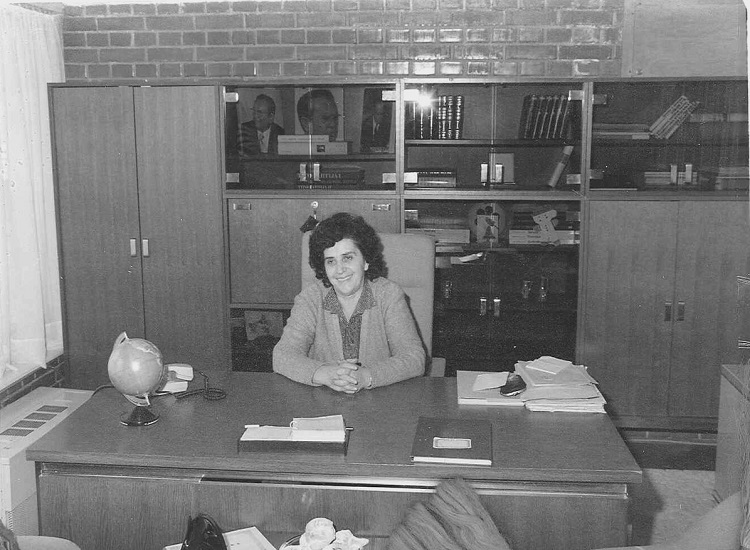
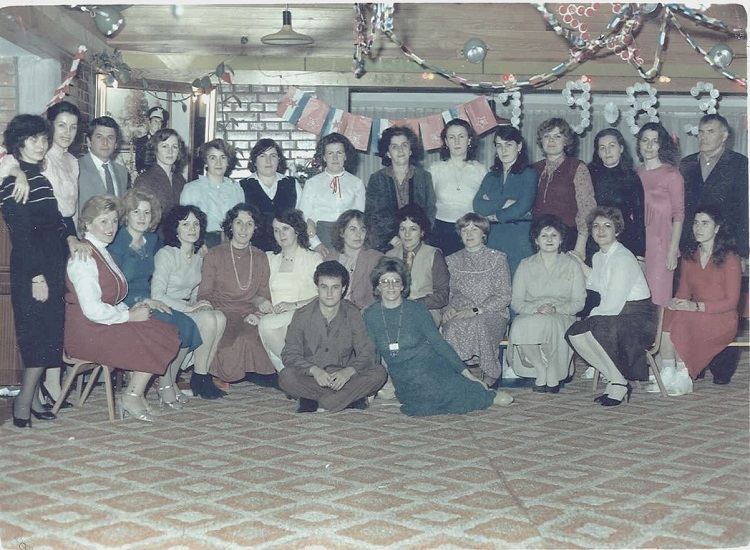
My grandmother died five years ago. She lived long enough to see Yugoslavia disintegrate and to witness the internal conflicts that had preceded the 1980s but which throughout the socialist period had either been minimized and ignored or violently suppressed. The 1980s had been a fall from grace for her, too: according to a short biography of her in a collection published in the mid-1990s, “due to socio-political pressures she took early retirement” in 1986, from a successful career in education and political activism.
As a child, my grandmother had been a courier for the communist partisans in Gjakova, along with her three older brothers and her older sister, who had joined the movement at one time or another. She had been young, and the war had left deep scars on her; as she grew up, she lived in the shadow of her brothers’ glory (the sister is mentioned less often in family accounts).
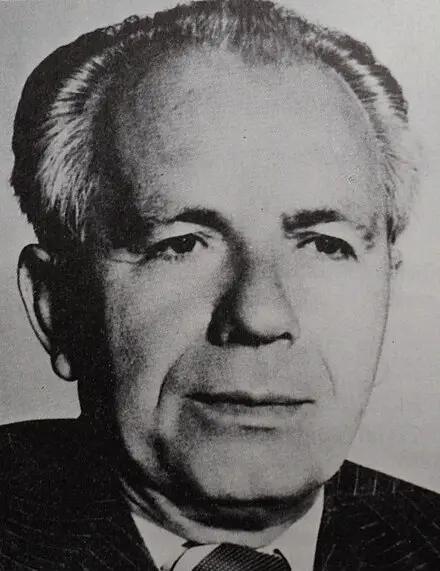
To this day, the old wooden door of the family house in Gjakova bears a plaque commemorating Fahri Hoxha, the brother who was hanged by the Nazis in August 1944. But one of the surviving brothers, Fadil – a commander of the Kosovo partisans who became a high-level politician in the Socialist Federal Republic of Yugoslavia – is remembered the most, and remains a subject of debate to this day.
In a rare video of my grandmother, filmed in 2012, she appears troubled and trembles as she speaks before the camera. She is dressed in black, a colour she wore constantly after the death of her son in 1993; a simple scarf brightens her sombre attire. It is supposed to be a day of celebration, but she is among dozens of people gathered in a poorly lit room, at the office of the Organization of Veterans of the National Liberation Anti-Fascist War (OVLANÇ) – as World War II was called in Yugoslavia.
They have all come for the unveiling of the statue of Fadil Hoxha, a “People’s Hero” of Yugoslavia, a few days before the centenary of Albania’s Declaration of Independence – no doubt to incorporate Hoxha’s historical figure as an inseparable part of the history of the Albanian nation. I was drawn to Yugoslav history like an amateur archaeologist digging for artefacts in their own backyard.
The ceremony is a bitter celebration: After years of bargaining with the authorities for a public space, a square or a street, where the statue would be erected, the organization was forced to place it in a small, forgotten room near the former “Brotherhood and Unity” square – today, “Adem Jashari” square. Seated next to her younger brother, Skënder, today one of the few members of the veterans’ organization’s leadership, she does not mince her words.
“This is shameful. Fadil was not a person who deserved a bust in a room,” she says, shaking her head in disbelief. After nearly 10 years, after a series of promises to place it in the centre of Gjakova, and much resistance from the municipal assembly, the bronze statue remains forgotten in a corner of the veterans’ office, gathering dust.
Yugonostalgia
Throughout her entire life, my grandmother was Fadil Hoxha’s little sister, and throughout my entire life, I was her granddaughter. I had started writing this essay with the aim of gathering the memories of the few remaining people who had either been actively involved in building a socialist Yugoslavia, or who had barely survived its repression, but from the very beginning I realized that my grandmother’s family history affected every meeting, every interview.
My surname opened doors, but also closed them. Interviewees would tell me stories they thought I wanted to hear, assuming that I was seeking to preserve the family’s honour or to save the last traces of “the better Yugoslav life.” “Unreflective nostalgia breeds monsters,” concludes Boym. They were not entirely wrong. I was drawn to Yugoslav history as an amateur archaeologist is drawn to dig for artefacts in their own backyard.
I was born in 1988 and do not remember Tito, nor did I experience the Yugoslav consumerist happiness of the 1970s. Was I becoming Yugonostalgic, and wouldn’t that be a bad thing from the start? After all, nostalgics are considered sentimental, naive, and somewhat foolish beings. With dazed eyes, they fondly recount the past, gazing with admiration at every memory as if it were a single click from which time has erased all imperfections.
But as Svetlana Boym shows in her book The Future of Nostalgia, this ultimately modern condition, which stems from our need to stop time, to stop progress, has more nuance than it appears. Nostalgia is inherently ambivalent and can be a longing for both a place and a time. More importantly, unlike melancholy, which is individual, nostalgia focuses on the relationship between personal and collective memory. In her book, Boym describes two types of nostalgia: restorative and reflective.
The first does not see itself as nostalgia, but as truth and tradition, and manifests itself in national and nationalist revivals active in anti-modern myth-making. While restorative nostalgia revels in reconstructing “monuments of the past,” reflective nostalgia “lingers on ruins, the patina of time and history.” Reflective nostalgia, therefore, is about longing, loss, and the impossibility of harmonizing the gaps in memory that restorative nostalgics so insistently seek to fill.
As Boym writes, on the one hand we have restorative nostalgia, which reinforces a homogeneous “national narrative,” a collective memory based on narratives that enforce “an absolute truth.” Meanwhile, on the other hand, we have reflective nostalgia, which emphasizes the relationship between individual and collective identity – not by trying to recreate unified narratives, but by preserving the gaps and differences that arise from opposing perspectives. “Unreflective nostalgia breeds monsters,” concludes Boym.
My inquiry was nostalgic, yes, but it was reflective nostalgia. I had tried to gather my grandmother’s scattered memories – not to construct a coherent narrative about her or her generation, but to reconstruct a picture of a different temporality, in which my grandmother had once been young and happy, a valued member of her community. Ultimately, it was a search for a temporality in which my grandmother actually made sense.
A Distinguished Woman
As a former teacher of history and geography, my grandmother liked non-fiction books, especially contemporary biographies of notable people. She found comfort in reading about great men and great women, the interplay of the personal and the historical in the course of a single life, and I like to think she also enjoyed the gossip.
In her later years, she would read the memoirs of American presidents, first ladies, and European politicians, appreciating the style in which such books wove together truth and experience, fact and thrill. These books were in complete contrast to the way we had been taught to write biographies in school, whether of well-known personalities, historical figures, or, especially, of martyrs.
Dozens of such monographs gathered dust in my grandmother’s personal library: chronicles of the first teachers in Kosovo; books about historical figures who, in one way or another, had contributed to the development of the Albanian nation, and, of course, books about her brother, Fadil. All these books followed a template and repeated similar motifs. To my literary taste, the dry narrative that accompanied these lives, deemed worthy of documentation, made them seem everything but worth living.
These men and, more rarely, women, were born on a certain day and place, but they all somehow came from patriotic families and went on to perform patriotic acts. These families could be described as feudal, intellectual, wealthy, or poor. Sometimes people came from old civic families; other times from generous landowning families, and more rarely from the working class or land-tilling families.
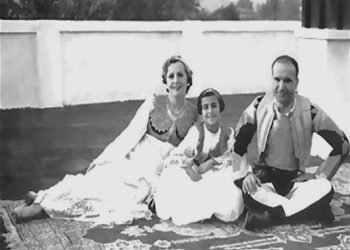
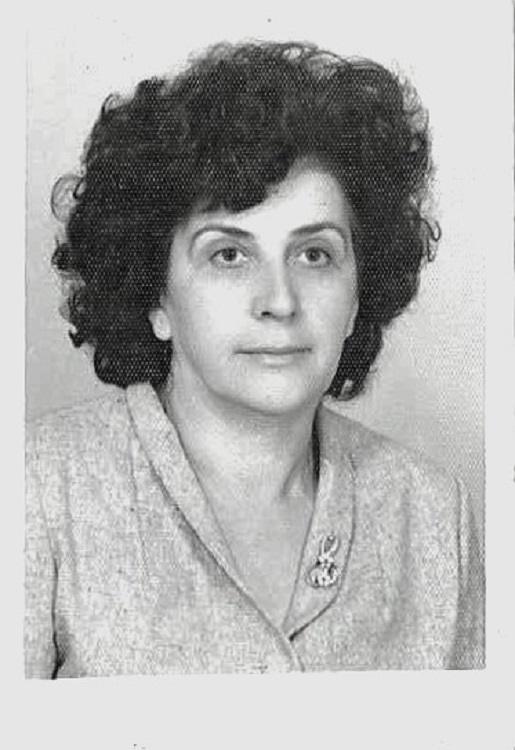
But the common thread among all these biographical subjects was that they came from somewhere, their family’s patriotism having opened a path of glory for them, preceding their arrival on the stage of life and forever shaping their intentions and actions – or at least our interpretation of them. In this tradition, it should be said that my grandmother, Myrvete Limani, née Hoxha (1930), was born into a patriotic, homeland-loving family that valued education above all else.
She attended primary and secondary school in Gjakova, was an active member of the National Liberation Anti-Fascist War from 1942 – when she was still a child – and joined the Communist Party quite young in 1948. She was among the first teachers to graduate from the Normal School in Gjakova and continued her studies in history and geography at the Higher Pedagogical School in Belgrade. Between 1948 and 1949, she took part in the youth action for the construction of New Belgrade.
Upon completing her studies, she returned to Gjakova to teach at the high school, before continuing to teach at the high school in Prizren. In 1957, she moved to Pristina to teach at the “Aca Marović” primary school, today the “Faik Konica” school. / Memorie.al