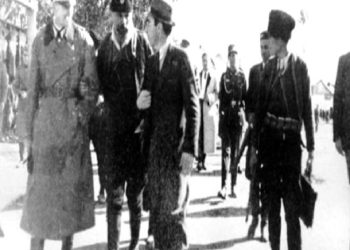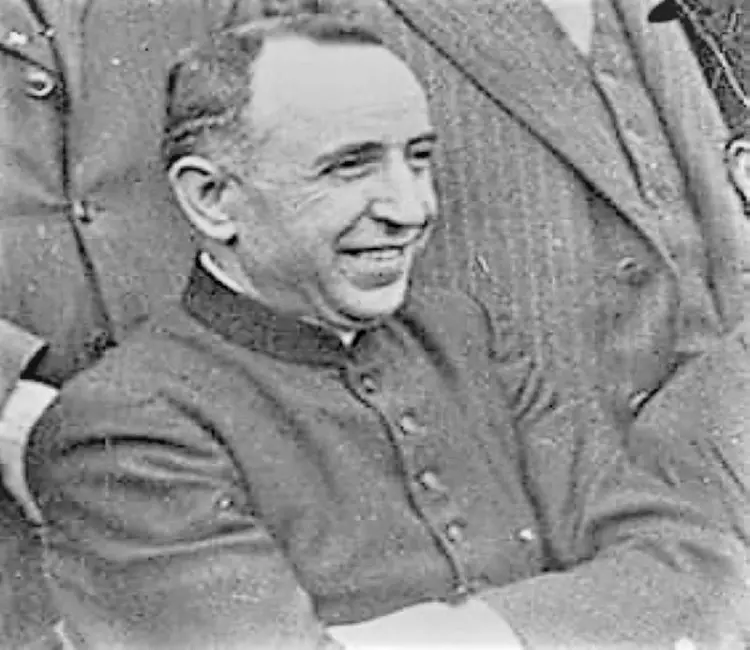
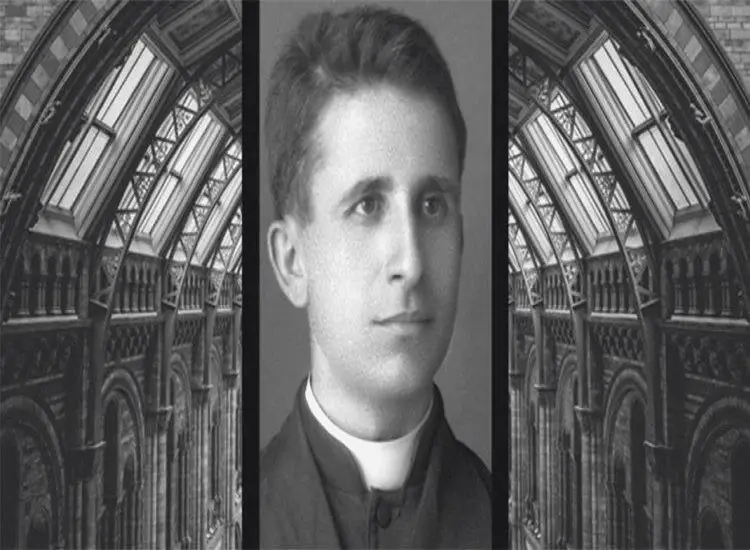

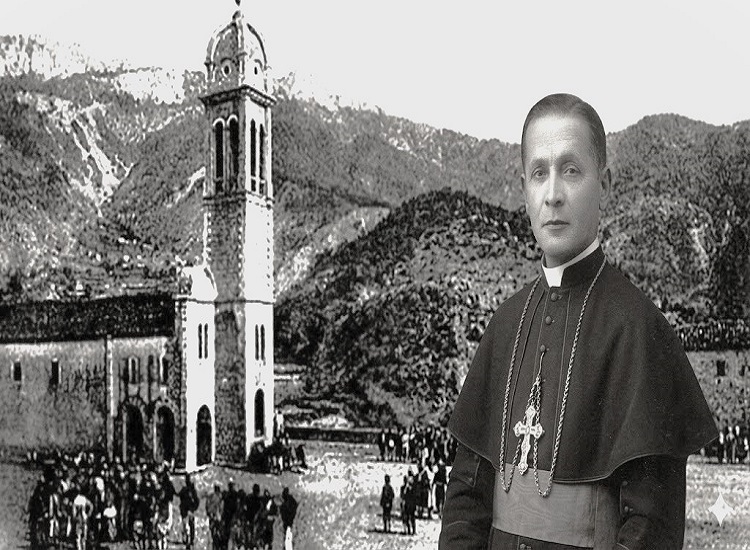
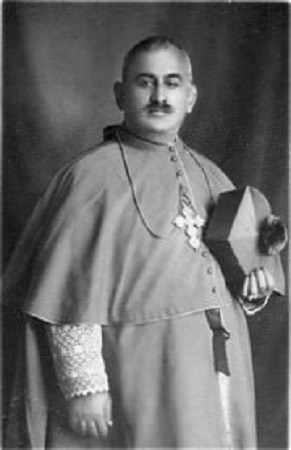
Memorie.al / At the time of the Balkan and world upheaval, in 1938 the Apostolic Delegate, Leone Nigris, came to the Diplomatic Seat in Albania. He was born in Ampezzo (Carnia) in 1884. After his studies in Udine, he was ordained a priest in 1908. Later he was a professor of Literature at the Seminary of Udine and in 1929 he was chosen as canon-judge in the metropolis of Udine. He was distinguished for the publication of several books in the field of theology. Because of the cleverness he possessed, Pope Pius XI, in 1938, appointed him Apostolic Delegate in Albania. His official arrival in Albania is recorded on 16 October 1938, disembarking in the morning hours by ship in Durrës, accompanied by the secretary of the Apostolic Delegation in Albania, Dom Nikollë Gjinaj.
In Durrës, alongside the many believers, he was received by Imzot Pjetër Gjura, Archbishop of Durrës, and the parish priest Dom Anton Zogaj and the parish priest of Tirana, Dom Shtjefën Kurti. Continuing the road to his Seat in Shkodër, the Apostolic Delegate Nigris, at 12 o’clock, arrived in Milot and Gurrës. In Lezhë, he visited the Orphanage Center of the Franciscan Fathers, where on this occasion the poem of the poet Ndre Mjeda, “Lissus”, was recited.
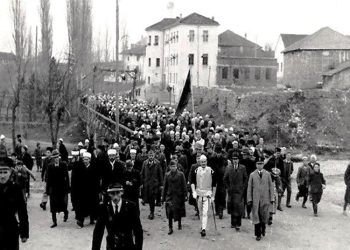
From Lezha to Shkodër, accompanied by believers who greeted him along the way, Nigris stopped near Rozafa Castle at the Shrine “Our Lady of Good Counsel”, to continue the road to the Cathedral of Shkodër, where he was received by hundreds of believers and the high church hierarchy, Imzot Gaspër Thaçi and other bishops. Leone Nigris, as the last diplomat, stayed in Albania until 11 October 1945.
Church and political events in Albania
Nigris, in the south of Albania from 1939, acted in the capacity of the ordinariate, for the Apostolic Administration of the South, founding several parishes and many missionary centers. He proposed to the Holy See the transfer of the Apostolic Office from Shkodër to Tirana, on the grounds that the presence of the Apostolic Delegate in the capital as a center would be more advantageous than in Shkodër, which was the edge of Albania.
While negotiations on this issue were taking place, it happened that on the night of 18 December 1943, the Apostolic Seat in Shkodër burned down. The response of authorization was slow to come and meanwhile the military occupation of 7 April (1939) came, which made the problem of purchasing houses in the capital difficult, thus leaving his idea suspended.
In the Secret Archive of the Vatican, Nigris has two very important reports for our country and church life. In one of the reports of 11 October 1945, among other things he recounts that, “The bishops of Arbëria are good, but it cannot be said that they were at the height of their mandate! The number of Dioceses was excessive! Six Bishops over about 120 secular and regular priests”! “The dominant sign of the clergy,” emphasizes Nigris, “was pastoral sluggishness. The people had a pronounced tendency toward politicization, a visible devotion to money!”
“The chief-diocese of Bar,” says Nigris, “was in a miserable condition, while that of Skopje (which included Kosovo) had social problems.” In the report of 1 January 1945, for the period 1938-1944, sent to Pope Pius XII, Nigris speaks extensively about the political situation and states that, “during the Italian occupation I visited four camps of Greek and Yugoslav prisoners; during the German occupation I took an interest in prisoners and in Italian citizens. As in the Italian regime, so also during the German occupation, I became a protector of the Jews.”
In closing his reports, Leone Nigris says: “Thus a period of six and a half years, quite lively, was closed drastically, with the succession of four regimes opposed to one another: 3 wars, 2 military occupations, civil war, a series of antagonistic Governments mainly based on personal ambitions, a continuity of ‘tour de force’ to preserve the balance and not to compromise the Representation of the Holy See, without counting the many dangerous personal adventures,” concludes Nigris.
The expulsion
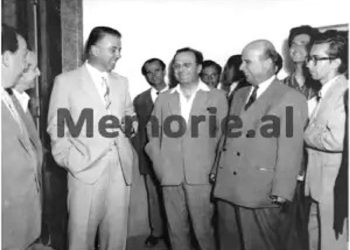
At the end of March 1945, Enver Hoxha summoned the Apostolic Delegate Nigris, asking him to go to Rome and present to Pope Pius XII the desire of the Albanian Government to have diplomatic relations with the Vatican. But this journey of the Vatican diplomat was without return, because he was forbidden to return to Albania.
This was the moment when Albania closed its doors for forty-five years in a row to the Papacy, the city-state in Rome, or the Holy See, which is the virtual state with jurisdiction throughout the world and internationally recognized, which has diplomatic relations with 178 states of the world.
Albania closed the gate to the precious friend, who in the difficult centuries has helped Albania and the Albanians, in the social, political, and educational field, until the final departure of the esteemed diplomat Leone Nigris, who, as if he left behind him a divine curse, after which the black death of communism covered us.
After his departure in January 1945, by Enver Hoxha’s regime, the formal role of Apostolic Delegate was played by Imzot Frano Gjini, bishop of the Abbey of Mirdita, until his execution by firing squad in the Kiri valley, in 1948. As a result of atheist communism, the balance was: alongside the destruction and confiscation of religious objects, it is recorded that very few clerics had remained alive. According to a statistic, it is learned that during the period (1945-1980) when the communist regime came to power, there had died in the state prisons, 2 archbishops, 5 bishops, 1 abbot, 65 diocesan priests, 33 Franciscans, 14 Jesuits, 10 seminarians, and 8 nuns.
With the great changes that occurred in Albania at the beginning of the 1990s, regarding respect for human rights and the introduction of political pluralism in our country, it became possible to begin the first contacts with the Holy See, with the State of the Vatican. As a result of the talks, diplomatic relations between Albania and the State of Vatican City were established on 7 September 1991 at the level of ambassadors.
The Holy See accredited to the Albanian government in 1992 the first Apostolic Nuncio, Imzot Ivan Dias; in 1997, Nuncio Imzot Giovanni Bulaitis, and in 2008 and onward, Apostolic Nuncio of the Holy See, Imzot Ramiro Moliner Ingles. While in 1992, the first Albanian ambassador to the Holy See was Mr. Wili Kamsi. After the establishment of diplomatic relations between Albania and the Holy See, opportunities were created for the growth of bilateral cooperation.
A culminating point is the visit of Pope John Paul II to Albania, on 25 April 1994. A splendid and magnificent reception was reserved for the Holy Father by the Albanian people. His Holiness’s visit was a moral and political support for Albania. Let us hope that the arrival of Pope Francis, on 21 September in Albania, will have as much echo as that of Pope John Paul II and will serve further, in addition to diplomacy, also in cooperation relations in the field of culture, education, health, and the spiritual uplifting of our people. / Memorie.al