

From DASHNOR KALOÇI
Part One
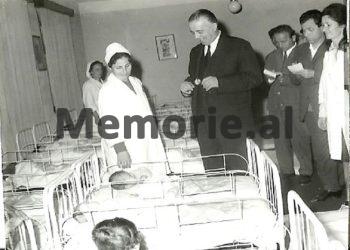
Memorie.al / Even though it was widely propagated that “unlike the capitalist countries, in Socialist Albania the health service was free for all citizens,” throughout the entire period of the communist regime of Enver Hoxha and his successor, Ramiz Alia, it left much to be desired. Indeed, in many aspects, such as the apparatus and equipment of hospitals and other health facilities with various modern medications, it was a problem that remained unresolved until the collapse of that regime. But one of the greatest wounds of the healthcare of the pre-1990s, it is said, was that of the high number of deaths of children aged 0 to 1 year, or as it was otherwise known in medical terminology, “infant mortality.”
Among other things, this is also made known by several archival documents of the Ministry of Health of that time, where its correspondence with some of the highest party and state institutions and bodies of that time is found, in which it is made known that only during the year 1971, in all the districts of the country, out of 72,771 births, 7,027 deaths were recorded in children aged 0 to 1 year.
But what shocked Tirana and alarmed the high party and state leadership of that time was the death of 27 infants in the Maternity Hospital of Tirana (today the “Nana Mbretëreshë” Maternity Hospital) in only a few days at the end of September and the beginning of October 1972, something which forced the relevant bodies of that time to close the Maternity Hospital of Tirana. But why did such a high number of deaths occur in that maternity hospital at that time and what were the reasons that the decision was taken to close that Maternity Home? What is said in the report-informations of the Minister of Health of the time, Dr. Llambi Ziçishti, sent to the highest instances of the state and what was the reaction and response of the high leadership, starting from Prime Minister Mehmet Shehu, the secretary of the Central Committee of the PLA, Hysni Kapo, the first secretary of the Party Committee of Tirana and member of the Political Bureau, Manush Myftiu, etc.?
The following archival documents, published for the first time, bring a detailed overview of the alarming state of infant mortality in Albania in 1971, as well as the efforts of the state apparatus to bring this tragic phenomenon under control. Through the report of the Deputy Minister of Health, Dr. Kleo Miho, as well as official reports signed by Dr. Bukurije Maçi at the Directorate of Mother and Child, the true picture of the medical service in the districts and villages during the communist regime is revealed.
These official documents of the beginning of 1972 bring to light not only the high figures of infant mortality, where respiratory tract diseases such as bronchopneumonia took up to 60% of cases, but also the deep infrastructural backwardness in rural areas. The documents reveal the failure of the plan for the construction of maternity homes and consultories, the lack of maternity leave and medical check-ups for children 0-3 years old, as well as the scandalous conditions of food in the village nurseries, where even the most basic items such as wheat bread and milk were missing. Regarding this, etc., the documents in question make us aware, taken from the Central State Archive (fund of the former Central Committee of the PLA), which are published for the first time and with the corresponding facsimiles by Memorie.al
THE REPORT OF THE DEPUTY MINISTER OF HEALTH DR. KLEO MIHO, SENT TO THE EXECUTIVE COMMITTEE OF THE PEOPLE’S COUNCIL OF THE DISTRICT OF TIRANA, ON THE FIGURES OF CHILD DEATHS
PEOPLE’S REPUBLIC OF ALBANIA Tirana, 18.I.1972
MINISTRY OF HEALTH
Directorate of Mother and Child
No. 54/7 Prot.
TO THE EXECUTIVE COMMITTEE OF THE P.C. OF THE DISTRICT
(Health Section)
In order to have faster data on the state of infant mortality, we request that every month (the number of births, the number of dead children 0-1 year and the percentage) be sent to us by the 20th of the following month. While every three months detailed analyses on the infant mortality of your district should be sent, as has been done.
Within the month of January 1972, the state of infant mortality (births, deaths and the percentage) of the year 1971 should be sent to us, as well as the analysis of the IV quarter. For the districts that have not sent the analyses of the other quarters, they must send us an annual analysis. Likewise, within the month of January, the plan you have for the qualification of village midwives should be sent to us. You will send these data to the Directorate of Mother and Child.
DEPUTY MINISTER
Dr. Kleo Miho
18.1.1972
REPORT-INFORMATION OF THE “MOTHER AND CHILD” DIRECTORATE AT THE MINISTRY OF HEALTH, RELATED TO THE NUMBER OF BIRTHS AND INFANT DEATHS DURING THE YEAR 1971
PEOPLE’S REPUBLIC OF ALBANIA Tirana, 11. IV. 1972
MINISTRY OF HEALTH
Directorate of Mother and Child
No. 54/17 Prot.
Subject: Information on infant mortality for the year 1971.
TO THE EXECUTIVE COMMITTEE OF THE P.C. OF THE DISTRICT
Health Section
Infant mortality as a republic is lower in 1971 than that of 1970, but higher than 1969 and concretely it is presented as follows (in relative figures):
Year 1969 = 76.1 % 1970 = 97.8 % 1971 = 93.8 %
According to the quarters in this year (1971) infant mortality is presented as follows (in absolute and relative figures):
Quarter I = 113 %
Quarter II = 76 %
Quarter III = 88.6 %
Quarter IV = 99.0 %
In absolute figures it is presented:
Quarter Births Deaths
I 19,782 2,242
II 23,405 1,815
III 16,581 1,473
IV 13,002 1,297
As can be seen from the above indicators, in the first quarter of the year 1971 there was the highest mortality both as a relative figure and as a total number of deaths. This situation, as is known, was analyzed with interest in the meeting held by the Dicastery for this problem in the month of April 1971, with the participation of all the heads of the health sections of the districts as well as other comrades from the center and from the districts.
Thus also as a result of the better and immediate organizational and medical measures taken by the health workers and bodies as well as of a better cooperation and assistance from the bodies of power and the mass organizations under the direction of the Party in all the districts, gradually we have a decrease in infant mortality.
In the II quarter we have the most pronounced decrease but this as a relative figure because the births have increased a lot, while the deaths as a total are more in the II quarter than in the III and IV. The IV quarter has a higher percentage of deaths than the II and III quarters but as an absolute number it has fewer deaths than these and much fewer births.
The working out, analysis and deepening of the concretization of the tasks that the XI plenum of the Central Committee of the PLA set out; in the service of mother and child has made the care of the whole society and of the health workers and bodies for the health of the pregnant and lactating woman as well as the good upbringing of children increase.
During the year 1971 the cooperation of the health workers and bodies with the bodies of Power in the center of the district and at the base as well as with the mass organizations has been better and with good results in many districts.
Likewise during the year and especially in the second six-month period the service of mother and child has been taken into analysis by the Executive Committees, the People’s Council of the district, the mass organizations which in many districts have developed and expanded activities for these problems.
Our Directorate for the state of infant mortality in the I, II, and III quarter (respectively and for the 6-month and 9-month period), has issued special informations which it has sent to all the districts. In this information we will speak briefly about some of the causes of infant mortality for the year 1971 based on our findings and on the analyses that the health sections with the demography commissions of the district have sent us. It should be emphasized that despite our instructions and insistences, still these analyses from some districts do not come at the proper level and many times are only formulary.
Thus also for the year 1971, as an annual, such analyses have been sent by the districts of Berat, Gramsh, Krujë, Librazhd, Mat, Mirditë, Shkodër, Tropojë, and Vlorë; while the district of PUKA has not sent the annual analysis at all, indeed not of any quarter. Some of these analyses have good materials in terms of the measures they have taken and will take in this service, but they lack many basic data and their commentary, such as for example:
How postnatal mortality (0-7 days) is presented, that of the first month and of the six-month period and their causes, which diseases have predominated during the quarterly or annual period, how the assistance at birth has been and how the Maternity Homes are used, where the children have died and whether they have received medical help, how many have died within the first 24 hours, what percentage of the dead are without diagnosis, how many are deaths in the maternity hospital, how dystrophy and rickets are presented, etc.
Perhaps with accuracy all these cannot be (as for the diseases or dystrophy and rickets) but the others must be accurate because the sections themselves have and must have them for their work.
During the past year many districts have justified themselves that they did not have even a single scene to make this study of infant mortality, and in the IV quarter of the year 1971 a model card was sent to all the districts for the survey of child deaths from which these indicators would also emerge, but still many of these districts and in the analysis of the I quarter of this year (1972) have not sent these indicators and their commentary, as we will emphasize also in the information for the I quarter that we will send you.
While more complete analyses for the year 1971 have been sent by the districts of Përmet, Lushnjë, Lezhë, Gjirokastër, Elbasan, Durrës, and Sarandë. As we saw above, infant mortality has a decrease from the year 1970, although this is a small decrease of 4%.
It is known that we considered the year 1970 as an extraordinary year because of the flu epidemic, but also from this year to the year 1971 some districts have an increase in infant mortality and concretely: Gramsh, Lezhë, Librazhd, Lushnjë, Mat, Mirditë, and Sarandë.
While from the year 1969, with the exception of three districts; Kolonjë, Përmet, and Sarandë, which have a decrease, all the other districts have an increase.
Some of the known causes that have influenced infant mortality for the year 1971 have been:
1 – Among the diseases that take the first place as the final cause in the deaths of children 0-1 year, the first place is taken by diseases of the respiratory apparatus and among them are bronchopneumonias.
These diseases in relative figures vary according to the districts from 25-60% (thus Durrës 46%, Dibra 51%, Elbasan 34%, Krujë 50%, Librazhd 60%, Mirditë 58%, Lushnjë 50%, Kukës 50%, Sarandë 43%, Skrapar 52%, Vlorë 44%, and Tirana 39% in the city and 31% in the village. While in the districts of Gjirokastër village neither the maternity home nor the consultory, which were not completed even at the end of the year, when the other measures finished and which was the plan to complete them.
Thus also during the year 1971 in many villages of the country the check-up and the leave of pregnant women has not been done properly, as well as the periodic check-up visits of newborn children up to three years old. During this year, greater efforts must be made to secure these premises in the village as well as for the beginning of the requalification of village midwives, according to the program sent by the cadre directorate.
In the past year in the village more nurseries were opened than in previous years, but as we have emphasized also in other materials, these were still too few compared to the needs of the village, the service and food in them had many shortcomings. The Executive Committees of all the districts had given instructions for better food, especially for wheat bread and milk, but which in many cases was not done until the end of the year! Thus in these conditions the nurseries will not only not attract many children but also their good upbringing is not ensured.
The spreading and generalization of the advanced and better experience in terms of care for the mother and child within the district or between districts is an aspect that would improve the service. For this, little has been done both by the health sections and by our directorate with the Dicastery.
Likewise, the assistance of our directorate for the districts and the control of the implementation of the instructions given has been insufficient. Likewise, the assistance from the central clinics, whether for a short time and special problems, has not been within the possibilities that these clinics have, and the follow-up of this by us has not been continuous. / Memorie.al
FOR THE DIRECTORATE
Dr. Bukurie Maçi