By Prof. Dr. Muhamed Mufaku
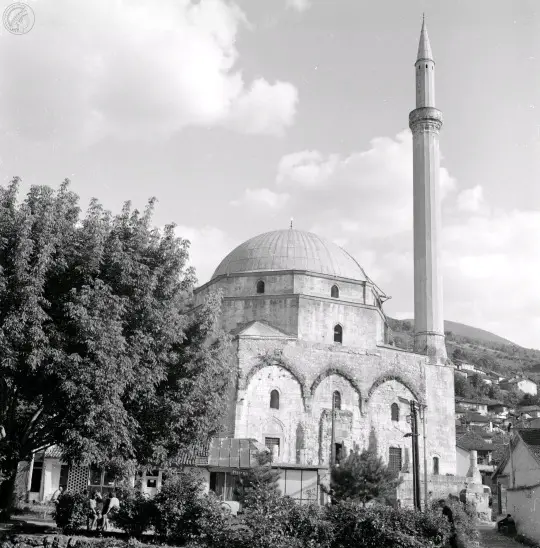
Memorie.al / The Mosque of Sofi Sinan Pasha in Prizren, built in 1615, are the jewel of the city, making it increasingly attractive to foreign tourists. Although Kosovo possesses other mosques of historical value in Prishtina, Peja, and Gjakova, the Sinan Pasha Mosque is rightly considered among the most beautiful in Albanian lands, both for its exterior appearance and its interior adorned with floral motifs. However, the Sinan Pasha Mosque is distinguished by the fate of how it escaped total destruction by the Great Serbian authorities – at the very time when the Burmali Mosque, the “Beauty of Skopje” on the banks of the Vardar, was demolished in 1924. Thus, the Sinan Pasha Mosque remained damaged and under the threat of total destruction until the end of 1940, when the District Court of Prizren issued a decision for its demolition, allegedly because it was the property of the Serbian Church. For this reason, the Sinan Pasha Mosque stands as a miracle, not only as an object of historical and artistic value but also for how it escaped total destruction until 1941, despite a judicial decree for its demolition.
Sofi Sinan Pasha, hailing from the village of Vila in Albania – which at the time belonged to the Sanjak of Prizren – had chosen a prime location for the construction of the mosque, utilizing stones from the Monastery of the Holy Archangels near Prizren. The monastery had been in ruins since the 16th century, nearly a century before the mosque’s construction in 1615. However, with the surge of new Serbian nationalism, a legend was created over time describing how Sinan Pasha had obtained the Sultan’s permission to destroy the monastery to build his mosque with its stones. This legend was debunked in due time by Hasan Kaleshi in several early writings and in his book published in Prishtina in 1972, titled “The Oldest Waqf Documents in Arabic in Yugoslavia.” Nevertheless, this legend was exploited by the Great Serbian authorities in Old Yugoslavia (1918–1941) to justify the destruction of the Sinan Pasha Mosque, claiming it as property of the Serbian Orthodox Church since it was built using the ruins of the aforementioned monastery.
In truth, the Sinan Pasha Mosque remained at the mercy of the new powers starting in 1912: first the Serbian (1912–1915) and then the Bulgarian (1915–1918). During that time, the mosque was confiscated and converted into a military depot, specifically for ammunition. With the conclusion of World War I and the establishment of the Kingdom of Serbs, Croats, and Slovenes, Serbian euphoria against Muslims in Kosovo, Macedonia, and Bosnia emerged, despite the new state signing the Treaty of Saint-Germain in Paris in 1919 for the protection of minorities. Within that aggressive nationalist euphoria, many Muslims were killed and many monuments of historical value were damaged, despite protests from the leadership of the newly formed Islamic Community.
As part of this campaign, in 1922, the Great Serbian authorities began demolishing the Sinan Pasha Mosque, starting with its portico (hayat), which sparked protests from the people of Prizren and forced the authorities to temporarily suspend the destruction. At that very time, the new authorities demolished the Burmali Mosque in Skopje in broad daylight in 1924 to build the “Army House” in its place.
Following the reformation of the state, which took the new name “Kingdom of Yugoslavia” in 1929, a new national-level Islamic community was established, which secured more guarantees for Muslims and their status. Under this structure, two equal councils (mejlises) were formed: one based in Sarajevo and the other in Skopje, covering Macedonia and Kosovo. However, the Great Serbian authorities were dissatisfied with the emergence of Albanians on the scene in Kosovo and Macedonia under the umbrella of this organization, led by Ferhat Draga. Through the contribution of Ferhat Draga, the new constitution of the Islamic Community in 1930 managed to guarantee autonomy for Muslims and the right to manage their properties, including mosques.
This emergence of Albanians, headed by Ferhat Draga, angered the Great Serbian authorities and pushed the Minister of Justice, L. Marković, in May 1940, to suspend all legitimate organs of the Islamic Religious Community in Skopje. In their place, he appointed a state commissariat composed of pro-Serbian elements to serve the government’s plan to eliminate the influence of the Albanian factor in the institution, which aimed to protect and manage Muslim properties.
Under these conditions, the Serbian Orthodox Church renewed its request for the destruction of the Sinan Pasha Mosque and its handover to the Church, based on the legend that Sinan Pasha had demolished the Monastery of the Holy Archangels to build the mosque with its stones. These details remained unknown and were not mentioned even in Kaleshi’s aforementioned book, until they were discovered by historian Qerim Lita in a paper for an international conference in Tirana published in 2021.
Thus, after reviewing the request of the Serbian Orthodox Church, the District Court in Prizren issued a decision on December 2, 1940, placing the Sinan Pasha Mosque at the disposal of the Church. In the reasoning for the decision, it is stated that the mosque “which is built on this plot constitutes the property of the plaintiff because it is built in the plaintiff’s municipality with the material of the ruined monastery of Saint Archangels, built by Tsar Dušan, which monastery was ruined through terror and violence while the material was transported to Prizren, and the mosque was built from this material…”
The influence of ideology is clearly visible in this decision – specifically, anti-Albanian politics based on the Serbian legend mentioned above. But here another scandal emerges: the lack of defense for the aggrieved party! In other words, this reveals the motive for the suspension of the legitimate organs of the Islamic Community for Macedonia and Kosovo and the installation of the commissariat in May 1940; the new body appointed by the authorities did not appear in court at all to defend its property.
This absence prompted the Grand Mufti (Reis-ul-ulema) of the Islamic Community in Sarajevo to address the Minister of Justice on December 24, 1940, stating: “In the District Court of Prizren regarding the Sinan Pasha Mosque there, for which the Commissariat did not send its defense representative, a decision was brought [that] the mosque has been given to the church.” Understandably, this was a protest that unmasked the purpose of suspending the legitimate organs of the Islamic Community: to allow the Serbian Orthodox Church to present its request for the destruction of the mosque and the return of the land as its property in court without the presence of the injured party!
With this arbitrary decision that legalized the Serbian legend and turned the mosque into the property of the Serbian Orthodox Church, the demolition of the mosque became a matter of time for the church. In these circumstances, time saved the mosque – specifically, the collapse of the Kingdom of Yugoslavia following the Axis invasion on April 6, 1941, which led to the creation of ethnic Albania (1941–1944). In Prizren itself, where the Second League of Prizren was formed in September 1943, a decision was made under the dictates of the new power in July 1945 that Kosovo “by the will of its population, joined federal Serbia within the Yugoslav Federation”!
In this new state of affairs, characterized by a rapprochement with Albania until 1948, the new communist authorities in Kosovo issued a decision to place the mosque under state protection, which de facto annulled the Prizren District Court’s decision of December 2, 1940. However, internal conservation of the mosque only began in 1952. After a long delay, it was opened in 1968 as a Museum for Oriental Manuscripts. Upon the request of the head of the Islamic Community in Sarajevo, it was returned to the possession and maintenance of the Islamic Community in Prizren by a court decision in 1969. Nevertheless, the mosque required years of renovation until it was opened to worshippers in 2007. Between 2013 and 2015, works were completed to arrange the courtyard with the help of the Turkish agency (TIKA), which turned the mosque into an attraction for tourists from around the world./Memorie.al