By Vladimir Myrtezai
Memorie.al / Whenever I look back at that time, the further I stand from it, the more interesting that relief appears to me. In reality, living it meant being trapped in a heavy frame of rules – a suffocating control over privacy and free life. Yet, in such a narrow strait, one strives to project the simple value of life, or the very form of survival, as a conditioned existence that one was forced to submit to, to accept, and to participate in.
We were the characters of this imprisonment, of these strict rules. And yet, there was a strange, self-generated happiness, as if by design and persistence, a refusal to submit – or rather, a way of posing for happiness amidst a somewhat exaggerated void, as if to overcome it.
Within the Albanian psyche, there was another sprawling solace found in paternal and tribal ties; this kind of comfort somewhat blunted the weight of a missing perspective on freedom. It made human reality somehow more flaccid, filled with the small troubles and interests of the day that built that necessary wall of survival – a sort of substance that spread freely into every created relationship.
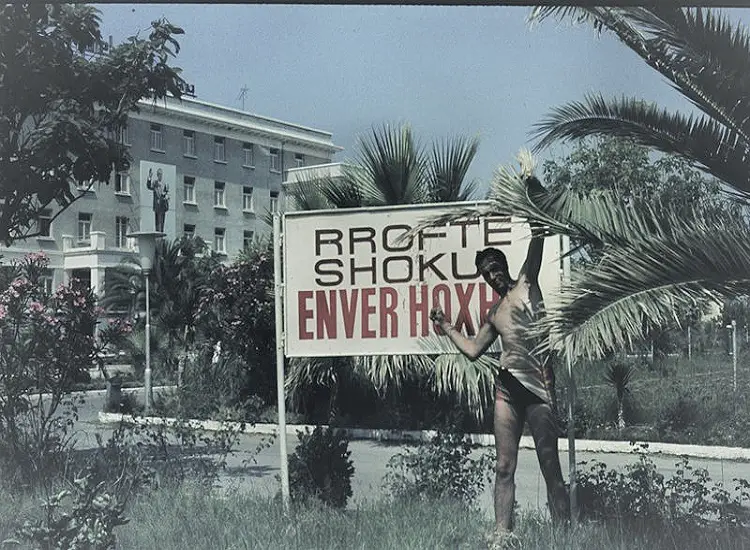
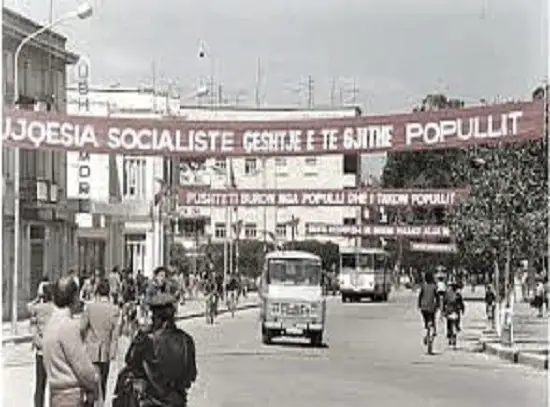
In its essence, that era – excluding the lack of rights and freedom – possessed a kind of empathy distributed across a sterilized landscape. There, the greatest joys were the sharp, highly visible signs of propaganda at key visual corners, which somehow provided the atmosphere of a spiritual blossoming for a human mass that rejoiced in its waving banners and standardized, often pathetic, futuristic messages. But far more often, one felt a marginalized symptom over that entire atmosphere, where only the banners reigned in a screaming signaling.
Mostly, it was a near-inorganic relationship between what was produced and lived, and the propaganda itself. Through texts and slogans that were “by hand,” of a commendable quality and a taste that typified this anchoring landscape, the physiognomy and absurdity of a visual relationship were defined – one that today would sound like a controversial language between ideas and the true spiritual reality of that time. Widened sidewalks and quite spacious roads with a minimized, sparse touch of greenery and an absence of cars.
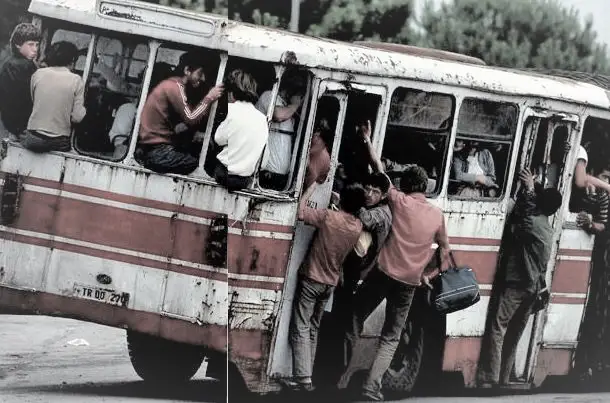
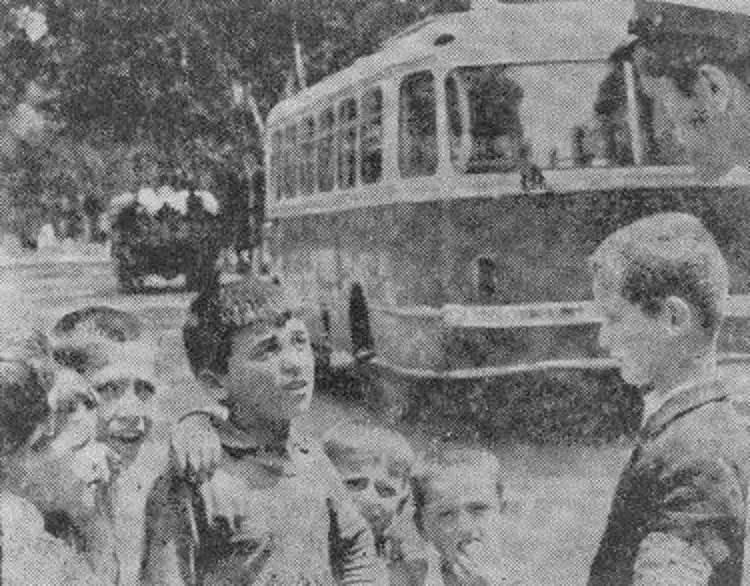
Here and there, only a few urban wrecks appeared, like accordion buses, and the occasional, solitary service taxi. It was a well-controlled reality with a faint breath, where it seemed as if nothing ever happened. But in fact, beneath this rigid landscape, occasionally parched by rationality and formulaic repetition, there was life – even a fiery life full of intrigue, as anywhere the human species casts a shadow. Surely, the subjects were apportioned according to their ration in their own noise and fame. In every way, there was a prolonged duality of conscience and the manifestation of all forms of survival.
Due to a life lived in the collective – in such basins of human consumption – there were strange mixtures and the most alluring flirts, serving as oases of feelings planted by the idea of permanent hiding and relationships that were almost bursting in their realization. But the being, the people, had turned this kind of relationship – mostly limited by extreme and highly changeable representative minds – into something natural.
The ratio of manliness, according to customs, divided over time into clusters in ordinary cafes, and the illumination of the other sex in a faded, deficient, and often vain relationship, served as the anchoring of a broken urban landscape or an atmosphere well-divided into various ordinary tasks within the family courtyard – it was heavily disproportionate.
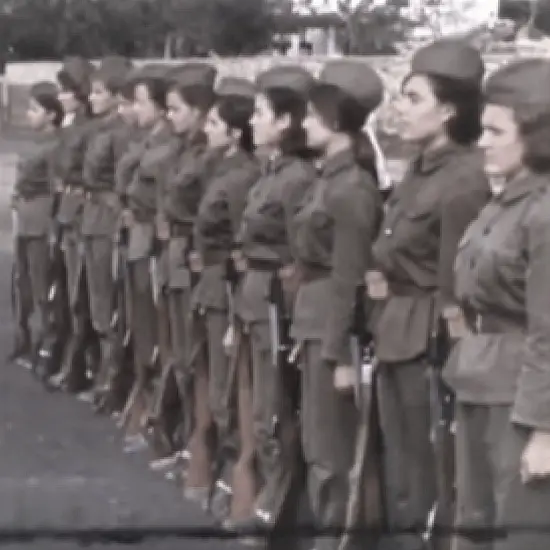
Despite the fact that in propaganda, and occasionally in power, solitary models of women’s participation in active life were created, in all the escapes of the mind, even if you tried to design it by hand, you could not recreate the discordance silently legalized between the relationships of male and female couples.
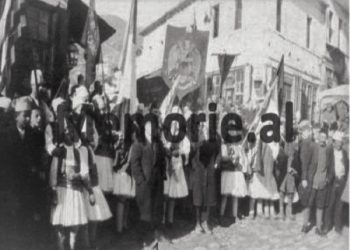
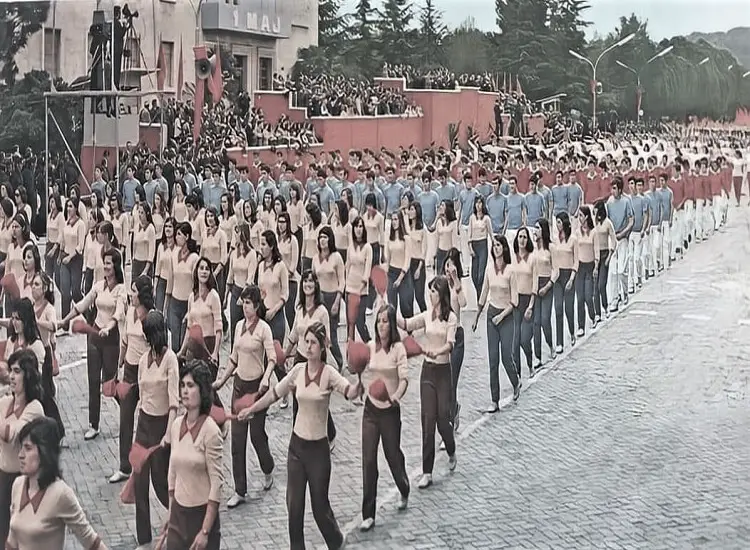
The May 1st and Liberation Day celebrations occasionally unlocked a magnified surge of people who, along with the banners and placards, changed the colors of the atmosphere. They were ideal inventions where, in essence, their meaning was forgotten only to decompose, change, and unravel the routine of the days into a festive bed.
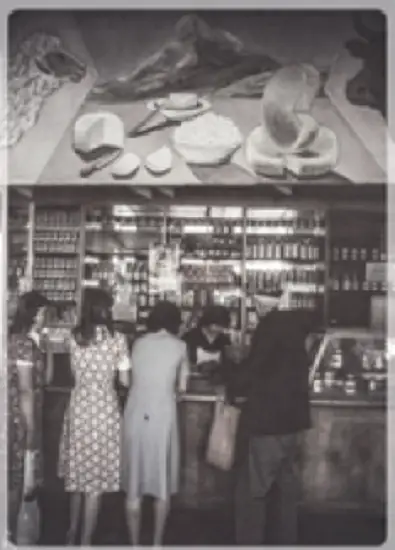
“Kafja e Madhe,” “Turizmi,” and the “Old Turizmi” were sufficient corners for all those who, in a way, created the ritual of a city. As meeting places, but also as emblems of beehives, they made you feel somewhat in a situation of sufficient inter-communication between the locals and those arriving from other cities. In an admirable poverty of assortments, one could lounge with a few types of local drinks and simple refreshments.
The open front areas of these cafes were overpopulated by the same characters and a swarm of curious people who paraded ceaselessly through these important nodes, where they would catch some contact or daily news. In the city center was also the notice board for death announcements, where people gathered mostly to satisfy their curiosity about those who had just departed this life.
Mornings and shift changes created another surge of human passage which, mixed with those who lingered and observed, closed the typical landscape of a city organized in closed, fixed hours. This city lived according to its own predetermined rhythm and woke up in a routine repetition, occasionally carrying with it a scorching heat and, at times, a rain that never ceased watering a quite unique metaphysical reality. Aside from the northern part of the city, where the arteries of two or three processing plants stretched, the rest lay in a wild revelry of thick, untamed shrubs and raw, unprocessed parts.
From above, the city resembled a geometrized cacophony of a simplified drawing, colored with elongated plumes of smoke and some circular concrete oases where a strict, imposing, and standard architecture was aimed for. The only human vents were the kindergartens and nurseries, where one could smell the scent of milk and muhalebi (rice pudding), mixed under a considerable protective coolness that made these landscapes even more morbid, showing a strange attention to the cult of birth. Hospitals maintained a sterile, populated order, filled mostly by those assisting and giving courage to the weakest – the sick, who seemed chronic and atrophied within measured meters of a crippled perspective of hope.
At specific hours, a total faintness was felt in the city, where leftover and partial tasks moved as if through a dropper, along with onlookers finishing their daily ritual. The people fed themselves in a primary, basic state with vital elements of survival, in an open struggle regarding the food base and especially the use of combustible liquids, which were the primary source of energy for cooking, washing, and preparing. The somewhat freer and more dominant people were few, but they drew special attention – they were either involved in art or writing in a reduced press, well-controlled from above.
The city maintained a timed symmetry in its rhythm, and surprises occurred as they do everywhere, in strange forms and appearances. Foreigners in this city were interesting and lonely, watched with curiosity by the crowd; they were, in a way, the primary reading of another life. A kind of secret luxury to be the center of attention, but also a high curiosity regarding their cultural blending – their customs, clothing, or behavior.
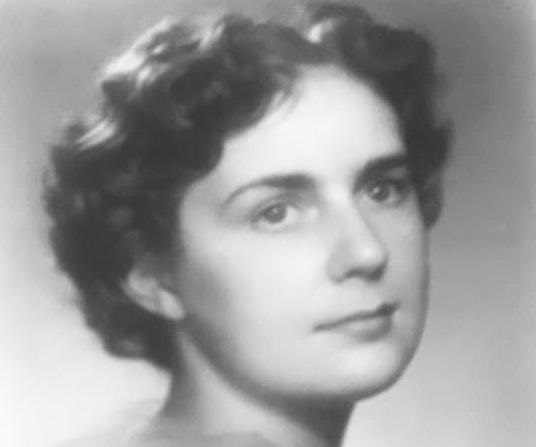
I knew one of them, the Polish woman Danuta Jukni. The acquaintance was difficult and slow, giving each other many proofs of trust and affection that consolidated more and more over the years. It seemed to me like a sympathy at first sight, as usually happens with people of a somewhat more distinct, calculated, and measured kind. She was a pediatrician, very capable and renowned in the northern city for her sternness and a kind of rigorous, alarming sensitivity regarding human health in general.
Danuta had her own profile – her own urban mark – in a restrained regularity between light gray and blue. With a “Bianchi” bicycle, she was quite frugal in relationships and very controlled in behavior. She was somewhere in her forties and still maintained a kind of feminine freshness in restrained and very natural tones. A careful hand had made possible the transfer of her and her husband – a well-known artist under the shadows of suspicion for “formalist art” at the time, yet entirely incomprehensible and outside the trend of official embrace. Danish Jukni.
The love between them was born in Krakow, Poland, during a flu epidemic. Danish fell ill with an infectious disease and spent a long time hospitalized in the same hospital where he met Danuta. It was a calculated love in an impressive match between a beautiful Polish girl and a young Albanian with high aspirations for the art of painting.
Albanians, in their own way, impressed by contacts with schools abroad, managed to penetrate spiritually into pairings that became fashionable, whether from Russian, Czech, Polish, or Romanian schools. A battalion of choices in an era open to leftist ideas which, nonetheless, maintained an impressive historicist baggage and form for underdeveloped and smaller countries. Their presence and return to different terrains influenced the cultures of each, but also the manias, forms of expression, and a somewhat classified modern ethics. An immediate surge for change brought a new wave to mentalities and the cultural course, somewhat enriching the variety in their public appearances and the somewhat progressive thought of their era.
But shortly after the Fourth Plenum, somewhere in the 1970s, thanks to the politics of the time, the unraveling of the left camp began. Clear contradictions emerged between the renegades of the compromise line and the sectarian, puritanical stances of certain countries following a harsh, defined line regarding genuine dogmas.
Albania chose the line of standing with open loyalty to the extreme left, in a grip and closing trance toward communism and the continuation of its own embracing theory. Under this wave, many connections between these countries collapsed and were traumatized because of politics. There was a shuffling and imbalance of positions, a shyness and indecision in the lives of everyone involved in this historical affair.
The entire Albanian society was subjected to this magnified comb of state control, especially intellectuals and artists who found themselves on the brink of painful and fundamental choices. The sixties were years of depression, let’s say on a spiritual level, as the euphoria of the leftist camp grouping felt cracked by causes within the camp – extra-opposite stances and harsh lines in the internal choice and use of power.
Due to the closure, country borders tightened in controls and became impenetrable, without any cause for sufficient communication to culturally stir societies or even in its unitary and internationalist union. The panorama of the post-seventies and onwards is an open digression against public life and the shyness and contraction of life in the country due to a repression from the bottom up – the movement and refreshing of the so-called cultural revolution.
In this atmosphere, many involved in relationships with foreigners, who could not abandon their dreams and spiritual choices, accepted to become “Albanianized” and submit to the regime. In this atmosphere, many were dispersed into different districts to be under even closer scrutiny by the authorities, but also with the aim of fighting a kind of revisionism within the leadership line and a kind of cleansing from the “micro-bourgeois diseases” – an already visible syndrome of a class of intellectuals who were silently the gray mass of the power.
Many of these characters were sent away to escape the attention and weight of the center, in a fleeting and scattered distribution across Albania. Regardless, they were enviable and quite attractive characters in a decomposing and disillusioned sense for many people who had grown up in standards that were not very cultivated or refined, under an instinctive and unparalleled Mediterranean emptiness.
The first meetings with the Polish Danuta flowed from the meetings I had with her husband, Danish – another frugal and withdrawn nature, a man of few words and quite ironic in the conversations held with him. Eager to be part of the silent word or of even deeper thoughts, the process of acquaintance through the codes of art began to function in this complicated generation of people who needed to be decoded to catch the bitter taste of what they knew, but also to learn how the secrets of the art we practiced daily could be qualified and extended in content.
It was a kind of luxury built day by day, step by step, with the giving and taking of trust and the providing of proof that we were dealing with a utopian reality, where the greatest force to be overcome was the dreaming or the hope of a “scoop” waiting to happen. But life has its naturalness, and the pockets of everyone’s conscience, in their emptying, carried a high and idealized interest in human relationships at their base – a sufficient humus to feed the hope that we all kept open like a necessary window of oxygenation.
The narrative of everything that happened was human and interdependent for these same reasons. It traced, sometimes in silence and sometimes in light, a relationship that was consolidating into a friendship entirely simplified into small interests and faint illuminations of something growing slowly. Surprisingly, from the history of art, the wives of painters, in particular, have been active in the relationship with their husbands’ art.
Danuta was an independent nature and not very influenced by the art of her husband, which was actually a cultured modeling of nuances as vital as they were analytical and rational. Precisely for this reason, her nature was selective and not very deepened, let’s say, in the extra expression of things. She had a natural connection with nature and animals in particular and was a class housewife in modeling small things within a family extremely reserved in its privacy. The classic model of a woman who adores nature, movement, light colors, and different types of culinary arts.
One day she told me: “Please, can you find me a cow or ox liver, I don’t remember exactly…” “Yes,” I told her, “I will find it for you.” I had a veterinarian friend who found it and brought it to my house. I sent it to Doctor Danuta; she thanked me, and we parted. Two weeks later she said: “You are invited for tea in the afternoon at my house.”
I went with great curiosity to see a Polish woman’s home from up close. She had prepared a pâté with the liver I had sent her and had a filled jar ready for me as a gift. It was a sad afternoon with gusts of heavy rain and frantic, unstable weather. It was exactly the kind of time where you could undo a glass of tea and confess trivial things from daily life. I discovered a nature quietly exchanged on a half-open sofa, where she moved home accessories back and forth. The house was kept under a restrained gray, with all possible layers to be completely calm and in a closed world of meditation. One spoke slowly and with a kind of quietness that made you want to destroy it for its measured order – as if oxygen, grimaces, and high tonality were controlled by weight. She packaged the things for me and again asked for something – a walk somewhere in the Northern Highlands if I had time. Again, I said yes!
It couldn’t have happened otherwise, and we realized it on a murky afternoon with drifting patches of sun like bright holes in an unstable time. I cannot get it out of my mind how, for a moment, as we were passing through the fields of Malësia e Madhe, she said, “Stop the car.” In the middle of a plateau stood a lonely cow, chewing in its own trouble. She stepped out of the car – a “Xingfu” of Chinese production – and walked dozens of meters into the middle of the plateau to feed a wild cabbage to the lucky animal, in a landscape transfused between reality and the fantasy of a creation. These were gestures that, in their suddenness, took us out of the game in terms of sensitivity and gave us strange, forgotten messages of a delicate, entirely forgotten relationship with nature. I blushed within myself from the trouble of feeling somewhat outside of this sensitivity.
These gestures seemed very romantic and past to me – things I had seen or read in books or noir films. But that was how that woman was: beyond any direct imagination, cultivated and restrained, wrapped in her silence which made everything even grayer.
I was very curious about how they felt as a couple – a Polish woman and an Albanian man. It was a versatile relationship conducted in silence with sparse and refined signs, everyone in their place and weight in a relative and minutely controlled independence from each other.
Certainly, as a woman, she mostly felt pressure and isolated herself within a natural light of a quiet and active nature in her expressed certainties and uncertainties. Sometimes she had such outbursts that came out pleasantly from the confusion of the Albanian language; she looked like a kitten in a meadow with those naive fences that mostly resembled the harsh and jumping Albanian mentality. Half-blushing, half-confused without the homeland of her natural language, she would burst into the Polish language in a burst of volleys, half-deafening.
Our friendship became closer and closer and slowly she began to feel freer and more open with me. I liked these walks because they were different, in a quiet and contemplative climate, and in a projection between people in chemistry who had softly laid a kind of cobblestone where one could now walk freely. Meetings became more frequent, and she began to confide in me about somewhat closer and more delicate things. But as happens with women, at certain moments she would create a surprising relationship – like something you don’t always have in hand and certain.
We were drinking tea as always on her couch, and suddenly she said: “The day you sent a personal exhibition to Tirana, your works terrified me…!” I was surprised because I always thought she liked me as an artist. In fact, it was a sudden, sincere affirmation of what she preferred. It was a phase where the rules of painting were being broken, and my creativity was led by displaced accents of aesthetics where I thought touch, condition, and gesture were more important than chronology, harmonic form, or natural visual description. Also due to themes and brutal interruptions on the plane as an emotion of another kind – very significant and impressive. Apparently, this kind of expansion took her out of her fluid states so close to nature, but she had the courage to tell you.
Another interesting meeting was in Tirana. The system had just collapsed, and certainly all the stagnant relationships had moved, and a new configuration was being reviewed among groups and friends to reformulate, along with those sent away to the districts, another configuration in the arts. The Jukni couple had just moved and was re-normalizing relations among friends in interesting and mixed groupings – now between traditional friends and younger ones. A meeting was organized at Jukni’s house in memory of the golden times and to re-examine a somewhat balanced and confrontational relationship, let’s say, regarding what had happened to Albanian society.
There were Jusuf Vrioni and his wife, Thoma Thomai with Lizeta, Pirro Milkani with the beautiful pianist Bepi Kristidhi, the Fico sisters, Delina and Albana, and myself. An afternoon tea of the classic kind, with a relationship of many signs of gentleness and toned noises. All harmonized in respect of this meeting and with jokes and conversations of the kind that forced you to be more silent to enjoy and be pleased with the presence in this kind of grouping. Tirana was in chaos and in a frantic trend of exchange relationships where everything was bought and sold in an instant, and the margin of flight was so high and optimistic that it seemed we were living in the “golden age.” The youngest in this meeting were me, Delina, and Albana, and the loudest at the same time.
I felt a sharp attention from those present because of my clothing, which was “all-asoj” (strange) – starting in a classic way and then with two or three violent elements (a kind of sheepskin vest with patches and a pair of oversized military boots with a neck) – a nonsense that slightly shook the surface of a classic veil of the group, with a lot of beard and a free and openly aggressive behavior. A lack of language in clothing that suggested I was not used to such gatherings of a kind I had never lived before.
It was a kind of aggression as an open manifestation of that sudden transformation under the principles of a freedom released fiercely without sense, language, or compromise. Danuta, as always, was restrained and with a light heaviness in all her limbs, like a person who, in a late start, tries to rest and self-console all that ordeal of absence and the real possibilities of a group already shuffled by history. She felt weary and soft.
Quite painful was her final send-off when she passed away. A funeral procession in style and taste with rare respect and many people accompanying the cortege, and an elongated group of nuns who gave the final ease to her soul to rest peacefully at her final station. Danuta remained like an unreturned love until the end, like every human sorrow and every love projected in a time of absurdity. In the Jukni family, we experienced three important partings: the death of Harri, her dog who died of a long and lingering illness; her sad death, but like a story found and watered in books; and the tragic and similar death of her husband – a contagious love not to be disconnected from life. All together, they were a painful and purple saga of a human scene in passion and love lay out like never seen before.
The Polish Danuta Kosciuszko Jukni was a special emblem in the chain of human connection that fate sent to the land of the eagles, in a love watered with labor – an unrepeatable, fatal love with no return./Memorie.al