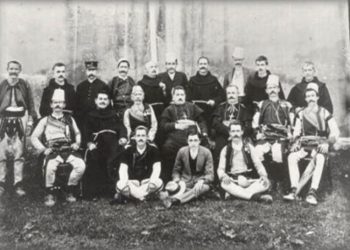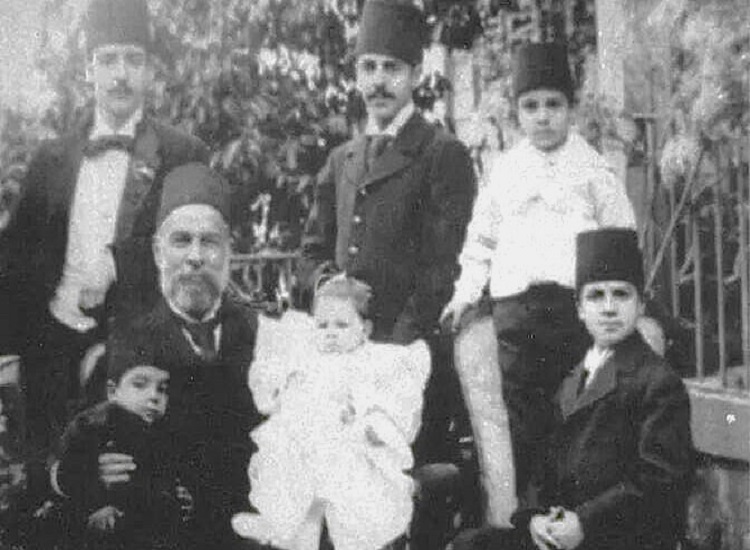
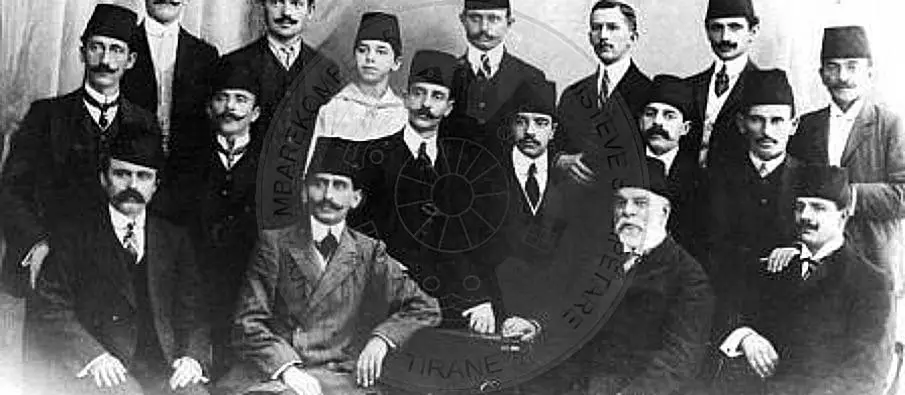
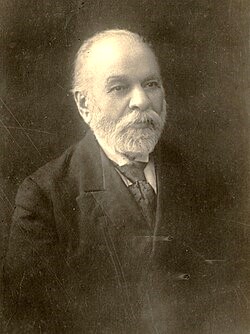
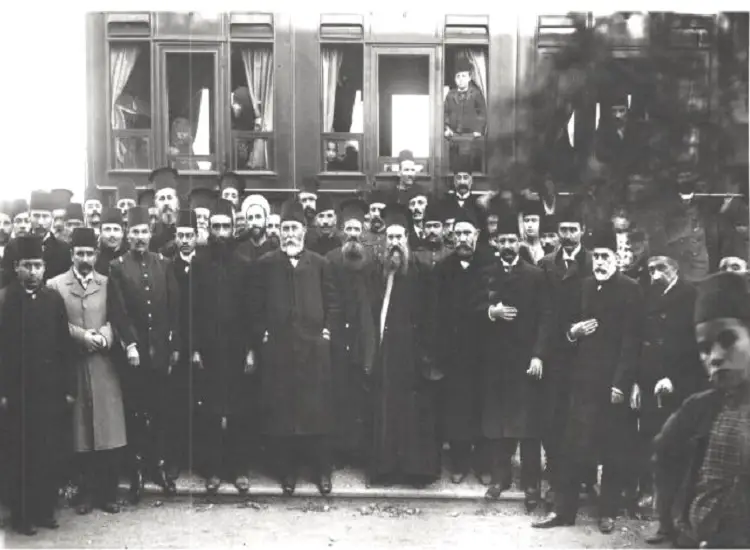
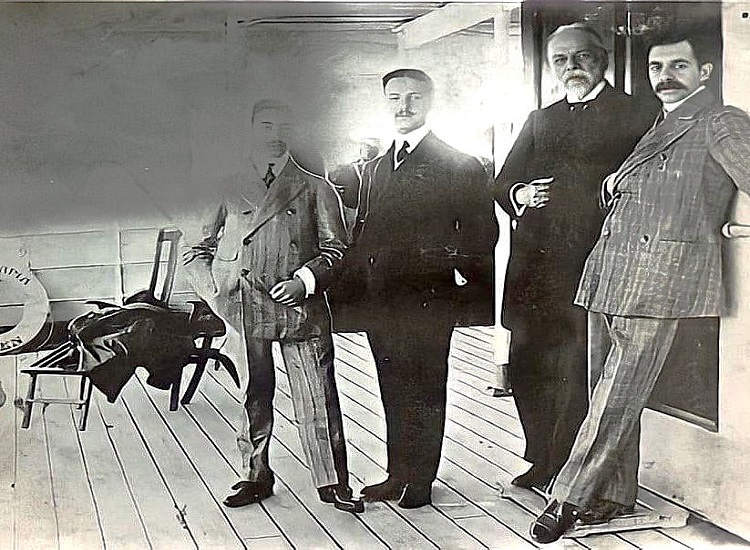
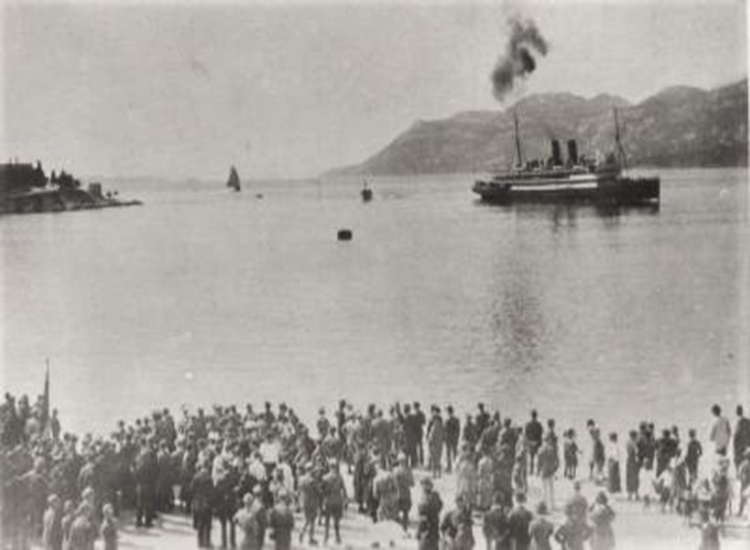
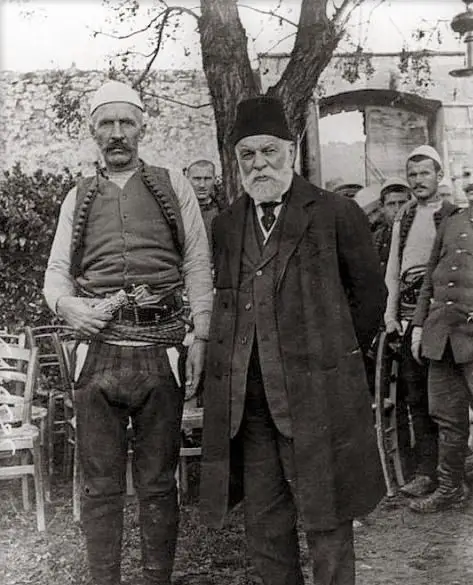
Memorie.al / This are the interview that Ismail Qemali (Ismail bey Vlora) gave to an Italian journalist in Rome on April 1, 1913, four months after the declaration of independence. Finally, Ismail bey had managed to leave Vlora, blocked by Greek ships, and visit the capitals of Europe. As he himself says, it seemed to him as if he had come out of a real prison – such was the anxiety caused by the blockade. He had been able to leave on the yacht of a French duke who wanted to become prince of Albania. This photograph probably shows the moment of departure from the coast of Vlora to board the yacht. The period we are talking about was among the most difficult in Albania’s history: Kosovo had been occupied, the Serbs had come as far as Durrës, Shkodra was surrounded by Montenegro, while the Greeks, besides blockading the southern coast, had advanced as far as Tepelena. In this tragic situation, the ambassadors of the Great Powers were debating in London to determine the borders of the new Albania.
The interview was conducted by Achille De Benedétti and was published in the newspaper ‘Il Giornale d’Italia’ on April 2, 1913.
ISMAIL QEMALI managed to leave Vlora the day before yesterday on the yacht of the Duke of Montpensier. I met him this morning at the train station as he arrived from Bari, where he had left Isa Boletini, who was slightly ill, together with the young man Luigj Gurakuqi, the Minister of Education. Qemal bey had come with two of his sons, who have accompanied him through all these vicissitudes. The distinguished old gentleman looked very well. He was happy to have arrived in Rome after fleeing Vlora.
I ask him how the journey went.
ISMAIL QEMALI: Excellent from every point of view. A few days ago, the ‘Mekong’, the yacht of the Duke of Montpensier, arrived in Vlora flying a British merchant flag. The Duke immediately invited me onto his wonderful ship and asked if I wished to come to Italy. It was a real stroke of luck. I would have been mad not to have taken advantage of this rare opportunity. For me, this meant freeing myself from a strange imprisonment. It was also an opportunity to help my country’s cause a little more closely.
But the Greeks, didn’t they catch you?
ISMAIL QEMALI: No. They saw us very clearly. Besides, do not forget that the ‘Mekong’ had come from Corfu. If they had wanted to capture me, they could have done so easily. I did not hide the fact that I was leaving. A Greek torpedo boat, tasked with blockading the coast, spotted us and allowed us to pass without any problem. The journey went very well. The Duke’s yacht is truly wonderful, and I am glad that I managed to get out of this imprisonment without any expense and in such good conditions.
But your friends in Vlora, Excellency, did they object to your departure?
ISMAIL QEMALI: They themselves advised me to take advantage of this unexpected opportunity. They are convinced that the Albanian question is not in Vlora, in this city where freedom was declared in a kind of prison, but elsewhere, and especially in London, where our future fate is being discussed. I have left clear instructions to my government friends, making them reflect on the serious consequences the country would suffer if they were to undertake any hasty act or start any revolt. They swore to me, and I am quite calm that my compatriots will maintain a peaceful stance, as I have advised them and as is my wish.
Have the Greeks advanced further?
ISMAIL QEMALI: No. They have not advanced beyond Tepelena. Something important happened in Tepelena, because the Turks cut the bridge to hinder the invasion. So, the Greeks have not gone further than Tepelena. They know that Vlora is inviolable, especially due to the will of Italy, but also of Austria.
But they haven’t captured Berat?
ISMAIL QEMALI: No. In the entire sanjak of Berat, they have not gone beyond Tepelena.
What was the situation like in Vlora when you left?
ISMAIL QEMALI: Very calm. There have been no other internal difficulties, apart from the anxiety of the naval blockade that has isolated us and caused us to lack some basic necessities of life. Only one thing happened that is truly worth noting: the arrival of an Austrian officer in civilian clothes, accompanied by a priest and a sailor.
How did he manage to come?
ISMAIL QEMALI: He landed at the mouth of the Seman River on a ship of the Lloyd Company, and from there came to Vlora by rowboat. You know that in Vlora there is an element that does not want Albania’s pure independence. This element has always fought me and tried to create difficulties for me. The officer who came said that he was able to arm the population and give us weapons. However, I had no difficulty explaining to the people that we had no need for such machinations and that we could achieve the security of our country by trusting in the protection that Europe gives us.
In Italy, the press had news of these Austrian intentions in Vlora…
ISMAIL QEMALI: Then this news is not new to you. Nevertheless, I know Vienna’s politics, and in any case I am grateful to Austria for its interest in Albania. On the other hand, I also understand the difference between the two policies, of Vienna and of Rome…!
At this point, Qemal bey fell into a diplomatic silence.
What about the difficulties the blockade creates for you in terms of food?
ISMAIL QEMALI: Oh, better not to talk about it. It is something that causes anxiety. I am glad to be in Italy also because I will ask both your government and the ambassadors of the Great Powers, or the Greek minister, to put an end to this ugly and useless measure. After 20 days, Vlora will be in complete starvation. We have performed miracles to keep the people alive so far.
But it is not possible to continue further in this state. There are now humanitarian reasons for which the blockade must be ended. By continuing the blockade of Vlora, the Greeks are acting unjustly, in complete opposition to their civilization. Why do they want to stupefy a population that harms no one with its neutrality, with the catastrophe of hunger? No reason can justify the blockade of Vlora.
Is it not true that troops of Xhavit Pasha are roaming there?
ISMAIL QEMALI: They are simply irregular soldiers in a miserable state, who pose no military concern. Xhavit Pasha is in Lushnjë near the Shkumbin River in truly tragic conditions and cannot undertake any kind of action against the Greeks, nor drive them from the positions they have captured. At least for now, the Greeks control Saranda and all the points of the blockaded coast. They have declared that they will not touch Vlora, because that is the will of the two Adriatic powers, so they should not fall upon it under the pretext of the blockade. I hope to make known the humanitarian reasons that call for the lifting of the blockade.
Then, Qemal bey asked me to tell him the latest news from the London Conference on Albania. Regarding the southern borders of Albania, I explained to him what the Greek thesis was, which demanded Korça, Këlcyra, Tepelena, as well as Gjirokastra and Saranda.
ISMAIL QEMALI: But that is like cutting off Albania’s arms and legs (exclaimed Qemal bey). Let us hope that the will of Europe, which one day will triumph, will lead to the integrity of the populations that are purely Albanian. It is truly strange that the Greeks think they can take even Korça!
What are the current relations between Turkey and Albania?
ISMAIL QEMALI: They are completely peaceful. We received in Vlora the official communication from the Grand Vizier, recognizing Albanian independence and the right to our flag. This answered the great insult that Xhavit Pasha’s troops inflicted on our flag in Tepelena. The Turkish government launched an investigation and informed the mutasarrif of Berat that it already recognized our autonomy and asked the last remaining Turkish authorities on Albanian territory to respect our emblem.
Has the issue of the prince of your state been resolved?
ISMAIL QEMALI: Oh! The issue of the pretenders to the throne, or of the Albanian principality, risks being inflated excessively. I had the chance to meet the Duke of Montpensier, who with his humanitarian help got me out of the strange situation I was in. Naturally, I expressed to him all my gratitude for this noble act and told him that Albania would be honored if it had at its head the descendant of a distinguished and historic family. But I also told him, for the sake of sincerity, that the time had not yet come to think about the prince issue, which would have to be resolved later.
What do you think, Excellency, about the issue of Shkodra?
ISMAIL QEMALI: You can guess for yourself. I think the Shkodra issue is now on the way to a solution. Montenegro’s stance does not seem to me to have a chance of success. The reasons why Shkodra must remain with Albania are well known. The Great Powers, who fully understand the need for such a decision, have already agreed to make Montenegro withdraw.
Have you read the telegram of King Nikola, who speaks of the fortress of Christianity that must oppose Islamism?
ISMAIL QEMALI: That is precisely the weakness of the Montenegrin thesis. How can King Nikola think to impose, by arms and violence, the religious conversion of Albanian Muslims? Has he considered that he would have to prepare for many, many bloody wars? Nevertheless, I believe that in the end Montenegro will retreat before the will of Europe.
I am glad, – concluded Qemal bey, – that I managed to get out of Vlora to further defend Albania’s rights in the European capitals, in your city and especially in London. Apparently, Peja, Prizren, and Gjakova are lost, but there are some territories that can still be saved. And I will try to do this with faith in the sacred rights of my people.”
After a few days, Ismail Qemal bey will leave for London. There he will try to defend the cause of peace not only in the interest of his country, but at least somewhat also of Europe, which, in the Albanian question, may see the failure of its efforts to maintain peace. He thus begins a political pilgrimage through the capitals of Europe, where Rome is the first important stage. / Memorie.al