From Bashkim Trenova
Part Sixteen
NAZBOLSHEVISM – LITERATURE AND THE ARTS
FOREWORD
Memorie.al / Historians, political philosophers, intellectuals from different schools or positions have dedicated thousands and thousands of pages, entire volumes, studies, and articles to the comparison between Nazism and Communism. Generally, in their publications and studies, they focus on the police control of society by these dictatorships, the role of the dictatorial state hierarchy and the head of state as suppressors of free thought, the omnipresence of official propaganda in society, the mass massacres and the network of concentration camps, the activity of the police, the NKVD in the USSR (later KGB) and the Gestapo in the Third Reich. In his book “Le Passé d’une illusion” (The Past of an Illusion), François Furet notes that Nazism and Communism share the same opposition to liberal democracy and what they call “capitalist bourgeoisie.” Both ideologies claim to be socialist and use the image of socialism. Communist countries called themselves “socialist.” “Nazism” is a shortening of National Socialism.
Continued from the previous issue
Chapter II – MUSIC
In 1954, Khachaturian composed the music for the ballet ‘Spartacus’. This ballet, as its title also attests, centers on the legendary leader, the gladiator who rose against the oppressive slave-owning power of the time, against the Roman Empire. One would think that, in this respect, the ballet is in harmony with the demands of Socialist Realism. Despite this, it was harshly criticized by the official criticism of the time, reworked, and presented with a new choreography in 1968.
In Soviet ballet, a special place is also held by the choreographer of Jewish origin, Leonid Veniaminovich Jacobson, known as one of the most distinguished ballet masters in the world. He and his work, spanning the years 1930-1970, were accused of “eroticism, acrobatics, and other ‘isms’, of submission to corrupt Western art… ‘murderer of great Russian ballet’.” Speaking of Russian ballet, we can also add that even before the October Revolution, the Imperial Theater of St. Petersburg had lost dancers such as Mikhail Fokine, Anna Pavlova, and Vaslav Nijinsky, drawn away by Sergei Diaghilev’s Ballets Russes in Paris. After 1917, this theater lost almost half of its staff, including Tamara Karsavina in 1918, Mathilde Kshesinskaya in 1920, Olga Preobrazhenskaya in 1921, and Georgi Balanchivadze, who became famous as George Balanchine in Paris in 1924.
Song and choral music also occupy an important place in Russian culture. According to Socialist Realism, they must be creations of the working masses and for the working masses, they must mobilize the people as actor, as active participant in the spectacle. Most songs of the Soviet period are composed simply, easily accessible to the masses, in order to spread the ideology and “values” of communism among them. Soviet songs and chorales have revolutionary content, reminding Russians and other Soviet peoples of their duty to mobilize in building a new homeland. They hymnify the communist regime, the heroes of the Revolution, socialist workers, the collectivist pathos, socialist patriotism, the heroic Russian spirit, and the defense of the country against Nazi aggressors.
Often they are a mixture of Russian folklore and military marches. The Bolshevik ideologues, the Russian League of Proletarian Musicians, shaped the song to be necessarily optimistic and, consequently, composed in a major key. The post-Revolution Russian song, composed according to the official demands of the time, generally lacks the lyrical, individual, or personal element traditionally present in Russian culture and the popular consciousness.
The Soviet song has a special role in hymnifying the Russian spirit, of Great Russia, and in building the cult of Lenin and Stalin. This is also seen in the verses of the USSR state anthem, where they are presented as two heroes, as good fathers of the Soviet peoples, why not even as gods. Here are some of these verses for illustration: “Unbreakable union of free republics / Great Russia has forever stood… / Through storms the sun of liberty shone / And great Lenin illuminated our path / Stalin raised us / He inspired our faith in the people…”.
‘И вновь продолжается бой’ (‘And the battle continues again’) is one of the Soviet songs dedicated to the October Revolution and Lenin. Its lyrics include these verses: “And the battle continues again / And the heart alarms within the breast / And Lenin is so young / And young October is coming.” ‘Ленин всегда с тобой’ (‘Lenin is always with you’) by composer Serafim Tulikov, is another song that praises Lenin. ‘Мы будем как Ленин’ (‘We will be like Lenin’) with music by A. Sardan, ‘Песня о Ленине’ (‘Song about Lenin’) by Aleksandr Hollminov, ‘Ленин’ (‘Lenin’) by Yuri Chichkov, ‘Ленин и весна’ (‘Lenin and Spring’) by Rostislav Boyko, ‘Ленин Партия Народ’ (‘Lenin Party People’) by Ivan Slyot, ‘Ленин поможет тебе’ (‘Lenin helps you’) by Kolmanovsky, ‘Ленин с нами’ (‘Lenin is with us’) by A. Novikov, ‘Ленина помнит земля’ (‘The earth remembers Lenin’) also by Novikov, ‘Он родился весной’ (‘He was born in spring’) by I. Lyuchenok, ‘Песня нашего сердца’ (‘Song of our heart’) by Yuri Chichkov, ‘Разговор с Лениным’ (‘Conversation with Lenin’) by V. Loktev, ‘Святое Ленинское знамя’ (‘The Holy Lenin Banner’) by A. Aleksandrov – all weave eulogies, raise the cult of Lenin.
Among the verses of the song ‘Святое Ленинское знамя’, it is said: “Wise Lenin and great Stalin / Glory forever and ever”! In 1937, the Soviet power celebrated its 20th anniversary. On this occasion, the song ‘Москва Майская’ was composed for the documentary film ‘двадцатое мая’ (‘Twentieth of May’), in whose original lyrics Stalin is praised. In 1938, Dunaevsky composed “Песня о Сталине” (‘Song about Stalin’).
Here are some of its verses: “And we proudly sing this song / And we hymnify the grandeur of the Stalin years / We sing to the beautiful, happy life / To the joy of our great victories / From one shore to the other / Along the mountain peaks, where planes converse / People give a beautiful song about Stalin, wise, dear, and much beloved.” Before and after, songs and marches for Stalin were also composed by many other Soviet composers such as M. Starokadomsky, A. Aleksandrov, Anatoli Novikov, L. Polovinkin, S. Chernetsky, B. Terentyev, Sergei Prokofiev, K. Masalitinov.
In the verses of their songs we read: “Only this person is famous in the USSR,” “invincible and legendary,” “It is known that Stalin’s genius…”, “Stalin is the banner of happiness, the dawn of humanity,” “Thank you, great teacher,” “Thank you, great Stalin.” Stalin never expressed opposition, never made any criticism, mild or devastating, of the music or lyrics of songs dedicated to him. No author was condemned for these songs.
Russian culture is imbued with great patriotism, with Russian pride, with the strength of the Russian character, of the invincible and ever-victorious Russian army. This is also noticeable in many songs composed before and throughout the Soviet period, sometimes unnaturally, but forced, to play a certain role. The very well-known song ‘Калинка’ (‘Kalinka’), for example, composed in 1860 by Ivan Petrovich Larionov, has been performed in its folkloric colors. In another version, it has been performed by Cossacks in a military tone, and likewise, by the Red Army Choir.
‘Прощание славянки’ (‘Farewell of Slavyanka’) is a Russian patriotic march composed by Vasily Agapkin in 1912; it pays homage to Slavic civilization. This march served as the unofficial anthem of the White Army of Admiral Aleksandr Vasilievich Kolchak. It also entered the repertoire of the Red Army Choir and has often been played during military parades on Red Square. It is understood that the author of ‘Прощание славянки’ did not know Socialist Realism, not yet born, but that does not stop the “Reds” in the Kremlin from stepping in the same way as the “Whites,” if it suits them, if it serves them.
‘Полюшка, поле’ (‘Field, oh field’) is a military march, composed in 1933 by Lev Kniper, reminiscent of Cossack cavalry marches. It is one of the first mass Soviet songs, which enjoyed great popularity. Among the verses of this song are: “Field, oh field / Wide fields / Heroes cross the field / Ah, yes, heroes of the Red Army.” In fact, as the Russian writer L. Lyubimov expressed: “Above all, in this song is all of Russia, the old and the new, all Russian glory…”.
This perhaps explains its extraordinary success in Soviet Russia. “Russian glory” has been constantly manipulated by those who have held or hold the reins of power in the Kremlin, be they White or Red. ‘Катюша’ (‘Katyusha’), composed in 1938 by Mikhail Isakovsky and Matvey Blanter, is also a very well-known song. It is dedicated to a girl who writes to her beloved on the war front and prays for him. Despite being very intimate, in the conditions of the general militarization of life in the Soviet Union, this song was also “militarized,” sent to the front during World War II, and is also part of the repertoire of the Red Army Choir.
Russian creators, artists, and later Russo-Soviet ones, have continuously attached great importance to the Russian land, Mother Russia. Thus, the song of 1936, also very well-known, ‘Широка страна моя родная’ (‘Wide is my native land’), by authors Vasily Lebedev-Kumach and Isak Dunaevsky, is transmitted to its listeners. This song is like an anthem. At different times, in the 1930s, before the dissolution of the Soviet Union, and also after, it claimed to be the number one song in the country. Even today, it is heard on major holidays in Red Square in Moscow. Among its verses are: “My dear country is wide / It has many forests, fields and rivers / I know no other country like it / Where man breathes freely.” The text is simple and without any effort to be “embellished,” with a propagandistic character.
The Bolsheviks, however, demanded more from this song. After the adoption of the Stalinist Constitution of 1936, a stanza was added: “At our table no one is superfluous / Each is rewarded according to merit / We write the Stalinist State Law in golden letters / No year will erase these majestic and glorious words: everyone has the right to study, to rest, and to work.” It seems we have not a song lyric before us, but a banal propagandistic speech. Despite this, even for this propagandistic service, on January 1, 1937, the newspaper ‘Правда’ (Pravda) published the Resolution of the Central Executive Committee of the USSR: “For services rendered to cinematic art and for the creation of a number of Soviet songs that have become the property of the masses, the Order of the Red Banner of Labour is awarded to composer I. O. Dunaevsky and poet Lebedev-Kumach V.I.”
‘Священная война’ (‘The Sacred War’) was composed by Aleksandr Aleksandrov (founder of the Red Army Choir) two days after the Nazi aggression against the Soviet Union. The song calls for a sacred war to defend and save the homeland from barbarian aggressors. It became an anthem for the defense of the homeland. It should be recalled on this occasion that until October 15, 1941, “The Sacred War” was not very popular because critics of Socialist Realism thought it had too tragic a resonance, that it did not sing of a quick victory with “little blood,” but a difficult, deathly battle.
Only after that date, while Hitler’s Wehrmacht had taken Kaluga, Rzhev, and Kaliningrad, “The Sacred War” began to be heard daily on the radio throughout the Soviet Union. The song gained popularity on the fronts of the Great Patriotic War and served to keep the morale of Soviet troops high during difficult battles. The “sacred,” “untouchable” Socialist Realism, even in this case, proved manipulable, giving way to pragmatism according to the appetites and calculations of the masters of the Kremlin. They are the ones who do not hesitate to dictate their will even in completely unnecessary cases, to politicize verses that have nothing politically or ideologically condemnable, to change song lyrics to make them even more useful in their efforts to dominate art and culture in every cell, and through them, to enslave the spirit of a country, of a people.
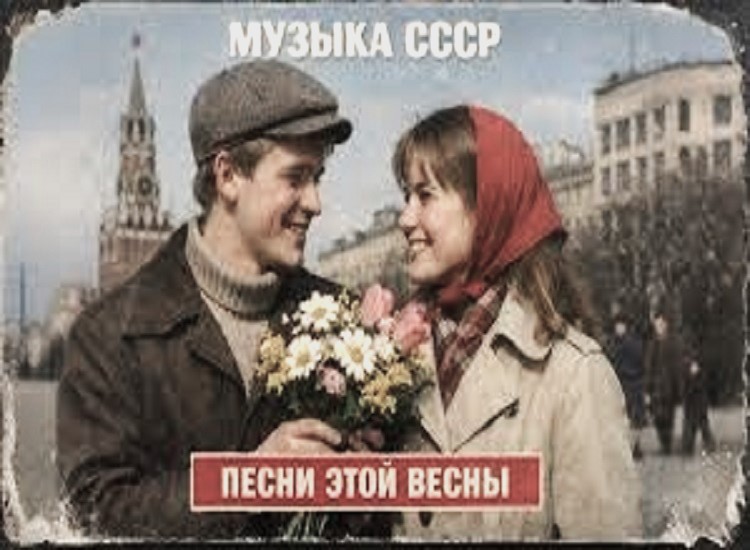
‘Подмосковные вечера’ (‘Moscow Nights’) was composed in 1955 by Mikhail Matusovsky. It very quickly became an emblematic song. The author, born in Leningrad, originally titled it “Leningrad Nights.” The song’s lyrics, at the request of the Ministry of Culture, were changed and instead of the nights of Leningrad, it was dedicated to those of Moscow. The highly successful song, even though it is a lyrical, romantic song that has nothing to do with the army, has in many cases also been performed by the Red Army Choir.
Many songs have been dedicated by Soviet composers to the socialist homeland, to construction sites, to the spring of new life in city and countryside, to the enthusiasm of youth, of the working masses, to the sky of happiness. A song of this nature, very popular, is ‘Марш энтузиастов’ (‘March of the Enthusiasts’) from 1940, composed by Isak Osipovich Dunaevsky. It was performed by Lyubov Orlova in the film ‘Светлый путь’ (‘The Bright Path’) by Grigori Vasilievich Alexandrov. Here are some of its verses: “In the daily life of the main construction sites / In the joyful noise, the lights and the bells / Hail, land of heroes / Land of dreamers, country of scientists! / You stretch across steppes, you stretch across forests / Boundless, invincible / You stretch towards the tropics / You stretch towards the pole. / Stretch, my dear, boundless, invincible country. / Nothing stops us, neither at sea nor on land. / We fear neither ice nor clouds. / The flame of our soul, the flag of our country we will carry across the world and through the centuries. / We are always right in our courage. / Our work is a matter of honor, a matter of courage and a deed of glory.”
Verses worthy of a speech or report at some party congress or conference, inflated verses, outside any reality, like a drug, verses that reflect communist megalomania, a sick expansionist spirit, hungry for space. In this spirit are many other songs such as, e.g., ‘Не расстанусь с комсомолом’ (‘I will not part with the Komsomol’) composed by Aleksandra Pakhmutova in 1970, or ‘Любовь Комсомол и Весна’ (‘Love, Komsomol and spring’) composed in 1978 also by A. Pakhmutova. These songs are dedicated to neither Komsomol members who ask neither about storms nor fires, which, nevertheless, will always have love, spring, etc., among them.
The Soviet song began its “educational” role through the mirages of the blue sky in the first years of the communists in power, and not only with Komsomol members, i.e., the youth valued as a reserve of the Communist Party, but starting from childhood. In 1922, at the request of Lenin’s wife, Nadezhda Krupskaya, the ‘Гимн пионеров’ (‘Anthem of the Pioneers’) was composed by Sergei Kaidan-Dyoshkin. “We are the pioneers – children of the workers / The time of bright years is approaching / The Pioneers’ call: ‘Always ready’!” These are some of the verses of this anthem song. By the Bolsheviks, in the name of a happy future, of a blue, cloudless sky, children are asked to be “always ready!”, to accept everything like an obedient flock.
The most famous song dedicated to the Soviet Homeland is, in all likelihood, ‘Мой адрес — Советский Союз’ (‘My address is the Soviet Union’) composed in 1972 by David Tikhmanov with lyrics by Vladimir Kharitonov, on the occasion of the 50th anniversary of the Soviet Union. In the lyrics of this song are the refrain verses: “My address is not a house, nor a street / My address is the Soviet Union.” After the dissolution of the Soviet Union, this song was no longer heard for some time. It was revived, it seems not by chance, during a football match in which, suddenly, and the entire stadium began to sing it in chorus.
Great Russian nostalgia for the lost space?! The vocal-instrumental ensemble “Samotsvety” still has this song in its repertoire even though the Soviet Union is dead. The dream of a resurrection of the lost empire, of the lost space, still lives on, it seems. And where can it find a place, where can it be more easily injected than into the bosom of thousands of fanatical, manipulated fans? The Soviet song plays a special role in propagandizing what are regarded as achievements in the country’s socialist construction, as magnificent, unparalleled victories made a reality under the leadership of the Party, of Lenin and Stalin. The Soviet song, i.e., Soviet propaganda, does not restrain itself, it goes into delirium.
The 1950s are known as years during which new lands were opened and as years of economic recovery after World War II. A large number of songs were dedicated to them. One of the first was ‘Марш коммунистических бригад’ (‘March of the Communist Brigades’) with music by Anatoly Novikov. Here are some of the verses of this song: “Today we are not at a parade / We are on the road to communism / In the communist brigades Lenin is with us / … We are everywhere where it is difficult / Every hour is precious / Daily work is rest for us / If we have given our word / We will not disappoint you / Let us light the sun of new life over the globe.”
Another song, also of this nature, is ‘Песня о тревожной молодости’ (‘Song of the Anxious Youth’) composed by Aleksandra Nikolaevna Pakhmutova. It is dedicated to the Komsomol members of the difficult 1920s, who engaged in building a brilliant future, as the Soviet vocabulary of the time, and later, said. In the lyrics of this song it is said: “Our worry is simple / That is our only worry: / That our homeland may live / and that there be no other worry.” In short, it sings to the robot-man. In 2014, this song was performed as a military march during the victory parade held on Red Square.
The song ‘Четырнадцать минут до старта’ (‘Fourteen minutes to launch’) is a mass song composed by Oscar Feltsman, a song that became a kind of unofficial anthem for cosmonauts, the anthem of the USSR’s space program. Its lyrics were written by Vladimir Voinovich. In the land of the Soviets, in the 1960s, the space theme became mandatory for every concert, wherever it was held, from pioneer camps to the Kremlin. In this context, the song ‘Четырнадцать минут до старта’ was used by Bolshevik propaganda during the Soviet-American rivalry for the conquest of outer space.
The Soviet leader of those years, Nikita Khrushchev, himself greeted cosmonauts Nikolayev and Popovich, who sang the song from outer space. He also quoted in his greeting its verse: “Our tracks will remain on the dusty path of distant planets.” The choice of this very verse by the head of the Kremlin clearly appears not to have been made by chance. On the other hand, a quote from a Soviet leader is, in itself, a major event. Immediately after it, the central newspaper of the Communist Party of the USSR, “Правда” (Pravda), published the song in two consecutive issues, first in the special evening edition, in red, then in black, in the regular morning edition.
Despite the success and use of the song for the aforementioned purposes, as well as for other purposes for internal effect, always in the spirit of Russian pride, of the Russian soul, of Soviet Great Russia that stretches over two continents and conquered even outer space, the lyricist, Vladimir Voinovich, could not later escape denigration and persecution. He was condemned as a dissident and his Soviet citizenship was revoked. His books, theatrical pieces, and film scripts written by him were banned. ‘Четырнадцать минут до старта’ however continued to be sung, but without citing the name of the lyricist. /Memorie.al