By Eugen Shehu
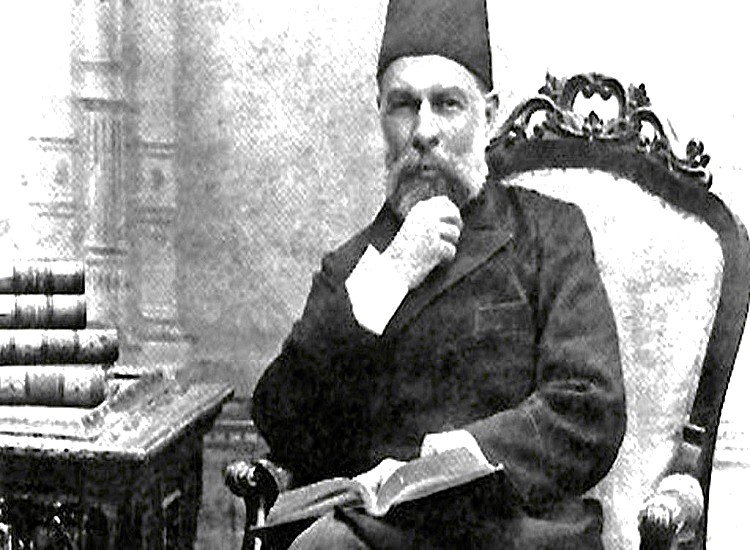
Memorie.al – Left somewhere, in the sleepy periphery of memory, shut away somewhere, in the dark drawers of half-a-century-long communist historiography, the figure of Aqif Pasha Elbasani could not lose its brilliance as one of the most outstanding figures in the entire history of our nation. In the ebb and flow of history’s tides, in the decisive moments of existence itself, our people called upon this figure, listened to his heart, felt the power of his patriotism, and followed him—not by cheering, but by joining their rifles with the rifle of his patriotic thought.
Now that the communist “dream” has turned into an unprecedented disappointment for our entire nation, now that we hold in our hands irrefutable historical and factual evidence, now that more than ever we are unflinchingly confronting the truth, it is very easy for us to understand why Aqif Pasha Elbasani was consigned to oblivion—this brave man of patriotic word and deed, this pioneer until the end of his life of uniting the Arbëresh/Albanian lands under a single administration.
Without delving into the details of the nurturing of his national sentiments, one can say that at the beginning of the century he was among the patriots of Elbasan who strove so much to resolve the troubles of their fellow citizens. To the harsh Greek and Slavic influences, and their treacherous intentions, Aqifi always responded with prudence and bravery, demonstrating, besides courage, erudition in presenting and interpreting historical facts with our covetous neighbors.
It is entirely understandable to everyone that the Sultan could not bestow the title of Pasha on just anyone. But Turkey saw in Aqif Elbasani’s character all the virtues and qualities, and moreover, his honesty. Nevertheless, what is evident throughout the work of the Elbasan patriot—love for his homeland—could not be compromised for a single moment by any honors that the Sublime Porte might bestow upon him.
On the eve of the declaration of independence, in the troubled November of 1912, Aqif Pasha Elbasani, enjoying a considerable reputation not only in the city but also throughout the entire region from Librazhd to Peqin, held the post of prefect. Together with the prefect of Berat, Azis Vrioni, he would organize special volunteer units, prepared both to withstand the Serbian invasions and to support the leaders of the national movement for independence.
The correspondence of Aqif Pasha Elbasani with Ismail Qemali is now well known; the latter once declared that: “without Aqif’s help, my security in Vlorë would be unthinkable.” At the head of the patriots who signed the declaration of independence and sent the telegram to the people of Elbasan, Berat, Ioannina, Delvinë, Gjirokastër, Korçë, Vlorë, and Përmet, was the signature of Aqif Pasha.
Among other things, the telegram states: “We give you the joyous news that, through divine grace, we have now declared independence in the name of our sacred nation and in the name of all of Albania…! Tomorrow the necessary ceremonies will be held.” (Central State Archive. Fund 71, File no. 1, Document no. 1330, original, translated from Turkish.)
The difficult years that followed for our Albania, dragged unwillingly into the currents of the Balkan Wars, would inevitably demand, among other things, patriotic men with souls that beat only for the nation. And if there is a brilliant galaxy of such men, Aqif Pasha Elbasani is undoubtedly one of them—indeed, I would say, among the foremost.
Viewing the movement of Hoxha Qamili as an unprecedented act by those who wanted to turn back the wheel of history, as a betrayal of the nation-wide aspiration to turn eyes and soul toward the West, Aqif Pasha Elbasani publicly addressed his fellow citizens, calling on them not to forget that the Albanian blood shed cries out for independence, for an honest livelihood, for democratic governance, and for the great ideals of ethnic unification.
He also, at the same time, unmasked the rebels led by Haxhi Qamili as blind assassins of Albanian aspirations. “For our troubles,” he told the people of Elbasan, “it is not necessary to leave them at someone else’s door to be resolved, because after any solution, even from Turkey, even greater clamors arise. It is worth respecting each other with honor and resolving our troubles from the heart, for we are Albanians.” (Letter from Aqif Pasha to the men of Albania, National Party Program.)
The role of Aqif Pasha Elbasani in the holding of the Congress of Lushnjë has now begun to be illuminated. This role is worth seeing not only in its patriotic aspect but also in the vision that Aqif Pasha presented regarding the further course of events in Albania. Always with his gaze fixed on the West of Europe, Aqifi would insist at this Historic Congress on the internationalization of our national cause, as well as on the adoption of the most contemporary models of state governance.
His words were heard with particular respect and were even largely supported by the representatives from other Albanian regions at this historically significant assembly. Aqif Pasha Elbasani was unanimously elected by the delegates of Lushnjë to the Regency, representing, among other things and in religious terms, the large Bektashi community in Albania. He was and remained until the end of his life a worthy soldier of this faith, so patriotic throughout the ages. But I think I should dwell longer on another great value of his work.
On that value which, even though the years may bury it somewhere, never ceases to cry out like those seagulls in the stormy sea that fly unafraid of the foam of the waves. Precisely in his blessed desire to see Albania fully united, where Tosk and Gheg live in harmony, where the government thinks only of the people and its future, where the law seeks to protect the honest man.
This dream is utterly beautiful for Albanians, utterly simple to relate on some Elbasan evening in the cafés of Namazgja. But Aqif Pasha Elbasani would set to work to realize something, if not all, of what his homeland, so cruelly enslaved by Eastern thought and mentality, awaited. It was the political circumstances (the unending disturbances of Albanian forces) that forced Aqif Pasha to temporarily emigrate from his homeland and, moreover, from the city of his heart—Elbasan, the city of knowledge and culture, of progress and patriotism.
But is it mere coincidence that this personality of Albanian nationalism chose Austria as a place to continue his efforts on behalf of the national cause? I think so. The internal disturbances in Albania, in the years 1913–1917, had determined (though not along clear lines) who could be accepted as allies of the Albanians in their fight against the danger of partition by Balkan neighbors.
Some of the advanced circles of Austrian diplomacy had openly supported the Albanian cause, even showing Europe that with honest assistance, the problems of this nation could be mitigated. The Chairman of the Congress of Lushnjë had known at close range the efforts of the progressive circles of Austrian diplomacy and thought he might find hope in that country, in those people who at least raised their voices against the injustices done to his homeland.
In February 1922, he went to Austria and, thanks to his diplomatic culture, immediately befriended the progressive intellectuals there. Friends who had known him before came to meet him; fellow patriots who had only heard the good name bestowed upon them by his work gathered around him in long conversations. Little by little, the circle of friends grew, and Aqif Pasha Elbasani thought the moment was exactly right. At the head of a broad group of exiled Albanian patriots, he founded the National Party.
Could this name of this group of patriots have been a coincidence? Certainly not! At that time in Albania, various groups and parties with naturally clear visions had begun to organize, but the merit of Aqif Pasha lies precisely in this: knowing the internal workings of the parties and their programs, he felt the need to call for a union of Albanians under one flag of their ancestral ethnic lands.
The historical injustices against our lands would henceforth constitute not only a national misfortune; they would serve as an appeal to all patriots, nationalists, and the entire Albanian political class to place Ethnic Albania at the center of their efforts. Aqif Pasha Elbasani feels more than a moral obligation that every Albanian must not only feel something for Albania and its misfortunes but also fight to make amends as much as possible, to work for the future of his country. On the first pages of the program and regulations of the National Party, Aqif Pasha courageously makes a public appeal to all Albanians:
“Today, even I, an old man, am coming before you with my program. You should know well that this program is not the fruit of theoretical thought, but the convictions of an old man who has spent his entire life among you, in good days and in bad, who has not left you alone in sorrow or joy, who knows the good and the bad, who appreciates virtues and needs—in short, they are the fruits of a long political life, full of lessons and trials…” (Program and Regulations of the National Party; National Library Archive – Tirana).
A profound connoisseur of the historical realities that Albania was painfully experiencing at that time, in the program of this party, Aqif Pasha Elbasani sought to awaken the dormant consciousness of his compatriots that the state and the law, legal and cultural institutions, needed to function as soon as possible. But at the same time, the wise old man paved the way for democratic and liberal reforms, where due place was given to respect for and freedom of human rights.
The idea that Albania should definitively turn its gaze toward the West, toward the newly born democracies there, was, according to Aqif Pasha, the only sure road for Albania’s future. Having at his side patriots who foresaw and understood the future of their country only in civilized Europe, the wise old man from Elbasan clearly stated in a call of that time: “We, followers of Western culture, demand that patriotism and Occidentalism, which are the two main pillars of our political existence, be openly confirmed—not with words and fairytales, but with living, clear, and indisputable deeds.”
And undoubtedly, what will forever enshrine the figure of Aqif Pasha Elbasani in the pantheon of our people’s glory is precisely the idea clearly laid out in the program of the National Party: that the complete independence of the state is a sacred foundation. By institutionalizing this legitimate right of Albanians, the wise old man from Elbasan reminded the Western chancelleries that Albanians can and must be led only by their own state, having not the slightest desire for the protectorate of any other state.
At the same time, since intellectuals, patriots, and diplomats had come together in the National Party, the appeal was very clear: each of them should help as much as possible to dispel from Europe that distorted vision that Albanians cannot govern themselves. The struggle and efforts of Aqif Pasha Elbasani for the unification of Albanian ethnic lands seem to be summarized in a single phrase from the program of the party he created. It is entirely understandable that these efforts of Aqif Pasha spread like that mountain stream into the wide riverbed of Albanian aspirations for the unification of scattered blood, for the triumph of a legitimate right.
“The borders of Albania were set by God; they cannot be changed in favor of anyone…” These words, carved as if with a chisel into the memory of centuries, will remind our land neighbors that they are and will forever remain responsible not only before history but, more importantly, before God.
All lives come to an end. Deeds, of course, remain. But if every minute of life has been spent in service to the homeland, if every heartbeat has contained the trembling of native freedom, then life and deeds live and walk together for eternity. Before a statue was erected to Aqif Pasha Elbasanas in his hometown of Elbasan, the people had already raised thousands upon thousands of such statues in their hearts and songs. / Memorie.al
Bern – Switzerland