By Minella Aleksi
Part Two
-Kadare’s Albania: a starting-point laboratory for universal questions –
Memorie.al / In communist Albania, few events managed to stir public opinion. Usually they were Party plenums or the publication of a new novel by Kadare. While the former determined the official direction of the regime, the latter stirred in reader’s endless efforts to understand what was hidden behind the writer’s allegories, symbols and ambiguities. The regime and Ismail Kadare traveled in opposite directions: one sought submission, the other freedom. Their paths crossed continuously in a silent duel, where neither managed to fully defeat the other. After publication in the West, for many Albanians the question arose: how could one be a great writer and at the same time publish in such a repressive system?
Researchers agree that Kadare approaches Dostoevsky, not in form, but in the essence of the concern: both seek to reveal the hidden forces that rule man; one in the labyrinths of the soul, the other in the labyrinths of history and power. Dostoevsky is more a psychologist and philosopher. In “The Palace of Dreams”, power is not based only on violence; it seeks to control the most intimate space of the individual. His style is more poetic and metaphorical. More a narrator of history and myth through political allegory.
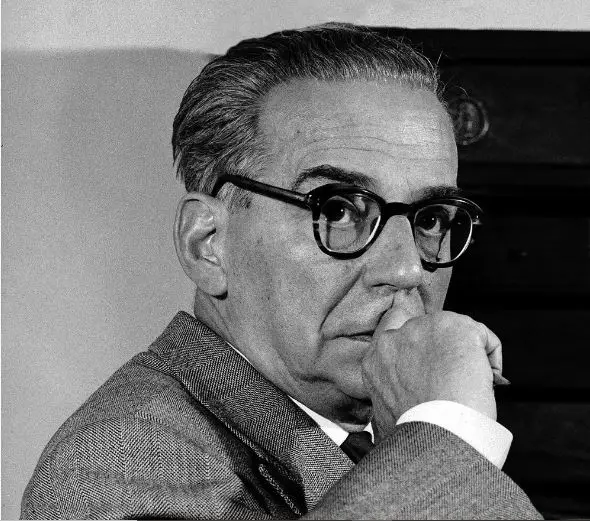
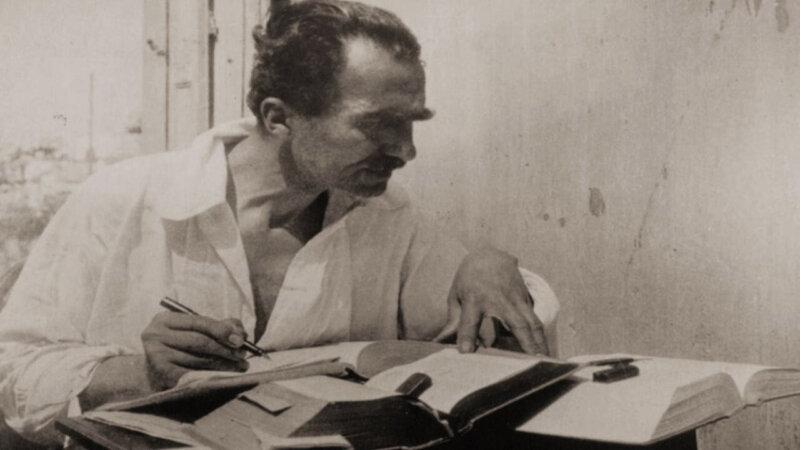
In Orwell’s “1984”, man risks being oppressed and manipulated by the system. The state or ideologies can control people’s thought. It is clear, direct, sparing in the use of literary figures and aesthetic elements. More a political and social critic. Before Kadare gained broad international resonance, many Western readers knew the Balkans mainly through authors such as Ivo Andrić and Nikos Kazantzakis.
The West displayed a strategic interest in the Balkans, arising mainly from political and geopolitical factors. For Andrić, the Balkans was above all a long history of coexistence and human tragedy. “The Bridge on the Drina” becomes a symbol of union, connection, East and West, of a world where Muslims, Orthodox, Catholics and Jews live together for centuries, until nationalisms and wars destroy that balance.
For Kazantzakis, the Balkans is not so much a historical object as a space of spiritual and existential collision. Researchers place Kazantzakis, together with Andrić, in the tradition of a Balkans skeptical of the course of modern history. Kadare brought a perspective that until then was much less known, the Albanian experience of Balkan history, the relationship with the Ottoman Empire, Albanian myths and life under dictatorship.
In this sense, he expanded the literary map of the Balkans in the Western imagination. The Balkans for Kadare is often the drama of history and identity. A space where empires and projects of civilization collide. “The Three-Arched Bridge” does not symbolize union, as in Andrić; on the contrary, it heralds invasion and the change of the country’s historical fate. Andrić seeks to understand how peoples live together, Kazantzakis how man struggles with himself, while Kadare how history and empires shape the fate of nations.
Kadare’s perspective and influence was more cultural and intellectual than political. Kadare changed the way many people in the West understood the Balkans. According to Kadare, Europe has often seen the Balkans as its troubled border, a space where history appears in harsher and more dramatic forms. But he tries to overturn this perspective: the Balkans is not a deviation from European history, but a mirror of it.
What seems extraordinary in the Balkans is often simply European history concentrated in a smaller and more exposed space. This is one of Kadare’s most original ideas: the Balkans is not “outside Europe”; it is a place where Europe’s contradictions become more visible. Before Kadare, for many Europeans, Albania was almost an “unknown space” on the cultural map of Europe.
When the Balkans was mentioned, stereotypes about backwardness, conflicts and exoticism often dominated. Through works such as “The General of the Dead Army” and “Chronicle in Stone”, Albania was not presented as an ethnographic curiosity, but as a country from which universal themes could be treated: war, memory, power, identity and death. After the fame of these novels, Albania became a universal literary subject.
The Balkans was presented as part of European history. Albanian totalitarianism was explained from within. Perhaps Kadare’s most important influence was not the transformation of European thought about the Balkans, but opening space for a more complex reading of its history, culture and contradictions. Readers in the West valued Kadare because he transformed the Albanian experience into literature with universal resonance, where the national particular became a universal value.
Instead of writing simply political chronicles, Kadare showed the cultural and psychological mechanisms of power. For many Western readers, novels such as “The Palace of Dreams” and “The Pyramid” offered a new way of thinking about control, fear and freedom. Many Western readers read Kadare because Albania in his works became a metaphor for broader human problems. It was described as a laboratory of history, which created universal questions. Because an Albanian village could represent an isolated community anywhere in the world.
An Ottoman empire could symbolize any large system of power. A blood feud could rise to the level of the universal question about the cycle of violence and revenge. (“Broken April”, “The Wrong Dinner”, “The Shadow”, “The Accident”). Therefore, Kadare’s originality did not lie in the invention of new themes, but in the ability to use the Albanian historical and cultural experience as a new way of seeing issues that belong to all humanity. This is why his works can be read simultaneously as Albanian, Balkan, European and universal novels.
He had the ability to transform a local historical testimony into literary material with broad human meaning. The boundless power of his imagination lies in the fact that he uses very concrete elements, a tradition such as the Kanun, a historical conflict, an isolated city, a collective memory, an oppressive regime, a family drama, and raises them to the level of fundamental questions: how does man behave before power? How free is the individual before history? How are fear and violence inherited from one generation to the next? How does a society affect the fate of the individual?
Precisely this makes it possible that, for example, a French, German, Italian or American reader does not read a novel like “Broken April” only as the story of an Albanian custom, but as a tragedy about the cycle of revenge (the blood industry) and the power of social rules. It becomes a literary space where dramas and questions that belong to humanity in general are treated.
He does not remove Albania from his works in order to become “universal”; on the contrary, he achieves universality precisely by entering deeply into a concrete Albanian experience. Western readers “tasted” Kadare’s literature as something special. Not as a dish without a special taste, which can be eaten by everyone, and which is not remembered? A dish with very special ingredients may have a certain origin, but precisely that specialness can make it precious to others.
So, the question is not posed: “which writer is greater”, but: what hidden dimension of power does each of them manage to reveal. In Kadare the universal emerges from the concrete: “An Albanian man, in an Albanian city, with a certain history, with a memory of invasions, with inherited customs and fears, faces a system that seeks to control his life”.
Here the universal emerges from the concrete subject. It happens differently in Samuel Beckett’s work “Waiting for Godot”, where the characters are almost stripped of historical identity. We do not know much about the place where they are, we do not have a concrete society, and the characters are more existential figures than representatives of a certain culture. This is Beckett’s strength: he takes man to a very pure, almost universal situation, waiting, uncertainty, the meaning of life, anxiety. A reader from any country can feel this.
But compared to Kadare, the difference is: Beckett removes many local signs to reach man in an almost universal state. Kadare enters deeply into a typical local reality to reach universal man. Another example is Kafka. In “The Trial”, the system that oppresses the individual is deliberately unclear, there is no named state, the law is an almost metaphysical mechanism, and the individual faces an anonymous power. This makes the work universal, because it can be read as any society where man feels powerless.
Orhan Pamuk also places the events of his works in his own country, mainly in Istanbul and Turkey; Pamuk focuses a lot on urban life, Turkish identity, the relationship between East and West, the cultural transformations of modern Turkey. The country and the city become almost characters in their own right. In Pamuk psychological introspection dominates.
The universal is sought through personal and existential anxiety. It happens differently in Kadare, where the universal is “permeated with the ‘smell of history’, empire, dictatorship, tradition, national memory, and concrete customs. Allegory and the historico-political dimension dominate. In Nikolai Gogol, the universal comes mainly through the description of human weaknesses and behaviors that are found everywhere and at all times: greed, vanity, corruption, ambition, loneliness, the absurdity of bureaucracy.
In Kadare the universal breathes through the layers of history, the shadow of empires, the experience of dictatorship, the weight of tradition and national collective memory. His literary universe is built on a dense network of allegories, where the past and the present dialogue continuously, giving the work a deep historical, political and human dimension.
And precisely this makes him interesting for many Western readers: he brought a very special Albanian universe, but within this universe was found questions that belonged to all humanity. When you read great writers, you are not only learning history or characters. You are confronting different answers to fundamental questions: Is man essentially good or inclined toward evil? How much freedom does the individual need?
Is the state a protector of citizens or a threat to their freedom? Should man obey authority or his own conscience? Unlike the sciences that study man from the outside, literature enters his inner experience and displays it in all its complexity. Therefore great literary works do not only tell stories; they become laboratories of human nature and mirrors where man observes himself.
This is the essence. I think that to compare great writers in order to proclaim one the best means to disregard the very nature of art. They walk on different creative paths, but aim at the same horizon: the discovery of human truth and the expression of universal values that transcend times and borders.
But it is true that Kadare also had many detractors and strong polemics around his figure. For some, he was a silent opponent of the regime, who expressed disagreement through allegory and artistic symbolism; for others, his success was seen as evidence of certain closeness to the structures of the system. This dilemma has fed for decades continuous debates about his figure and legacy.
When an author becomes a national symbol, criticism of him is no longer only about literature. He becomes a figure onto which people project their political, historical and ideological conflicts. The greater the prestige, the greater the oppositions become. Jealousy is not an Albanian peculiarity. Kadare did not create a consoling literature, destined to caress the collective conscience or to feed comfortable myths.
A part of Albanians did not always welcome this approach, because Kadare placed before them an unusual mirror. He did not offer them portraits adorned with false glory, but described them as he saw them: with the mud they carried on their shoulders and with the illumination they also radiated. In his work, the Albanian is neither an idealized figure nor a dark caricature, but a complex being, composed of contradictions, weaknesses, resistance and dignity.
Precisely this sincere, often merciless mirror, aroused admiration in some and dissatisfaction in others. And the truth, when it is stripped of illusions, is not always awaited with approval. The debate about Kadare does not rest on his evaluation as a writer, since his literary importance is widely recognized in the international arena.
The most complicated issue relates to his role during the communist period and to the way his work, through symbolism and historical reflection, brought to light deep truths about Albanian society, power, fear and collective identity./ Memorie.al