Part Three
Memorie.al / The CIA has revealed the major role that the Soviet Union played in communist Albania. In several documents that were “Top Secret” but have been declassified for years, it is shown that the USSR built a number of important military bases, especially in the south of the country. There, details are given about the submarines that Moscow had on the island of Sazan and in the Bay of Vlorë, as well as the air bases, such as those at Rinas, Kuçova, etc. Then, an overview of political developments is provided, mentioning the dismissal of the Minister of Defence, Beqir Balluku, in the summer of 1974, from all his functions in the army and the party. Likewise, a special place in the declassified CIA documents is given to those dealing with Albanian political emigrants in Yugoslavia, who were incorporated into the Committee of Prizren, initially chaired by Apostol Tanefi, and subjected to the pressures of the UDB, which recruited them through coercive measures, such as being forced to return to Albania, etc.
Continued from the previous issue
Almost all Albanians who immigrated to Yugoslavia during the communist regime became part of the UDB. The CIA has brought to light a document that shows the entire recruitment process of agents by the UDB. According to the document, Albanians were tortured and forced to cooperate with the UDB. After being trained, they were sent back to Albania with specific missions, but the majority did not carry them out and instead lied about the information they provided. The CIA also mentions Dušan Mugoša, stating that he was the chief officer responsible for recruiting Albanians.
Yugoslavia – Albania
Albanian Refugees 1954 – The Committee of Prizren
Every Albanian who flees to Yugoslavia is forced to join the Committee of Prizren. If he refuses to do so, he is denied the issuance of a Yugoslav identity card, as well as clothing and food rations. If he is over the age of 15 and under 60, he is sent to a concentration camp, where physical punishment is also applied. In the case of women, children, and the elderly, those who refuse to register with the Committee are left alone, but without food or shelter. Therefore, all those who do not wish to die from deprivation are forced to become part of the Albanian Committee of Prizren, whose leadership is entirely under the control of the secret intelligence services, the UDB.
The name of the committee of Albanian refugees is chosen as such so that it can be identified with past patriotic movements, such as the historic assembly of the League of Prizren of 1878 in the Kosovar city. And in fact, the main offices of the league of Albanian refugees are located in Prishtina. The rights of the Albanian members of the committee are limited, and those who spy on one another have more freedom. UDB officers use all means, including bribes, threats, seduction, or torture, to penetrate Albanian information.
Corruption has reached such a point that it can seriously undermine the motivation of emigrants to cross the border and also make Yugoslav efforts less effective than they could be if the morale of the refugees were higher. General Dušan Mugoša is not only the so-called “officer in charge” of the Albanian refugee program, but also the head of organizing refugee programs from all the satellite countries of the USSR.
Colonel Čedo Mijović is also involved in directing Albanian affairs, from his office at the Yugoslav Ministry of the Interior. Both Mugoša and Mijović are of Montenegrin origin and speak Albanian well. Mijović is friendlier in his treatment of refugees. He is reported to help them from time to time and speaks kindly to them. Recently, for example, the Albanian refugee Gjon Gjinaj, who had been interned for six months in Serbia together with Kolë Çuni, was sent by Mijović to a spa center for treatment for a few days.
The Fear of the Albanians
Unlike those refugees who have turned into UDB agents spying against their own compatriots, the majority of Albanians have had no confidence in the aims or the program of the Committee of Prizren. This organization is regarded by most as a façade that Yugoslavia has erected in preparation for the eventual annexation of Albania as its seventh republic. Earlier, Yugoslavia spoke of “liberating Albania from Hoxha’s claws,” but this line appears to have been abandoned for about five months.
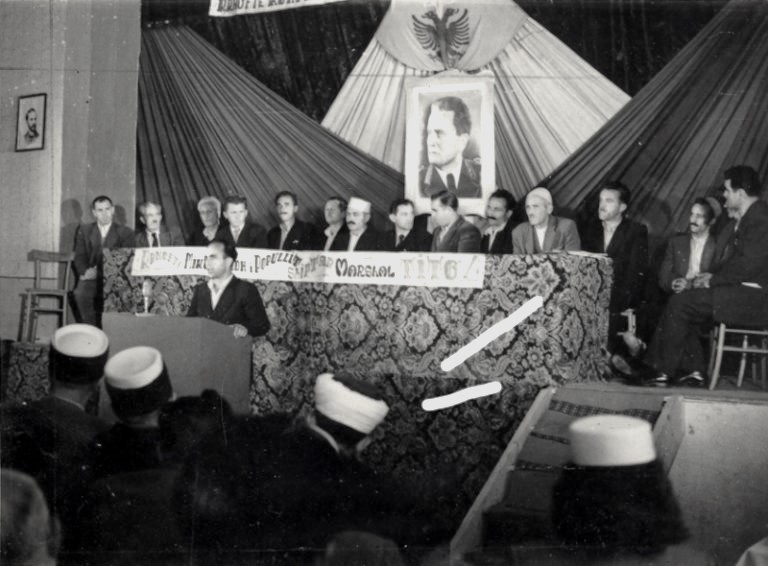
The refugees are said to be in a state of alarm due to Tito’s recent rapprochement with the Soviet Union and its satellite countries. They believe that they will soon be handed over as a gift to the new communist power in Albania, under Yugoslav sponsorship. This fear was much more evident among the approximately 300 Albanian refugees who were delegates to the Committee of Prizren at last year’s Assembly, where in his speech Dušan Mugoša said: “I have received news that you have become objects of oppression following the recent turn in our policy and our rapprochement with the Soviet Union.
But I assure you that both I and President Tito will protect all refugees during this phase of the development of new policies, and each of you will be given the opportunity to emigrate to whichever country you wish, or to remain in Yugoslavia with full citizen rights.” This assembly took place in an atmosphere of heavy mistrust and uncertainty. Even those few pro-Tito Albanians on the committee did not seem to believe in the promises. The list of new committee members was, of course, prepared in advance. Apostol Tenefi and his colleagues appeared to have greatly abused their privileges during their term, persecuting only their personal enemies and favouring their own followers.
At this point, the discontent among Albanian refugees was evident, and it seems that it was this situation that forced the Yugoslavs to change the composition of the Committee. Its new hierarchy appears to consist of honest people, and those in leadership (the UDB officers) are sincere communists. One such person is the new president, Hajrullah Ishmi, an educated and courteous individual, one of whose brothers was hanged by the regime in Albania during the time of the Italian occupation. The General Secretary of the Committee, Ramadan Spahia, as well as the Committee Secretary Arif Starova, is also in the same category as Ishmi.
Movements
Meanwhile, Apostol Tenefi, Can Tahiri, Lutfi Spahiu, and Qazim Lusha have been demoted to members of the advisory committee. The latter consists of 40 members and has no particular importance. Also included here are Ndue Pjetër Gjonmarkaj and Mark Gjecaj (“l’Amico delle Montagne”). The latter has been appointed inspector, which, it is said, is done by the Yugoslavs with the aim of compromising him. Gjecaj himself was dissatisfied with the appointment, but all his attempts to avoid it were in vain. The resolute defence that Pjetër Gjonmarkaj made of the leaders of the Albanian emigration in Western countries brought harsh criticism and insults from Dušan Mugoša, but nonetheless, Gjonmarkaj was accepted into the advisory committee at the request of all the members of the Assembly.
Nik Sokoli retained the post of vice-president of the committee. While Qazim Lusha, Can Tahiri, Mark Ujka, and Kol Hasa are useful tools in the hands of the UDB. The following committee members are reliable anti-communist Albanian nationalists: Caf Ismail Deli, Mark Pashku from Vermosh, Mirash Gjoka from Shkreli, Kolë Pali from Dukagjin, and Dod Frani from Vukli. Lutfi Spahiu is the most suitable person to lead among all the refugees, but he has been sidelined by the Yugoslavs because they have no trust in him at all. At his request, Mark Gjeçaj was transferred from Kosovo to Novi Sad, where he now lives as a Catholic priest.
Albanian refugees are given accommodation according to three main groups: those who come from the south of Albania and Elbasan are assigned to Macedonia; refugees from Dibra, Luma, and Mirdita are assigned to Serbia; while those who come from Dukagjin, Malësia e Madhe, and Shkodra are settled in Montenegro. Albanian students at the University of Belgrade receive assistance and are controlled by the UDB. UDB officers monitor their assessments and educational progress, and those who show great willingness to serve also receive money or travel opportunities to Zagreb or Dalmatia. Albanian refugees in Yugoslavia are not allowed to join or express sympathy for any other political groups except the Committee of Prizren.
Regarding the general political affiliations of refugees in Serbia and Montenegro, only about 5 percent of refugees from Shkodra are supporters of the Balli Kombëtar (National Front). About 30 percent of refugees from Dibra and Luma support the National Bloc. While others, although anti-communist, support other political currents. Supporters of the *Balli* and the Zogists are limited to those people who held positions during the respective periods. Young people are generally indifferent to politics. Refugees generally think that the liberation of Albania from the communists must come only from the West, but there are many who think that a change in Albania cannot come except in the event of another world war.
UDB Missions
Mark Pashku, currently the leader of the refugee group settled in Montenegro, is one of the strongest supporters of the Balli Kombëtar. He says that Albania’s salvation must come only from the West and that for this; the best representatives are the members of the National Front. Albanian refugees who are physically fit and have experience with resistance groups in the country are forced by the UDB to return on clandestine missions to Albania. The objectives of the UDB regarding infiltration missions into Albania are to gather information on the Albanian army and its fortifications, on troop movements, and on the morale of local populations.
With these, the UDB also aims to learn the location of organizations of communist satellite countries, or of anti-Tito Yugoslav ones, which are encouraged by the Albanian government. The UDB occasionally distributes propaganda brochures in Albania and also attempts to identify Albanians who favour anti-Tito opinions. Most of the Albanians involved in such missions return to Yugoslavia and give fabricated information to officials or provide no information at all.
Before setting out, they are told not to kill communist officers in Albania, but in fact, the envoys try to save the lives of ordinary soldiers and try to kill as many communist officers as possible, and in such cases they excuse themselves by saying that they encountered unexpected resistance from the state security organs. It is also common for these infiltrated groups to destroy the propaganda brochures they carry with them from Yugoslavia, perhaps because known UDB informants are mercilessly eliminated by the Albanian authorities.
The missions are not welcomed with sympathy by the Albanian population either, who have stated on many occasions that they cannot risk retaliation from the authorities by helping or hiding the infiltrators. Albanians have discovered that they have no advantage from helping foreign missions, while they have repaid their previous support for Yugoslav operations by speaking ill of Albanian religion and customs. Many Albanians think that there is no great difference between the communist regime in Albania and that in Yugoslavia, while Tito is just as hated as Enver Hoxha in Albania. / Memorie.al