Part Four
Memorie.al / In 1962 Enver Hoxha caused strong clashes with the Soviet Union. He attacked East Germany during this period and this was not accepted by anyone. The data has been made public by the CIA. The document also shows how Nexhmije Hoxha in 1952 propagandized the reading of books with Soviet influence.
Continues from the previous issue
August 1952
The Paramilitary Conference
On 18-19 May 1952, the Albanian paramilitary organization SHNUM (Society for Aid to the Army and Defense) held its second annual conference since its creation in December 1949. It is formed according to the Soviet model of DOSARM, and according to its statute, its purpose is the development of the patriotic spirit among the working classes and all Albanian citizens, as well as their preparation for the defense of Albania. SHNUM is personally directed by Enver Hoxha and has made considerable advances during the last two years.
The opening speech at the conference was held by Colonel Sadik Bekteshi, who analyzed the achievements and status of the organization, mentioning in particular the achievements in radio and telephone use training, vehicle driving, medical assistance, military sports and shooting. Among the negative sides he emphasized the unsatisfactory work of SHNUM in maintaining ties with local units and the low discipline of some units.
Other criticisms were offered by SHNUM delegates in Pogradec, who spoke about the lack of support for their units from the central headquarters, emphasizing that for 9 months the national presidency had not sent any representative to follow the work carried out in Pogradec.
Another speaker, Colonel Taki Koloneci, said that SHNUM, just like their Soviet counterparts of DOSARM, operates on a voluntary basis, therefore he criticized the fact that its leaders receive salaries. Myfit Topore of the Tirana branch said that the organization can avoid large salary payments by operating totally on a voluntary basis.
The Directorate of SHNUM consists of 11 people: Colonel Petrit Dume, General Spiro Moisiu, Captain Pandeli Varezi, and the Secretary of the Trade Unions Xhelo Muftiu, Llazar Lipivani, Mërkur Çelo and Vera Pojani, of the Albanian Red Cross.
November 1952
The Conference of the League of Writers
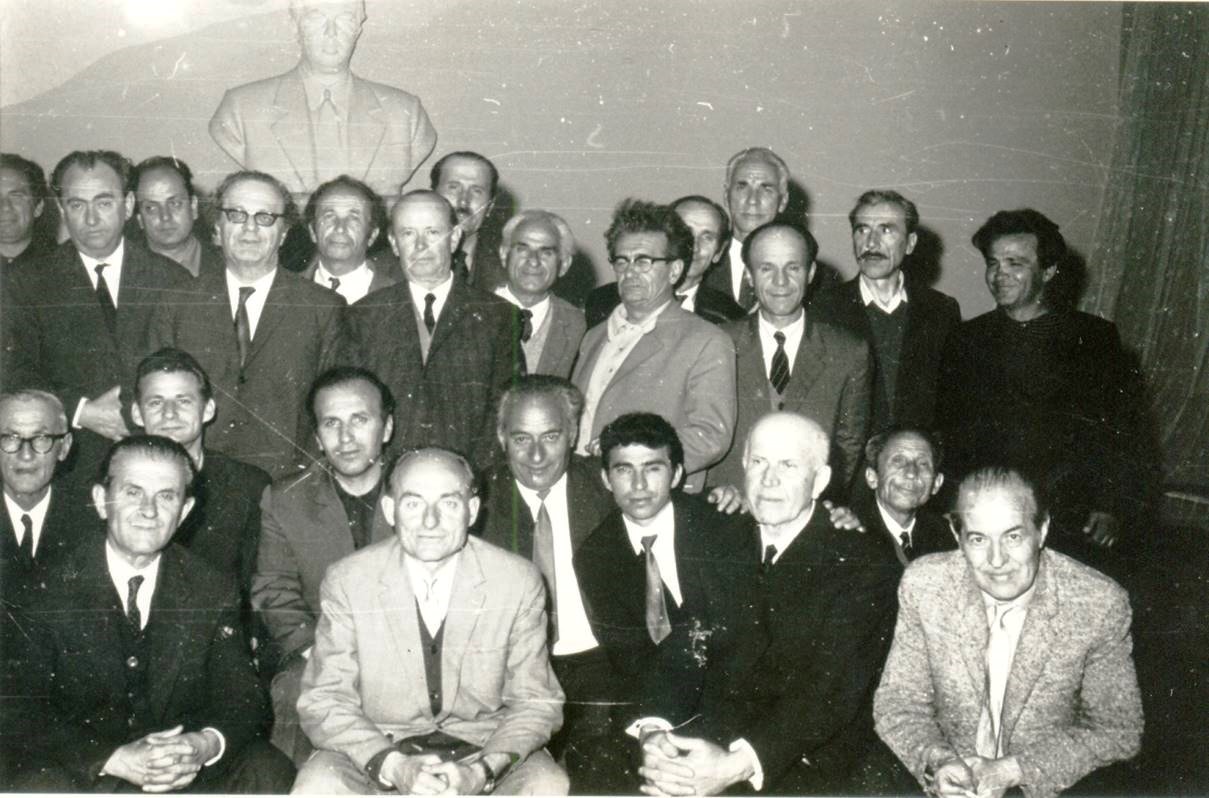
The fourth conference of Albanian authors was held on 14-15 September 1952 at the National Library in Tirana, where among others participated; Manush Myftiu, candidate of the Politburo, Nexhmije Hoxha, member of the Central Committee of the Party, Fadil Paçrami, the author Gjergji Gulia and a delegate of the Albanian-Soviet Friendship Society.
After the opening speech of Dhimitër Shuteriqi, the election of new officials was made. Then Shefqet Musaraj held the report on the activities of the League and evaluated distinguished prose writers, such as Kin Dushi, Zihni Sako, Fatmir Gjata and Dhimitër Shuteriqi, as well as the poets Llazar Siliqi, Dhimitër Shuteriqi, Luan Qafzezi and Andrea Varfi.
In drama, Kol Jakova was cited as the author of the play “Halili and Hajria”. Musaraj analyzed the defects of Albanian writers and advised them to adhere to Soviet models in their efforts for socialism and peace. Nexhmije Hoxha spoke about the need for militant socialist literature, recommended by the Soviet model and led by Enver Hoxha.
The conference evaluated the achievements of Albanian authors and the development of criticism and self-criticism, in their loyalty to the party and friendship with the USSR. Nevertheless the conference emphasized some weaknesses in the organization of writers and called for more frequent meetings.
It encouraged the literature departments to implement the conference’s guidelines and called for writers to reflect the life of the working class, the youth, women and soldiers. The conference also requested that within the framework of the five-year plan the use of Soviet experience be expanded and the giving of accounts be improved. The League should pay special attention to aesthetic literary materials, translations, the purity of the Albanian language and the work for the construction of socialism.
November 1958
Macedonia, Bone of Contention
The Macedonian issue is being raised again as an irritating element in Yugoslavia’s relations with Bulgaria. The Bulgarian communist theoretician Dimitur Ganev said in a recent speech that Yugoslavia is attempting to denationalize the population of Macedonia. The Albanian press has also accused Yugoslavia of persecuting its minority in Macedonia, but taken together both accusations are believed to be part of the anti-Tito campaign of the Soviet Bloc.
Yugoslavia has protested to the ambassadors of Albania and Bulgaria, while in October it announced the creation of the Macedonian Orthodox Church, within the republic. The issue of national identity, territorial rivalry and Bloc interests are part of the complex Macedonian question that has ruined relations in the Balkans for many generations.
The very term Macedonia refers to a poorly defined geographic area in the Balkan peninsula, as well as to the Slavic people of the Yugoslav republic of Macedonia. Its main area is generally accepted but cannot be precisely defined since it is not homogeneous in terms of population, economy and geography.
But its position is of interest both to Yugoslavia and to the Soviet Union, as a possible air or land corridor between Soviet Albania and the wider Bloc in the north. During the time that Yugoslavia was loyal to the Soviet Bloc, the Bloc’s interests were safe, but with its distancing in 1948, Albania has remained detached from the Bloc and exposed to possible antagonistic influences of the West, or other factors.
Although the issue of the patriotism of the Macedonian Slavs is an important aspect of the problem, the region also has Bulgarians, Albanians, Turks and Romanian-speaking Vlachs. Even among groups of the same ethnicity there are linguistic and religious differences. Albanians and Turks are Muslim communities.
Yugoslavia claims that the Slavs of Macedonia speak a language different from Serbian, but its differences with it are very small. While Bulgaria says that the Slavs of Macedonia have the same heritage as them and speak a language very similar to Bulgarian. Greece does not recognize the Macedonian nationality, but only “Macedonian Slavs”, as are the northeastern communities of Greece.
Until before the Balkan wars of 1912-1913, Macedonians did not have a national identity and were seduced or suppressed by the Serbs and Bulgarians, but since the creation of the Macedonian Revolutionary Organization, the country has created national awareness and aspires for political independence.
Although the verbal exchanges between Yugoslavia and Bulgaria seem only like a propaganda clash, they signal that despite a decade of relative calm, Macedonia remains a hot spot. The Macedonian issue is expected to remain at the level of “cold war” between them and a means of influence for the Slavs of Macedonia.
September 1960
The Soviet Bloc Increases Pressure
The Hoxha regime in Albania, which has long been under pressure to abandon its pro-Chinese stance in the China-USSR debate, is now being put under another form of pressure, with the numerous criticisms coming from various countries of the Soviet Bloc. In a recently published speech of the Central Committee of East Germany, the party chief Walter Ulbricht denounced in particular Albania for dogmatic and sectarian views at the Moscow conference.
This public accusation confirms reports that the Albanian delegation led by the Party Secretary, Hoxha, has taken China’s side in the debate with the USSR, despite many months of political and economic pressure from Moscow. Reports are varied regarding the extent of Tirana’s “deviation”.
Some sources say that Tirana has criticized the internal and foreign policy of East Germany, which has irritated not only the Soviets, but also the Chinese, who further advised the Albanians to remain silent. The Albanian delegation left Moscow about a week earlier than the others.
Open criticisms among the countries of Eastern Europe had not been seen in the Bloc since the time of Yugoslavia’s split. While the open criticisms of Albania from East Germany, which were supported also by other, satellite countries, was a warning that Tirana should align itself with Moscow.
The fourth Congress of the Albanian Communist Party, initially scheduled for December, has now been postponed to 13 February. But seeing Ulbricht’s statement, there is a possibility that the East Germans and others will not send high-level delegations to Albania, out of suspicion that the congress might be used as a forum for dogmatic and sectarian views.
Nevertheless preparations for the congress have begun and the regime’s leaders may be modifying policies to soften the debate with Moscow and at the same time not to compromise their traditional radical positions.
June 1961
The Soviet Withdrawal Highlights Albania’s Isolation
Moscow’s efforts to isolate Albania from the Soviet Bloc and other parties friendly to the Soviets took a more direct turn in the last two weeks with the beginning of what could become the total withdrawal of Soviet military personnel from Albania.
This reaction is most likely prompted by Albania’s open hostility and the harassment of Soviet personnel in the country, as well as by the recent spy trial in Tirana, with clear anti-Soviet implications. Despite the implied Soviet threat that Albania will be excluded from Bloc affairs, continued economic and moral aid from China enables it to endure Moscow’s pressure.
The USSR is apparently implementing plans for withdrawal from the Vlora base, as eight of 12 Soviet submarines have left, and there are no signals for replacements in the opposite direction. Three of the submarines that have remained at the Vlora base are reported to have been placed under the Albanian flag.
In addition to what appears to be a withdrawal from Vlora, the USSR may be planning to reduce military, technical and diplomatic personnel throughout Albania. The US Embassy in Moscow reports that the Albanian military attaché there left at the end of May, most likely expelled.
There are reports that the Soviet military attaché in Tirana and his staff also left at the end of May, as has happened with Albanian students in the Soviet Union. Albanian antagonism and harassment toward Soviet personnel have most likely contributed to the acceleration of the rupture. Since the beginning of the year it is reported that the Soviet embassy has been kept under strict surveillance measures by security organs, following anyone who entered or left the building.
Reports say that two minor officials of the Albanian Ministry of Foreign Affairs have been executed for passing secret documents to officials of the Soviet embassy, while from the Vlora base it is reported that in one case, the Albanian authorities stopped the passage of a train with supplies for the military personnel there.
The withdrawal of Russian technicians who have assisted in the country’s economic development according to economic cooperation agreements seems to fit the theory of the Soviet Union’s replacement by China as Albania’s main economic sponsor.
According to the broad economic cooperation agreement between Albania and China signed in April, China is expected to send an unspecified number of technicians to Tirana. So far it is still unclear to what extent that cooperation will be implemented, but reports of the last six months indicate the arrival of a considerable number of Chinese personnel.
The reports become even more credible due to Albania’s refusals of cooperation offered by the Italian communists, as well as with some Soviet satellite countries such as Poland and Czechoslovakia. There are also signals that in the last six months Czechoslovakia have canceled the promised credit for the development of the mining industry, perhaps due to a request from Tirana for the creation of factories for mineral processing in Albania.
The Chinese are reported to have promised in the recent agreement the construction of a mineral processing plant. Nevertheless the satellite countries are not exerting the same pressure on Albania. The propaganda trials of 15-27 May were generally ignored by the Soviet and satellite media. But the newspaper of the Bulgarian Trade Union on 28 May praised the sentences given to the Albanian “traitors”.
In the first days of the trial, East Germany had reflected in the media a small news item from the trial. The Chinese communists broke their silence on 2 June with a long editorial in the state daily, where they evaluated Tirana’s measures and the sentences. While some Chinese newspapers had carried parts of the court’s decisions.
March 1975
Albania Warns the Soviets Against Interventions
Tirana has recently published an article in which it is suggested almost openly that the Soviet Union has instigated the action of some individuals within the Communist Party, perhaps referring to the dismissed Minister of Defense Beqir Balluku. The article of the party daily “Zëri i Popullit” is written by Fiqirete Shehu, member of the Central Committee and wife of the Minister of Defense Mehmet Shehu.
Mrs. Shehu bursts out against those she calls foreign enemies and their attempts to divide the party from within. She writes that since it is not easy to act openly, “the enemies are using our people, party members, who oppose us, but holding the party’s flag in their hand they in fact try to distort its teachings. As experience has shown, they seek to recruit them for their own purposes.”
Further the article cites as examples of sworn enemies Liri Belishova, who has been purged because of her pro-Soviet sympathies, after Albania’s rupture with Moscow in 1961. Anti-Soviet denunciations are a common tool for Albania’s propaganda, but the recent article aims to increase vigilance in the campaign started since last summer with Balluku’s purge. The reasons for his dismissal have not been made public but it is believed that he criticized the Chinese for delays in aid and spoke in defense of rapprochement with the Soviets.
The news of Soviet machinations alarms Tirana more than anything else and the article may also be a reaction to recent revelations about Soviet intervention in the Yugoslav government. Now that the sixth case of Soviet intervention in Yugoslavia has come to light, Shehu’s article may signal other purges in the ranks of the state apparatus, as Hoxha’s xenophobic regime fights with all its forces against real or imaginary enemies. / Memorie.al
Continues in the next issue