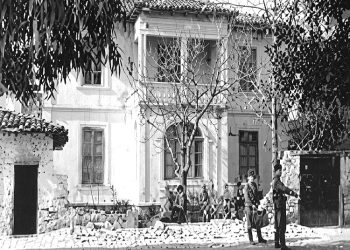


Memorie.al / At the mouth of the National Park of Dibra, the village of Nistrovë is hidden among centuries-old trees, where one hears the gurgling of the Bukovari Stream, a branch of the Radika River. On the banks of this stream, in Upper Reka, the village in question is known to have been registered 400 years ago in the Ottoman Empire’s cadastral registers, inhabited by Christian Albanians who, even under Ottoman occupation, did not change their religion due to their location and their highlander character. The village, viewed from the west, sees the Radika River, which has recently become known for a controversy regarding the diversion of the river of the same name. Behind it rises Mount Kabash, to the west the majestic Mount Korab, to the south Guri i Zi (Black Stone), and to the east Mount Verdun. Life in that area is sustained by the famous Radika River, along which residents descend to the city of Dibra. There is no Albanian, even with only an eight-year education, let alone those with a higher cultural level, who has not heard and read the name of Josif Bageri, ranked alongside other distinguished figures of the National Renaissance.
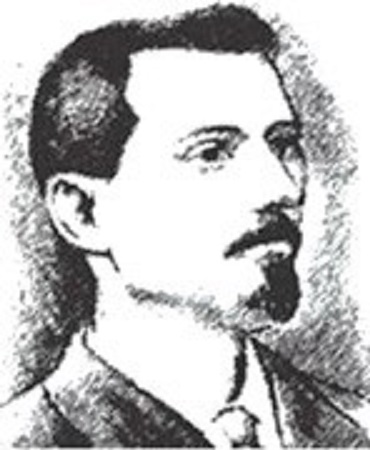
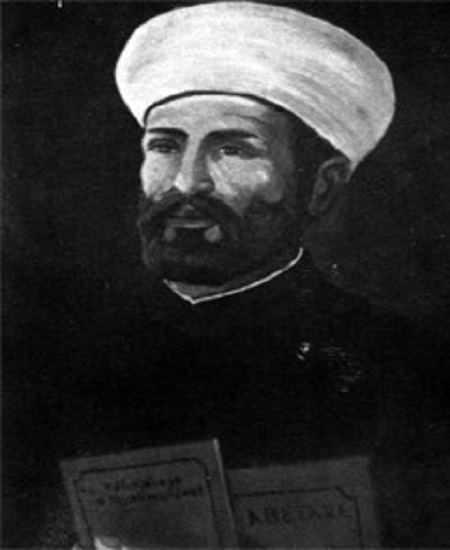
The sympathetic figure of the fighter Josif Bageri, this fighter with a rebellious spirit, has been immortalized in the official history of Albania, in the memory of the people of the Dibra and Reka regions, in a monograph by the researcher Ruzhdi Mata, but also in commemorative symbols, such as the bust that stands today in the garden in the center of the city of Dibra in Macedonia, alongside other heroes united for the Albanian cause, the statue of Skanderbeg, and that of Said Najdeni in Great Dibra. His bust has been placed in a position looking toward the land of his ancestors and descendants.
Although a time laden with the worries and problems created by misguided Albanian politics, with daily clashes and wanderings, with injustices in court cases over property and work, with a struggle for livelihood and survival, one still finds sensitive souls to place a flower, to light a candle, to say a few words at the graves and symbols of our ancestors, who gave their lives for this country, for this future, which, though criticizable, is beautiful. Without the past, there is no future. Short-sighted is he who thinks the opposite. It is like having climbed a tree and ignoring the steps you used to climb up. What happens if they are removed from under you?…
Thinking this way, Elida Jorgoni, chairwoman of the association “Albanian National Nest”, alongside many other activities, also organized an “expedition” to rediscover once again the traces of the patriot and Renaissance figure Josif Bageri, in the lands where he was born and operated, in Great Dibra, and also to commemorate him and his patriotic work. For this, she chose spring, a beautiful and productive season, which offers the opportunity to achieve the objectives and goals of a “project,” if we may call it that.
With the trust and support of the Dibra patriots from across the border, the activist Jorgoni, a true patriot of our days, had studied and planned everything down to the details. The expedition consisted of intellectuals from university backgrounds. The departure was from Tirana to Elbasan, with a morning coffee stop at “Peshkatari” (The Fisherman), on the banks of the Shkumbin River in Librazhd. There the group learned about the itinerary of movements in the neighboring state.
After passing Qafë-Thana (Thana Pass), under the sun of a beautiful May dawn, the somewhat adventurous journey continued towards Great Dibra, as we are accustomed to call it. The road from Struga to Great Dibra is a beautiful panoramic road, from which one sees the great mirror of the river that emerges from Lake Ohrid and feeds two hydroelectric plants harmoniously integrated with nature, without causing strain on the powerful flow of its waters. After an hour of travel, throughout the journey one sees “friendly constructions” harmonized with nature – villas of the Dibra people from across the border, who have part of their large families in great countries like the USA, Canada, England, and elsewhere, but who, with their culture and savings, provide a tone of assistance to the autochthonous part living in that Albanian space of Macedonia.
The group’s movement system in this area is marketed with informational knowledge about settlements and their activities along the road north to the capital of Dibra. Certainly, with administrative reorganizations and coexistence with the Slavic population, the administrative level has now been reduced and the Municipality of Dibra, as it is called, no longer has the previous level of economic and social strength; nevertheless, everywhere one notices the hand of a people who love their early settlement, order in socio-cultural and industrial constructions.
After nearly an hour of travel, the group enters the municipal center. The reception by the municipal staff and its mayor was brotherly and informative from both sides. Informed a few days earlier about this activity, the mayor, in his office, following tradition, gave an informative presentation about the city, learned more about the group’s plans, wishes, and movements, as well as the possibilities for their realization.
What caught our eye was the scrupulous organization by the local authorities for the entire visit to proceed harmoniously. For this purpose, part of the municipal staff was organized to stay close to us and make us feel at home. This was noticed with the assignment of employees to organize this historical study visit in the center and the second day in the cradle of Upper Reka, in the settlement of our character that the scientific group had undertaken this journey to study. After we rested and took a refreshing break, in the afternoon we headed to the historical part of the city, where the memorials of Albanian heroes – Skanderbeg, Said Najdeni, and Bageri the “rebel” – stand.
The ubiquitous Mrs. Elida Jorgoni, connoisseur of the figures of our national renaissance of the past two centuries, and some of the group, accompanied also by interested residents of Dibra, paid their respects with the national flag and bunches of flowers at the busts and monuments. In fact, the city was in a festive mood, as our arrival coincided with May Day, a Saturday, and the following day was Sunday.
After dinner, after a refreshing and characteristic meal, the group withdrew to their hotel rooms to prepare for the next day’s tourist-historical journey to the Mavrovo National Park.
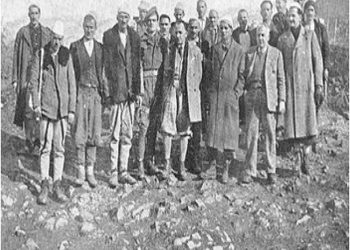
The next day, the group, accompanied by hosts from the Municipality of Dibra, set off for Nistrovë, to the graves of Josif Bageri’s ancestors. Part of that uphill, tiring road was covered on foot by the small group of 13 intellectuals organized by the indefatigable Elida, to place flowers on the graves of Josif’s family members.
The mountain journey was impressive with the freshness of the gurgling Radika water, where we more than once recalled those gatherings organized in Tirana for its protection from the inappropriate use of its waters for energy purposes. Our arrival near the village and the church had its own symbolism. Since we could not go to the church, Elida made the surprise, which she had apparently thought of beforehand: right there in the cemetery, she organized a memorial service according to the customs of Albanians of both Christian and Muslim faiths, with halva and wheat.
After that, our national symbols – the flags – were placed; photographs were taken of the participants, remembering not only our Renaissance heroes but the entire region of Great Dibra. Performing the appropriate rites, as required by the patriotic and religious memory of our lands, and with a relief in our souls, the group returned to Albania, hoping that some scientific expedition will seek to find in Kosovo the remains of this “rebel” Renaissance figure, an example of hope for the new era with new heroes so necessary for a democratic Albania with Illyrian and Pelasgian roots.
The return was again a pleasure, as we had almost completely fulfilled our duty. After leaving behind the rare beauties of the National Park, spread across its western part together with scientific friends from Gostivar in neighboring Macedonia, we set off towards Albania, loaded with impressions and emotions, but also with the hope that a more fruitful expedition will be undertaken by the group to discover Josif Bageri’s grave in Kosovo.
It is a necessity to evoke all the centuries-old values of an ancient people; otherwise, the development and national existence of a nation cannot be achieved. It is a primary duty of every government, as is the work of socialized individuals who create material goods for today and tomorrow; otherwise, a nation does not deserve to exist. The scientific expedition organized by the association “Albanian National Nest” was an impressive activity, a lesson to recognize and highlight patriotic values, for which we seem to feel an ever-increasing need. To achieve the objective, one must not leave unmentioned and uncongratulated here the hospitality of the Dibra people and the help of Dibra emigrants in the USA.
Josif Bageri, the “rebel” Renaissance figures
Many patriots have tried, with indirect data, to determine the year of birth, the year of death, and the place where the distinguished Patriot Josif Bageri died. According to some, he was born in 1868, while regarding his death, his widow, Vasilika, gave the date of April 15, 1916, which she transmitted to her youngest son, Aleksander Josif Jovan Bageri. Josif began his life in the village, tending livestock, and occasionally descended to Dibra, where his grandfather worked as a farrier. In these movements up and down, the clever young lad grew up thinking about the future.
Thus, one day he went down to seek work in Dibra. He started as a cobbler’s apprentice, and then went to Tetovo and Gostivar in the cobbling profession, which accompanied him throughout his life. During this time, in his struggle for a normal life, at the age of 16-17, he met his future life partner, Vasilika from Prilep, who became his strong support in good and bad times, bearing him 9 children in succession, many of whom did not live out their lives under those difficult economic conditions. But this did not bend the couple; they faced the hardships.
They took the road of emigration, with their first stop in Bulgaria, precisely in Sofia, which was gathering momentum, as it had declared autonomy at that time. In Sofia, there was also a large mass of Albanians from the southern regions of Albania: Korça, Kolonja, Përmet, Gjirokastra, Elbasan, but among them were also many from Dibra and Kruja. Fate brought him to settle with these Albanians at the café “Albania” and the grocery store of the patriot from Boboshtica, Dhimitër Nikolla Mole.
There, every night, artisans, construction workers, etc., gathered and exchanged the troubles of their lives. In 1895, Koste Jani Trebicka and Kristo Papastefan Luarasi came to Sofia, who, together with Dhimitër Mole, began teaching Albanian to the young men and giving them books. Soon, the Albanians organized themselves into an educational and cultural society with the symbolic name “Dëshira” (The Desire), where the young Josif began to stand out not only as an activist but also as a writer with his poems.
At this time, he began to approach Bulgarian socialists, defending and representing the artisan class – cobblers, stone carvers, masons – who, because they guarded their craft and tools for survival, had created an organization called Mason, which had adopted its own statute and was characterized by an aura of secrecy and professional confidentiality. His involvement with the Masons led to a distancing of Josif from the “Dëshira” society; he attempted to create a new society, “Bashkimi” (The Union).
At the end of 1899, Josif went on a visit to Istanbul to meet our great poet, Naim Frashëri, and the conversation with him gave impetus to his further activity, but the death of his new friend in 1900 saddened him greatly. He himself described the meeting with the great Naim Frashëri in Istanbul: “In the autumn of 1898, on the 12th, we had the good fortune to encounter the ever-unforgettable enlightened spirit, Naim Bej Frashëri, who at that time was very ill, but he received us as his own children, and we got along very well, talking only about the national issue, i.e., our meeting was exclusively about the national issue. The meeting with this luminary was long, despite his poor health condition.”
After Naim Frashëri’s death, he left the society and traveled to Serbia and Kosovo. While traveling to Peja, he expressed the idea of uniting the two Albanian regions, as well as opening Albanian schools as the highest expression of Albanianism against Turkey. During his visit to Kosovo, he distributed the newspaper “Drita” (The Light) by Shahin Kolonja and Kristo Luarasi. There he met Bajram Curri.
A spur to the militant unity was his meeting in Sofia with Çerçiz and Bajo Topulli, Mihal Grameno, who, after carrying out some action against the Turks, always found the door of Kristo Luarasi’s house open, with the hospitality of his wife Polikseni.
In 1907, he connected with Hil Mosi and sought to organize a society called “Afron dita” (The day is approaching). The stance towards the Young Turks – with new faces but old ideology – in 1908 made him return to his Reka, where he began to organize education.
During the two years 1909–1911, he published the newspaper “Shqypeja e Shqypnisë” (The Eagle of Albania), which was a political organ, maintained by the generous help of Albanians and distributed free of charge among the impoverished Albanians. Despite being fought against and called pro-Bulgarian, it was one of the most progressive newspapers of the time. This newspaper, together with the anthology “Kopshti Malësor” (The Highland Garden), constitutes the complete work of his creativity. His figure, sharp and lean in physique, is remembered by the members of the “Dëshira” society.
He was characterized by them as a fiery patriot involved in politics, which traveled frequently between Istanbul and Bucharest, distributing books, and even secretly entering Albania for patriotic work. He lived with his family – his wife and two children, a son and a daughter – in a peripheral neighborhood of Sofia, called Banishora, on Bratja Milladinovi Street (Milladinov Brothers Street), full of gardens and rare houses. Many Albanians ordered their shoes from him. Even Bulgarian personalities of the time, such as the proletarian poet Dimitar Polyanov, valued him as a great Albanian, a very intelligent man.
In 1912, after the Declaration of Independence, he came to Albania precisely at the time of Ismail Qemali and Prince Wied. He leveled strong criticism at Esat Pasha and his intrigues. In 1916, he undertook a heroic journey, against his family’s pleas, traveling on foot, as he had no financial means. This was his final journey. He closed his eyes, exhausted and alone, in April 1916 in the hospital of Pristina, while a well-wisher closed his eyes and gathered the books he had with him. He was buried in the Orthodox Church of Pristina, where it is said his grave is also located (?!…)/ Memorie.al