From Agim Xh. Dëshnica
Part Three
– At Gjergj Fishta and the miserable professors of socialist realism –
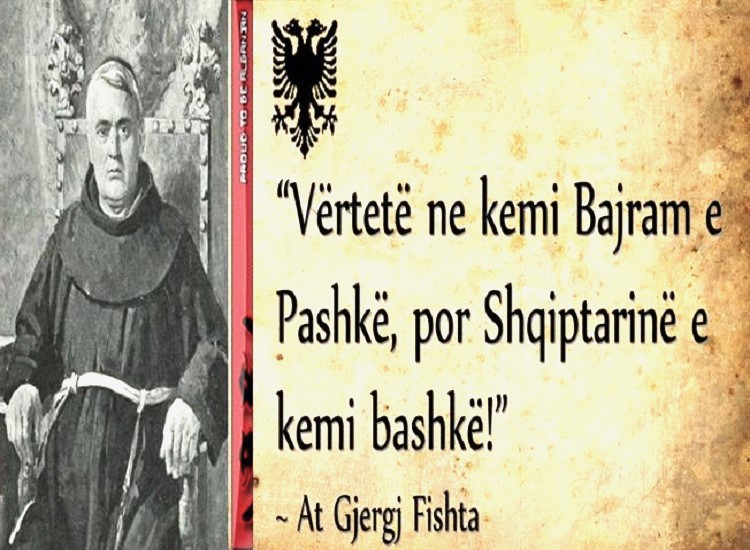
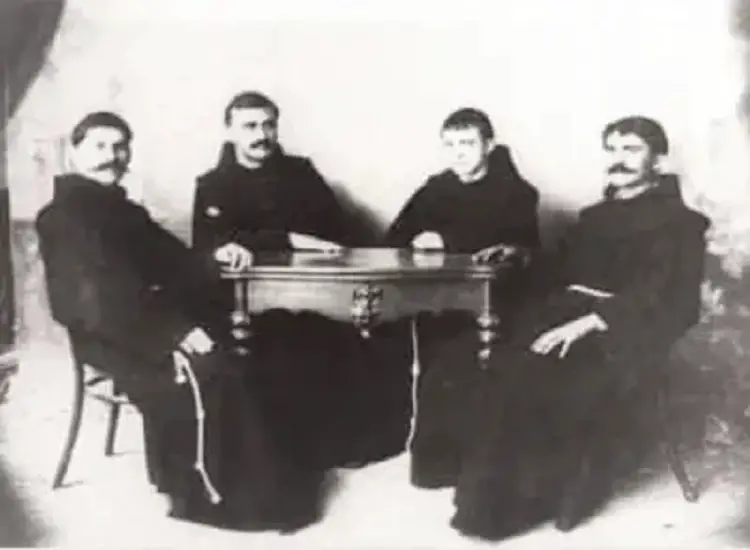
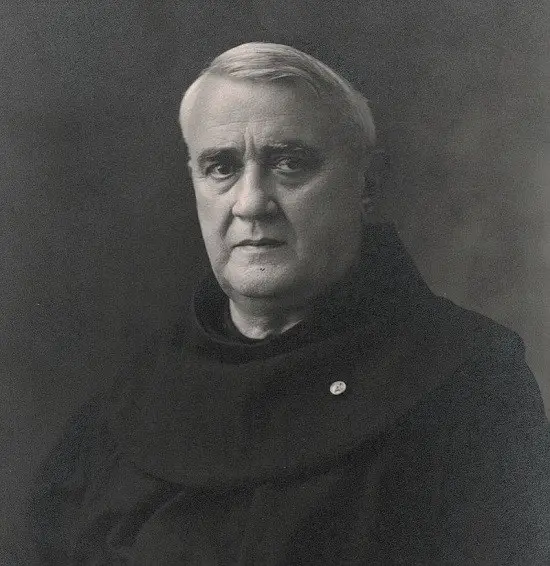
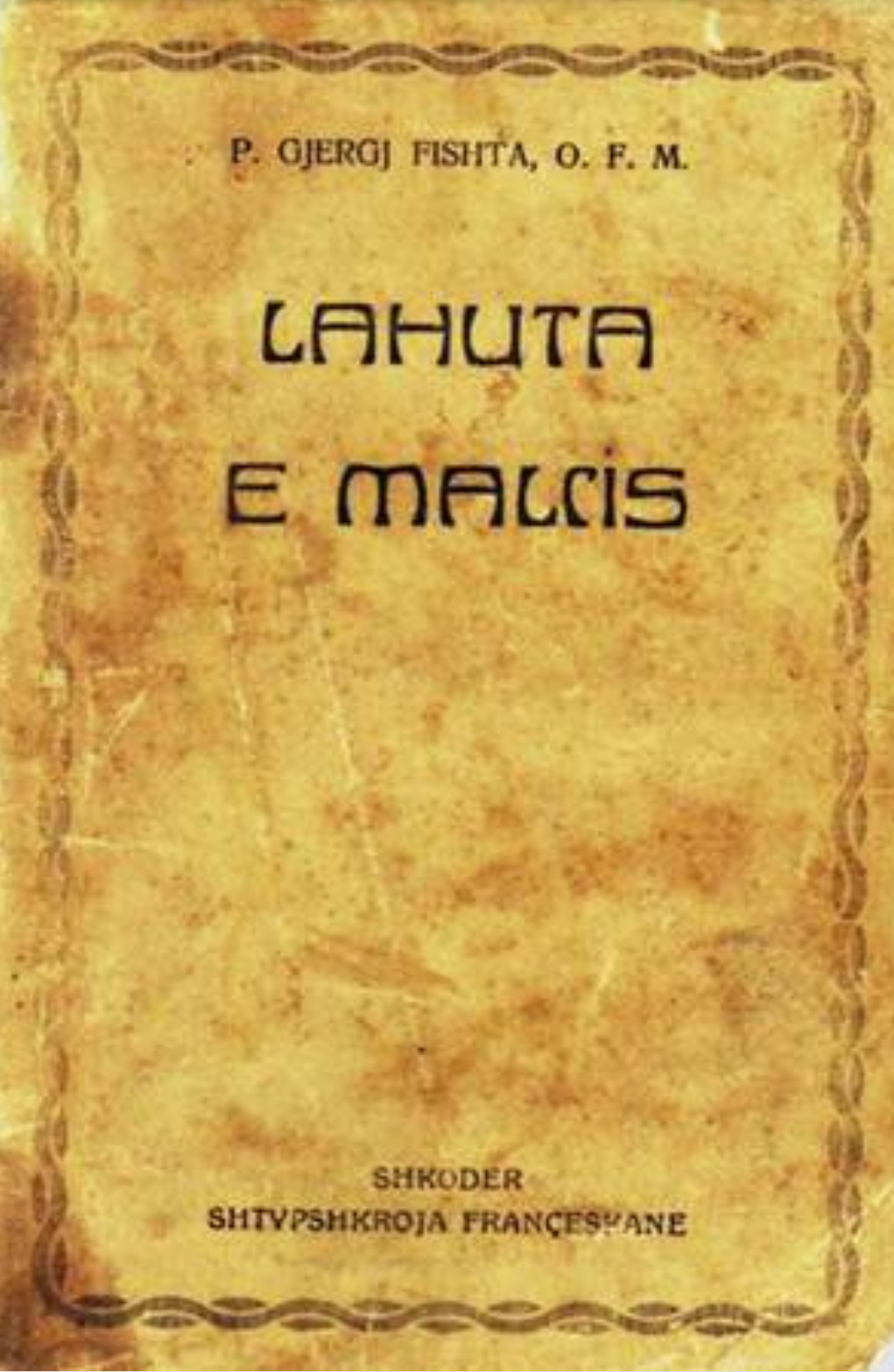
Memorie.al / In the book “History of Albanian Literature – 1983”, an attempt was made to disparage the work of the national poet At Gjergj Fishta with words such as these: “The main representative of the clergy, Gjergj Fishta (1871–1940), poet, publicist, pedagogue, politician, directed for a long time the press of the Franciscan order and the cultural and educational activities of this order. For him, the interests of the church and religion stood above the interests of the homeland and the people, something he declared and defended with all his demagoguery, but also with cynicism, and placed at the foundation of his literary work. His main work, the epic poem ‘The Highland Lute’, propagated anti-Slavism and relegated the struggle against Ottoman rule to a secondary plane.”
Continued from the previous issue
About Gjergj Fishta has also been written in the German-speaking world. After 1990, At Gjergj Fishta was decorated with the “Nderi i Kombit” (Honour of the Nation) Order. His commemoration on the occasion of the 100th anniversary of Albania’s Independence was one of the highest tributes that could be paid to a National Poet like At Gjergj Fishta. But what does Fishta say with his own poems?
FROM THE HUM OF VOICES
THE ALBANIAN LANGUAGE
Like the song of the summer bird,
That dances in April’s green;
Like the sweet breeze of the wind,
That nurtures the bosoms of the rose:
Like the wave upon the shore,
Like the roar of a terrifying storm,
Like the thunder of an earthquake,
Just so is our Albanian tongue.
Ah, yes, sweet is its word,
Like sleep upon a lap,
Like light full of brightness,
Like immeasurable joy;
It is heard resounding,
Like the wing of a Cherub,
As it flies through the heavens
In the fiery dances of love.
Therefore, cursed be that Albanian son,
Who this language of God,
The inheritance left us by the Forefather,
That inheritance does not pass on to his children;
And may his mouth dry up, yes,
Who scorns this divine tongue?
Who, in a foreign tongue, when there’s no need?
Speaks and neglects his own.
In the Albanian tongue our mothers
From the cradle have told us,
That there is one God, whom we must love:
He who gave us life;
And in Albanian they told us that God
Granted Albanians their Albania,
That as long as the seasons and time turn,
They shall enjoy it, son after son.
Through the Albanian tongue the whole world
Shall know what stock you come from,
Shall know you as Albanians:
Brave in voice as you are.
Therefore, if you love your kin,
Mountain, shore, and Highland
Let them today shout out from one mouth:
In their own tongue: “Long lives Albania!”
ALBANIA
Even the moon shall know it,
Even the sun shall have seen,
That around this globe,
There is no land like Albania!
Wide fields and green hills,
Far from despicable vice, where fear is not,
Here Spring clothes itself with joy,
Like the colourful bed of Paradise.
Under a sky forever clear,
In rays and light imbued with holiness,
Hill and Green Mountain
Stand like sentinels in the air.
On those hills and those mountains,
Golden springs and limpid fountains,
Rushing through the valleys still,
Gurgle down slopes and streams.
Upon those heroic mountains and hills,
Those lads, like Fairies, then graze,
Their weapons, forever loyal,
Are remembered among all the tribes.
There graze, both Tosk and Gheg,
Like two rays in the flame of one sun:
Like two fires that go burning,
When lightning strikes from high heaven.
Those majestic mountains,
Those, yes, have been able to see
How much irresistible strength
Has fallen into the Albanian’s very marrow.
The earth trembles and the sea roars,
The mountains ignite with flame and sparks,
When he, fearsome as an earthquake,
Rushes where Liberty calls him.
Rivers and streams grow small before him,
Seas and mountains make way for him;
Kingdoms cannot break their word to him,
Hell cannot stop his onslaught.
Shake off the dust, therefore, Albania,
Raise your brow like a queen,
Because with lads you warm in your lap,
You cannot be called a slave, no.
Yes, even the moon shall know it,
Even the sun shall have seen,
That around this globe,
There is no land like Albania!
Live and thrive, then, my Albania,
Live and thrive forever like summer,
With knowledge and with Liberty.
THE EXILED ONE
“Farewell! – my homelands,
That now disappears slowly – little by little;
The sea roars, the wind howls,
The boat rocks, wave upon wave;
Towards that sun that is flaming,
There I go now to my own…
Farewell! o blessed land!
Farewell! as long as life lasts!
Tomorrow, when upon us
The sun’s ray shall fall,
Who knows how much water and earth?
Shall part me from you?!
But when I asked the cruel clouds,
But when I asked the sea’s mistresses,
Whether for you, my Arbëresh* land,
No one shall speak to me, wretched one…
Other fields and other sands
Shall I see, and other seas:
I shall hear, yes, other dances,
Other tongues in other cities;
My homeland, though, I shall not see,
Where I was born and became a man;
My eyes, too, shall weep,
Without finding anyone to comfort them.
Without my own, but with one God,
Wandering through foreign lands,
The days and seasons shall pass me by,
Mocked and scorned by everyone.
I shall have wretchedness for a hearth,
And burning sand for a bed.
I shall have the owl for a sister,
I shall have, alas! The tigress for a mother.
My mother, left without her living son,
Shall weep for me, who knows, one day,
While my sister, dead to longing,
In vain, one day, shall wait for me.
She, poor thing, shall know the grooms,
To bring a bride to mother’s house:
But my brother, who knows, by those times,
Shall be rotting underground!
And, that land – alas! Fate from the heavens! –
Shall not be, no, the land of my Forefathers,
Where the sky clears more beautifully,
Where in the Albanians’ sweetest tongue,
Prayer rises before God,
Where the sworn faith is sanctified,
Where hearts know not what fear is,
Where the highlands are majestic.
Oh! you highlands of Albania,
Where the sun and moon shine brighter,
Where the hero’s camp lies,
And where lads grow like fairies!
I shall never forget you,
Wherever Fate may roam me:
As long as I can speak,
I shall always remember you!
And those pines and cypresses,
I shall always keep in my mind,
And those shepherds’ huts and those valleys,
And those sheep and those bells…
But, oh, alas! My mountains,
That now disappear slowly – little by little;
The sea roars, the wind howls,
The boat rocks, wave upon wave.
Farewell, then, highlands and mountains!
And you, cliffs and you, streams!
And you, ridges and you, pine needles!
And you, brooks and you, springs!
Farewell, you valleys and sheepfolds!
Farewell, bells and sheep!
Farewell, you wide fields,
You meadows, and you, threshing floors!
Farewell! you house of my Forefathers,
Where first my eyes saw the light,
And where you gave shelter to travellers,
My father’s friends and where I welcomed them!
Farewell! my poor hearth,
Farewell! you wretched weapons,
Farewell! you mother and sister,
Farewell, as long as life lasts!”…
Fishta’s final messages
According to some Albanian publicists, among them Fritz Radovani, it is known that renowned writers of the literary world, before departing life, have expressed touching last words, hymns, testaments, advice, messages… Our national poet Gjergj Fishta passed away at the end of December 1940. Shortly before he fell silent in the Shkodra hospital, from a severe pneumonia in a time of frost and snow, he left advice and messages to the young Franciscan friars. In his testament, these words are read: “I die satisfied, because I have worked for homeland and faith.”
Meanwhile, according to At Viktor Volaj, a close collaborator of the poet Gjergj Fishta, he had mentioned the need for a revision of “The Highland Lute” and repeated the word “crucified one” (i kryqëzuemi) in Latin. Then he asked them to paint on the wall facing his bed scenes from “The Last Judgement”. While a friend of the poet mentions Fishta’s last words: “Not for any other reason, but because I am leaving the enemy on Albanian soil, I regret that I must die!”
According to the memoirs of At Zef Pllumi, when Fishta was asked by his confreres to refuse the title of Academician – Fishta, according to a certain rule, had to hold a series of conferences in various cultural institutions – he replied: “During the conferences, I shall repeat to the Italians, without mincing words, that Rome indeed once had a great reputation, but the Illyrian legions and the great Illyrian emperors were the ones who held the fate of Rome in their hands. I also make another promise: that as soon as I complete those conferences in six months, as the regulations require, I shall immediately ask to return to Albania.”
Reading the article by Prof. Nasho Jorgaqi against Fishta and the Franciscans, there appears before our eyes the life and work for the homeland of the creator of “The Highland Lute”, with which he addressed the entire Albanian nation for unity against foreign occupation. From Fishta’s luminous work, full of varied sounds, the Albanian language is heard “like the song of the summer bird.” / Memorie.al
Arbëresh = old term for Albanian, often used for the land or people with patriotic/poetic nuance.