
Part Four
Continued from the previous issue
Memorie.al / “The black night of 5 November 1975 is the night when the three highest military men of the Albanian Army were executed,” said one of our colleagues at the time, in a half-voice. And indeed, “this black night” lasted a full 11 months. It began on 25 November 1974 and ended on 5 November 1974. On 24 November 1974, at 10:00, Mehmet Shehu entered Enver Hoxha’s office. He was pale and talking to himself. For two hours straight, he stayed in the Commander’s office. They discussed for a very long time and when he came out, his legs trembled and he seemed to walk like a drunk…! Since 4 July 1974, the Politburo had been deeply shaken to its foundations. After the Durrës meeting, where the “Black Theses” were first revealed, the Sixth Congress of the Party of Labour of Albania had condemned them very harshly, as well as the authors of those theses. They were Beqir Balluku, Petrit Dume, Hito Çako and Rrahman Parllaku.
The knock on the Balluku family’s door
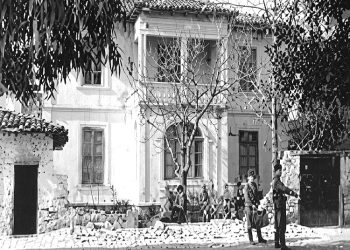
But another drama was being played out only 100 metres further from Petrit Dume’s villa. At the same hour, at the three-storey villa of Beqir Balluku (located opposite the “VIP” Bar-Café in the Bllok), a “ZIS”-type transport truck with Berat licence plates was parked. The “ZIS”-type truck loaded the Balluku family’s belongings in record time. At 04:30 in the morning, the three civilians had knocked on the door and handed the letter to one of Beqir Balluku’s three sons. The family had foreseen it. Beqir Balluku’s villa was the only three-storey villa in the Bllok and was a villa that had aroused the envy of both Enver Hoxha and Mehmet Shehu.
At first, three members of the Politburo lived in this villa, but on Beqir Balluku’s order and thanks to his friendship with Enver Hoxha, two left, leaving the villa free for Beqir Balluku. The civilians loaded the family members into the truck in record time and immediately they set off for Berat. Their fate was very bitter. They became third-class cooperative farmers. They were able to escape internment only in 1990, while reports continuously reached Enver Hoxha’s desk, reporting how the families were interned and not allowed to participate in the trial. A very painful story.
How were the bodies of the three executed men transported in a refrigerated truck from Linzë, Tirana, to Vranisht, Vlorë?
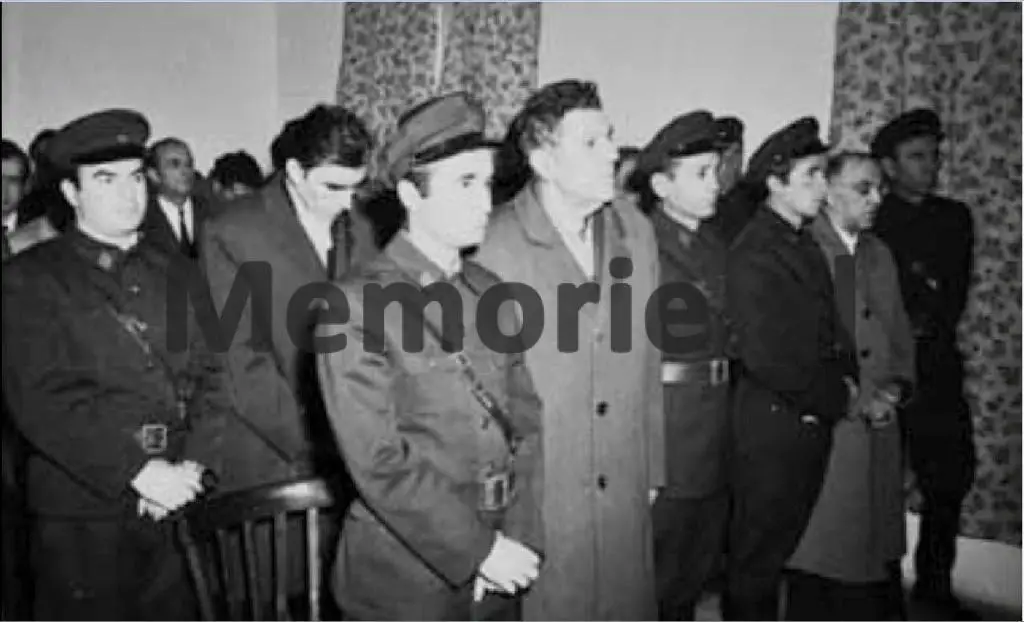
For nearly 11 months, the three generals were interrogated in Prison 313 of Tirana. Their trial lasted only 30 days. On 5 November 1974, the Supreme Court set the date for their execution. The Supreme Court had decided that on 5 November 1975, the decision taken by this court would be carried out. However, because the three condemned men did not accept the accusation and addressed a letter to the Presidium of the People’s Assembly and the First Secretary of the Central Committee of the PPSH, asking for their lives to be spared, the execution decision was postponed to 5 December 1975. The three condemned men waited 30 days for the reply from Enver Hoxha and Haxhi Lleshi, to have the capital punishment given to them reviewed.
At the trial, the generals had declared: “We are not revisionists, we are not enemies of the people and the party, and we have not drafted any kind of military putsch or any kind of black theses concerning the activity of the Albanian army.” Hito Çako, who was the political commissar of the army, declared: “I am not a revisionist, but a determined communist, until the end of my life. Revisionists, you see, you might have them close to you (Enver Hoxha) and you must identify them.” The former Minister of Defence, Beqir Balluku, had sent over 30 letters to Enver Hoxha from prison, in which he constantly emphasised that he was an honest patriot who had received seven wounds in the war and that he was a convinced and determined communist. He had never betrayed the ideals of the Party of Labour of Albania.
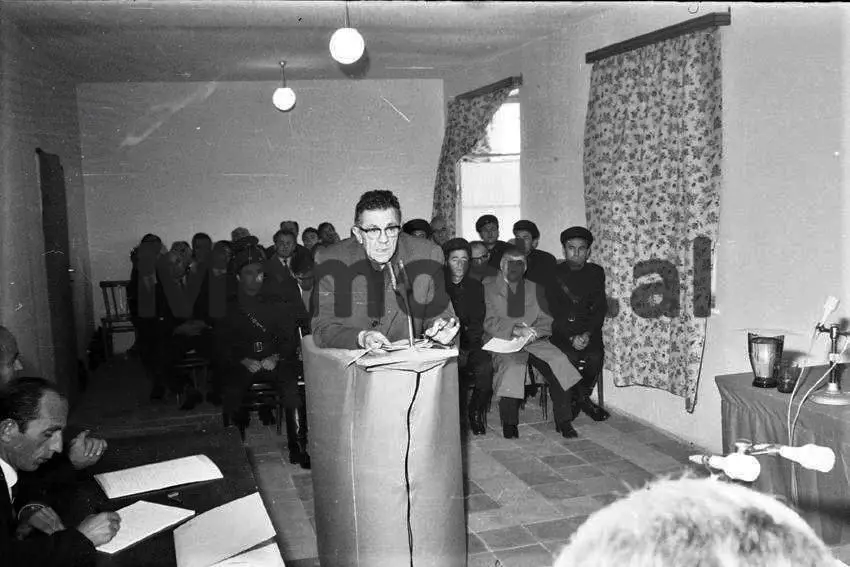
But for reasons never fully clarified, his letters were not taken into account; on the contrary, they remained unanswered. The letters are kept in the Archive of the Ministry of Internal Affairs, Box No. 1211, together with many, many photographs from the trial sessions of the three generals. Likewise, the details of the court decision and of about 20 trial sessions that took place over 30 days, each lasting four to six hours, are located in the Archive of the Ministry of Justice, in folder number 145 of the Supreme Court decisions of 1975.
Enver Hoxha formally respected the 30-day deadline for a reply when a condemned person asked for a pardon, but the reply of 4 December 1975 was very shocking: “The decision of the Supreme Court of 1 November 1975 is to be implemented. The request of the three condemned men is not taken into consideration.” Such a reply, given by the Chairman of the Presidium of the People’s Assembly, Haxhi Lleshi, had reached the desk of the Minister of Internal Affairs, Kadri Hazbiu. On 4 December, the Minister of Internal Affairs took all measures to implement with the utmost precision the decision of the Supreme Court to execute the three generals.
Kadri Hazbiu personally participates in the execution of the three generals
On the evening of 4 December, former Prime Minister Mehmet Shehu met head-to-head with Kadri Hazbiu in his prime ministerial office, to ensure the smooth running of Operation “Voroshilov”. The operation was coded as such because the three generals had all graduated from this Academy in the Soviet Union. The name was chosen by specialists of the Second Directorate of the State Security. The “Voroshilov” file was prepared with all the details by the Minister of Internal Affairs and presented to the Prime Minister. The Prime Minister, after examining it very carefully, made the appropriate remarks.
Mehmet Shehu had the habit that whenever documents were presented to him by ministers, he examined them very carefully, but at the same time made the necessary remarks. He was also very demanding in the implementation of all tasks assigned to his subordinates. As soon as he finished the meeting with Kadri Hazbiu, he followed his usual workday routine. He found a pretext to go to the Commander. But the real reason was the report he submitted on the implementation of the Supreme Court’s decision to execute the three generals of the Albanian Army. The three glorious generals of the War and of the leadership of the Albanian Army – Beqir Balluku, Petrit Dume and Hito Çako – were to be shot.
In the afternoon of 4 December, Kadri Hazbiu performed his final task. He, together with the four highest officers of the State Security, travelled towards Mount Dajt. He took a long tour, up to Qafa e Priskës. He travelled with the window open and told his driver to go slowly. (The car had only arrived a few months earlier from Romania.)
He made the journey from Tirana to Qafa e Priskës without speaking a single word. Two other Chinese-made “Jeep”-type vehicles followed behind. He observed the terrain very carefully and when they arrived at Qafa e Priskës, he held a meeting with a group of miners from the second shifts of the marble mine. After the meeting, he took the road back. Again he ordered the driver to go slowly. Throughout the time, he carried out a detailed reconnaissance of the entire area.
In the back seat, he had one of the best topographical officers (from Sukth, Durrës) who explained in detail what each hill was called, how the heights were named, what the land formation was like, and many, many other details. When he had passed the water pipe of the “Vladimir Iliç Lenin” hydroelectric plant, near the Dajt quarry, he ordered the car to stop…!
How did Kadri Hazbiu organise the execution and burial of the three generals?
Kadri Hazbiu stopped at the hill located southeast of the village of Linzë. He ordered his driver to turn left onto a “Zetor” tractor path of the Priskë Agricultural Cooperative. After driving about 200 metres, he told the three officers in the back seat of the “ARO”-type off-road vehicle to get out. He stopped in a meadow surrounded by hawthorns. He gave final instructions and ordered that all measures be taken so that the death sentence by firing squad of the three generals would be carried out at this hillside.
The topographical officer mapped all the details of the implementation of Operation “Voroshilov”. At 16:00, three “IFA”-type vehicles of the Republic Guard had arrived in the inner courtyard of Prison 313. The three generals were transported to Linzë in three different cars. All points of the Code of Criminal Procedure were implemented with the highest precision by the former Minister of Internal Affairs, Kadri Hazbiu. He was the director of this operation.
Kadri Hazbiu participates in the execution of the three generals
At 21:00 on 5 December 1975, one of the officers close to Enver Hoxha, who remained by his side all his life, reported to the Minister of Internal Affairs all the orders the Commander had given. He told him that every point of the regulations for the execution of the three generals must be implemented with precision, secrecy must be maintained, while the Commander accepted his proposal that the three executed men be transported from Tirana to Vlorë to be buried in a common grave in the village of Vranisht, Vlorë.
The topographical officer presented the map with the burial site of the three generals to the minister. Kadri Hazbiu, who knew every wall and every ledge of Vranisht in detail, congratulated him on the burial site found. “It’s a safe place.” Kadri Hazbiu asked: “Have measures been taken for the journey from Linzë to Vranisht to be done at night, and for the morning to find us with everything completed?” After receiving the approval of the topography officer, he ordered the group of prosecutors to begin the procedures. The procedures were very simple. Six policemen held the three generals by the arms, their heads covered with hoods, while the firing squad had taken its place in time.
The three generals, who still could not believe they would be executed, were like frozen people. The cimmerian darkness of that evening made this night of executions even blacker. Kadri Hazbiu, since 1954 when he had taken the post of Minister of Internal Affairs, had carried out over 20,000 arrests with his knowledge and had led hundreds of executions. The former fighter of the “Old Band” of Vlorë smelled gunpowder the same way he smelled the luxury perfume of the time. Security officers used to say that he loved the smell of gunpowder many times more than the smell of perfume.
He had a strange ability. He could accurately tell from what type of cartridge case the gunpowder smell released into the air came, without even seeing the weapon that had been fired. He was also a master of determining weapon ballistics. Around 22:30, the three generals had turned into corpses. They were shot without much fuss, on a pitch-black night, in a meadow of black soil created by the humus of the mares that covered that area.
From Tirana to Vranisht, with the refrigerated truck
At Cold Storage No. 2 in Tirana, located in Bërryl, a refrigerated van used for supplying meat to the Tirana market had arrived only a few days earlier. On 4 December 1975, the vehicle was parked in the inner courtyard of the Ministry of Internal Affairs. Its driver had been told that he could pick up the vehicle after three days. A driver designated by the operational chief of the Ministry of Internal Affairs had replaced its driver. The refrigerated van arrived the moment the firing squad left.
Before the blood had properly drained from the many wounds the three executed men had received, the order was given to load them into the refrigerated van, as they had to be urgently moved to a new destination. The loading of the three bodies was done with lightning speed. They were thrown into the refrigerated body as if they were three stray dogs, not three men who had created the new history of the Albanian Army! They left this world without even knowing themselves why they were enemies, why they were putschists, while they had never dreamed of “Black Theses”!
They had simply copied Soviet army regulations and adapted them for the Albanian army and terrain. That was their sin. For this sin, that is, for the Commander’s stubbornness, they were crossed. But their crossing was very macabre, very contemptuous, very racist and with 1000 question marks! A country gripped by crisis occupied itself with executions and human perversions. Three of Enver Hoxha’s closest friends, on that black and cold night, travelled from Tirana to Vlorë…! A black journey, conceived by miserable people who thought that their turn would never come, one day…!
The refrigerated-type van, with the three generals’ bodies, travelled from Tirana to Vlorë at great speed. All measures had been taken to keep the road clear. The Durrës Road Traffic Police took over the caravan of the three generals’ corpses in Ndroq, Tirana, and handed it over to the Lushnja Road Police at the Divjakë turn. The Lushnja police took it to Fier, and so on. At 03:00 on 6 December 1975, the bodies of the three generals had passed the city of Vlorë. At 04:00, they arrived in the village of Vranisht. The Vlorë Department of Internal Affairs had taken all measures. The burial site had been determined in the afternoon, while the graves had been dug at dusk.
Soldiers of the Guard watched over the common grave, while the gravediggers waited somewhere nearby. As soon as the van arrived, the order was given to cover the three corpses. The entire burial procedure lasted only 30 minutes. They were covered and the location was marked on the map by the light of a kerosene lantern, of the type used by the army. Kadri Hazbiu’s representative reported to him by radio. Kadri Hazbiu spent that morning at the Guest House in Vlorë. From Vlorë, the report was also made to Enver Hoxha regarding the completion of the burial procedures for the three former main leaders of the Albanian Army. The file was given number 1230, and with that number it is located in the Archive of the Ministry of Internal Affairs.
How was the grave of the three generals found in Vranisht, Vlorë, on 18 July 2000?
– Former Minister of Internal Affairs, Spartak Poçi, unravels the mysteries of the murder of the three generals –
On 18 July 2000, one of the five gravediggers of the common grave of Beqir Balluku, Hito Çako and Petrit Dume helped their families find the remains. Former Minister of Internal Affairs Spartak Poçi explains that according to the law, the file was multiplied by 13. Every State Security file and all files of the notorious trials of the dictatorship were multiplied by thirteen. In other words, says the former minister, they were made into 13 copies.
“The Minister of Internal Affairs, or any senior official of the Politburo,” says Mr. Spartak Poçi, “had the right to know only the location of two copies of the trial files of former Politburo members and high state officials.” According to him, two or three copies were in A3 format, while 10 copies were on microfilm, which in the language of state secrecy is called a “Jacket”. One copy of the “jackets” was stored and kept in the State Archive, one in the archive of the Ministry of Internal Affairs, and another copy in the tunnels of Mullet.
When the state treasury was stolen in 2001, a considerable number of State Security “jackets” were lost, as well as a complete copy of the trial files, starting from Koçi Xoxe, continuing with the “Group of Deputies”, with Teme Sejko, with the three army generals, and ending with Kadri Hazbiu and Feçor Shehu, which are the final files of “hostile activity” against Enver Hoxha and the Party of Labour.
In Mullet, a copy of the file on the assassination attempt against Ramiz Alia in 1988 in Tropoja was also lost. Former Minister Spartak Poçi explains that the copy located in the Ministry of Internal Affairs is one of the original copies. He recalls: “I spent a lot of time, outside official hours, looking at the execution files of Koçi Xoxe, Beqir Balluku, Petrit Dume, and especially the files of Mehmet Shehu and Kadri Hazbiu. All the files are there, with all the details, kept very carefully.” There are also all the evidence and counter-evidence from the trials.
Mr. Spartak Poçi is the son of General-Lieutenant Dilaver Poçi, former Political Director of the Army and former Commander of the Shkodër Corps, who was anathematised and interned in Belsh, Elbasan, together with the group of former generals. Mr. Poçi remembers in detail all those days, especially how Enver Hoxha interned the families of generals and senior army officers. Based on the copy of the map located in the Ministry of Internal Affairs and with the help of officials under the command of the Minister of Internal Affairs of the time, the families of Beqir Balluku, Petrit Dume and Hito Çako were given great help in finding their remains.
The execution map was opened, the orders for transporting the bodies to Vranisht were found, but it was difficult to find the exact place of their burial, because from 1975 to 2000 the terrain had changed a lot. The burial site in 1975 was a birch forest, while in 2000, everything had been overturned due to Enver Hoxha’s campaign, “Let us cling to the hills and mountains and make them as fertile as the plains”. After many efforts, the grave was identified.
18 July 2000, how did the families recognise the remains of the three generals?
For the families of the three former generals, finding the remains was a great victory. At least they would take them and bury their relatives. After a ten-year odyssey, the final moment finally came for all three families. The remains of the three generals were found, located in a common grave. The families recognised them by their teeth and the length of their bodies. When Enver Hoxha had buried them, he had left them no ring or any other mark. He had not even hung on them the medallion that, in such cases, is hung around the neck of those who are executed. In legal language it is called the “Matrix”.
So that their bodies would never be found, Enver Hoxha did not put the “Matrix” on them. He went so far in his Hitlerianism that he buried them in secret burial sites. The families never learned the grave. No other dictatorial leader in the world has done this. But after 1967, when he abolished religion, he also legalised secret burial for all those who were shot. He even went further.
If you were sentenced to ordinary imprisonment and died while still having time left on your sentence, you would be buried in the prison grounds until the sentence was completed. If you had a living relative, then they would give you the remains; if not, they would not. This was the practice applied to many of the children of former Politburo members and high officials of the dictatorship who died in prison. The families could not take the remains./Memorie.al