


By Father Zef Pllumi
Part Two
– OTHER SACRIFICES ARE NEEDED –
Memorie.al / These triumphs of the “People’s Democratic Power” caused great euphoria among the new rulers. They thought they had succeeded in deceiving all world public opinion with that farce of “free elections” that ended with 90% and so many other such violent manipulations: they were completely blinded, or had always been blinded, in order to seize and hold power over their own Albanian brothers, towards whom they showed no brotherhood at all, but acted like blind dogs of Belgrade: The new master of Albania – Belgrade – would take great revenge on the Albanians, who until then had been stubborn. First, the national pride of a sovereign state had to be destroyed: what use did Albania have for foreign representatives in Tirana?!
Continued from the previous issue
– “He too is dead. He was an opponent of Zog, interned in Italy, but he was anti‑Italian: it is said, nothing is known for certain, that after Italy entered Albania, two or three months later, the Italians killed him: he died in Rome during an appendicitis operation. Who dies from appendicitis?! Where?! In Rome!”
– “Appendicitis? I’ve had that operation too, come on, who dies from appendicitis! Nevertheless, they didn’t do badly: they saved us a bullet; he would have done more harm than good. Now,” said Duli, “close the boxes well, give me the padlock keys here: this one here, and this one here!” – he said, while putting them in different places in his key pouch, so that no one would dare touch them.
Then, when we came down from the attic, Duli went with me to the office he had set up there in the Convent and said: “We have to make the record.” And the record was made about Father Pal’s diaries and about the two boxes with the manuscripts of Gjeçovi and Marlaskaj. He didn’t write it badly, but he said to me:
– “This time I forgive you and I won’t put you in prison. Tell me, do you have anything else hidden?”
– “No.”
– “And who will believe you, if we catch you with a leak in your hand?”
– “Believe it or not, as you wish.”
The next day there was complete silence. But after two days, the Convent filled with partisans who searched every corner and every hole. They struck the walls with hammers to see if they were hollow inside. With levers and picks, they lifted the floorboards. With lanterns they searched the darkest attics. The Convent resounded with the noise of the search, while we, gathered in the refectory, listened to where they were searching and where they were breaking open.
During this time, Brother Ndue Vile from Orosh was called for interrogation. Brother Ndue was disappeared for a couple of nights: when he returned, he was completely transformed – his face turned yellow, he wouldn’t speak to anyone, he just put his finger to his lips and whispered: “I am God’s servant, don’t speak to me: I’m finished with everything”! He was completely terrorised.
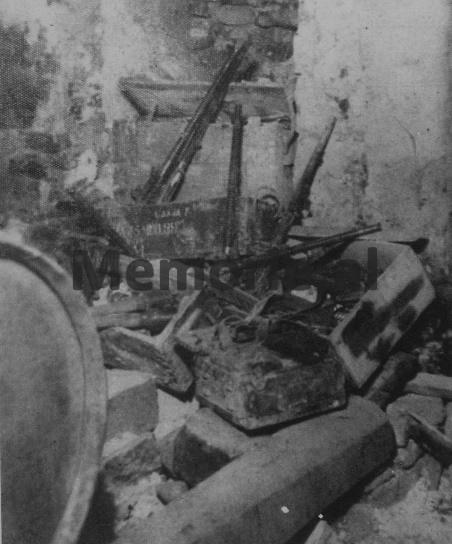
The servants during the period of anarchy under the Germans had been armed, so that the Convent would appear guarded by bayonets. But later, with the arrival of the partisans, they had hidden the weapons in the pigsty manure. When they were taken out, they were cleaned, because they were rusty and rotten. Duli with a group of soldiers brought them for us to see, us isolated in the refectory: they showed them to us with devilish joy, as if they had found something great.
Ever since Father Çiprian and Father Pal were arrested, many in the Franciscan Convent expected arrest, including me and Father Aleks Baqli. We foresaw that the Convent would be closed, since it was on the plan, but regarding the Churches, we thought they would remain untouched, as everywhere in Eastern Europe. So Father Aleks took some of his most precious books and sent them to the Church. There he stacked them under an altar, so that he would have time to retrieve them later and send them to his brother’s house.
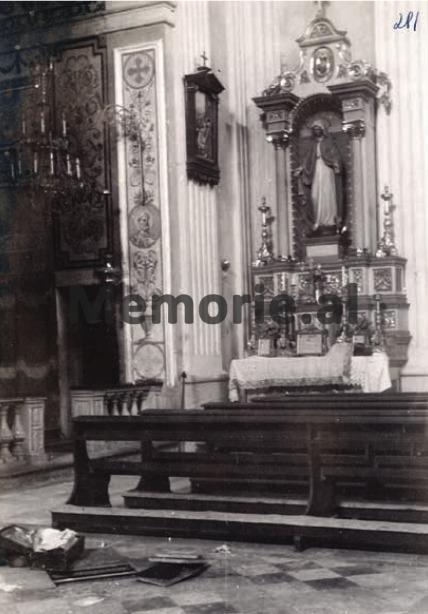
Now that partisan squad, after breaking open almost all the walls, floors and attics of the Convent, threw itself into the Church. First they attacked the tabernacle, as the most secret object: they tried to open it with levers. They couldn’t. Then Duli asked Father Aleks for the key. The tabernacle key was kept in the Sacristy. Father Aleks took the key, put the stole around his neck, knelt before the tabernacle (the ark where the sacrament is kept) and opened it. “Listen,” he said, “I beg you, only look, do not touch. There is nothing here against the laws.” He presented the sacred vessels.
– “These,” said one, “are made of gold. Gold is forbidden.”
– “No,” replied Father Aleks, “until now, neither earrings nor bracelets nor rings have been forbidden: only gold money has been forbidden.”
Duli stood up for him.
– “But what is inside these golden vessels?”
– “Here,” said Father Aleks, “no one can touch except consecrated people. These are hosts. We believe in Christ; I beg you, do not touch. There… hosts, all hosts!…”
– “And why do you keep these in golden vessels?”
– “I told you once more: it is Christ.”
– “Christ? Where do you see Christ?! There?”
– “I believe so: I see it with the eyes of faith. You do not believe, but you have no right to violate my faith. Please!”
– Duli then laughed loudly. He turned to his comrades, the higher officers, and said: “Do you see that Aleks really means it! So let us respect his faith. Aleks, close the safe (the tabernacle) and keep the key. We have seen what was inside.”
Meanwhile, several other partisans had spread through the Church, searching corner by corner. The Franciscan Church was very beautiful: the side altars had been brought from Tyrol artistically crafted by the firm “Stufflesser”. One of these altars was like a shelf inside, while covered by a bas‑relief on the outside, which was fixed with four screws. The partisans removed the screws and under the altar they found a stack of books. While they were taking them out, Duli and other officers rushed to that altar to see what was coming out. Leafing through the books, they found the name of Father Aleks Baqli written.
– “Aleks, are these your books?”
– “Yes.”
– “Why did you hide them here?”
– “To save them from you. I brought here the books I hold dearest from my library. I understand that you are going to throw us out of the convent, so I thought to keep these books with me.”
Meanwhile, the partisans searching the church, behind a statue of a saint, found a microscope. They didn’t know what it was: perhaps they thought it was a sophisticated weapon. Duli didn’t understand what it was either, but he called Father Aleks and asked:
– “Is this yours too?”
– “No. This is a microscope, which I believe belonged to the natural sciences cabinet; who knows who brought it here?!”
– “Certainly not us,” said Duli, “but you. Don’t worry, the one who brought it here to hide it behind the saints will come out” – and he let out a curse. “We have a magic stick that shows us everything.” Then, after the Church was completely searched and nothing else was found, the officers ordered that everything be put back as it was. A military guard was placed inside the Church as well. They took all the Church keys from Brother Ndue: it was opened for the people only when Duli wanted.
Brother Ndue Vila, Father Aleks Baqli, and two servants were often called for interrogation. After about 4‑5 days, they took me as well. When I left the refectory, there in the corners of the corridor I saw that they had brought from the Sigurimi section Father Pal Dodaj, Father Matí Prendushi, Father Donat Kurti, Father Çiprian Nika, Father Filip Mazreku, and Father Leon Kabashi. They were all far apart, separated from each other and handcuffed: almost all had long beards, because they had not been allowed to shave; all guarded by guards.
As we walked through the corridor, Duli would ask me: “Do you know this one? Do you know him?” And I would answer: “Yes.” He sent me into that archive corridor: there they had also brought down the two large bins of archive documents. The corridor was full of Albanian officers and, even more, Yugoslavs. They had also brought Yugoslav film specialists with equipment, but it seemed they had brought many other specialists for dirty work. One of them took out a file from one of the two bins, and from the file he took out a sheet: he exclaimed in our language:
– “See what connections these people had with Stepinac!”
So said an interpreter, thrusting before my eyes a letter written in Latin by Stepinac, the Archbishop of Zagreb, thanking the Franciscan Convent for the generous help they had given to a young Croatian priest, taken as a prisoner of war by the Italian army.
In that whole crowd of people, I also distinguished the photographer, Gegë Marubi. Duli called him, placed me in front, we went up the stairs together and climbed into that attic above the archive. There, by those metal suitcases with the manuscripts of Gjeçovi and Ambroz Marlaskaj, he took 2‑3 photos of me, with a flash. Meanwhile, when I sat in the corridor, near the bins, the carbon‑arc lamps used at that time for filming were shining.
Duli put his arm around me in the corridor and said:
– “Hey, Zef, when did you intend to start the war to overthrow the People’s Power?!”
– “You are a soldier,” I replied, “and you know well that with 3‑4 rotten rifles you can’t make war. Besides, these you see are papers, documents: with these you can’t make war!”
– “Why don’t you believe we found weapons?!”
– “I can’t believe it, because I know the Convent very well.”
– “Yes, but we know it even better than you. We have found everything you hid.” Meanwhile, he took me into that room where we had placed, between two walls, the entire historical archive of “Hylli i Dritës” (The Star of Light), as well as a very important part of the archive of the Franciscan Province.
– “Do you see,” said Duli. “Do you believe now…?! There, what you have done…!”
– “But these are papers, only papers, Mr. Dul; with these you can’t make war!”
Meanwhile, I watched with great pain the work I had done for so many months, under the greatest secrecy, spending sleepless nights, sometimes with Father Pal, sometimes with Father Gjon Shllaku. My heart sank to the pit of my stomach. In my mind, there between two walls, I had created a secret place that only I knew about, above ground. And how had everything collapsed?! Together with that wall, my heart also fell. Outwardly, I tried to keep calm, while my heart trembled. Side by side with Duli, drunk with the joy of success and, perhaps, also with a glass of raki, we walked through the long corridors of the Convent. – A shared journey of joy and anger, of life and death. So nothing new under this sun.
– He sent me to that room they had filled with weapons: he opened the door and said: “Look how many weapons you have prepared to fight us…!”
– “But when did you bring these?!”
– “What are you saying?” said Duli. “These are the ones you hid.”
– “No,” I said, “these are not hidden weapons. Do you see how they shine?” – While those four‑five hidden ones, do you see how rusty and rotten they are!
There were a large number of shining weapons there, and especially several boxes of red bombs, brand new, fresh.
That night the Yugoslavs and Albanians took all those photographs and those documentary films, which the State Security later exhibited as trophies of the war against clerical reaction in all the State Security museums, or even in the Atheist Museum of Shkodër, unique in the world. – Father Çiprian and Father Matí were photographed and filmed with weapons in hand; also Brother Ndue Vila. Father Pal at the parts of the archive that were found; me in the attic with the manuscripts; Father Leon, Father Donat, and Father Aleks inside the Church, taking out the books from the altar and the microscope apparatus.
Everything was presented as weaponry, because some of them had been placed in metal ammunition boxes to protect them from humidity, dust and light. Not long after, about three‑four days later, a large operation was carried out, directed by Slavic and Albanian officers, to transport all the archival documents. A lorry worked all day and night, taking from the Franciscan Convent in an unknown direction all the books found in the Church, all the archives, both the hidden one and the untouched part of the archive. On that day, Fishta’s Museum‑Room was also destroyed; all his manuscripts were barbarically loaded onto that lorry that went back and forth without stopping.
The documents were emptied out there without any order and without any care, as the files were being taken. Father Marin Sirdani could no longer endure this barbaric vandalism, and he said to Dul Rrjodhi:
– “Look, Dul, these are extremely important documents for the history of Albania, so show special care for them!”
– “Don’t worry, Father Marin, these rags are of no value to us at all: we write history ourselves…!”
These were the last days of the Franciscan Convent. Enver Hoxha’s Janissaries appeared at the Convent doors on the morning of December 11th, with a decree in their hands, to put into effect what had long been expected from the leaders of Slavo‑Albanian communism: Carthago delenda est! (Carthage must be destroyed!)
Into the refectory where we were gathered came several high‑ranking military officers and prosecution organs. After solemnly reading the decree received from above for the closure of the Franciscan Convent, they ordered us all to return to our rooms and to take for the journey only one change of
clothes and nothing else – no books, no furniture – because the Franciscan Convent, with everything inside it, had passed into state ownership. At the door, a search awaited us.
Someone asked if we were allowed to take our daily prayer books. They allowed us to take only one prayer book (breviary) in hand.
Each of us returned to his own room. And what were we to take first, since everything now was forbidden to us? I had two very precious things that I could not leave there: the “Lahutë e Malsisë” (Lute of the Highlands) with the author’s autograph, dedicated to me, and Fishta’s walking stick; that stick on which his majestic body leaned, held by that hand which had carved the most beautiful verses in a language until then little polished. I could not leave them there. I hung the stick on the joint of my left wrist, hiding it in the folds of the wide cape of the Franciscan habit, while in my right hand I held only the prayer book together with the “Lahutë e Malsisë”. When I went to the door to be searched, Duli was ready and called out:
– “You, Zef Pllumi, will come to be searched by me.”
There were 5‑6 others doing the searching. I had to present myself before him. He searched my pockets, touched my hips, chest, back with his hands; in the small bag I had only one pair of underwear; in my right hand, the prayer book and the “Lahutë e Malsisë”. He took that book and exclaimed loudly:
– “Comrade Prosecutor, this Zef Pllumi has the ‘Lahutë e Malsisë’ dedicated with Fishta’s signature: what shall we do?” – He asks for it because it is a personal keepsake.
The prosecutor was Hys Zaja, a former student of the Franciscan Lyceum, a few years before me, and he replied:
– “Give it to him!”
God willing, Fishta’s walking stick he did not notice anywhere. I saved it: I have it even today, after all the vicissitudes it and I have been through.
Before we left the Convent, one of those authorities gave us a short speech, addressing especially us young students. He said that; for us this was a day of liberation from those gloomy walls and that from now on we would be members of that youth which enjoys the benefits of socialism.
Therefore we should not turn our heads back and be influenced by the reactionary thoughts of the Franciscan Clergy, because the vigilance of the Party follows you at every step of your life. After they registered the addresses where we would go for those first three days, they released us into the courtyard in front of the Convent and the Franciscan Church. We could neither cry nor turn our heads back, from fear: the eyes of the Party were upon us.
Around midday, everything was over. Everyone dispersed, heads bowed and without a sound, to wherever they had indicated as their address.
I set out for Melgushë, where I had an uncle. The journey took about three hours on foot. I felt that everyone was looking at me. Perhaps that was so. But no one in the city had the courage to come and ask me or speak with me.
I went out of the city, beyond the Bahçallëk Bridge. I began to recite “Super flumina Babylonis, illic sedimus et flevimus, dum recordaremur Sion” (By the rivers of Babylon, there we sat down and wept, when we remembered Zion). I walked alone. I tried to quicken my pace so that night would not catch me on the road. But night had already caught me – the night of the mind. I no longer knew where to turn?!
Where am I?! Where am I going?! There? Over there? Where? What will I do?! All those youthful dreams: to become a friar, to become a saint, to become a scholar, to become famous for something – all vanished at that moment. I felt that I was nothing else but a balloon, a bubble in the air, moving in whatever direction the wind took it. And what is the wind? Is it life itself? Great sadness!
“O Lord, stay with us, for it is evening”! / Memorie.al