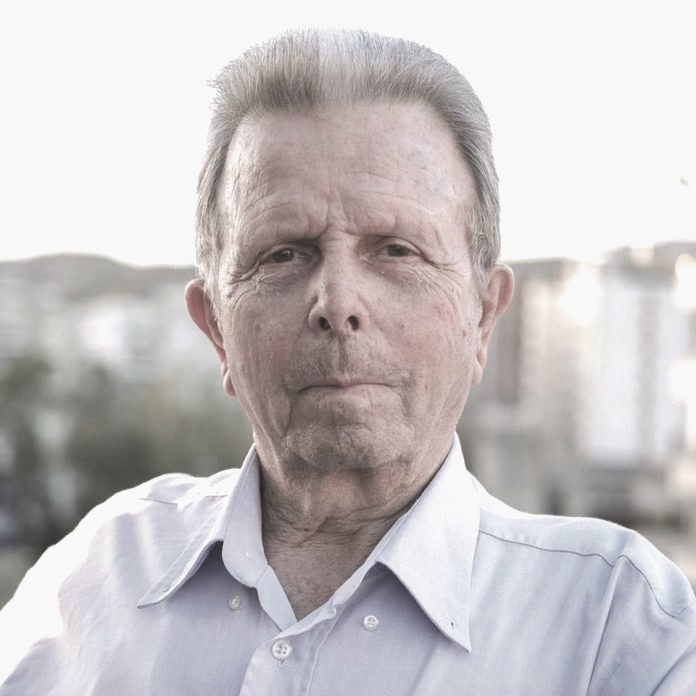
Memorie.al / Abaz Ermenji was so resolute in his criticism and condemnation of the stance held by “Albanian collaborators” during World War II that he accepted confrontations, reprimands, and even separation from them. His life’s work serves as a model of integrity; as early as April 7, 1939 (while a history professor at the Lyceum of Korça), he met the Italian occupiers with a weapon in hand, and on November 28, 1939, he demonstrated at the head of the youth of Korça against the Italian fascists. Later imprisoned by the fascists and interned in Italy, he returned to fight directly against both Italian and German occupiers, despite always maintaining his position as an anti-communist nationalist.
Abaz Ermenji was born on December 12, 1913, in the small and noble village of Gërmenj, situated among the mountains and groves of Skrapar and Gramsh, which at that time was part of the Berat district.
He completed primary school in Berat and secondary school at the Gymnasium of Shkodra. For four years, from 1934 to 1937, he pursued higher studies in France at the Sorbonne Faculty of Letters, specializing in History. In 1937, Abaz Ermenji returned to Albania and, surprisingly, was called for military service. At the beginning of 1938, he was promoted to second lieutenant, and in October 1938, he was discharged from the army and appointed Professor of Literature and History at the French Lyceum of Korça.
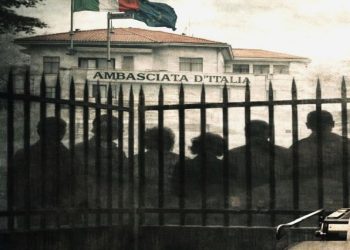
In April 1939, with the onset of the occupation of Albania by fascist Italy, Abaz Ermenji formed an anti-fascist resistance group in the city of Korça with his students and colleagues. Albania was occupied within a few days by the Italian fascists – his declared enemies – and feeling endangered, he fled to Greece, where he began working to expand the resistance against fascism. He stayed for a short time in the villages of the Kastoria province before being arrested by Greek authorities in Florina, where he was held for four months. There, he contacted other refugees from Albania, traveled as far as Athens, and made efforts to connect with Albanians in Egypt, the USA, and other countries to create an active nationalist organization for the struggle against fascism.
During his stay in Greece, he received several invitations from Italian authorities to return to Albania, with the promise that nothing unpleasant would happen to him. Believing he would find more ground for resistance from within Albania, he accepted the invitation and returned in October 1939, attempting to create anti-fascist resistance cells in several cities. On the anniversary of National Independence, November 28, 1939, a demonstration for the national celebration was organized in Korça, as well as spontaneously in many other cities across the country. In this large demonstration, Professor Abaz stood out as a primary leader, and on December 15, 1939, he was arrested in Elbasan and imprisoned. (It was Abaz Ermenji who was arrested, and not some communist, as is often claimed regarding the leadership of the front). He was initially held in Elbasan prison for two weeks before being transferred to Bari, Italy, where he remained in prison for two months. Later, he was sent (along with Safet Butka, Llazar Fundo, and Selman Riza) to the island of Ventotene, where many other Albanian and Italian anti-fascist figures were being held.
Here, he learned that he had been sentenced by a Tirana court to five years in prison. In August 1941, Abaz Ermenji, along with many other Albanian intellectuals, was released under the pretext that they were needed as educators, especially for the now-Albanian province of Kosovo. On the other hand, the Italians believed the situation in Albania and the Balkans had calmed, and for the sake of diplomacy and popular sympathy, they decided to grant amnesty to a large number of prisoners. On August 20, 1941, Abaz Ermenji returned to Albania, where he expanded his anti-fascist activities. At this time, encouraged by the Serbs and under Russian influence, Albanian communists had also penetrated many nationalist resistance groups – those of Myslym Peza, Haxhi Lleshi, Dali Ndreu, Abaz Kupi, etc. – to pull them toward their final goal of seizing power.
Since Abaz Ermenji was closely watched and threatened by the Italian Police, he decided to take to the mountains, where armed units (çeta) had begun to form. As a distinguished intellectual with military knowledge, he helped organize and expand the movement. With his regional unit, he participated in several attacks on Italian military posts. Gradually, nationalist and partisan units, working both in cooperation and separately, gained strength and authority, becoming a true threat to the Italian authorities, from whom they captured weapons, ammunition, and food, not only within the country but even across the borders into Greece and Yugoslavia.
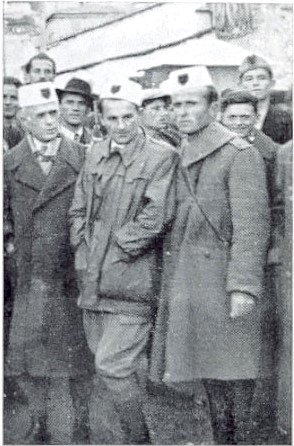
In May 1943, this was observed and reported in writing by the First British Military Mission, which arrived in Albania from Greece with Major Maclean and Captain Smiley. Abaz Ermenji escorted them from the Albanian border, a fact witnessed by Greek EAM groups. Furthermore, Ermenji was the mediator who introduced them to the communist units in Albania – known as the National Liberation Front – as well as other active nationalist units. It should be noted that Balli Kombëtar had been formed in 1942 under the leadership of Mit’hat Frashëri, a dominant political figure supported by other patriotic nationalist figures, most notably: Hysni Lepenica, Safet Butka, Skënder Muço, Zef Pali, Isuf Luzaj, and Abaz Ermenji, without excluding leaders of other major nationalist formations like Abaz Kupi and Muharrem Bajraktari.
The National Liberation Front took care from the beginning to influence the British Military Mission so that other groups were excluded from contact with the British, giving them the impression that the communists were the only active units in the country.
Major Maclean and his group withdrew to the mountains of Leshnja in the Skrapar region, setting up headquarters in an area controlled by partisan units. Being Ermenji’s birthplace, he sent a group of 50 men to Maclean’s headquarters along with a letter. Major Maclean was pleased with the content of the letter. They met with Abaz Ermenji at the end of May near the village of Përrenjas. The British Military Mission began supplying Ermenji’s men with weapons and ammunition, as well as operational technical instructions. In June 1943, they met again with Major Maclean, who requested that both groups unite into a single front under one command. Ermenji accepted such a coalition, provided the cooperation remained strictly military.
In early August 1943, Abaz Ermenji and his unit were preparing an attack on an oil base in Kuçovë. At this time, Major Neel, sent by Maclean, joined him to militarily coordinate the operation and further align with surrounding partisan forces. Ermenji received instructions from Maclean to delay the attack and first hold a joint coordination meeting with partisan representatives in the presence of Major Neel. The meeting took place in the village of Bogdan on the night of August 9-10, 1943. The communists began discussing politics and the future of power rather than the organization of the attack, proposing to delay or cancel it under the pretext of insufficient forces. They feared that the credit for this action would go to Balli Kombëtar.
Ermenji lost patience and decided to attack when the partisan forces left him alone. He launched the attack with a large force of nearly three thousand men. However, the enemy was superior in numbers and weaponry, and the forces withdrew, leaving 50 dead. This action was commended in a special letter from Maclean, which characterized and approved the attack and the bravery of Ermenji’s men. He received a promise from the British major that more aid, ammunition, and weapons would be sent to him. Likewise, in Julian Amery’s book, “Sons of the Eagle,” several facts are provided regarding successful actions against German convoys organized by Abaz Ermenji. The British followed the principle of supplying those who fought the enemy with weapons and food, which factually verifies the results of Ermenji’s actions.
In August 1943, the historic joint meeting between representatives of Balli Kombëtar and the National Liberation Front was held in Mukje (where Abaz Ermenji, engaged in combat actions, did not participate). As is known, an agreement was reached at Mukje regarding joint military operations, as well as Kosovo and future governance. However, this agreement – approved by communist representatives and welcomed with enthusiasm by the Albanian people – was rejected by Enver Hoxha under Yugoslav pressure. In September 1943, with the capitulation of fascist Italy, resistance groups, including those led by Ermenji and the partisans, entered Berat. The Germans arrived later and occupied the city, demanding they leave. Abaz Ermenji decided to fight and resist, specifically in the village of Kousitin. Once again, the communists made no move; furthermore, they condemned the “compromise” of their representative, Gjin Marku.
In October, the communists attacked Abaz Ermenji’s formation, forcing him to leave the Berat district. During the evacuation, he met Major Maclean and Captain Smiley, expressing his disappointment with the entire situation. During this meeting, Ermenji also denounced a letter from the Communist Party following the Second Labinot Conference, which instructed all its members to “fight the Ballists everywhere.” Although the British requested the letter before departing for Italy, Ermenji, in a final effort toward unity, refused to hand it over. He remained in the mountains and attempted to reorganize his forces, but always under the threat of the Germans and now the communists, until he was forced to temporarily suspend the intensity of his military operations.
During the winter of 1943-1944, Ermenji was completely cut off from any possibility of aid or cooperation and began to lose many of his men. They had no other alternative or means of survival, so they either deserted to go home or joined the partisans. His group began to disintegrate, and only a few loyalists remained by his side. In conclusion: Ermenji led a series of battles against Italian and German forces, specifically in Skrapar, Kuçovë, Mallakastër, Berat, and Pogradec. There are numerous foreign and Albanian documents that inform us about these battles which, despite being sidelined by 50 years of communist historiography, belong to the golden fund of our people’s struggle against foreign occupiers alongside the partisan brigades.
In May 1944, caught between two fires, tired, desperate, and without a way out, Abaz Ermenji met once more with the group of British Captain Hand, who was preparing to leave for Italy. The British captain saw that the routes to the coast were well-guarded by Ermenji’s forces and decided to stay with him to understand the difficult situation Ermenji faced. Ermenji detailed his need for vital military aid in a letter to Maclean. (At this time, Maclean was outside Tirana with Abaz Kupi’s group). In response, Maclean communicated to Captain Hand to depart for Italy peacefully, assuring that the necessary military aid would soon arrive for Abaz Ermenji’s forces. The captain left for Italy with another letter of requests from Ermenji, with instructions to deliver it to the high British authorities.
In September 1944, Ermenji met with the three British officers – Maclean, Smiley, and Amery – and it was agreed to form a joint group to fight the Germans vigorously. With the withdrawal of German troops in November 1944, the British officers also departed for Italy. Upon Maclean’s departure, Ermenji received notice that with the war’s end, no resistance group would be supported with aid any longer. Under these conditions, he disbanded his men, seeing the organized military units as unnecessary since the enemy had left and there was nothing left to do but enter a fratricidal civil war. Abaz Ermenji had the opportunity to leave for Italy with Abaz Kupi, but he stayed in Albania with his lifelong dream of forming the “Liberal Democratic Movement” group, which would operate outside the National Liberation Front with the hope of political pluralism, as in Western democracies.
From December 1944 until October 1945, Abaz Ermenji worked hard to create a strong opposition party and return Albania to a democratic regime. But, it seems, he had calculated simply as a dreamer. The communist stance was so strong and even annihilating that opposition was considered an unacceptable political crime. Seeing that there was no longer any financial, moral, or political support from the allies, Abaz Ermenji decided to leave the country across the borders in search of new paths. As a historian, Abaz Ermenji analyzes and explains the causes of Balli Kombëtar’s failure as follows: “The truth is that Balli Kombëtar, although numerically having the vast majority of the peasantry and the educated, proved from the beginning to be of a lower organizational level as a fighting force, with a weak Party, lacking discipline and authority, and possessing all the flaws of human nature or the specific Albanian mindset.”
“While the communists first prepared disciplined cadres among the urban youth and then gathered the peasantry into them, Balli Kombëtar began its work from the villages to have the largest possible number, and the cadres of its units or armed forces remained peasants until the end. These lacked the agility, conviction, and discipline of the fanatical communist youth cadres. The youth of Balli Kombëtar did not enter the villages and played no role in directing the peasant masses. In the Central Committee of the Communist Party and its high cadres, there was one viewpoint, one thought, and one decision. Those who thought differently were quickly eliminated, whereas Balli Kombëtar remained until the end an agreement between people with different and often opposing views and interests.”
“Balli Kombëtar received no help from the so-called nationalists of Central and Northern Albania. On the surface, these let it be understood, or said it themselves, that they did so with the purpose that Ballists and communists would eat each other’s heads, so that power would eventually fall to them…”! Abaz Ermenji crossed the Greek border on October 26, 1945, with 18 of his supporters. In Greece, he was arrested by Greek authorities and interned in the Gladstone camp in Thessaloniki, where he remained imprisoned for more than six months, suspected as a German collaborator. Ermenji was interrogated by British officer Lieutenant Young, who later passed the testimony to higher authorities. Ermenji declared and proved that he had not collaborated with the Germans; on the contrary, he had fought and shed blood against the Italian and German occupiers for the freedom of his country, for which he was judged by the British and released.
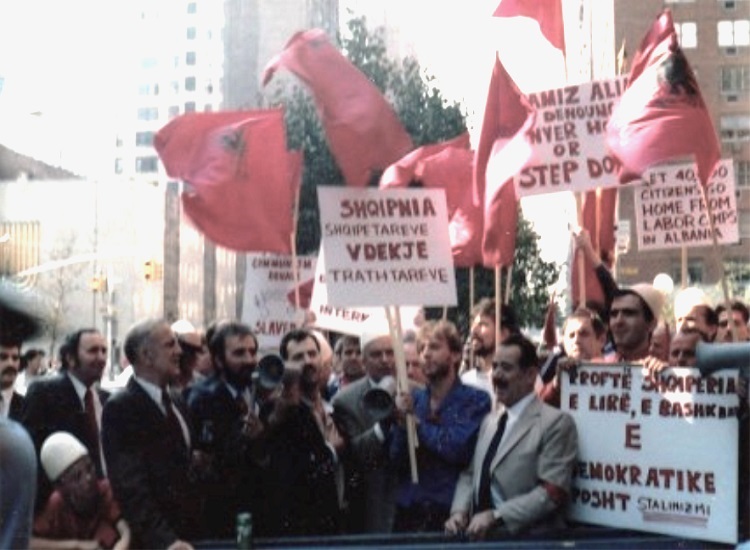
From November 1944 until the spring of 1946, Ermenji, alongside the Kazazi brothers, Muharrem Bajraktari, Hysni Dema, and other nationalist leaders from Kosovo and Albanian territories in Macedonia, intervened several times within the Albanian border and conducted a series of actions, demonstrating his qualities as a military leader in addition to his anti-communism. His rifle would be heard in Postribë, Çermë, Malësi e Madhe, Golaj, Orosh, and Bajzë, while the Tirana government had declared him a war criminal and imprisoned his father. Later, when the struggle of nationalist leaders in Albania became entirely impossible, Professor Ermenji left the homeland for good, convinced in his conscience that he would never stop helping his nation to eradicate communism and replace it with pluralism and democracy. He settled in Paris, where he led the “Free Albania” National Democratic Committee, which played a major role in efforts for an Albania free from the communist regime, as well as for the liberation of Kosovo from Serbian oppression and tyranny.
Following the overthrow of communist power and the establishment of pluralism, Abaz Ermenji was granted the opportunity to recreate Balli Kombëtar in Albania with even more advanced principles, starting in 1991. He returned to politics and was elected chairman of this party twice in a row, in 1994 and 1998. During this period, despite his advanced age, he contributed to raising the national sentiment of Albanians through a series of meetings and conferences across Albania. Professor Abaz Ermenji was decorated by the USA with the high “Eisenhower” award, with the citation: “Distinguished fighter in the struggle against communism.”
Ultimately, we can say that Professor Abaz Ermenji, as a resolute anti-communist, was simultaneously a fervent defender of the Albanian cause and the Albanian nation within its ethnic borders. His primary motive was to place “Albanianism” above parties, fighting in several battles, even on a common front with partisans against the Italian and German occupiers. His anti-communist efforts did not cease until he died. Through numerous articles published in the newspapers “Flamuri,” “Balli i Kombit,” in the collection “Albania,” etc., his scholarly work “The Place of Skanderbeg in Albanian History” stands as a magnificent Albanian apology.
Abaz Ermenji died on March 10, 2003, in Paris, France, as a patriot, nationalist, and resolute anti-communist, ensuring he would never be forgotten by his followers and sympathizers. He was escorted to his final resting place on March 14, 2003, with a grand ceremony in the nation’s capital, Tirana.
- Birthplace: Ermenj, Skrapar.
- Date of Birth:12.1913.
- Education: Primary in Berat; Higher education at the Faculté des Lettres, Sorbonne, Paris (1934-1938).
- Profession: History Professor.
- Professional Activity: 1938-1939, Professor at the Lyceum of Korça; 1939, at the “Normale” of Elbasan.
- Political Activity: 1939, organizer of the Lyceum of Korça youth against the Italian occupation.
- 1939-1941, internment in Ventotene by the Italians.
- 1941, member of Balli Kombëtar.
- 1943, member of the Central Committee of Balli Kombëtar.
- 1948, member of the “Free Albania” National Democratic Committee created by Mid’hat Frashëri in exile on August 26, 1949.
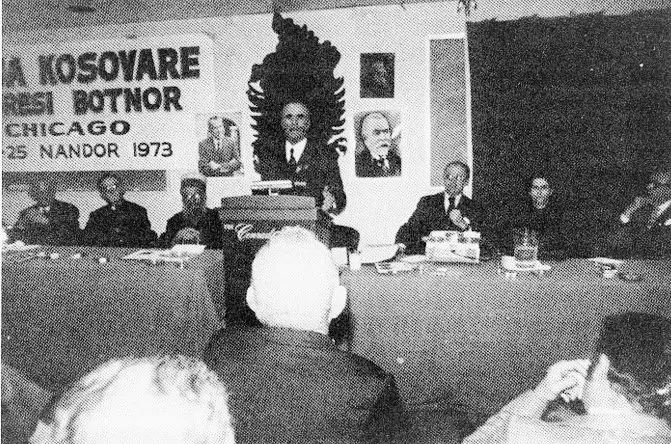
- 1955, one of the organizers of the “Kosovar League.”
- March 10, 1957, chairman of the “Free Albania” National Democratic Committee until 1992.
- 1992 until December 2002, chairman of Balli Kombëtar.
- Member of the “European Movement” and participant in all its congresses.
PUBLICATIONS:
- 1968, “The Place of Skanderbeg in Albanian History.”
- A study on the history of Albania, first edition Rome, Italy, and second edition Tirana.
- National Culture and Morality.
- Author of many articles and writings on Albania and the Albanian cause in the newspapers “Flamuri,” “Le Monde,” “Përmbledhja,” “Albania,” “Balli i Kombit,”
- Honored with the “Eisenhower Award” as a fighter for the protection of human rights. / Memorie.al