By Arben Shahini
Part one
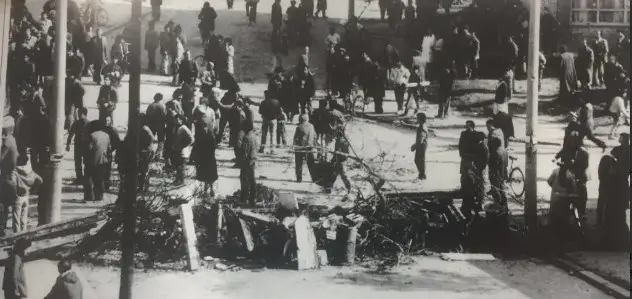
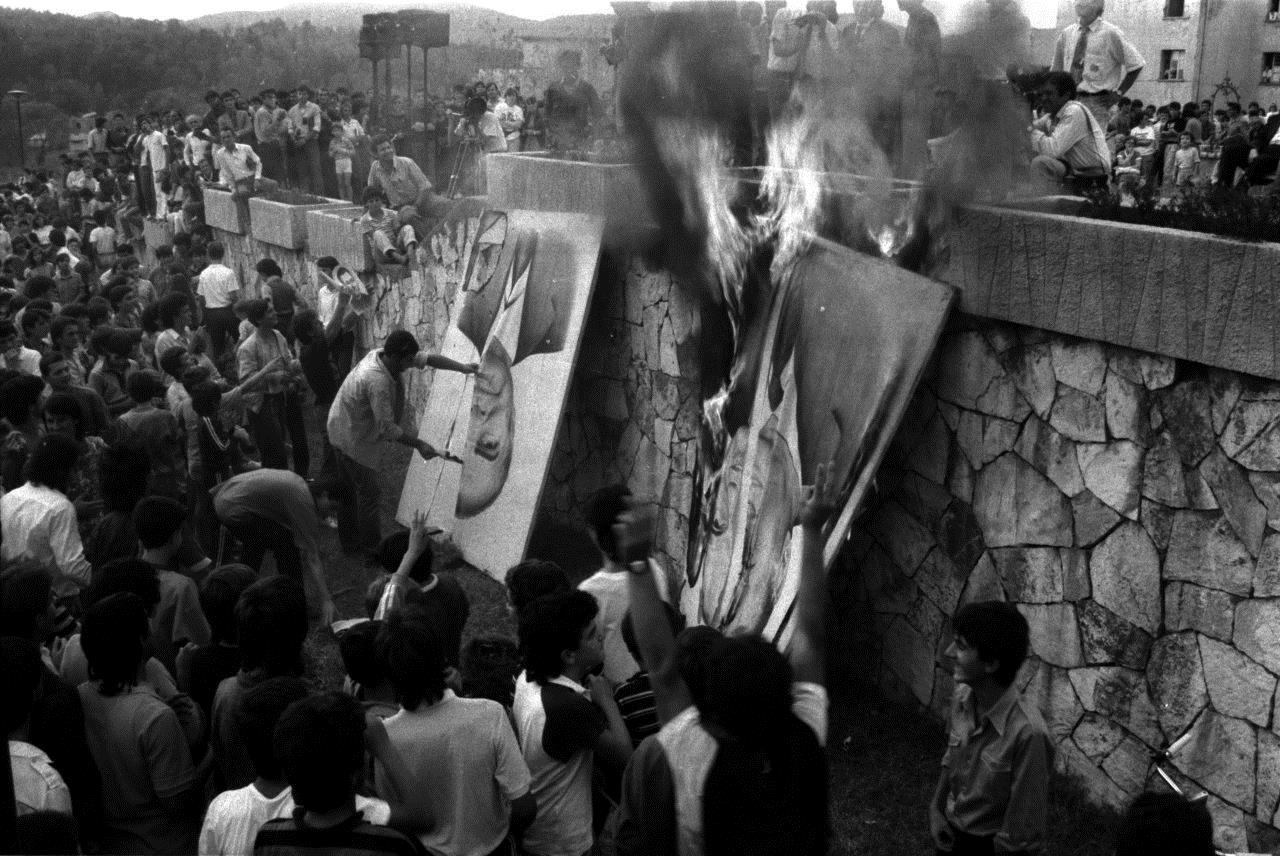
Memorie.al / On February 19, ’91, around 3:00 PM, the Plenum of the Central Committee of the PPSH issued a statement emphasizing that the students’ living conditions had significantly improved and rejected the students’ request to remove Enver Hoxha’s name from the University of Tirana as unfounded. The resistance of the Central Committee ended after two months, when the name Enver Hoxha was removed from the University of Tirana. Numerous special forces, order maintenance, and rapid intervention units, equipped with rubber helmets, batons, tear gas, and border dogs, had blocked the road leading from the “Liceu Artistik” (Artistic Lyceum) to the Radio-Television building. They had also blocked the road with two military “IFA” trucks for this purpose.
A large fire truck released high-pressure red-colored water with a wide throwing range of 20-30 meters, soaking all the protesters. This immensely irritated the demonstrating public, and they began to head toward the large cordon of police and rapid intervention forces. From the high pressure of the fire truck’s water, many women and children were knocked to the ground. There were many with their small children, and among them was Mrs. Liri Berisha with her young son, Shkëlzen.
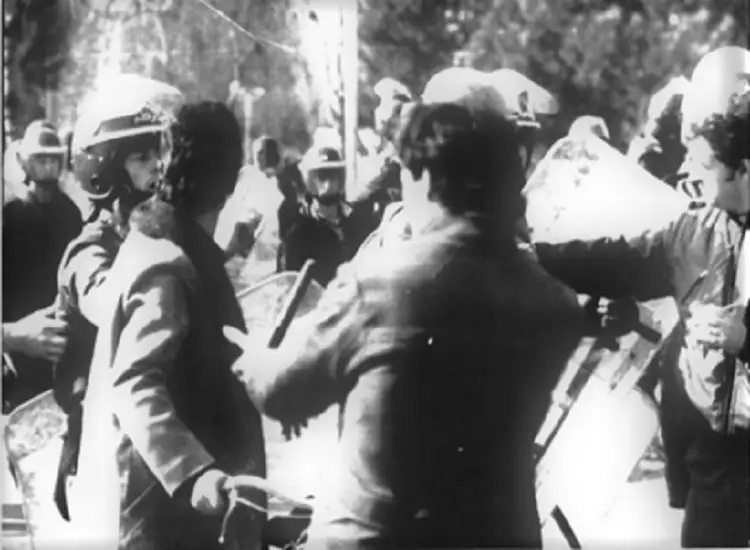
The fire truck sprayed red-colored water, and Liri Berisha did not escape this; she was soaked by the red-dyed water and also suffered eye injuries as a result of the high pressure from the fire truck’s powerful pumps. Witnessing this dangerous moment, the protesters began shouting for the women with small children to turn back. The police managed to push back a portion of the protesters as far as the former “Kosova” School, where hand-to-hand clashes occurred, escalating to the throwing of bricks and tiles.
Meanwhile, the main crowd of thousands of protesters, waving several national flags, charged the large military and police cordon with momentum and courage. After relentless clashes and the protesters’ unstoppable efforts, the police were forced to retreat to the Radio-Television building. Here, the police began firing into the air, throwing tear gas, and setting border dogs upon the protesters. At this moment, we must thank the employees of the Albanian Radio-Television and the Institute of Informatics, who had come out of their building in large numbers and shouted loudly: “Don’t shoot, don’t shoot!”
Here, a second clash took place between our crowd of protesters and the police and Rapid Intervention forces. The latter, faced with the pressure and heroic resistance of the protesters, retreated near the Prime Ministry building, creating a very strong defensive cordon to prevent the crowd of nearly 5,000 protesters following them from heading toward the government “Bllok.” About 10 to 15 soldiers of the Rapid Intervention forces were surrounded by protesters near the wall of the former Reception Directorate.
The protesters seized their rubber shields and batons. Meanwhile, some of the soldiers began to cry. The protesters were encouraged to begin chanting: “The army is with us. The soldiers are our brothers.” They released the soldiers, gave them their equipment back, and did not allow the irritated people to physically abuse them. At the “Liceu Artistik,” another large crowd of rapid intervention and order forces, accompanied by border dogs, had split and stopped the large crowd of protesters coming behind us from “Qyteti Studenti” (Student City).
Adrian Heta: “I was in the truck that toppled Enver’s bust”
The crowd of protesters grew even more energetic when it reached “Skanderbeg” Square to position itself near the monument of the communist dictator. Because the number of police and Rapid Intervention forces located near Skanderbeg Square and the National Historical Museum was very large, it was decided that the protesters would wait for the next wave of protesters coming from “Student City.” A white car passed through Skanderbeg Square, and as far as we understood, Sali Berisha, chairman of the Democratic Party, was inside.
This enthused the protesters. A group of protesters, who were at the “Liceu Artistik,” after clashing with the police, entered the park near the Parliament through “Elbasani Road.” Then, after passing the Municipality building, they positioned themselves around the Skanderbeg monument. The police and Rapid Intervention forces, accompanied by border dogs hidden behind the National Historical Museum, began to pressure the numerous protesters to retreat and disperse away from the Skanderbeg monument.
The police also used the fire truck, which sprayed high-pressure red-colored water that stained the protesters’ clothes. The other crowd of protesters blocked at the Prime Ministry building, frightened by the bursts of police gunfire in the air, withdrew from the attempt to enter the government “Bllok.”
They crossed the park behind the Prime Ministry and reached Skanderbeg Square, positioning themselves at the columns of the Palace of Culture. Meanwhile, this group of protesters attempted to attack from the fountain side but was repelled by the police. Small police cars circulated through Skanderbeg Square, sounding sirens to exert psychological pressure on the protesters. A young man named Durim Hoxha broke away from the main group of protesters near the State Bank to grab onto the fire truck’s cabin. However, shortly after, he fell, sustaining bodily injuries and rib fractures.
The fourth group of protesters arrived from “Student City” and positioned themselves around Skanderbeg Square. Among the protesters (mostly residents of “Kavaja Road,” Laprakë, “Ali Demi” road, Kombinat, etc.) located near the National Bank and the dictator’s monument, ideas were shared on how to attack the monument. Initially, the marble slabs of the stairs had to be broken to repel and clash with the police. Additionally, after this, it was necessary to stop a random heavy-tonnage vehicle to pull down the communist dictator’s monument with cables. To carry out this action, Saimir Maloku, together with his friends, asked the protesters for help to find a driver among them.
The presence of soldiers armed with snipers atop the Palace of Culture, Hotel Tirana, the National Historical Museum, and the surrounding buildings made this action impossible and extremely dangerous, and it could have been left for another day when the opportunity arose. Minute by minute, the number of protesters in the square increased. For a moment, a shout was heard: “Don’t retreat and don’t be afraid of the police, because they are armed with blank cartridges!” (training cartridges that make noise without having a bullet inside). This gave the protesters much courage. Three “IFA” police trucks covered with tarpaulins unloaded a large group of Special Forces near the fountain, equipped with plastic helmets and rubber batons. They created a strong defensive cordon around the square at the monument.
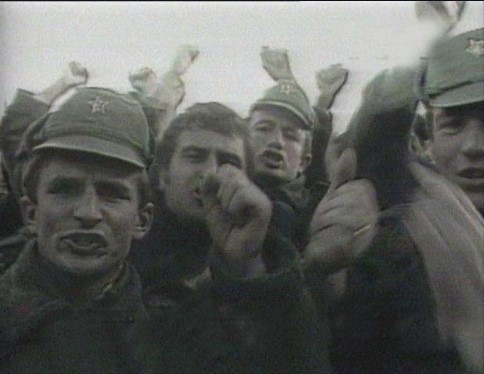
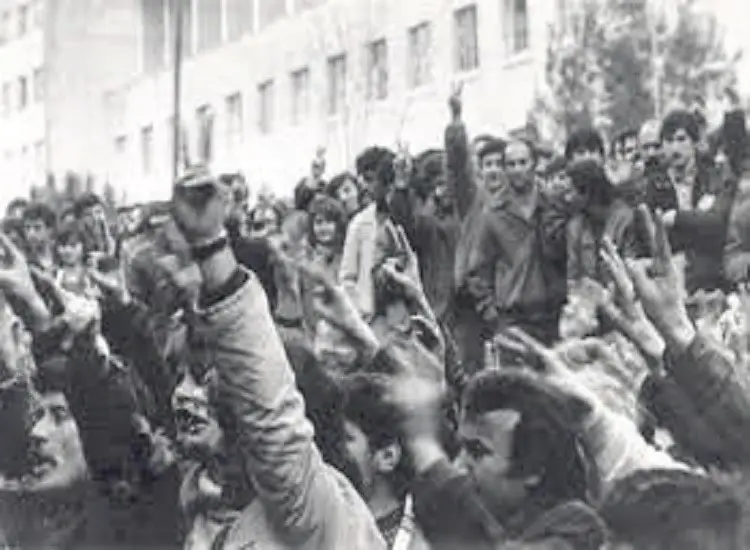
Meanwhile, Skanderbeg Square was packed to capacity by tens of thousands of people standing all around it, shouting: “The army is with us!”, “Remove the filth!”, “Freedom-Democracy!”, etc. A group of 40 to 50 people broke away from the crowd of protesters and positioned themselves near the dictator’s monument. They began to break the marble slabs of the stairs and started throwing them at the police. The Special Forces, order maintenance, and Rapid Intervention units, armed with shotguns and various weapons, began firing blanks into the air and occasionally attacking the group of protesters at the monument.
Meanwhile, the protesters retaliated by hitting them with stones and pieces of marble. From the eastern side of the National Historical Museum, numerous army and Rapid Intervention forces with border dogs came to the aid of the police. A protester near the monument held a national flag. Atop the National Bank building, the National Historical Museum, and the buildings at the entrance of “Durrësi Road” and “Kavaja Road,” etc., the police had positioned snipers and hidden cameras. Among the ranks of the protesters, the police and State Security had infiltrated many informants whose task was to report on the activities of dangerous rebel elements.
However, the efforts of the police and Rapid Intervention forces were in vain before the large crowd of protesters, who charged from all sides and forced them to retreat. The protesters, shouting “Victory, Victory!”, rushed toward the monument and became masters of Skanderbeg Square. A police helicopter flew over and filmed the numerous protesters gathered around the monument. A cameraman named Agim Buxheli was filming with an amateur camera. In the middle of the crowd, a citizen about 70 years old named Hysen Berberi, Saimir’s father-in-law, was struck in the head and covered in blood across his face.
Several female protesters took him to receive medical treatment at Clinic No. 5, located across from the former building of the League of Writers. Another citizen in a wounded state was lying on the ground. Six citizens took him in their arms, placed him in a nearby car, and sent him toward the hospital. During the clashes between the protesters and the Special Forces at the monument, Citizen Ardian Heta (the nephew of the well-known surgeon Prof. Dr. Hysen Heta) took an abandoned “IFA” truck that was in Skanderbeg Square.
Ardian took the wheel of the IFA truck and, after making two rounds around the fountain, struck a fire truck that was soaking the people with red-dyed water with the side of the truck. The fire truck stopped moving from this impact. Meanwhile, nearby was a policeman about 35 years old, wounded in the head by protesters’ stones and covered in blood. Ardian Heta, together with his friend Indrit Sukaj, took the wounded policeman into the truck and transported him to the Military Hospital in Laprakë. Before the truck left, many protesters told Ardian to come back, as the truck might be needed to topple the monument. He kept his promise and returned to the square with the truck.
Astrit Hatellari: “I put the rope on the dictator’s neck”
A large group of citizens was positioned near the spot where the communist dictator’s monument still stood. From “Durrësi Road,” two young men arrived with a roll of linen rope. At this same time, the “IFA” truck driven by Ardian Heta arrived at Skanderbeg Square. He drove the truck straight to the place where the dictator’s monument was located. Then a group of people helped Astrit Hatellari place the rope on the dictator’s monument. The first attempt failed because the rope snapped. They brought a steel cable, not very long, from the truck and tied it to the rope. In the second attempt, Astrit Hatellari, aided by another citizen, placed the rope near the fingers of the lowered left hand of the dictator’s monument.
Then everyone moved away to avoid being injured by the danger of the giant monument collapsing. The truck pulled the bronze-cast monument of the communist dictator 3-4 times, and it fell sideways in the direction of the National Historical Museum. Nearly 100,000 people in Skanderbeg Square, embracing each other with great joy over this unrepeatable event, began to cheer with immense enthusiasm. The symbol of communism fell. At the moment this monument was about to be toppled the democratic people of Tirana, with indescribable enthusiasm, shouted: “Let’s remove it, let’s remove the filth!”
Out of great curiosity, people went to the head of the dictator’s monument and, with the most peculiar actions, expressed their great hatred toward him. Then the protesters attached the cable to the head of this giant monument. The “IFA” truck driven by Ardian Heta, accompanied in the cabin by his friend Indrit Sukaj, dragged this giant monument along Skanderbeg Square. Numerous people sat atop the truck and the monument. All the people of Tirana in Skanderbeg Square accompanied the truck with numerous shouts and cheers.
Sulo Jaupaj: “I dragged Enver with the mining bus”
After all this, the “IFA” truck driven by Ardian Heta continued its itinerary toward “Elbasani Road.” Fifty meters away from the building of the (now) former Political Persecuted, the bust detached from the rest of the dictator’s giant monument. Also, the “IFA” truck suffered a mechanical failure (the clutch burned out) due to the heavy weight of the demonstrators mounted on the truck and the dictator’s monument. The crowd of demonstrators detached the cable from the truck and began to pull the dictator’s bust themselves as far as the Playground on “Elbasani Road.” Additionally, a “Skoda” truck from the freight park, driven by Sulo Jaupaj, approached the remaining part of the dictator’s monument, from the feet to the chest.
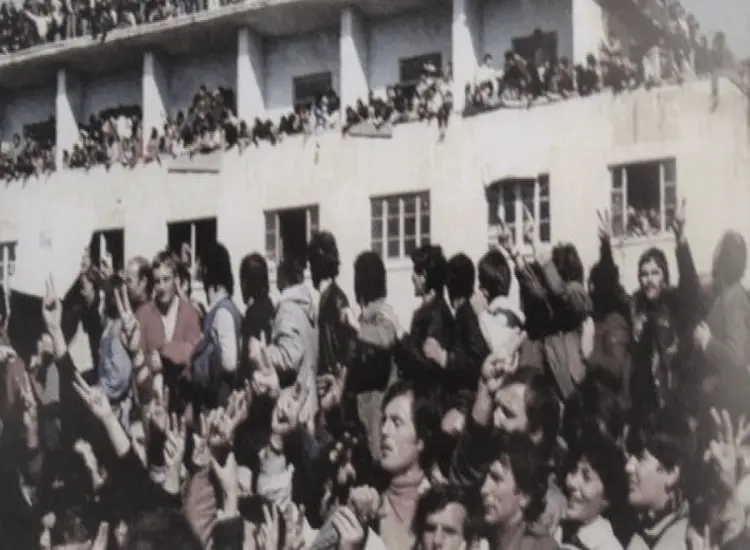
Many demonstrators tied this remaining part of the monument to the “Skoda.” Driver Sulo Jaupaj moved nearly two kilometers through the streets of Tirana with his truck, greeted by thousands of citizens. On the uphill section of “Elbasani Road,” to come to the aid of the tired demonstrators, a red bus arrived, which belonged to the workers of the Kërraba mine. This vehicle was driven by a 50-year-old dark-complexioned driver named Hysen Alla. The bus was filled with miners. The miners and the protesters quickly tied the dictator’s bust behind the bus. Then, Hysen Alla drove his vehicle toward the building of the striking students. When the bus arrived there, an extraordinary joy erupted among the hunger-striking students inside and the protesters.
The dictator’s bust was left hanging high at the striking students’ building. In the afternoon, many citizens gathered again at Skanderbeg Square. Many of them began to break the dark marble base of the dictator’s former monument. After it grew dark, the Kërraba miners re-tied the dictator’s bust to their bus. After this, the bus with several miners inside continued its itinerary toward “Kavaja Road.” In the area near the embassies, the police fired at the bus with snipers and broke two windows.
Ten miners were arrested, among them: Hysen Alla, Vladimir Xhillari, Agim Abazi, Arben Lame, Luan Paja (former founder of the PD branch for the Kërraba mine, deceased), etc. On that same day, in the cities of Gjirokastra and Korça, the monuments of the communist dictator were toppled. Albanian Radio-Television, as well as foreign news agencies, reported that in Tirana, at midday, the giant monument of the communist dictator was toppled.
At 8:00 PM, Ramiz Alia, former President of the Republic, appeared on Albanian Radio-Television and, in a public statement, said among other things: “Today our capital passed through one of the most dramatic and heavy days of its life. Irritated crowds, losing all logical reason, turned to acts of vandalism and managed to topple Enver Hoxha’s monument.”
After 9:00 PM that night and in the following days, the police and the communist State Security, based on footage from secret cameras and data from their informants infiltrated among the protesters, arrested about 300 protesters. Among them, nearly 70 people were sentenced to various prison terms on charges of illegal gathering, destruction of monuments, and assaulting state representatives. Hundreds of other citizens were fired from their jobs. / Memorie.al