
By Petro Marko
Part Four
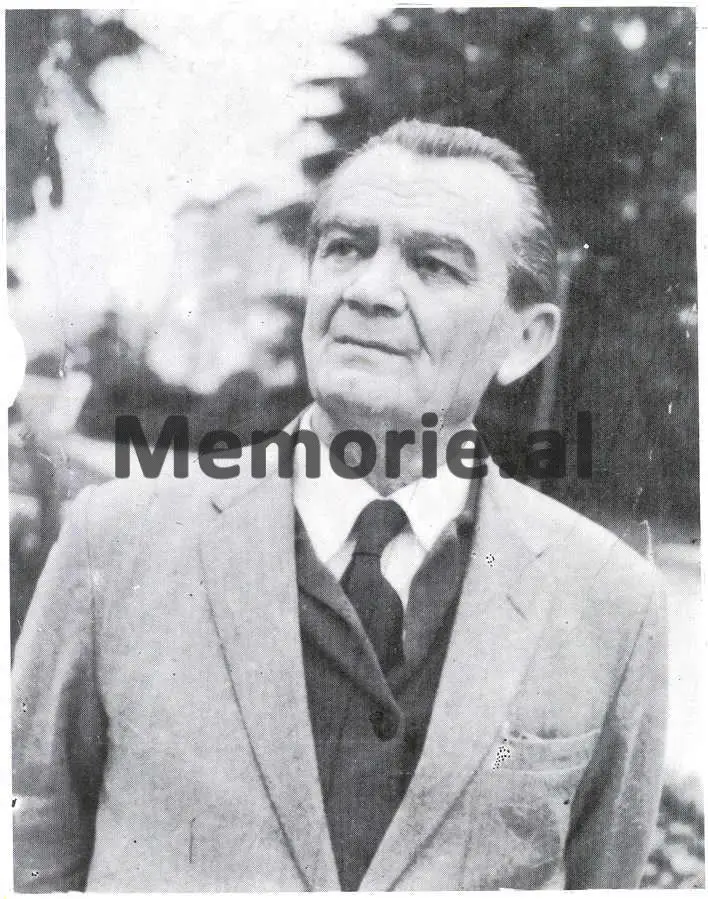
Memorie.al / The accounts of the renowned writer Petro Marko – former fighter of the International Brigades in the Spanish Civil War and the liberation of Tirana – reveal the behind-the-scenes of the National Liberation War and the reasons behind the friction between Koçi Xoxe and Enver Hoxha. The warning from Sejfulla Maleshova: “This is a terrorist party; keep your mouth shut, or you will suffer the consequences…”! Why Petro Marko was sentenced, who were those who orchestrated his arrest, and who helped him after his release? Selected excerpts from the book “Interview with me” published in the early ’90s after the collapse of the communist regime – a book that set sales records at the time.
Continued from the previous issue
THE CALVARY BEGINS: UNDER THE FOGGY SUN OF MY RELEASE
Question: How did you feel when you stepped out of the prison gates?
Answer: To be honest, I had walked out of prisons many times in years past, but I never believed I would leave this kind of prison alive. I embraced the friends I left behind and the iron door opened. Outside, Safo [his wife] was waiting for me; she had been standing across from the gate of the Old Prison for five hours. Strange! The light of freedom hurt my eyes…! But when I saw my Safo approaching, it felt as if the whole planet lit up, and in a second, all the darkness I had lived through vanished.
The Rizvanolli Family:
A noble Kosovar family by the name of Rizvanolli had provided a small room and kitchen in their yard for my family on “Bardhok Biba” street. My mother-in-law and her son lived there. Zija, Shefqet, and Ali Rizvanolli – Kosovar brothers declared “declassed” and heavily taxed by the regime – welcomed Safo’s family into their home. They treated them as their own, never accepting rent and helping however they could. They wouldn’t eat a good meal without sharing it with them. When I was released, this same friendship and big-heartedness continued.
THE BETRAYAL AT THE PUBLISHING HOUSE
I was in a state of limbo. No one would come near me. Bread was given through “triska” (ration coupons), and only those who were employed had them. Neither I nor my wife had jobs; we had no bread coupons. Eventually, in 1952, Sterjo Spasse and Spiro Xhai helped me find a job as a literary proofreader at the “Naim Frashëri” Publishing House.
I worked in an office with a friend, “X,” who was a translator. I had personally brought this “X” from the provinces where he was a teacher to work for the newspaper Bashkimi, because I recognized his talent as a poet. Now, he was translating from French. Occasionally we would talk, and he would feign surprise at why I had been imprisoned…!
One day, I was summoned by the party secretary, A.S. Two State Security (Sigurimi) officers were there.
-“Speak!” the Sigurimi officer said. “What have you told Comrade ‘X’?”
-“I don’t remember what I told my wife today, let alone conversations with ‘X’,” I replied.
– “You have spoken against the regime!” the officer repeated.
I realized “X” had informed on me. I demanded they bring him in. He entered, pale as wax – he was a coward.
– “Speak! What did this enemy of the people tell you?” they asked him.
He wouldn’t look at me. “If he is the man he claims to be, let him say it himself…” he said, staring out the window.
I was incensed. “Comrade ‘X’! There are two kinds of manhood: mine and yours. With your ‘manhood,’ you lived happily during King Zog’s time while I was in exile and prison. With your ‘manhood,’ you lived like a pasha during Mussolini’s occupation. And today, you live like a pasha under this regime that you secretly hate!”
The officer shouted, “Enough! Comrade ‘X’, leave!”
I expected the handcuffs. Instead, they told me I was being laid off due to “staff reductions.” I returned to the office, and “X” continued translating as if nothing had happened. To me, he was a non-entity, a carcass, an immoral man.
THE LETTER TO MEHMET SHEHU
Left with no job and no bread, I followed the advice of a friend, Mane Nishova, and wrote a letter to Mehmet Shehu, then Minister of Internal Affairs:
“To His Excellency Mehmet Shehu… I am Petro Marko, and I consider myself an honest patriot. I was a proofreader at ‘Naim Frashëri,’ where people who collaborated with the Germans and grew rich while we fought are still employed. Yet, I am the one laid off. I ask you: who holds the power, the enemies who collaborated or us? If it is them, tell us so we can return to the mountains to liberate the people from these leeches…!”
I handed the letter to the Deputy Minister, Mihallaq Ziçishti. On Saturday, a civilian came to my house. “Comrade Mehmet Shehu wants to see you in his office.”
When I entered, Mehmet stood up and embraced me with moist eyes.
– “Where have you been, you blessed man!” He looked at my old shoes and worn-out shirt. We talked for an hour. He was nervous, restless. He reminisced about the Spanish Civil War. He told me he would assign Bedri Spahiu (Minister of Education) to find me a job.
Mehmet knew the office was bugged. He mentioned that his job in the Ministry (uncovering the “Fifth Column”) didn’t suit him; he preferred fighting the enemy face-to-face. A few days later, I was appointed as a teacher at the Pedagogical School. In a small shack, at night by a kerosene lamp, I began writing my first novel, “Hasta la Vista.”
THE STRUGGLE TO PUBLISH: “HASTA LA VISTA” AND “THE LAST CITY”
“Hasta la Vista”:
When I finished it, I gave it to three friends from the Spanish War: Skënder Luarasi, Mehmet Shehu, and Zef Prela. They liked it. Mehmet warned me: “This book will make you many enemies among writers.”
The Writers’ Union initially refused to publish it. I called Mehmet (now Prime Minister). He intervened, demanding a written explanation from the Chairman, Dhimitër Shuteriqi. Shuteriqi told me quietly, “If you only knew who is truly blocking this…” implying someone even higher up [Enver Hoxha]. Eventually, it was published, though heavily censored.
“The Last City” (Qyteti i fundit):
Mehmet Shehu read the manuscript and told me to remove the “obscene and pornographic” language used by the characters.
– “But that is how prostitutes, smugglers, and Italian speculators talk!” I argued. “They don’t use the language of the Prime Ministry!”
Mehmet laughed.
Later, during a visit to the Publishing House, the director, Spiro Xhai, complained that I refused to censor the “naturalism” in my book. Mehmet laughed and told him:
– “He wouldn’t listen to me, so he certainly won’t listen to you! Take the novel and publish it exactly as he wrote it.”
Thus, “The Last City” was published without a single comma removed. It was my most successful work, and critics later hailed it as the first modern Albanian novel. However, after its initial success, it was never reprinted during the regime./Memorie.al