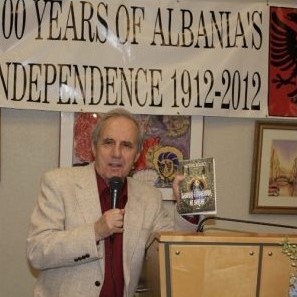
By Skifter Këlliçi*
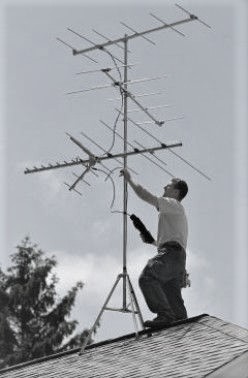
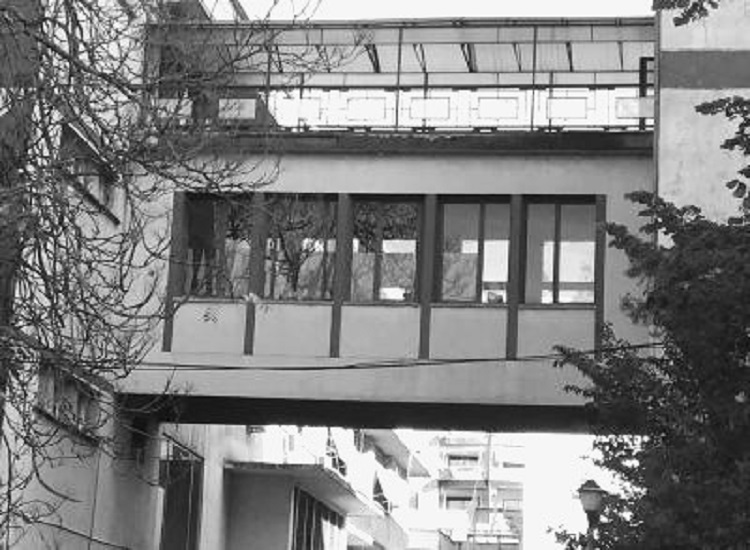
Memorie.al / In June 1970, fully 56 years ago, the next World Cup in football was taking place in Mexico. RAI and TV Belgrade were buzzing with broadcasts of this World Cup’s matches, while the Experimental Television Center in Tirana, still in its infancy (it had been born on April 30, 1960), “served” poor television viewers with dry news and mostly Albanian and especially Chinese films. I asked one of the technical directors if at least RAI channels could be brought onto our modest television screen, because, in order to follow these international sporting events, fans everywhere in Albania were erecting all kinds of antennas. (A friend from Korça told me at that time that one winter afternoon, when an international football match was being played in Rome, he had climbed onto the roof of his house and started moving the antenna all around, waiting for his friends in the room where the TV was placed to tell him where to position it. However, frozen from the cold, he had angrily tossed it further onto a tree branch in the yard. “Thank goodness, that’s where you placed the antenna,” he heard his friends’ voices.) A story for both laughter and tears.
“With the press of a button, we can bring RAI channels onto our screen,” the technical director replied to me. Then I continued with the next question, whether he, as an old communist, could make a proposal to Thanas Nano, the then director of Radio Tirana, that the matches of that World Cup be broadcast by TVSH, with my commentary. He found this proposal very suitable and passed it on to Director Thanas that very day. However, being pedantic and overly cautious, he rejected it.
One January morning in 1972, Manush Myftiu, a member of the Politburo and Deputy Prime Minister, unexpectedly came to the RTVSH building, who in an organized meeting, for no apparent reason, quickly and coldly informed us that by decision of the Politburo of the Central Committee of the PPSH, the director of this institution, replacing Thanas Nano, who had worked well but also had shortcomings due to his conservative, dogmatic, and pedantic tendencies, was appointed Todi Lubonja. It was the period when Enver Hoxha had “somewhat eased the prisons of the dictatorship” and would later also have a long conversation with Agim Mero, First Secretary of the Central Committee of Youth, in which he would particularly instruct that measures be taken to give young people the opportunity, alongside their studies and work, to be entertained more with cultural-artistic programs, evenings, artistic and sports performances.
And for this reason, the decision had been made to replace at the head of RTSH a bureaucrat with limited culture like Thanas Nano with Todi Lubonja, who in this regard had a broad horizon. Upon learning that I was capable of commenting on international matches, translating Italian commentators with headphones in my ears and also commenting myself, Todi Lubonja decided that the Italy-Belgium match, for the Euro ’72 qualifiers, which started at 17:00 on April 26, 1972, and was broadcast by RAI, and the other match, England-West Germany, which started at 20:45 on the same day and was broadcast by TV Belgrade, should also be broadcast by TVSH. On this occasion, the voice of the foreign commentators had to be replaced with background noise from stadium environments.
The next day, newspaper readers were surprised when they saw that on our television’s programs for that day; two international matches had been scheduled. But what they were, they couldn’t imagine.
It is understood that despite the fact that I had been the “hand” that had made this proposal, now that Todi Lubonja had presented it to Ramiz Alia, Secretary of the Central Committee for ideological affairs, who had approved it without hesitation, I was initially surprised. But I had no problem commentating the first match following the well-known Italian telecommentator, Nando Martellini, because I knew sports Italian well. I had a problem with the second match. From Russian, I understood very little (from Serbian), but since the voice of the Yugoslav commentator, as well as Martellini’s, was covered by stadium noise from our studio, with the help of notes and curiosities about football, taken from the Soviet press and what I knew, I “crossed the river.”
The impressions were as surprising as they were enthusiastic, even euphoric, because in many areas of Albania RAI was not visible, and commentary of a match in the Albanian language was a pleasant novelty for Albanian television viewers. Furthermore, after the broadcast of the first match, there were those who thought I had gone to Milan, where the first match was being played, but when they heard my voice in the second match, which only two hours later was taking place in London, they became convinced that I was commentating from TVSH. In July 1972, I reminded Todi Lubonja that besides international football matches; TVSH could also broadcast footage from the Olympic Games, which would take place from August 26 to September 11 of that year in Munich, West Germany. He liked this idea. And so one morning, at the beginning of August, he called me urgently to his office.
What had happened? As he explained to me, a day earlier at the Central Committee headquarters, he had met Enver Hoxha, who had congratulated him on TVSH’s broadcasts of international sporting events. And when Lubonja added that the Munich Olympics could also be broadcast, Enver Hoxha immediately approved this proposal. Therefore, Lubonja told me to start preparing for this major event in the world of sports. To tell the truth, I did not expect us to broadcast all types of events of this Olympics, because TVSH, unlike RAI (which had three channels), broadcast its programs only on one channel. Therefore, a selection had to be made of those types of sports that were known to our viewers. But the order from above was that the Olympics should be broadcast in their entirety. (Here I think they went too far…)
Naturally, at 18:00 and 20:00, as usual, the news would be given, at 18:30-19:00, the children’s program, and then all the remaining spaces of the daily program would be covered by the broadcast of the Olympics, also adding the entire program of its events, which started from the early hours of midday. This meant at least 10 hours, and in some cases even more, of commentary per day, which, of course, I could not do alone. So I talked with friends who knew Italian, even better than me. But they regretfully declined, because they were not at all fond of sports and, as a result, did not know sports terminology.
Only the well-known journalists Napolon Roshi and Pirro Naçe, as well as handball specialists Feti Borova and Kreshnik Tartari, accepted. But even they, as per their capabilities.
But before the start of the broadcast of this Olympics, these measures were taken: During the opening ceremony, images of the teams of the Soviet Union and the USA should not appear on the screen. They would be replaced by a placard reading: “The 19th Olympic Games in Munich.” Also, in case athletes from these two countries won gold medals, and consequently their respective national anthems would be played, their images should also be removed and replaced with the same placard. Today, one laughs at these absurdities of that time. With Borova, I also commentated on the final match USA – Soviet Union in men’s basketball, which started at 12:00 and continued until 02:00 in the morning, until then the most dramatic match in basketball history!..
And this, because the Soviets requested a timeout when only three seconds of play remained and the Americans were leading by only one point. I couldn’t understand what they could do in 3 seconds…?! But then, from the baseline, with a very high lob, one Belov (Sergei) passed the ball to another Belov (Alexander), straight towards the opponent’s backboard, who grabbed it and with a deceptive move jumped and put it in the basket. Thus, for the first time, the Soviet Union won the gold medal in men’s basketball.
I had prepared thoroughly for these games. I had read many articles, with data and curiosities from the Soviet sports press, which, although delayed, still arrived in Albania, I had read the book “Olympic Encyclopedia,” also in Russian, which included the results of the six best athletes in all types of events of the Olympics, from the first Olympics in 1896 in Athens. But, despite the explanations of the Italian commentators, which I heard through the headphones, there were sports I did not know at all.
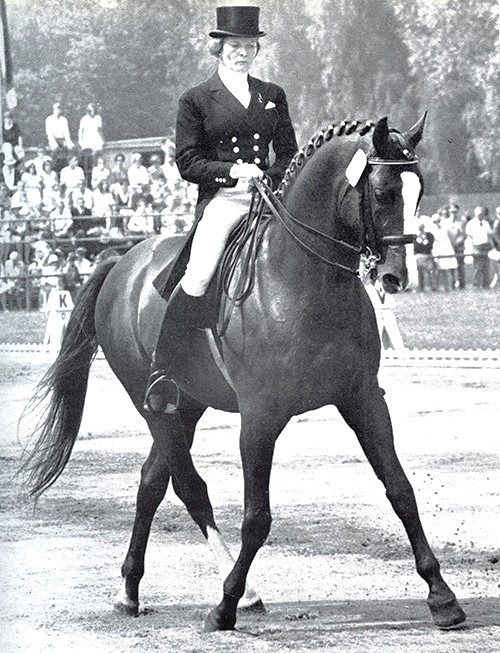
So I made mistakes, and even some blunders, like the following one…! One evening, one of the technicians at the broadcast console showed me on screen a horse competition, and for heaven’s sake, with commentary from a Yugoslav channel, i.e., in Serbo-Croatian, because at that time RAI channels were not linked to the Olympics…! On screen, I see a rider dressed in a helmet, white breeches, shiny boots, black jacket and top hat, mounted on a white horse, which to the sound of a melody and with a small, rhythmic military step, wandered lengthwise and crosswise on a rectangular field covered with sand.
On the screen, I read the word dressage, a sports term in French and English, which in Italian translates to “addestramento,” i.e., training. And, since the horse, apparently commanded by the rider, continued to make military-like strides, as soldiers do in drill training, first straight, then sideways, and then straight again, but without the commands: “Forward march!”, “Left turn!” or “Right turn!”… I thought to myself that this rider was doing… training, and oddly enough to… music, which would then be followed by the horse competition with jumping obstacles, which I had only seen in movies…!
However, I was surprised when I saw that this “marching” with short steps of the horse, guided by the rider, lasted rather long!.. Not only that, but suddenly applause was heard, and then the rider dismounted, left the field, and was greeted with cheers from numerous spectators in the stands around the sandy arena…! As much as from Russian, as I said, I understood some “crumbs,” even from Serbo-Croatian, in this case not a single word of the Slavic commentator stuck in my mind. Thus, I concluded my commentary by explaining that the rider had now finished his training, i.e., the warm-up, or what was called “dressage,” and would then with his white horse start the race with obstacles…! Fortunately, shortly after, images of athletics events appeared on the screen, now broadcast by RAI, i.e., in Italian, and I was freed from this anxiety that was taking my breath away.
However, the next day I felt even more anxious, even embarrassed, when a friend who was fluent in Italian and also knew equestrian sports, informed me that I had made huge blunders, when I had called those movements of the rider on the horse training before the obstacle… race! And this, as he explained to me, because this rider, with the commands he had given the horse via the reins he held in his hands and to the sound of that melody, part of the program, had actually finished the competition called “dressage,” and not training or warm-up…! Thus, the horse, also spurred by the melody, had traversed geometric figures, with letters from A, C, E, B to F, K… which I had seen on the screen, but without understanding them.
And finally, he added, that the rider who had finished that competition perfectly and had even won the gold medal, was… a German woman, named Liselott Linsenhoff, the first female rider, who after the 1968 Mexico Olympics, won for the second time in the Munich Olympics, such a medal in a competition that also included men. There was no bigger mistake!.. As soon as I went to the office, I immediately opened the “Olympic Encyclopedia” in Russian, which, apart from the unfortunate coincidence of this competition during those days, I had never parted with, and I read that everything that friend had informed me was true.
But fortunately, he was the only one who made this remark to me. And this, because this type of sport, i.e., dressage, was not known by our sports enthusiasts, or was known very little by people like my friend…!
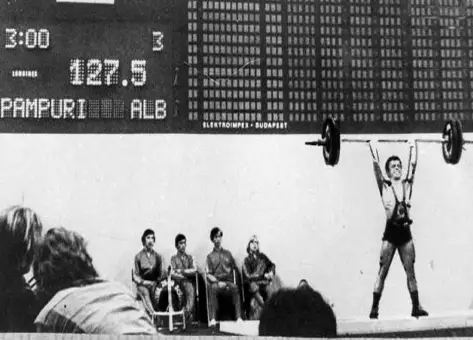
Nevertheless, on August 29, I had the pleasure of conveying to our television viewers a very joyful announcement: our athlete, Ymer Pampuri, during the weightlifting events, broke the Olympic record and was declared world champion in the press style (127.5 kg). Even today, he holds this record, because after this Olympics, this style was removed from official competitions. Upon returning to his homeland, I invited Pampuri to the “Sports Rubric,” where he nicely recounted moments from this exciting competition, which unfortunately was not broadcast by RAI.
Meanwhile, Radio Tirana also began broadcasting songs from the Eurovision Song Contest, TVSH’s artistic programs were enriched with television films, which were also bought from Eastern countries. Not only that, but on the orders of Mehmet Shehu, who was considered a staunch dogmatist, televisions produced by UEM were now sold together with the apparatus that allowed viewing of RAI’s second channel and programs of Yugoslav channels, where Western films, especially American ones, were also broadcast.
It was even allowed that the 1972 Sanremo Festival could be watched on televisions placed in work and production centers.
We thus come to the 11th Song Festival at RTSH…! Enver Hoxha did not like it. Not only that, but starting with him, a frontal attack began against bourgeois-revisionist manifestations in culture and art, which culminated in the 4th Plenum of the Central Committee, in which Todi Lubonja and Fadil Paçrami were condemned as enemies, and later also talented creators, writers, artists, musicians.
The broadcasts of international events by TVSH also suffered somewhat. One Wednesday evening in early March 1973, the first quarter-final match of the European Cup, Bayern Munich – Ajax Amsterdam, was taking place in Munich. But, that same afternoon in Elbasan, the local “Labinoti” was playing against a Bulgarian team for the Balkan Cup. I entered Todi Lubonja’s office. He was talking on the phone with someone about an interview on the occasion of March 8. I understood that the interlocutor was… Vito Kapo. Todi’s voice sounded sad. I explained to him how we should proceed: whether to broadcast in the evening the recorded match of Elbasan, or Bayern against Ajax. “The latter,” he explained to me, “because hardly anyone will follow the match in Elbasan, which we broadcast tomorrow.”
He was right. But two weeks later, at the meeting of the Party organization of the Central Committee, Enver Hoxha openly attacked Fadil Paçrami and then Todi Lubonja, describing the latter as a “right-wing deviator who has supported pronounced liberal and opportunistic views, modernist aesthetic tastes, who tried to give Radio-Television a merely informative and cultural-educational direction… which is in contradiction with the orientations of the Party’s Central Committee…”! (Enver Hoxha, Selected Works, page 9, year 1986). At a meeting of editors at Radio-Television, the aforementioned match in Elbasan was also mentioned, being described as a “political mistake” of Todi Lubonja, because it was that “national” match that should have been broadcast by TVSH and not the Bayern – Ajax match, between “bourgeois” teams.
Later, I was also criticized for my tendency for “commentaries with historical-sports data and literary figures.” In a match between Barcelona and Ajax for the European Cup in February 1974, I was this time directly criticized even by Kadri Hazbiu, Minister of Interior, because I had pointed out that at Barcelona’s “Camp Nou” stadium, about 30,000 Dutch fans had descended to support their team, a curiosity I had heard from the Italian telecommentator who was commentating that match. The criticism, according to the Minister of Interior, was related to the fact that I was indirectly highlighting the high economic level of the Dutch, who have plenty of money, even to follow their teams in foreign countries.
Television broadcasts of international sporting events on TVSH also suffered, starting with the 1974 Football World Cup. During their broadcast, the voice of the Italian commentator was removed along with the stadium atmosphere. Viewers were thus forced to hear only my voice, as if commentating in a deaf and funereal space from another planet. Therefore, viewers only heard my introduction with curiosities prepared for the World Cup matches and then switched to RAI channels, from which the footage of these matches was obtained, now dry as dead. Thus, even the broadcasts of sporting events, taken from foreign channels and broadcast by TVSH in the gloomy years of the communist dictatorship, were reduced to this.
TRAGEDY AT THE OLYMPICS…!
For the first time in the history of the Olympics, from antiquity until then, on September 5, on the 11th day of the 20th Olympic Games, which continued to be held in Munich, a macabre event occurred. A group of Palestinian terrorists penetrated the Olympic village, specifically the building where the Israeli athletes were housed. After several twists and turns, the terrorists, under the threat of weapons, captured them, killed two of them, and held the others hostage. So that night and the next day, instead of images from the sports fields and halls, we watched with anxiety what was happening in that building, immediately surrounded by German police forces.
The terrorists demanded that in exchange for the hostages, Arab prisoners in Israeli prisons be released. After hours of fruitless negotiations, all five terrorists were killed, but also the Israeli athletes held hostage, as well as a German policeman. This horrific crime was condemned by all world opinion. Even by the Albanian communist leadership, which usually always held a stance against Israel, in defense of the interests of the Palestinian people? On September 6, in the presence of 80,000 spectators and 3,000 athletes gathered at the Munich Olympic Stadium, a commemorative ceremony was organized for the victims of this terrible terrorist act, and then the competitions continued according to the schedule. But it is understandable how much this terribly tragic and completely unexpected event weighed on the emotional state of the spectators and the Italian commentators, whose voices I heard with emotion through the headphones.
The broadcast of the Munich Olympics by TVSH had repercussions. I remember that a relative of mine, a candidate member of the Central Committee, and assistant to a member of the Politburo, had told me that up there… above, they speak well about this great sporting event, through which for the first time our sports enthusiasts were also becoming acquainted, and about me who was commentating on them. Furthermore, at a meeting organized in October of that year, in one of the halls of the Central Committee, with us sports journalists, Pirro Kondi, after evaluating our work, also dwelled on the broadcast of this Olympics and, more or less, said: “At first we were hesitant, thinking about how the broadcast of all the Olympic events would be received by our television. But news came to us that even viewers from distant regions had followed them with interest.”
After the 4th Plenum, Todi Lubonja and Fadil Paçrami were expelled from the Party and condemned as enemies of the people, with 15 and 17 years of imprisonment respectively. At a meeting of the Politburo, Enver Hoxha was presented with a list of names of prominent personalities who could be approved for the position of Director General of RTSH. But Enver Hoxha, after giving the list a quick glance, without asking for the opinion of the puppet members of the Politburo, wrote diagonally on it these words: “Let Thanasi return to Radio. We may not have professional advancement, but he won’t make Todi’s mistakes.” (Marash Hajati, “The Back Door of the Press,” Year 1996, page 87). He was forgetting, or pretending to forget, that by decision of the Politburo, signed by him, he had described Thanas Nano as a conservative. He was also forgetting that he had strongly emphasized that the Party, (led by him), must fight with vigilance, both conservatism and liberalism.” / Memorie.al
(*Writer, publicist, former journalist and sports commentator at RTSH, 1959-1999)