Part Four
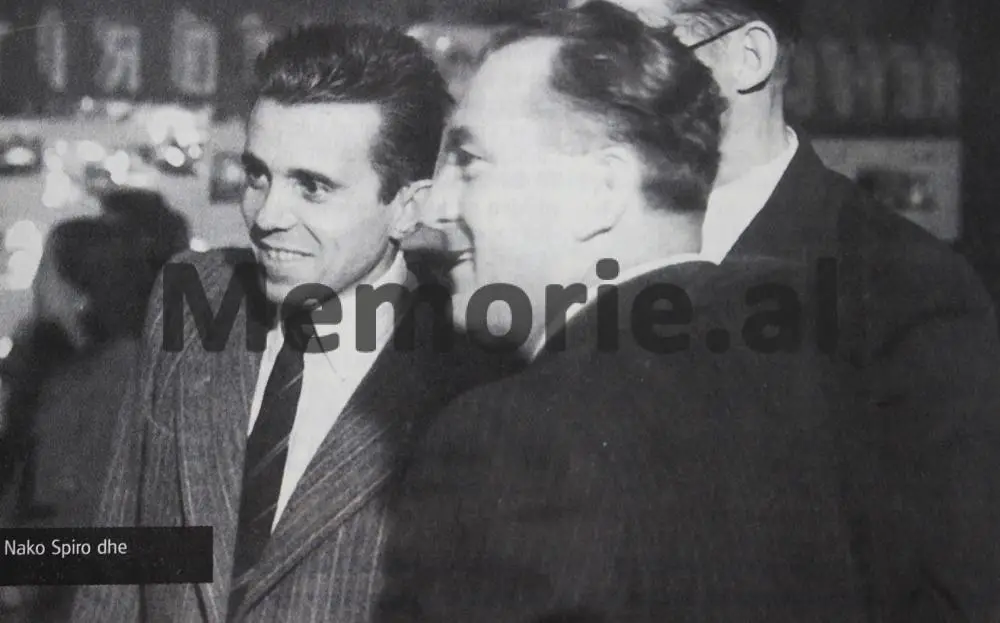
Memorie.al / The relations between Enver Hoxha and Mehmet Shehu during the communist regime were not at all good. At least, that is what the Americans claim. The CIA has declassified a document from 1955, which shows government dismissals, as well as the Hoxha-Shehu relationship. It states that there was great rivalry between them, and according to the report, Hoxha brought his own people into the government, and especially Spiro Koleka, in order to strengthen his positions. Furthermore, other documents show what was happening with the educational system in the country.
Continued from the previous issue
Internal Situation – June 1955
Two major shocks have occurred in the Albanian regime in the last three weeks, with two high-level leaders dismissed on charges of incompetence: Deputy Prime Minister Tuk Jakova and the Minister of Education and Culture, Bedri Spahiu. Among the possible reasons for this are the change in orientation of Albanian policies towards Yugoslavia, or the development of what has been reported previously, namely rivalry between Prime Minister Mehmet Shehu and Party Chairman Enver Hoxha.
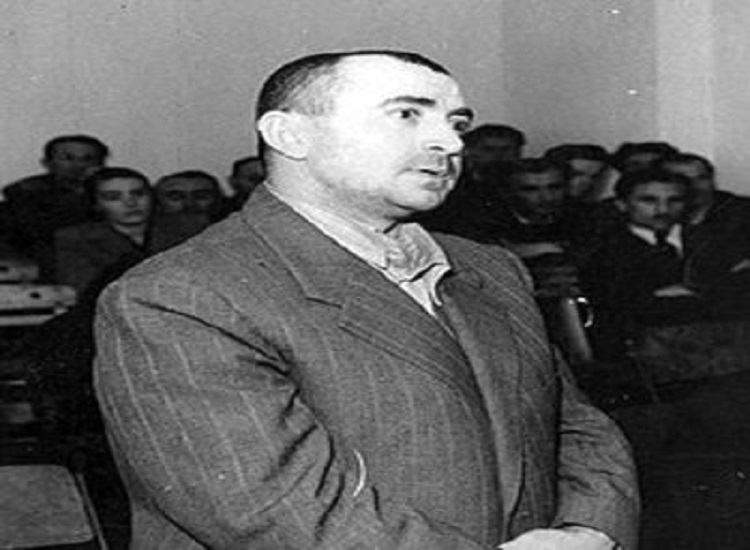
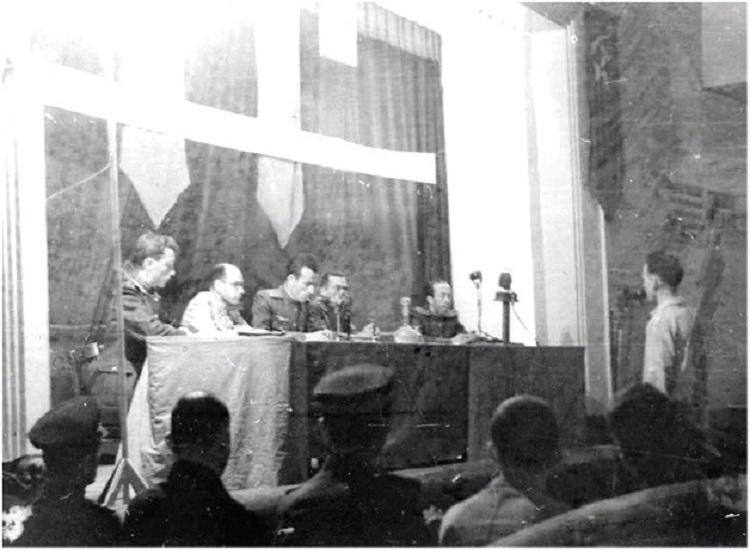
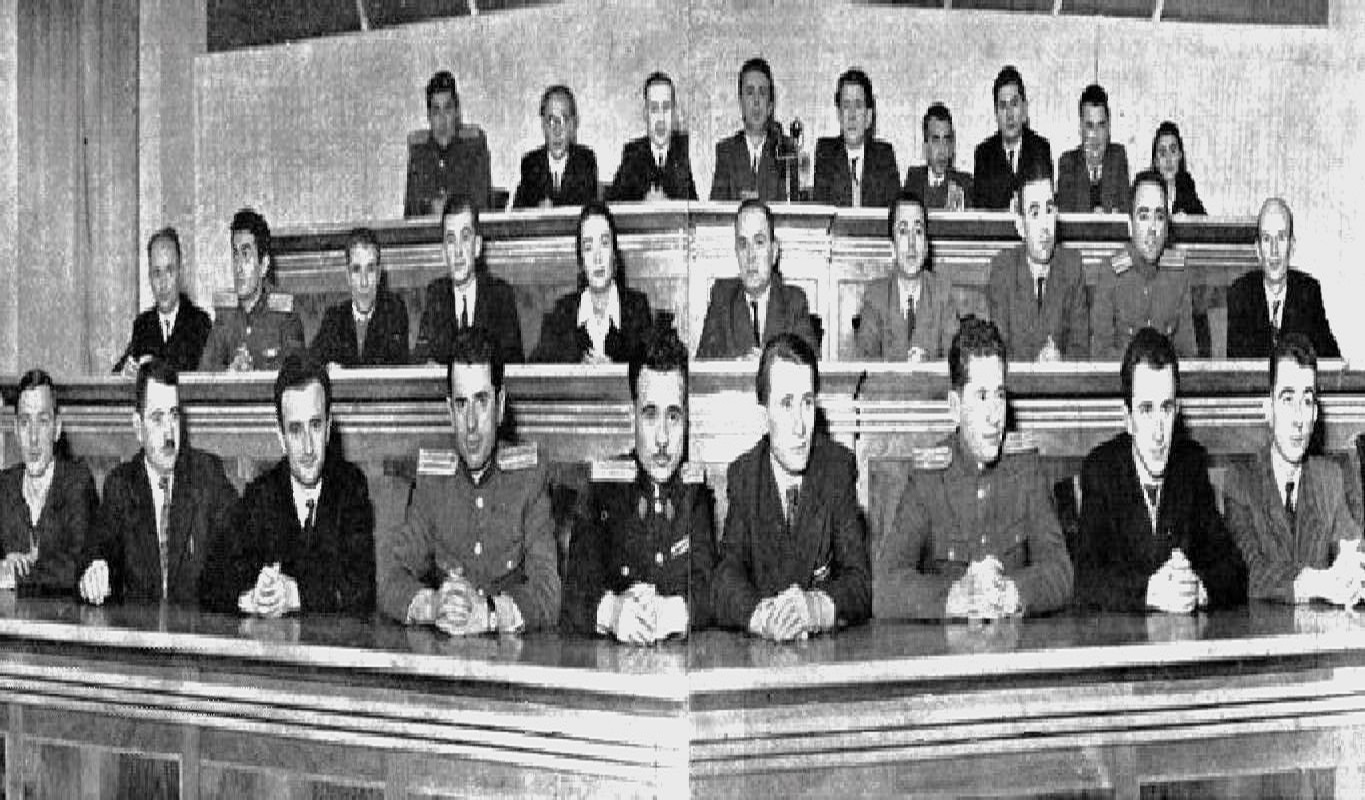
One of those dismissed, Bedri Spahiu, had headed the commission that tried and condemned Koçi Xoxe, the leading Albanian Titoist, in May 1949. Meanwhile, the other dismissed official, Tuk Jakova, is reported to have been in Moscow in the fall of 1948 to receive the orders for Xoxe’s removal and to replace him as party secretary. On the other hand, both of these men began to fall out of favor starting in 1951. Their dismissal was part of the personal difficulties of both within the party.
Regarding the Hoxha-Shehu rivalry, the evidence for their involvement with each other is mostly based on rumors. The strongest evidence concerns the elevation of Hoxha’s loyalist, Spiro Koleka, to the post of Deputy Prime Minister, signaling that other moves may be expected from Hoxha to strengthen his positions. The Italian Foreign Ministry also claims that the changes come after the removal of anti-Tito elements, and that the time has come for the USA to raise the issue of Albania’s impartiality.
The proposal indicates Italy’s desire for more maneuvering in Balkan affairs and suggests that perhaps Rome is exaggerating the risk of Yugoslav-Albanian moves. The Yugoslavs have shown little willingness to undertake unusual steps towards Albania and in fact appear more interested in what can be done with Bulgaria.
The Education System, December 1950
The education system in Albania functions as follows: The Minister of Education, Karaman Ylli, is also a member of the Central Committee of the Party. He is about 30 years old and has proven his loyalty to the party. In 1947, he was a member of the Albanian delegation to the Paris Peace Conference.
Upon his return, he became Minister of Education, replacing Naxhie Dume, a woman about 35 years old, the wife of an army general who was dismissed after the wave of purges and arrests following the execution of Koçi Xoxe. Informants say that the Minister of Education is under the supervision of a Soviet advisor, with an office inside the ministry. These advisors never intervene personally but pass instructions to the minister.
Deputy Ministers
Kadri Baboçi is about 45 years old, Deputy Minister of Education, responsible for administration and personnel. He is from Gjirokastër, where he was a teacher at the lyceum. Baboçi registered with the Communist Party with the arrival of the new regime and was appointed Deputy Chairman of Gjirokastër. In 1947-48, he was appointed Chairman of the Commission for Textbooks and School Curricula. When he became Deputy Minister, Baboçi replaced one Malile, who had left for the Soviet Union for studies. Informants say that Baboçi is a man of average culture and intelligence.
Shemsi Totozani is about 40 years old, Deputy Minister of Education responsible for school organization, and according to the informant, has shown ability in this field. Totozani went to France for studies but did not manage to graduate. He was a teacher in Vlorë and Gjirokastër during the Italian occupation, and was a partisan during the German occupation.
With the arrival of the new “democratic” government, he became Secretary of the Ministry of Education, when the post of Deputy Minister had not yet been created. Suspected of “deviationism,” he was assigned the position of director of the girls’ school in Tirana, but after the trial of Koçi Xoxe he was reinstated at the ministry where he was appointed to his current position.
General Directors
One General Director is subordinate to Deputy Minister Baboçi, but we have no information on the person holding this post. Another director is Siri Shapllo, subordinate to Deputy Minister Totozani. Shapllo is about 50 years old, from Gjirokastër, and has been a teacher at the lyceum. He was a partisan during the German occupation and is now a “moderate” political manipulator.
Section Heads
Section heads are subordinate to the General Directors, and have direct contact with the public. The Commission for Textbooks and School Curricula is responsible for drafting school textbooks and is merely a ‘pro-forma’ function, that is, to ensure that they adhere to the communist political program. Most textbooks are simply translated Soviet school textbooks.
The Commission consists of professors from various schools reflecting two schools of thought: one is for the complete use of Soviet textbooks translated into Albanian, while the other favors adapting Soviet textbooks in relation to Albania’s environmental conditions. The leader of the first school of thought, Qibrie Ciu, is a lame woman about 30 years old, who studied pedagogy in Florence.
During her administration, all Albanian textbooks were translations from Russian. She is described as having “violent political feelings” and was highly valued by the Soviets for her spoken and written language. The second school of thought was led by Kol Popa, a chemistry teacher at the Tirana Pedagogical School. During the Italian occupation, he had been a pharmacist in Elbasan, and had studied in Pisa, where he graduated in pharmacy and chemistry.
Our informant declares that in February 1950, instead of philosophy, Marxism was taught in Albanian schools, while in natural science courses, great importance was given to the theory of Evolution. Instruction in Western foreign languages (English, French, Italian, etc.) was prohibited. The Russian language was compulsory in every high school.
According to information received in August 1950 from a former Albanian teacher, the Ministry of Education has two representatives in each party committee. In the Ersekë committee, those responsible for primary education are Anesti Furxhiu and Gjon Verdufi. Four-year schools have been opened in almost all villages of Albania. In some localities, kindergartens and evening courses for illiterates have also been opened.
A former school teacher in Albania gives this analysis of secondary schools: Tirana has five or six high schools with a four-year program, and a three-year commercial school. There are also three or four Pedagogical schools for teachers, from whom primary school teachers are appointed. (Another report says that after completing the Pedagogical school, new teachers must also complete a three-month course at the Party school.)
Tirana also has a four-year Technical school, where students are prepared for various trades and professions. The above informant says that after secondary school, Albanian students can proceed to one of the universities of chemistry, physics, natural sciences, literature, and history-philosophy. University studies last two years, at the end of which graduates become teachers in secondary schools. The most distinguished students are sent to the USSR or to the satellite countries east of the Iron Curtain for further studies.
The university offices are on “Kavaja Street” (formerly “Via Mussolini”). Our informant says that scholarships are given to special students for devotion to the Communist Party. School books are sold at a cheap price, and the texts praise the aid that the USSR gives to Albania. Teachers’ salaries range from 3,000 to 5,000 lek per month.
Teacher Appointments, August 1951
Graduates of the Pedagogical Institute can be used as teachers up to high school grades. Russian is taught both at the Pedagogical Institute and in high school. For those who want to be appointed as school teachers, the following criteria are necessary:
– A certificate from the village base organization certifying that they are “good people,” interested in work, and come from the lower social classes.
– If the candidate is a member of the Communist Party, the certificate is given to him personally. If not, the certificate is sent by courier from the base organization to the area party committee.
– The applying candidate must send the certificate to the committee, together with his diploma. He is then examined by a doctor to see if he is mentally sound and has no communicable diseases. The doctor gives him another certificate.
– The candidate also requests a certificate from the vital statistics office of his area.
– After two weeks, the Committee office responds in writing to the candidate regarding his approval; if he receives no response, it means the application has been rejected.
– Regularly, opponents of the political line of the Albanian Communist Party are not appointed as school teachers.
The appointment of a teacher is announced by the area party committee. It is not known whether the Ministry of Education intervenes in local teacher appointments, but our informants think that the area party committee has the authority to make the appointments itself. After appointment, the new teacher must consult the manual called “The Teacher’s Assistant.” The book sets out the main principles of communist propaganda that the teacher must reflect in his dealings with students.
It also presents problems related to the work of cooperatives and collective farms. The teacher is obliged to spread propaganda in favor of these communist institutions and also in favor of the Soviet Union. For example, the book says that in 1947, the Soviet Union gave Albania ten tractors, and in 1948 gave 56 tractors, and states: “See how much our friend the Soviet Union has helped us.” In general, all subjects of study are filled with propaganda in favor of communism.
Youth Organizations
In the Bilisht School where our informant studied, there is a youth organization. Not all school students were enrolled in this organization, since only those from the lower social classes could participate, and preferably only the children of partisans who had been killed fighting against the occupier. Enrollment in the youth organization was done after a meeting with all the school’s students.
At this meeting, the youth leader, who had all the students’ names, read out those who met the criteria for admission to the Youth Organization based on the biographical data of the students and their families. The youth leader read out the names of the students who would be admitted to the youth organization, and for each accepted name, he explained the special reasons for each student’s admission.
He also gave reasons for the non-admission of students to the organization, but promised that they would be admitted later when they had worked hard for the Party. Regularly, students wanted to enroll in the organization not because of ideology or communist sympathy, but to avoid being seen as “reactionaries,” since reactionaries were usually expelled from school. In another statement, he says that students who belonged to the Organization had better chances of advancing in their studies due to teachers’ leniency.
For the election of the youth leader, there were two methods: Secret vote among the council members, and secret vote of the students for eight pre-selected candidates. The votes were then counted, and the one who received the majority became the Youth Leader, while the one who came in second became the Youth Secretary. The school’s youth council pledges to implement the training program presented by the area party committee.
From the seventh grade onwards, propaganda lessons and the theory of communism are given by members of the youth organization council, while in the lower grades these lessons are given by ordinary teachers, who are also members of the communist party. According to a decision of the school organization council, all students gather twice a week for three hours in the afternoon to explain the theories of communism and the teachings of Stalin, Lenin, etc.
Whenever there are Soviet holidays, there are also afternoon meetings with students where the meaning of the holiday and what it means for humanity are explained. On an anniversary of the October Revolution, pictures of Stalin and slogans in support of Albanian-Soviet friendship were placed on school walls. The celebrations of the October Revolution last one month.
Teachers’ Salaries
The base salary of a primary school teacher is 3,500 lek. But from this, social contributions, the Red Cross, and government taxes are deducted, which amount to about one month’s salary per year and are deducted from each month’s salary. The total deduction amounts to 550 lek per month. / Memorie.al