Part Two
Memorie.al / For the CIA (American Intelligence Service), the Yugoslav Dushan Mugosha was one of the organizers of the Albanian Communist Party. There have been many debates regarding his role and what he did in communist Albania, while now even the CIA has shed light on the matter. In a declassified document from 1952, it is stated that he was part of a liaison against Enver Hoxha in Yugoslavia and worked against the communist regime in Tirana. Likewise, the document also reveals the connections that Albanians had with the UDBA (Yugoslav State Security Administration), mentioning several names of spies of the Serbian secret service. In several other documents from the same period, the Russian role in our country is also detailed.
Continued from the previous issue
Operational Tasks
According to the established framework, it is ordered that CIA operations in Albania be carried out in accordance with the following instructions. These operational tasks will reflect the requirements placed upon the CIA by the National Security Council and the Department of Defense. These will take into consideration the CIA’s capacities, interpreted according to several basic principles:
State priorities indicate how the emphasis of actions should be placed. Low-priority tasks should not be neglected while carrying out high-priority tasks.
During intelligence gathering, including observations and operational-type movements, actions must be kept separate from one another at all times, and resources should be used according to the established order of priorities in national policy.
Agent Potentials
There are contacts between some officers and two members of the Albanian legation in Rome. Several meetings have not offered much hope for a possible defection, although one has shown potential for conversion. The means for audio surveillance exist, but clandestine infiltration into the embassies in Rome or Paris is not currently possible. In Paris we can conduct wiretapping, but American personnel is not readily available.
Usually, in such operations, a liaison point is needed, and we are informed that there may be complications. While in Rome we have the equipment and personnel, but due to the low priority assigned to Albania compared to other areas, there is little chance of utilizing them. Usually, the recruitment of agents is conditioned by the absence or emergence of incidental opportunities. We will continue to seek and exploit every opportunity that arises.
Fortification Works in Albania
January 1950
The areas of Tomorri, Lubesh, and Kapinova are now closed to all movement and for all purposes. There has been acceleration in the deliveries of materials to this area. For example, on May 4, 1949, early in the morning, about 29 trucks with materials passed through Berat towards Çorovodë. All the vehicles were military and next to the drivers sat a security officer. In addition to the covered trucks, there were also those carrying electrical cables, which traveled only at night.
The first checkpoint on the Berat-Çorovodë road was installed at the “Proletarian Revolution” Bridge, which is about 300 meters south of Berat. The next checkpoint with security personnel is Quhajezi, a small village with three farms (cooperatives?) from which the residents have been evacuated. It is located about 7 km south of Berat. In Berat there are two diesel pumps, one of which serves exclusively the trucks moving in the Berat-Vertop direction. This pump dispenses about 650 liters of fuel per day. The distance between Berat and Vertop is 17 km.
Fortifications on the Mat River
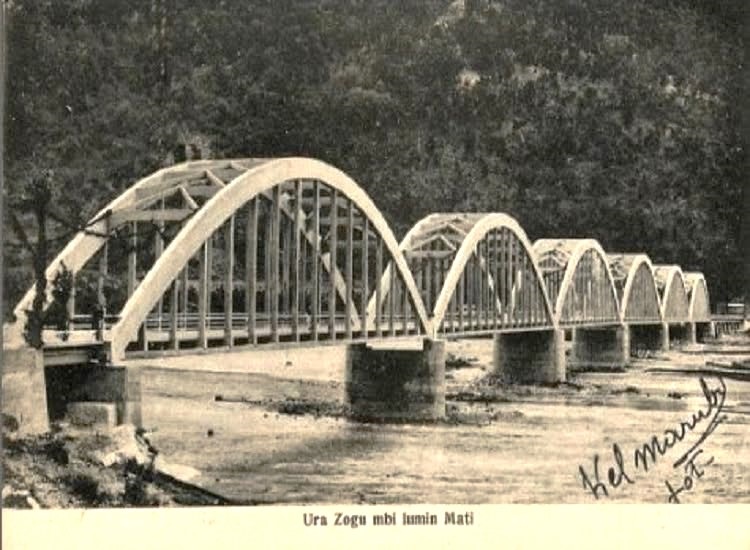
The Mat River flows through the Pllan-Milot area and has a 1,300-meter bridge that crosses the river near the Pllan and Milot mountains. This bridge was built in 1925 and was named after King Zog, but it is now called the Mat Bridge. Mount Pllana, to the northwest of the bridge, is 500 meters high and has underground fortifications with heavy weapon positions facing north. The fortification has two entrances.
There are also fortifications on the small mountain Maja e Kunorës, about 200 meters high. The fortifications overlook the plain of Lezhë. The village of Rubik is located at the base of these mountains; the area is mined and there is also a camp for guerrillas there. Mount Milotit, to the southeast of the bridge, is 600 meters high. Here there are underground fortifications started as early as 1931. One entrance is on the southern side, about 200 meters from the village of Milot, and the other is on the Tirana-Shkodër road.
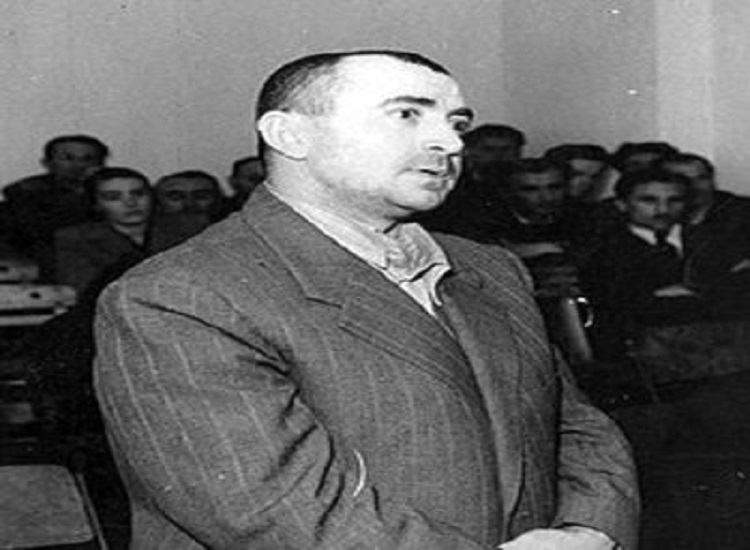
Further details regarding the communist regime come to light. The CIA has declassified a series of other documents from the 1949-1951 period, and there they provide details on the situation occurring in communist Albania. Great importance has also been given to Koçi Xoxe. The former Minister of the Interior was among Enver Hoxha’s greatest enemies.
In 1946 he became a minister and held the post for two years, after which he began his struggle with the regime. According to CIA documents, he remained in hiding in the mountains of Çermenika, while he declared that he had the support of the Yugoslavs, even as the regime accused him of being a UDBA spy. On the other hand, data has also been released on the agents recruited by the CIA in Albania.
February 1949
Koçi Xoxe reported to be hiding in the Çermenika region
The former Albanian Minister of the Interior, who was recently removed from the government during the party purges, is reported to be hiding in the Çermenika region, a mountainous area in the Elbasan prefecture. He is reported to be accompanied by about 250 followers who are preparing to launch attacks against the Albanian armed forces. The Yugoslav army is reported to be allowing Koçi Xoxe to freely cross the border in and out of the country.
July 1949
It is reported that the civilian population along the border regions with Yugoslavia is being relocated by the authorities. The border areas and the coast of Prespa are being declared military zones and their cultivation has been prohibited. In the areas of Mitiopolit and Finiq, the construction of two new camps of dimensions 1km x 2km has begun. The government is considering the construction of a motor road between Finiq and Sarandë.
Yugoslav communist refugees crossing the border into Albania are reported to find themselves recruited into army brigades commanded by Soviets. Unconfirmed reports speak of the creation in the Shkodër area of four such brigades, of unconfirmed size.
Resistance Activities – November 1949
On October 8, 1949, heavy fighting was reported in the village of Thirrë between government troops and the nationalist resistance. Sources spoke of significant resistance forces, as their leaders had gathered for a conference called in Thirrë by Ndue Pjetër Gjonmarkaj. The fighting lasted two days and ended with the defeat of the government forces.
To strengthen control over the northern areas of Albania, Hoxha’s government made several changes to local governments. The sub-prefecture of Mirdita was transferred from Shupal to the Lumth field. The bajraks (communes) of Kthellë and Selitë were placed under the jurisdiction of the sub-prefecture of Mat. The bajrak of Fand was placed under the jurisdiction of Kukës. Now the sub-prefecture of Dibra has only three bajraks: Orosh, Kushnen, and Dibra.
Sources report that about 50 members of the Balli Kombëtar, believed to have entered Albania in mid-October, were betrayed to government forces by regime-loyal residents. About 30 of them were killed and the other 20 were captured. A brigade of armed and well-trained Albanian refugees in Yugoslavia, known as “Koçi Xoxe’s Brigade,” is reported to be stationed on the Albanian border near Lake Shkodra, awaiting orders to act against Hoxha’s government.
October 1950
During the months of July and August 1950, the military command of Shkodër gave the order that all German, Italian, Serbian, Greek, and Turkish weapons were to be released/dumped at the confluence of the Drin and Buna rivers. Explosives and automatic weapons were excluded from this. The operation was carried out under the secrecy of darkness and was executed by 12 people sworn to secrecy and threatened with death in case of disclosure.
Note: The reasons for this are not clear, nor are the fact whether the weapons were part of the military forces or confiscated from the civilian population. The reporting does not indicate whether the weapons were being “dumped into the water” to be destroyed or protected with the aim of their subsequent recovery. We are making efforts to determine if such or similar actions are taking place in other parts of the country.
On August 25, five anti-communists escaped from the prison of the Rrëshen prefecture. Pjetër Kodeli managed to escape while Shkurt Prenga and Marka Preng Vorfi were killed. On September 18, 1950, government forces clashed in Simon with anti-communist groups led by Gjon Frrok Kurbini, from Kryeziu. In the clash, three government soldiers and the nationalist Mark Llusku from Munegu were killed. In September 1950, the anti-communists Nikoll Pjetri, Gjon Karaqi, Ndue Llesh Karaci, Zef Marka Nikolli, and Ndoc Dod Qafa were arrested in northern Albania.
November 1950
We have received information about more than 2,000 Greek communist guerrillas stationed somewhere on the Tirana–Shkodër road. In the first week of September, about 120 of them were transferred to Korçë and about 150 to Gjirokastër. Those remaining on the Tirana–Shkodër road are reported to be receiving military training at unspecified locations, about 25 kilometers north of Tirana. There are several patrols of Greek guerrillas controlling the Elbasan–Librazhd–Pogradec road.
It is reported that about 1,200 guerrillas have been incorporated into the Albanian army to reinforce the regime installed by the Cominform. In connection with this, purges of suspected elements have continued in the army, while desertions have also become increasingly frequent. On August 15, 1950, a group of anti-communists led by Hysni Belishova successfully attacked the barracks of Pogradec and destroyed the military materiel belonging to the Greek rebels.
Information indicates that elements of the Greek guerrillas have been incorporated into the special Pursuit Brigades of the communist regime. During the night of April 2-3, an important police post was attacked north of Librazhd by a group of 22 nationalists, led by one Blloshmi; they took control of the police post and killed the commander. Among the documents found in the building was also an order to cease all resistance activity in the region and to report without delay any suspected persons among the population or even among the police members themselves, who might influence or sabotage the elections. /Memorie.al