
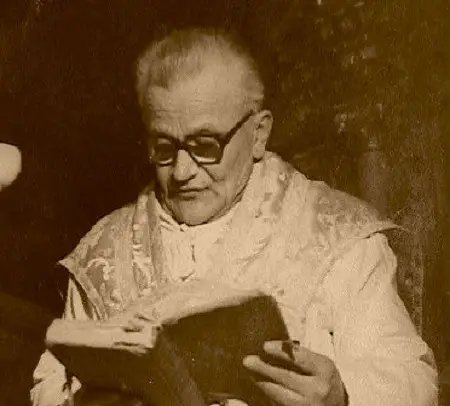

By Visar Zhiti
Part Nine
Continues from the previous issue
“From the depths of hell, I saw Jesus on the cross…” / “My Prisons…”, by Dom Simon Jubani
– Exchange of messages with the new publisher –
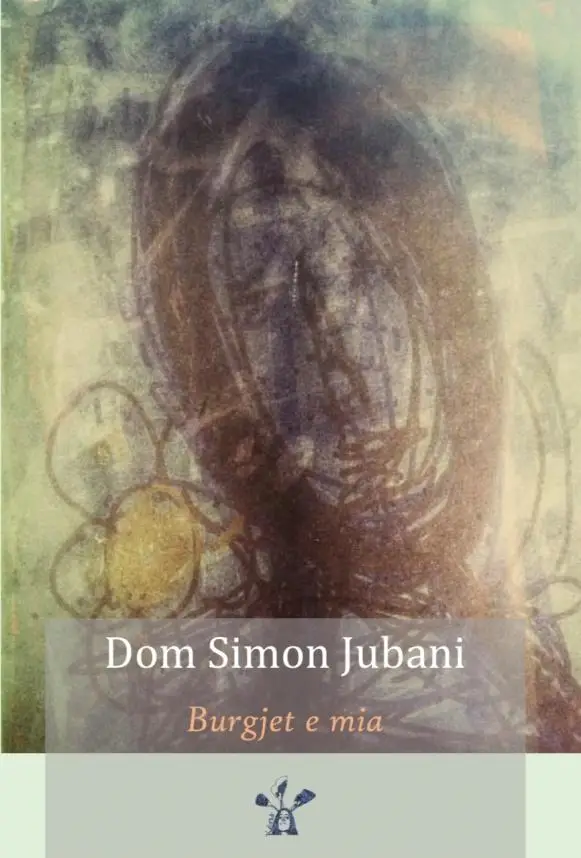
Memorie.al / That the book “My Prisons” by Dom Simon Jubani also came out in English, with a title like a prayer verse, “From the depths of hell I saw Jesus on the cross” – I believe not many people know that. That it was translated from French, meaning it had also been published in France – still few knew that. That last year his “Memoirs” were published in the mother tongue, in the author’s beautiful Shkodran dialect, by the magazine “Kens” on the 10th anniversary of his passing and on the 20th anniversary of their first publication?
Even fewer people know that. That the first edition of the memoirs “My Prisons” – it is not known in which printing press it was printed in the homeland, whether in Shkodra or Lezhë, Tirana or Durrës or Gjirokastër – but the book was distributed poorly, quite haphazardly, yet it was no coincidence that it was hindered just as the author was once persecuted; it was not meant to have wide circulation, a kind of ban, as much as possible.
- It is a book that dares, that clashes; accounts of the Calvary of a life, from priest under dictatorship, in its prisons for years and years, 26 years sentenced to the hell of the living, openly accusing the dictatorship and the dictator, and then his release – but not freedom – the fall of the communist empire, with its dubious democracy, led by those who also made the dictatorship; this not only disappoints the rebellious priest of the prisons, but also irritates him, and he again opposes, continuing to preach resistance with the power of the cross and of character, accusing again that the new leaders are continuators of the old leaders, sparing even his fellow sufferers, to the point of anger, so much that you are tempted to say: “A stubborn book by a stubborn priest”! But it is his truth, part of the epochal truth.
The subject matter of the book seems to be endless suffering, cruel persecution. Confronting that suffering with the paths of faith and morality, with Catholic character and spirit, he manages to challenge even his own Church at times, what he does not like – so it seems. Meanwhile, he will be the one to celebrate, secretly and openly, the first Mass after those murky decades, when Albania had been constitutionally declared the first and only atheist country in the world, banning religions, destroying places of worship, turning churches and mosques into cinemas and sports palaces, into agricultural warehouses in villages and arms depots for military units – not content with that, but also killing the clergy, especially the Catholic one as the most cultured, thus the most opposed.
Dom Simon Jubani was also thrown into prison, apparently to bring his dizzying, bitter testimony. At the very beginning, he tells how his brother – also a priest – was poisoned, and he comes to the poisoned democracy and his own death. A different revelation, narrative, Mass and torture, Enver-devil – he likes to write this name with a small initial letter – violence, forced labour, along with the victors, ignorance had also come, says the author. And as a citizen, he declares: “I belong to the party of the poor and the massacred, of the victims of yesterday and today”…
Yesterday and today for Dom Simon Jubani are a continuation without any deep change!
- The author is no more. But, as it seems, not only the first but also the last word is his. And I wanted to write to the preparer and publisher of his memoirs, the writer Lisandri Kola, also a scholar and lecturer of Albanian literature at the University of Michigan, director of the magazine “Kens”, where the work was reissued. “My Prisons”, equipped with an extensive informative and evaluative preface.
…study, criticism, document, specialised evidence readable by all, culturology – I wrote. – It is courage that comes from deep within the work itself and from the image, a foreword that reflects the character of the author’s character, as his stances required, and so it is – I continued – but I feel regret for what is written about a fellow sufferer of his in Burrel; I have not been in prison with them, but no one I know among the prisoners ever spoke ill of him. The subjectivity of the furious also hurts, but we must get used to the truths of others, to see how true they are for everyone…!
To read Dom Simon Jubani. To find calm amidst the anxieties…
You have done an important work, because even “mercilessness” is strict mercy – I concluded my message. – A miracle, this anti‑deception book, with a kind of anti‑devil devil…!
Dr. Lisandri Kola replied to me:
Jubani is harsh as an author and a ‘rebel’ (he calls himself a hard nut in his book). His version about Arbnori (our fellow sufferer – my note) is perhaps unique, but censorship, as soon as the book came out, leaves room for many question marks. Nonetheless, many truths are hidden in (former) archival materials. As you know, even when they are accessed, they are censored by AIDSSH itself. So, the names of informers, spies, B.p., pseudonyms, etc., are eliminated.
The preface in French and English is by a Frenchman, a friend of Jubani’s who followed his apostolate. He seems to have sponsored both editions. […]
The first edition was curated by Ana Luka, under the literary pseudonym Anza Shkodrane. I… obtained permission after all those years at the Archdiocese of Shkodra and we were preparing the edition; the Franciscan Library published it on paper…
Nevertheless, we are glad that from one censored book, on the 20th anniversary of the 1st edition of “My Prisons” and the 10th anniversary of S.J.’s passing, four versions were published: 2 in Albanian, 1 in English, and 1 in French. It truly is a miracle!
- And I would write to him again:
…I thought I had no reason to read any more about “our” prisons, but it taught me to look at my own prison with more relentless persistence…!
The book shook me, moved me; the author is extreme, just as his truths often are. Such a stance is needed, sparing nothing, just as “nothingness” spares us, especially when it is murderous. I say again that I regret for my fellow sufferers; in principle I am with Dom Simon, but he could have told his truth differently, so that the wounded are not wounded also by us, because it resembles a late revenge. Still, the truth must come, without masks. I know what we suffered from the “prison spies,” filthier and more sinful than outside… but let’s leave the rest, let’s look at what makes time and history. Magnificent is the first Mass, a hymn that only Shkodra could give as a prelude and only stubbornness as if of a saint, that of Dom Simon Jubani, could pull it off…!
Memoirs are a necessary work; they are also a guide for the future, especially when they are artistically beautifully written, so the alchemy of suffering has been achieved. I greatly value the traditional auto‑irony and sarcasm that Shkodra possesses…
And Dr. Lisandri replies again:
Thank you very much… for your thoughts and comments about the book. I think that Dom Simon’s profile is like the episode of Jesus when he drives the merchants out of the temple. The question is: should Jesus have been ‘softer’ with the sinners? I believe there is only one answer in this case. That is how I also perceive S.J.’s testimony, which is harsh and just (as much as a human being can be). Objectivity and narrative ‘radicalism’ have perhaps been missing from the Albanian book after the ’90s. Its written form suggests reflection and urges institutions to move…!
S.J. gives a testimony; it is up to Albanian institutions to affirm or prove the opposite, if there still are documents for review.
But I said that the peak of that work is the ending, as you yourself say, and the ‘contestation’ of the religious hierarchy regarding theoretical formation for salvation. Throughout the pages, you certainly find other pearls, such as the ‘anti‑communist’ communists whom America has accepted into its state. The case of the deacon, Ndoc Vasili, alias Anthony Kapaj, who assisted the communists in bringing weapons into the Franciscan convent. He died ‘in peace’ three years ago in New York. The style, moreover, is unique for prison narrative.
- I was unsettled by the reading. The entire work seems to carry this diabolical echo: the impunity of evil, which creates its own climate. Consciences are damaged, and there are no more responsibilities, no repentance or ideal commitments. So much so that it appears to me as a negative accountability, where the doors of “My Prisons” have not been morally closed, because the black‑fate dossiers of the dictatorship have not been opened. It is not enough to bring out what phenomena caused damage, but also which names projected them and which ones implemented them inhumanely. Where they and what are are they doing? The future must not be a repetition of the past.
As belated as Dom Simon Jubani’s work may seem now, so also untimely, it nonetheless comes again in time, and whenever we read it, it is its time that delivers a message.
I remember the chapter where he sees dictatorial Albania as a Zoological Park – that’s how prisoners’ conversations were, that’s how they saw the prison, as a reserve. A sad, black, Orwellian humour. Meanwhile, the author’s compassion for the country and language is as sensitive as for truth and freedom, which exist in the metaphorical magnitude of a wounded heart; they have their own conclusion and culminate with his Shkodra – “the main neighbourhood of the Heavenly Jerusalem” – that is how he marvellously calls it.
And again a twist, to the end: we are given two epilogues, as rarely happens, one on earth and the other in heaven. As if they want to emphasise an ambiguity that is not the author’s but of reality. The epilogue on earth is the comedy of Albanian democracy, as Dom Simon Jubani would like to call it. While the epilogue in Heaven is crushing; it contains a divine reprimand that only an Albanian priest like him would dare to write, demanding in paradise the punishment not only of evil but also of its practitioners as a craft of terror.
Here, the author sees himself dead with an exultant sorrow, a tired body… toothless, broken and pulled out by torture, but also with an undying, mocking smile, as his soul detaches to leave for the heavens, to paradise… and there he meets Saint Peter, but instead of Saint Michael with his scales weighing people’s deeds to decide where they will go, there was someone else – unbelievable – Enver Hoxha in a white suit, with scales in his hand, and even with wings (?!?!).
How is that possible? We exclaim together with the author.
Dom Simon Jubani recalled that once he had attended a Mass where a foreign Jesuit had preached that even if you are a criminal of the world, if you repent, even in the last minute, as you are giving up your spirit, you have salvation; the path to paradise is open – our Church allows it.
What? And Dom Simon Jubani, now only a soul, rebels again with mocking fury: I find you in paradise, both them – my dictator, the faithless one who rotted me in prison, not only me but my whole people? Then I leave paradise. We cannot be together…!
And his soul wanders the heavenly roads. But now which way to go? – he asks among the clouds. “I have nowhere to go away from you, O Lord! Only you have words of eternal life” – he answers himself with the words of Saint Peter. In fact, the question remains open for Albania, which must drastically and justly break away from its evil and hurry to go to its own paradise, but with justice and mercy – that is, into the normality of things, into the Europeanisation of life, if I may say so. Such is the homily of a priest who saw Christ on the cross that is he, from the depths of hell./Memorie.al
Covers of the editions of Dom Simon Jubani’s memoirs, in Albanian, English, and French.