By Thomas Frashëri*
Part Two
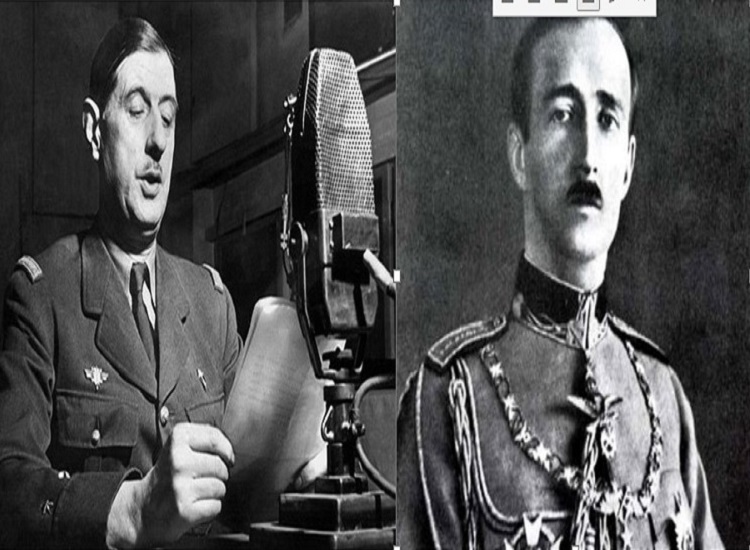
Memorie.al / “After the misfortunes of June, the sovereigns and ministers of Norway, the Netherlands, Luxembourg, the president and ministers of the Polish government, and later the Belgian government cabinet had arrived in British territory. The Czechoslovaks began to organise themselves, while the King of Albania undertook several contacts.” In General de Gaulle’s War Memoirs, this is the only allusion made to the Albanian royal government in exile. Laconic, almost insignificant, this note nonetheless conveys the opinion that the head of Free France held about the situation of the Albanian Kingdom during the first years of the Second World War: he recognised the legitimacy of the King of the Albanians and, by ranking him alongside the other exiled sovereigns of the Allied countries (Netherlands, Luxembourg, Poland, Czechoslovakia), he considered Albania as a friendly, resistant country.
Continues from the previous issue
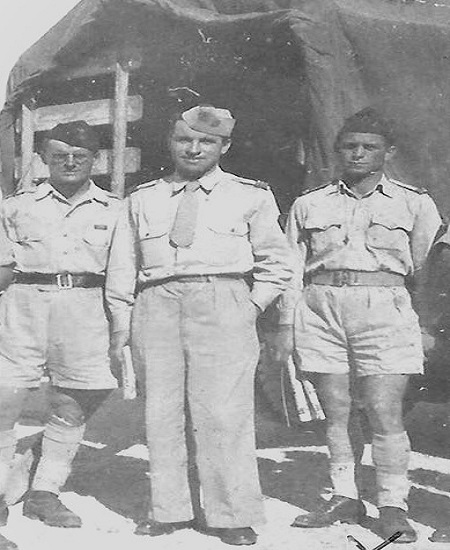
Just like Commander Agolli-Doshishti (his best comrade in arms), he was first assigned to the Old Dean military camp in England, only to move some time later to Algiers, in 1943. After being informed of General de Gaulle’s dissolution of the Vichy armed forces of the Levant in November 1942, Lieutenant Begeja became part of the reorganised military forces of the Levant in 1943. Commander Agolli-Doshishti also served in these units. Highly esteemed by French officers and soldiers, Lieutenant Begeja returned to civilian life in 1946, after having fought honourably for the liberation of France.
Cited in the order of the day of the 1st Independent French Brigade, under the supreme command of the Levant, on 1 February 1946, Colonel Sajous describes him in these terms: “This foreign officer, who volunteered for the Free French Forces, has shown in every circumstance a conscience and high professional values worthy of emulation, earning the respect and friendship of his comrades. He leaves the brigade with the best memory among his superiors, the troops he commanded, and all those who knew him.”
With indisputable loyalty to the memory of General de Gaulle and fighting France, this modest and selfless man – who was decorated, among other honours, with the Commemorative Medal for Voluntary Services of Free France – served the Albanian Royal Crown for many years as an officer of King Zog’s General Staff, and later King Leka I of the Albanians. By royal decree of 2 October 1975, published in Madrid, the King appointed him colonel commander of the Royal Guard in exile.
On his grave in the Parisian cemetery of Thiais, where until November 2012 the grave of King Zog was located, the great Cross of Lorraine is carved, along with a commemorative plaque on which can be read the letter that General de Gaulle wrote to Lieutenant Begeja on 1 September 1945, in homage to his commitment.
Grateful France
In the letter that General de Gaulle wrote to Lieutenant Begeja on 1 September 1945, we find these words: “Answering the call of France and risking your life, you joined the Free French Forces. You became part of the voluntary teams of our comrades in arms, thanks to whom our country was able to continue, with honour, the war it had begun. You were among the most deserving of those who made our country’s victory possible. Now that the goal has been achieved, allow me to thank you warmly and simply, in the name of France!”
For General de Gaulle, the contribution of the dozens of Albanians who fought proudly under the French flag was not merely proof of the truth of France’s universal appeal in the fight for freedom. This contribution openly demonstrated that the Albanian people, despite countless difficulties, had not ceased to love and fight alongside Free France and its allies.
Thus, when on 22 January 1959, Charles de Gaulle, President of the Republic, met for the first time in Paris the plenipotentiary minister of Albania – which was already a People’s Republic – he had occasion to express these considerations: “I am happy to make your acquaintance. I have a very high regard for the brave Albanian people, who fought with arms in hand. I hope that relations between our two countries will develop and improve, as happened when a third power could not interfere between us.”
A subtle diplomat, General de Gaulle was referring both to Italy, which had prevented King Zog in the 1930s from establishing stronger relations with France, and to the Soviet Union, which constantly blocked relations between the West and Albania. Recalling – and mentioning in conversation with the Albanian diplomat – the Albanian resisters who fought alongside him, shows General de Gaulle’s care not to let the Albanian volunteers fall into oblivion; the head of Free France had had the opportunity to recognise and admire their values and virtues.
It was precisely these values and virtues that convinced General de Gaulle to grant Albania the status of an allied and victorious power after the end of the war. Thus, in 1945, supported by the Quai d’Orsay (French Ministry of Foreign Affairs), he believed that whoever the regime that would be established in Albania – provided it guaranteed the country’s independence – should enjoy the exercise of sovereignty over the entire Albanian territory within its pre‑1939 borders.
On 7 January 1945, General de Gaulle sent the first official military mission to Tirana, to the Albanian interim government. Albania had just been liberated (29 November 1944), without the help of the Red Army, and the head of the communist resistance, Enver Hoxha, was still simply the commander of the National Liberation Army, not the leader of a republic of soviets. His totalitarian aims would come to light a short time later.
The first report, addressed on 20 January 1945 to the head of the French government, stressed that this country was now independent, even though Tito’s Yugoslav influence was very noticeable. The report highlighted the risk of the country being partitioned between Slavic influence and Italo‑British influence, and underscored the fact that France had at least a moral role to play in favour of guaranteeing the country’s unity.
But in 1945, the greatest risk was not that Albania would fall under the Slav‑communist orbit. The country again risked – as it had many other times – partition to the benefit of Greece, which, although it well knew the merits of the Albanian resistance, insisted, with the half‑silent approval of the British, on having rights to territorial compensation over Albania, since Greece had been attacked by this “collaborator” country of the Axis powers in 1940.
King Zog, first in England, then in Egypt, where he went into exile after the war, did not cease for years to fight Greek claims in Albania. To Greek emissaries who several times proposed aid to restore him to the throne in exchange for ceding part of the territories of Northern Epirus to Athens, he replied that he would rather help the Albanian communists fighting alongside Enver Hoxha, who placed national sovereignty above all, than give Greece even a crumb of Albanian territory.
The Athens newspapers even accused Zog I of being in the service of Tirana’s communists, while in reality he was their sworn enemy. Contrary to what one author has claimed, there are no incontrovertible facts that France in the 1940s supported Greek claims over so‑called Northern Epirus, or that it encouraged plans to incorporate the small country into the Yugoslav federation – a possibility not ruled out by Belgrade, Moscow, or London.
The Political Directorate of the Quai d’Orsay, in a letter dated 25 June 1945, encouraged General de Gaulle to do everything possible to preserve Albanian integrity and sovereignty against the territorial appetites of its neighbours, through intensive economic and cultural activity, while avoiding friction with British and Soviet interests in the country.
This letter recommended intervention at the highest levels of the Holy See to appoint an apostolic nuncio of French nationality in Tirana. This would be in the most authentic tradition of France’s protection of Albanian Catholics, especially since in this field defeated Italy had just lost its privileged rank in Albania.
France did not neglect the aforementioned elements and, although it showed great care that its policy not appear as unconditional approval of the new regime, it recognised the Albanian government in December 1945 through a letter signed by the General. With this act, Paris gave a signal in favour of balancing forces in the region, thus contributing to weakening all the openly declared claims of Athens and the more restrained annexationist urges of Belgrade.
Even after General de Gaulle’s departure from power, a month after the official recognition, France did everything possible to maintain balance and did not join the Greco‑Anglo‑American opposition regarding Albania’s invitation to the Paris Peace Conference, which began its work on 29 July 1946.
Considering that Albania should be recognised as a victim of Italian aggression, Georges Bidault, President of the Conference, voted against the Greek territorial claims of Prime Minister Caldaris, and enabled recognition of Albania’s right to war reparations from Italy.
France was also in favour of final recognition of Albanian sovereignty over the coveted island of Sazan in the Bay of Vlorë. The support that France gave to the Albanian state of that time – support based on the memories of a common resistance – does not mean that official Paris gave the Tirana regime carte blanche at every moment.
In the name of the shared memories of the resistance – which the figure of King Zog and his volunteer soldiers embodied in a certain way – the French government turned a deaf ear to all the repeated requests of the People’s Republic of Albania for the arrest and return of political émigrés who, around King Zog, had created the “Free Albania” Committee in 1949.
This committee freely continued its anti‑communist political and propaganda activities during the presidency of General de Gaulle between 1959 and 1969, a situation that created a major conflict between Paris and Tirana at the beginning of the Fifth Republic. But there is more. General de Gaulle did not hesitate to exchange official letters, when necessary, with King Zog, especially in the months preceding the latter’s death, in April 1961.
On several occasions, official correspondence that the postal services of the Quai d’Orsay had to deliver to the representation of the “Albanian Kingdom” – unable to locate it – was deposited in the mailbox of the embassy of the People’s Republic of Albania, a circumstance that could not but disappoint Tirana’s diplomats. According to data from the Albanian counter‑intelligence, the General had met the King and Prince Leka at least once, but this information has not yet been confirmed by any other source.
Without forgetting King Zog’s stance during the war and the loyalty of his soldiers to France, General de Gaulle, President of the French Republic, paid homage to the sovereign when he passed away at the American Hospital of Neuilly‑sur‑Seine in April 1961. He sent as his representative Roger Frey, Minister of the Interior, who had old ties with anti‑communist circles and knew the royal family well. Roger Frey also attended the funeral of one of King Zog’s sisters in 1965. / Memorie.al